When you click on links to various merchants on this site and make a purchase, this can result in this site earning a commission. Affiliate programs and affiliations include, but are not limited to, the eBay Partner Network.
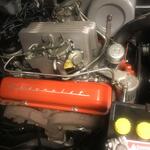
Finally rebuilding my 283 290 hp and need new pistons . Anyone know of any domed pistons for 30 over block . Have not seen any except custom ones which are way to expensive . Thanks in advance guys for any help and leads.
I'll offer an alternative. If you get a 327 crank and use 307 pistons you will probably come out cheaper and have 310". The 295P30 piston is a flat top but with the extra 1/4" stroke that will increase the compression. A quick calculation with 56 CC heads would be around 10.5:1. These pistons are available for under $150.
The Keith Black number for a cast 283 piston is K166.30 but I don't know that they are available. Just not that many people calling in for 283 pistons.
Last edited by Robert61; May 15, 2021 at 09:13 AM.
When I had my 283" 283HP engine rebuilt in 2018 it was reported that no one made over the counter +0.030" correct pistons, they were a special order. The machine shop doing the work uses Ross pistons located somewhere in Calif. Ross and needed the heads to mock-up the pistons to get my desired 10.5:1 compression ratio. They also needed the cam profile for valve reliefs. My heads are 539 series with a pyramid casting or standard FI 1957 heads. The process took upwards of 6 weeks by the time a head were sent back and forth before the new pistons arrived. I was surprised that after 60 years someone did not have the tooling in place to produce small block Chev pistons of any size to accomplish a specific compression ratio. The pistons were expensive as you have discovered but short changing on the lower end was something I did not want. Today the engine will easily wind up to 6000 RPM and with the right gas it seems happy... Al
Those pistons, flat crown with valve clearance notches, have a net "dish", not a "dome". KB lists domes as a negative number (they reduce chamber volume), and a net dish as a positive number because it adds chamber volume. This is the opposite the convention used by most other piston manufacturers. They also offer the KB166 that has a net dome of 4 cc. You have to be VERY CAREFUL when adding piston dome or dish values to CR calculators, depending on the sign convention used by both the piston manufacturer and the CR calculator.
...screw it up and you're going to end up with either a lot higher CR than you want or much lower than you want.
Don't pay too much attention to the stated CR on the KB Web site. This is done with just one particular thickness head gasket. (I don't remember what it is.) Use a third party CR calculator that allows you to specify deck clearance, chamber volume, head gasket thickness and diameter, and net piston volume. Of course you need accurate values for all these parameters or your calculations are garbage.
Robert’s suggestion to use the 327 crank would add a lot of power. Exactly the same as turning a 350 into a 383. 1/4” additional stroke makes a difference.
When working with antique engines out of production for 55 years (283 SBC) high cost of parts and parts scarcity is the norm. I've been playing with classic cars for years and am very familiar with custom parts, hand made gaskets, and fabrication work required to keep them rolling. Ross pistons are excellent and worth the money. A good friend had a set made up for a .030 over 389 Pontiac about ten years back and they were almost $600 for the set back then. I suspect now that they'd be twice that. But, it is what it is. If you want to save money, don't buy a classic or don't worry about correctness and plug in a 350. If you want to do your 283 right, so it will run another 50+ years or 100,000+ miles, it's going to cost you. Simple as that.
From: "You may all go to Hell- and I will go to Texas- Davy Crockett
St. Jude Donor '12
I agree. The only other thing I would change up would be the pin height on the 283 +30 pistons to run 6 inch rods. Lose a bunch of reciprocating weight, plus lose the weak 283 rods. But then, I never could leave well enough alone.
Robert’s suggestion to use the 327 crank would add a lot of power. Exactly the same as turning a 350 into a 383. 1/4” additional stroke makes a difference.
Taylor's Rule: Two similar engines identical other than stroke will make about the same peak power at the same mean piston speed.
So the longer stroke engine won't make more peak power, but the longer stroke engine will make more average power across the useable range making it feel more powerful in normal driving where you don't use more than mid range revs very often.
Taylor's Rule: Two similar engines identical other than stroke will make about the same peak power at the same mean piston speed.
So the longer stroke engine won't make more peak power, but the longer stroke engine will make more average power across the useable range making it feel more powerful in normal driving where you don't use more than mid range revs very often.
Duke
Getting a bit off topic here, but small bore, very long stroke straight 8 and straight 6 L-head engines I've owned made gobs of low end and mid range power, making them very easy to drive without the need to shift down to lower gears much. The 383 stroker in my '61 has much more torque at usable rpms than the 350's and 327's I've driven and I like the feeling!
Duke, drive an identical car with a 350, now swap in a 383. The 383 feels like it is a much larger engine.
The 350 may make the identical power at 6,500 RPM that the 383 makes at 5,600 rpm but the 383 will feel much more powerful on the street all else being equal. Most of us spend a lot of time driving with RPM in the 1,000-4,500 rpm range, exactly where more torque gets noticed.
GM built many 307 engines, they went in Chevelles and trucks. I had one in my 71 Blazer. This is the combo of 283 bock with 327 crank.
The other popular saying among racers, “There is no substitution for cubic inches”. I guess that is why a 427 is not the hot ticket any more, they can’t compete with the 454, 496, 502, 540, 572 and 640 engines out there.
Im replacing my 327 with a 406, it adds 50 hp and 100 pound of torque with similar street manners and operating range to the L79, max rpm 6,000. I have not planned to check piston speed. The L79 will not match those numbers.
I don’t see the downside?
First off thanks to all the response. I am still leaning towards domed pistons for the 3.905 bore . K B has some that are hypereutectic which I have never dealt with Please give me any thoughts or experience with these . I will still check with Ross on Monday and keep Roberts 327 alternative as a backup plan . This is for a 290 hp I've had over 40 years.
If you go with custom pistons make sure to use 4032 alloy. The manufacturers will know all about this. Some don't offer it, don't use them. JE has 4032, Mahle as well, not sure about Ross. With 4032 you'll run about .002" less piston to cylinder wall clearance. There are a few reasons this is more desirable for street engines. Less piston rock means better ring control and less piston noise. Not a major issue but something to consider. I thought the whole basis for this thread was inexpensive replacement pistons not what is the best piston I can buy.
First off thanks to all the response. I am still leaning towards domed pistons for the 3.905 bore . K B has some that are hypereutectic which I have never dealt with Please give me any thoughts or experience with these . I will still check with Ross on Monday and keep Roberts 327 alternative as a backup plan . This is for a 290 hp I've had over 40 years.
I used the KB166 domed pistons in my 58. Worked well and I didn't have any issue getting them. Of course this was 5 years or so ago. I believe I bought them from Jegs or Summit. Using this piston put my compression ratio right where it needed to be. I cc'd the head chamber volume and then used one of the online calculators to figure the CR.
First off thanks to all the response. I am still leaning towards domed pistons for the 3.905 bore . K B has some that are hypereutectic which I have never dealt with Please give me any thoughts or experience with these . I will still check with Ross on Monday and keep Roberts 327 alternative as a backup plan . This is for a 290 hp I've had over 40 years.
Hypereutectic pistons are pretty much the norm in modern cars. KB pistons have a high mounted to ring, which runs hotter and must have more end gap than typical rings on OE pistons that have a conventionally placed top ring. The Web site calls this out. Be sure you and whoever assembles your engine understands this. There are many reports of broken ring lands. This will happen if the top ring gap is insufficient and the rings ends butt together and warp, which will break the piston above the ring.
So they have gained somewhat of a bad reputation. Some "engine builders" refuse to use them, but there is nothing wrong with them. The problem is the morons who assemble the engine and either don't read the top ring gap instructions or don't follow them.
Only a 50 HP jump from a 327 to a 406? Does not sound right.....please clarify!
It was just a number for comparison. If comp ever starts shipping cams again I will assemble it and find out. Cam has been on order several months. I expect close to 500 hp and torque with the AFR 210 heads 10:1 compression and a pretty tame camshaft.
If I can’t get the cam of choice I have a new L79 cam I can install just to get it running.
For comparison on this post if the 327 was stock L79 and the 400 was built with a similar cam and heads I think 50 hp and 100 ft torque gain would be pretty accurate.
Designer Imagines A Corvette That Looks More Like a Corvette Than the Corvette
Slideshow: A Jaguar designer's personal project imagines what a modern front-engined Corvette might look like if Chevrolet revisited the golden age of the Stingray.



 Piston Help