




Loaded Kick Panels

Team Owner


Joined: Aug 1999
Posts: 30,995
Likes: 99
From: Ontario

I don't understand why everyone here is having problems with the 4x6's in their dash. Paul I remember you had those Pioneer 6x9s in the back and I believe the 4x6s in the front in your 79 and you seemed to be very pleased with it. In fact you used to recommend that to others on the forum. After doing some research and from the help of a few of the folks here I had ended up with some Infinity 4x6 reference speakers for the front.
That was a long time ago! Indeed the system in the 1979 worked very well, even superb, with a Pioneer 50W x 4 head unit (4 x 6s up front and 6 x 9s in back). The key to the rear speakers was the shallow magnet for fitment. Just before I sold the 1979 I switched to a JVC head unit with the same power rating and the difference was like night and day: the sound was terrible! So head units of like specs can be very different.


That was a long time ago! Indeed the system in the 1979 worked very well, even superb, with a Pioneer 50W x 4 head unit (4 x 6s up front and 6 x 9s in back). The key to the rear speakers was the shallow magnet for fitment. Just before I sold the 1979 I switched to a JVC head unit with the same power rating and the difference was like night and day: the sound was terrible! So head units of like specs can be very different.
Last edited by Paul L; Jan 23, 2009 at 08:21 AM.
Team Owner
Joined: Aug 1999
Posts: 30,995
Likes: 99
From: Ontario
This is an interesting learning exercise! And it shows my ignorance of things electronic :o. For some reason I had the idea that unhooking the dash top 4 x 6"s, replacing the kick panel 4 x 6s with the 6 1/2" units (effectively going to a two-speaker system) would give a nice boost in power and sound. In other words, the 50W x 4 head (however accurate that wattage rating might be) would direct 2 x 100W to the new 6 1/2s??
I was at FutureShop today and dropped by the car audio center to get some Dynamat. A little chit-chat as to what I was doing was revealing. The fellow said basically that I will simply be losing the 50W x 2 channels! So the new 6 1/2"s would be getting the same power input as the current 4 x 6"s down there. I'm beginning to wonder as to the usefulness of this project. Is there a way to get 2 x 100W down to the kick panel speakers? Or is a two-channel amp in my future?
I was at FutureShop today and dropped by the car audio center to get some Dynamat. A little chit-chat as to what I was doing was revealing. The fellow said basically that I will simply be losing the 50W x 2 channels! So the new 6 1/2"s would be getting the same power input as the current 4 x 6"s down there. I'm beginning to wonder as to the usefulness of this project. Is there a way to get 2 x 100W down to the kick panel speakers? Or is a two-channel amp in my future?

Thread Starter
Team Owner
Joined: Aug 2006
Posts: 24,125
Likes: 15
From: Columbia Missouri
Those Polk speakers don't need 100 watts. They work best at half that, and are effective even lower. You can power them with an amp but I would not give them 100 watts. I would say that 75 is as much as I would give them from an amplifier.
It's all about the two channels. Using 4 channels isn't better than 2 channels.
If the 2 channel setup, two kick panel speakers, are better speakers in a better locations, they will sound better. Then add a poor sounding speaker in a poor location...ie dash, then it will detract from the overall quality.
In this case, what I am saying is that two good kick panel speakers will be better than two kick panel speakers an two dash speakers. More isn't always better, and the wattages you have going to the kick panel speakers would be the same either way. You're not adding or gaining power by deleting two speakers, you are just changing the stage and how the sound is perceived by the listener.
Team Owner
Joined: Aug 1999
Posts: 30,995
Likes: 99
From: Ontario
Those Polk speakers don't need 100 watts. They work best at half that, and are effective even lower. You can power them with an amp but I would not give them 100 watts. I would say that 75 is as much as I would give them from an amplifier.
It's all about the two channels. Using 4 channels isn't better than 2 channels.
If the 2 channel setup, two kick panel speakers, are better speakers in a better locations, they will sound better. Then add a poor sounding speaker in a poor location...ie dash, then it will detract from the overall quality.
In this case, what I am saying is that two good kick panel speakers will be better than two kick panel speakers an two dash speakers. More isn't always better, and the wattages you have going to the kick panel speakers would be the same either way. You're not adding or gaining power by deleting two speakers, you are just changing the stage and how the sound is perceived by the listener.
It's all about the two channels. Using 4 channels isn't better than 2 channels.
If the 2 channel setup, two kick panel speakers, are better speakers in a better locations, they will sound better. Then add a poor sounding speaker in a poor location...ie dash, then it will detract from the overall quality.
In this case, what I am saying is that two good kick panel speakers will be better than two kick panel speakers an two dash speakers. More isn't always better, and the wattages you have going to the kick panel speakers would be the same either way. You're not adding or gaining power by deleting two speakers, you are just changing the stage and how the sound is perceived by the listener.
Safety Car


Joined: Jun 2005
Posts: 3,775
Likes: 4
i just pulled the 4x6s out of my dash and put them in the kick panel. fit like they were made for it in the birdcage there.
it sounds worlds better already. still a little too much when ive got it cranked upto 100%, but a little working with the EQ should solve that.
now i just need to cut some new wire and mount them to the kickpanels. right now theyre just stuck to the birdcage with their own magnets. oh, and i can put in my original 69 dashpad now. those are the ones that dont have cut outs for the speakers in them.
it sounds worlds better already. still a little too much when ive got it cranked upto 100%, but a little working with the EQ should solve that.
now i just need to cut some new wire and mount them to the kickpanels. right now theyre just stuck to the birdcage with their own magnets. oh, and i can put in my original 69 dashpad now. those are the ones that dont have cut outs for the speakers in them.
Thread Starter
Team Owner
Joined: Aug 2006
Posts: 24,125
Likes: 15
From: Columbia Missouri
i just pulled the 4x6s out of my dash and put them in the kick panel. fit like they were made for it in the birdcage there.
it sounds worlds better already. still a little too much when ive got it cranked upto 100%, but a little working with the EQ should solve that.
now i just need to cut some new wire and mount them to the kickpanels. right now theyre just stuck to the birdcage with their own magnets. oh, and i can put in my original 69 dashpad now. those are the ones that dont have cut outs for the speakers in them.
it sounds worlds better already. still a little too much when ive got it cranked upto 100%, but a little working with the EQ should solve that.
now i just need to cut some new wire and mount them to the kickpanels. right now theyre just stuck to the birdcage with their own magnets. oh, and i can put in my original 69 dashpad now. those are the ones that dont have cut outs for the speakers in them.
Infinities have a reputation of being a very harsh speaker no matter the location. I'm glad that the kick panel location in better but they will always be harsh and shrill simply because that's what Infinity fans like.
A softer speaker is certainly going to make the experience more enjoyable and I can suggest a few brands if you're interested.
Safety Car
Joined: Jun 2005
Posts: 3,775
Likes: 4
ya, i found that out after i bought the damn things. but, theyre staying until i redo the stereo again at which time im going with the 6.5s and sub.
ah hell.... throw me some suggestions for the 4x6 and 6x9s. knowing me, ill probably replace them. my max power is 100x4 @ 2 Ohm or 50x4 @ 4 Ohm
ah hell.... throw me some suggestions for the 4x6 and 6x9s. knowing me, ill probably replace them. my max power is 100x4 @ 2 Ohm or 50x4 @ 4 Ohm
Pro

Joined: Mar 2008
Posts: 551
Likes: 3
From: Spokane Washington
So on speaker recomendations I would like a decent 6.5 that can handle the output of my JL300/4. I am running boston 6X9 3 ways off of in the rear and will also use it to power the 6.5? I can upgrade to more power I also have a 450/4 unused at the shop that i could easilly swap out. I want qualty sound so that I can here it cleary from out side th ecar. But I dont want to spend a fortune on the speakers 150-250.
Corvette Stories
The Best of Corvette for Corvette Enthusiasts

Top 10 Most Expensive Corvettes Ever Sold on Bring A Trailer
Brett Foote
10 Things Every Corvette Owner Needs (2026 Edition)
Michael S. Palmer
8 Most "Only Corvette Owners Understand" Quirks and Problems
Pouria Savadkouei
10 Reasons the C6 Z06 is Still A Performance Benchmark After 20 Years
Joe Kucinski
How Much Horsepower Every Corvette Engine "LOST" in 1972
Joe Kucinski
Top 10 DOs and DON'Ts for Protecting Your Convertible Top!
Michael S. Palmer
Top 10 Most Explosive Corvettes Ever Made: Power-to-Weight Ratio Ranked!
Joe Kucinski
150 hp to 1,250 hp: Every Corvette Generation Compared by the Specs That Matter
Joe Kucinski
8 Coolest Corvette Pace Cars (and Replicas) of All Time
Verdad Gallardo
Race Director


Joined: Oct 2000
Posts: 11,891
Likes: 3
From: Kansas City, MO ...I'd like to go fishing and catch a fishstick. That'd be convenient. - Mitch Hedberg
PhyscoVette - Worry about sound first, power later.
Go to a store and listen to speakers. Buy the ones that sound best to you. The power ratings are far less important than everyone seems to think. If you are hooking them to a quality amp, you don't even need to concern yourself with power ratings. Most audio that sounds like crap outside of the car can be attributed to two things: 1. it sounds bad inside the car 2. the vibration of car parts heard from outside the car make the audio sound bad.
For my car, I chose to use Polk Audio because I have lots of prior experience with them. I don't like harsh highs and I wanted a full bodied midrange/bass.
Go to a store and listen to speakers. Buy the ones that sound best to you. The power ratings are far less important than everyone seems to think. If you are hooking them to a quality amp, you don't even need to concern yourself with power ratings. Most audio that sounds like crap outside of the car can be attributed to two things: 1. it sounds bad inside the car 2. the vibration of car parts heard from outside the car make the audio sound bad.
For my car, I chose to use Polk Audio because I have lots of prior experience with them. I don't like harsh highs and I wanted a full bodied midrange/bass.
Team Owner
Joined: Aug 1999
Posts: 30,995
Likes: 99
From: Ontario
Interesting project. But very tedious although it kept me busy this afternoon. And that's a good thing given the terrible winter weather outside.
Template for the 5 1/4" opening was taken from a plastic coffee can lid.

I don't have a Dremel so I punched out the large pieces with a sharp wood chisel/hammer and finished off with a round file by hand. That's really hit and miss as you can snap/split a whole panel section with one wrong hammer hit. It's a bit like the old thread on a front fender stress crack: just drill a 1/8" hole at the end of the crack it will go no further. Or a 1" chisled hit at the end of that holed section in the kick plate. Both work. Stress is relieved. I did it today. Be careful, it so easy to split that panel end-to-end.

The guys at the local FutureShop donated some scrap Dynamat. Not pretty but it will work. And who will see it?
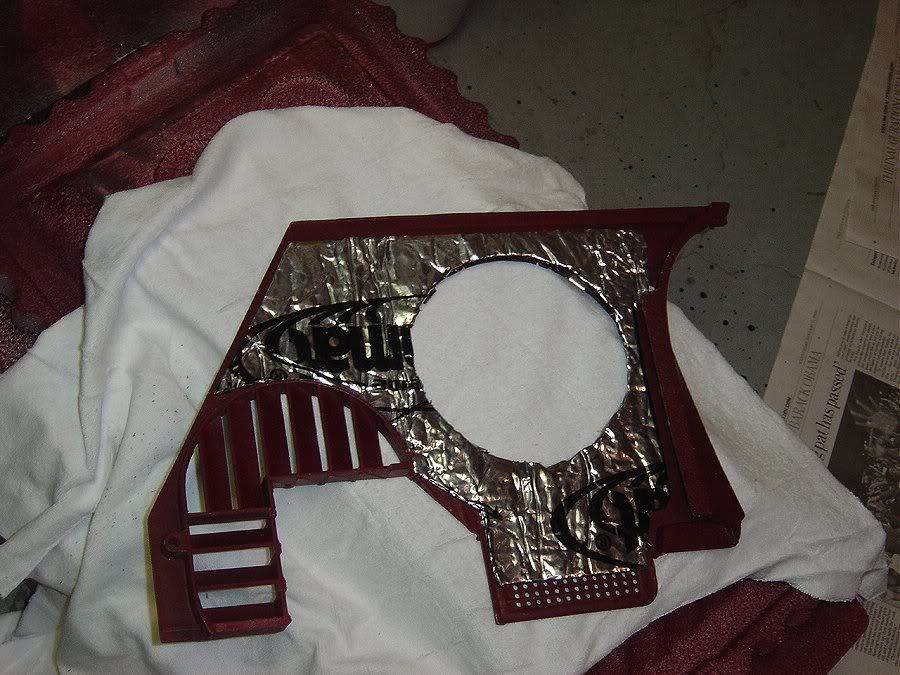
This is where things stand. I've learned a lot in this thread. My thanks to DB et al.
Template for the 5 1/4" opening was taken from a plastic coffee can lid.
I don't have a Dremel so I punched out the large pieces with a sharp wood chisel/hammer and finished off with a round file by hand. That's really hit and miss as you can snap/split a whole panel section with one wrong hammer hit. It's a bit like the old thread on a front fender stress crack: just drill a 1/8" hole at the end of the crack it will go no further. Or a 1" chisled hit at the end of that holed section in the kick plate. Both work. Stress is relieved. I did it today. Be careful, it so easy to split that panel end-to-end.
The guys at the local FutureShop donated some scrap Dynamat. Not pretty but it will work. And who will see it?
This is where things stand. I've learned a lot in this thread. My thanks to DB et al.
Last edited by Paul L; Jan 23, 2009 at 08:57 PM.
Thread Starter
Team Owner
Joined: Aug 2006
Posts: 24,125
Likes: 15
From: Columbia Missouri
Paul, those look amazing, and I know you're going to love the sound quality.
I have to ask because the second pic confuses me a little bit...but do you have the speaker mounting flange on top of or behind the kick panel? It looks like just the rubber surround is peeking through the speaker hole which indicates the mounting flange is under the panel.
That's fine and all but it'll deepen the mounting depth and the grills are designed to hide the mounting flange when it's mounted on top of the kick panel.
I have to ask because the second pic confuses me a little bit...but do you have the speaker mounting flange on top of or behind the kick panel? It looks like just the rubber surround is peeking through the speaker hole which indicates the mounting flange is under the panel.
That's fine and all but it'll deepen the mounting depth and the grills are designed to hide the mounting flange when it's mounted on top of the kick panel.
Team Owner
Joined: Aug 1999
Posts: 30,995
Likes: 99
From: Ontario
Paul, those look amazing, and I know you're going to love the sound quality.
I have to ask because the second pic confuses me a little bit...but do you have the speaker mounting flange on top of or behind the kick panel? It looks like just the rubber surround is peeking through the speaker hole which indicates the mounting flange is under the panel.
That's fine and all but it'll deepen the mounting depth and the grills are designed to hide the mounting flange when it's mounted on top of the kick panel.
I have to ask because the second pic confuses me a little bit...but do you have the speaker mounting flange on top of or behind the kick panel? It looks like just the rubber surround is peeking through the speaker hole which indicates the mounting flange is under the panel.
That's fine and all but it'll deepen the mounting depth and the grills are designed to hide the mounting flange when it's mounted on top of the kick panel.
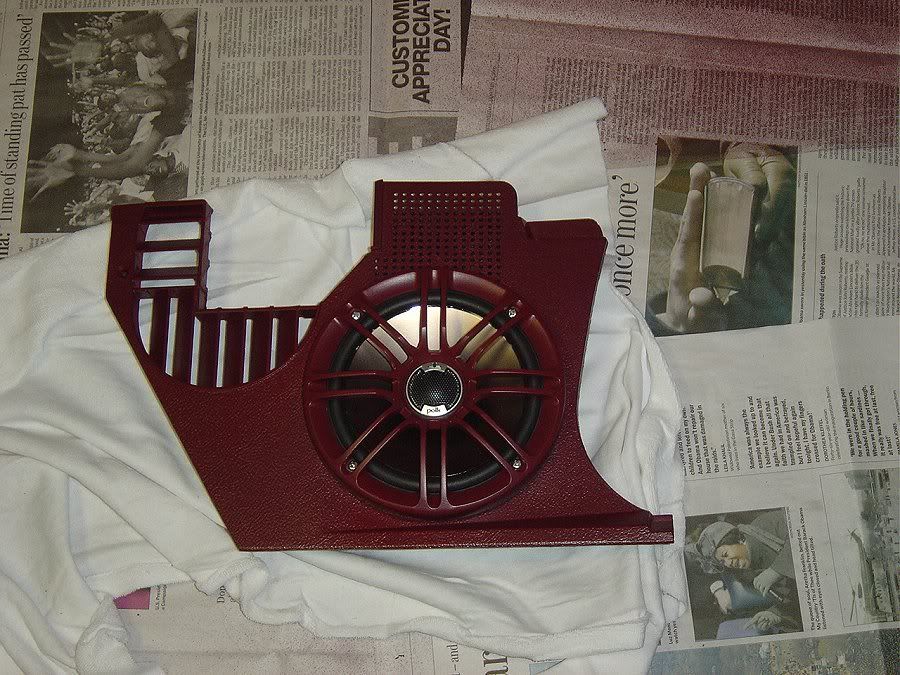
That pic shows parts of my measuring, measuring, measuring fetish before drilling, cutting, grinding, whatever. The speaker is installed outside/on top of the kick panel. I would estimate installation depth of about 1 1/2". My 4 x 6s (pics above) are mounted "inside" the panels and have a 1 11/16" depth. So I think this new setup is OK. If this is wrong I will start again.
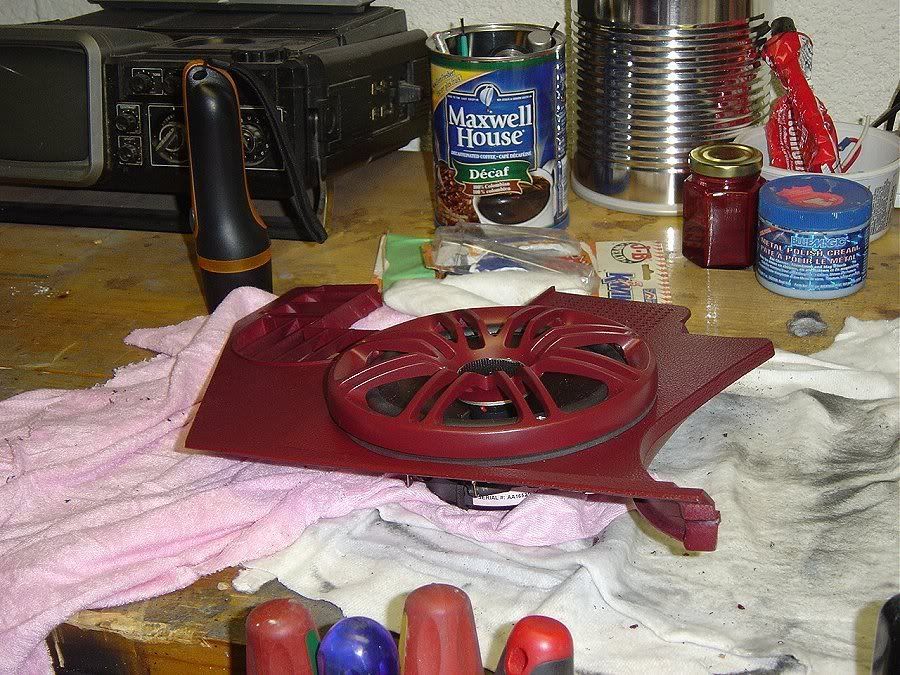
*Edit*. New pic. Install depth looks like ~ 1 1/2". Should be OK without hitting anything.

Last edited by Paul L; Jan 23, 2009 at 08:03 PM.
Team Owner
Joined: Aug 1999
Posts: 30,995
Likes: 99
From: Ontario
Thanks DB. I'll do the other side tomorrow with a little more confidence. Bit of an experiment today and some "OK is this right thoughts?" but I benefitted very much from peoples' pics on positioning the cut-out hole. Love it when people share their pics and experiences! I counted holes and postions from those pics to make the cuts!
Last edited by Paul L; Jan 23, 2009 at 08:40 PM.

Melting Slicks

Joined: Nov 2002
Posts: 2,231
Likes: 7
From: Fort Pierce Florida
I suggest coaxial speakers. Components are nice but they make things more complicated. Besides, set up properly a coax speaker can sound just as good. Having the tweeter built in will be your best bet.
The Polk speakers I suggest to everyone is a great place to start. They have a low rating, and they fit. This means no cutting and you don't have to have an amp.
If you want higher power, you'll need an amp, and you'll probably have to cut the lips on the body mount pocket.
I can give you a few suggestions for speakers but it depends on your goals, the design of the system, and your budget.
Keep the highs and mids in your kick panels, leave the dash speakers out, and like I said, I don't like using rear speakers.
The Polk speakers I suggest to everyone is a great place to start. They have a low rating, and they fit. This means no cutting and you don't have to have an amp.
If you want higher power, you'll need an amp, and you'll probably have to cut the lips on the body mount pocket.
I can give you a few suggestions for speakers but it depends on your goals, the design of the system, and your budget.
Keep the highs and mids in your kick panels, leave the dash speakers out, and like I said, I don't like using rear speakers.


Burning Brakes

Joined: Nov 2006
Posts: 1,125
Likes: 4
From: Flower Mound TX.
A friend and forum member needed a little help loading their new kick panels with new speakers for a modern stereo system. I offered to do the work, so he shipped me the kick panels, speakers, and some sound deadener. The Dynamat they sent was in horrible shape...ripped and creased...I was NOT going to use it. I replaced it with some Damplifier that I had on hand, and completed the set of kick panels. These pics were taken before boxing them up, and they are going out tomorrow.
I'm just posting these an example so it's seen from front to back and people can see how different speakers can look in the kick panels.
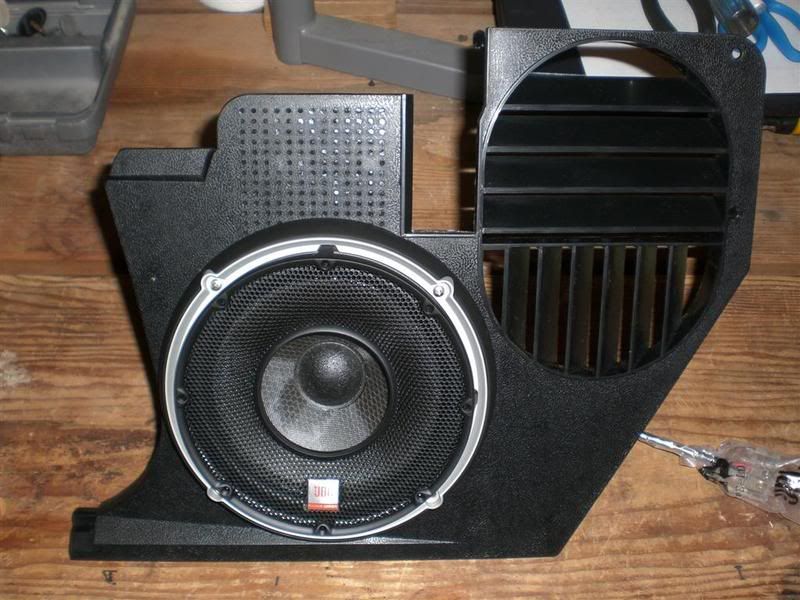
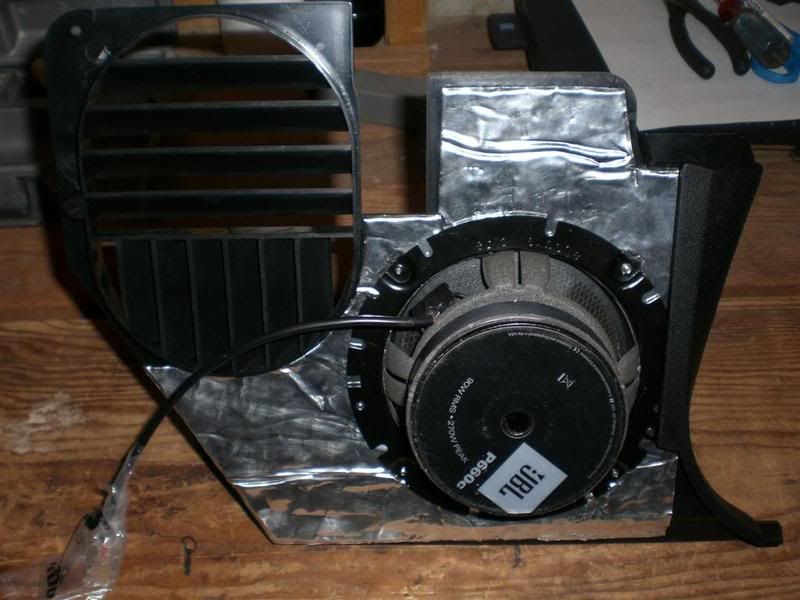
I'm just posting these an example so it's seen from front to back and people can see how different speakers can look in the kick panels.
Dude, when you moving to Texas? 
Melting Slicks


Joined: Apr 2001
Posts: 2,030
Likes: 363
From: Lubbock Texas
This is an interesting learning exercise! And it shows my ignorance of things electronic :o. For some reason I had the idea that unhooking the dash top 4 x 6"s, replacing the kick panel 4 x 6s with the 6 1/2" units (effectively going to a two-speaker system) would give a nice boost in power and sound. In other words, the 50W x 4 head (however accurate that wattage rating might be) would direct 2 x 100W to the new 6 1/2s??
I was at FutureShop today and dropped by the car audio center to get some Dynamat. A little chit-chat as to what I was doing was revealing. The fellow said basically that I will simply be losing the 50W x 2 channels! So the new 6 1/2"s would be getting the same power input as the current 4 x 6"s down there. I'm beginning to wonder as to the usefulness of this project. Is there a way to get 2 x 100W down to the kick panel speakers? Or is a two-channel amp in my future?
I was at FutureShop today and dropped by the car audio center to get some Dynamat. A little chit-chat as to what I was doing was revealing. The fellow said basically that I will simply be losing the 50W x 2 channels! So the new 6 1/2"s would be getting the same power input as the current 4 x 6"s down there. I'm beginning to wonder as to the usefulness of this project. Is there a way to get 2 x 100W down to the kick panel speakers? Or is a two-channel amp in my future?
One option for you is to keep the 4x6 dash speakers initially and like has already been suggested, use the fader control to set them at whatever level sounds best. If they are too harsh, especially on the highs, you could install a filter to clip the highs and lows and just pass the mid-range frequencies that are more pleasing. Personally, when I install my system, I plan to tune the dash speakers to pass the frequency range for human voices as I find too often in car stereo systems, the voice quality is lacking for my tastes. I also plan to install a head unit that will allow for time delay correction - this feature allows you to tune the timing that sounds are provided to each speaker from the head unit so the sound from each speaker in the system effectively reaches the ear at the same time.
I don't know how your head unit is set up. It might be possible to bridge the internal amp so you could get 2x100 if you choose to eliminate the dash speakers but it sounds like the kick panel speakers you've purchased don't really need 100 watts.
I also wanted to make sure folks understand that the power rating of speakers does not translate into the size amp that is needed to drive them. One specification of speakers is their sensitivity rating which correlates to their efficiency. Speaker sensitivity is expressed in decibels (dB). The greater the number, the more efficient the speaker and thus the less power required to drive the speaker. An interesting fact is that for every 3 dB increase in sensitivity, you can cut the amp size in half. For example, if a particular speaker has a sensitivity rating of 85 dB and will produce a certain volume level at 50 watts of input (amp) power, a similar speaker with 88 dB of sensitivity will produce the same volume level at only 25 watts of input power. Thus, the cost of buying more efficient speakers can translate into a less costly (and smaller) amp. Speakers will generally handle a lot more power than they are rated for IF the sound is clean. Pump enough distortion though and you can blow the best of them.
On the discussion of dash speakers in general and the perceived harshness from bouncing off the glass, I find it interesting that the factory Bose system in my Suburban actually faces the tweeters at the glass. That Bose system is actually not bad for a factory system. I could blow it away with a good aftermarket system but it's adequate enough that I don't want to spend the money.
Hope this helps some.
DC
Thread Starter
Team Owner
Joined: Aug 2006
Posts: 24,125
Likes: 15
From: Columbia Missouri
OK, suggest an amp, sub, and the kickpanel speakers for me if you don't mind DB. Willing to spend up to $700 on speakers, amp, and enclosure if I have to (I can build an enclosure). Want bass, but don't need so much that it shakes the cars around me. Also, have to be able to put my T-tops in the back (Florida weather). I don't mind a little cutting of the bird cage for the kick panel speakers. I just want a decent sounding system.
Pm me your email address and I will email you a system plan and go over some details.
I wish I was but I'll be staying here in Columbia, sorry.

Polk's 4x6" plate speaker is good for it's size and I have not used any of their 6x9" speakers. I just don't see the need for them, as the 6.5" round speakers are more efficient. There isn't really an application that the 6x9" would need to be used over a 6.5" so that's always what I use for mids. If I want bass I install a sub.
Thread Starter
Team Owner
Joined: Aug 2006
Posts: 24,125
Likes: 15
From: Columbia Missouri
One specification of speakers is their sensitivity rating which correlates to their efficiency. Speaker sensitivity is expressed in decibels (dB). The greater the number, the more efficient the speaker and thus the less power required to drive the speaker. An interesting fact is that for every 3 dB increase in sensitivity, you can cut the amp size in half. For example, if a particular speaker has a sensitivity rating of 85 dB and will produce a certain volume level at 50 watts of input (amp) power, a similar speaker with 88 dB of sensitivity will produce the same volume level at only 25 watts of input power. Thus, the cost of buying more efficient speakers can translate into a less costly (and smaller) amp.
This is all very true. Unfortunately you have to believe what the speaker manufacturers tell you about their sensitivity and whether it was tested on a scale that would apply to normal use.
Companies that really do sell premium speakers that are rated honestly and do what you describe are VERY expensive. Not only that, I have to always remind myself that this is CAR audio...not HOME audio. Car audio is very unpredictable and any one of ten thousand things can alter how these components act in these unique environments. That rating of 3 db more might show up on paper but in the doors of an SUV the rules change and all that extra cash for a better speaker won't mean squat over road noise.
I can post links to only 6 sets of speakers that would cost the same amount of money as a C5 Corvette. That's pitiful. If good sound can come from a cheap set of speakers that let you hear your music over the engine and road noise, and helps you keep things simple, then I will take that any day over a $21,000 car stereo system.