







Panel Replacement, Detectable?

Thread Starter
Melting Slicks


Joined: Apr 2007
Posts: 3,189
Likes: 111
From: Tolland CT
 Panel Replacement, Detectable?
Is there a way to tell if a body panel has been replaced, assuming it wasn't spliced. Any typical give away, something the factory did differently?
I ask mainly out of curiousity. Wondering at times if the rear panel on mine was changed. The bonding strips are there, no splices or other suspicious markings.
I ask mainly out of curiousity. Wondering at times if the rear panel on mine was changed. The bonding strips are there, no splices or other suspicious markings.

Melting Slicks
Joined: Jun 2009
Posts: 2,709
Likes: 3
From: Savannah GA
Compare the areas in question on both sides of the car. If the panel was damaged enough to warrant replacement, the inner suppports and splash shields likely needed repair as well. Since these areas do not show from the outside, shops might cut corners a bit on the cosmetics here and that will be the "tell".
Thread Starter
Melting Slicks
Joined: Apr 2007
Posts: 3,189
Likes: 111
From: Tolland CT
Compare the areas in question on both sides of the car. If the panel was damaged enough to warrant replacement, the inner suppports and splash shields likely needed repair as well. Since these areas do not show from the outside, shops might cut corners a bit on the cosmetics here and that will be the "tell".

Team Owner


Joined: Sep 2006
Posts: 31,272
Likes: 4,364
From: Westminster Maryland
Hi BB,
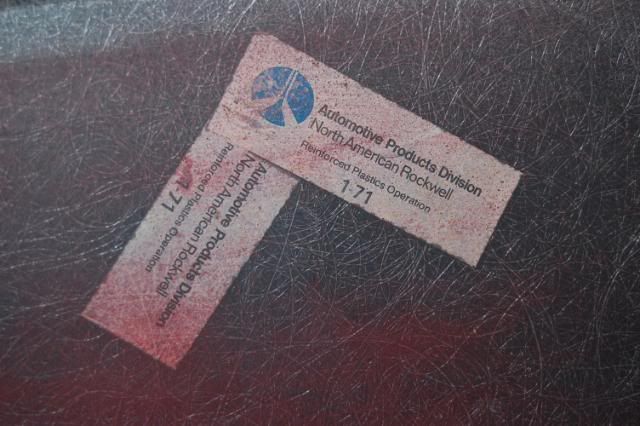
SOME of the body panels had mfg's labels on them which would sure be a clue to originality.
Here's a picture of a label on the underside of the hood surround in the left wheel well. The date is 1-71, the first week of 71. I don't know why there are 2 labels. They are molded as part of the panel, not stuck on.
The body tub of my 71 has the same label dated 36-70.
Also, originally the areas where bonding strips were going to be used were 'roughed-up' (it almost looks like sand blasted) in order to increase adhesion. I'd look for signs of that too.
Some original bonding strips had numbers molded in to them. I'll get a picture.
Good Luck!
Regards,
Alan
SOME of the body panels had mfg's labels on them which would sure be a clue to originality.
Here's a picture of a label on the underside of the hood surround in the left wheel well. The date is 1-71, the first week of 71. I don't know why there are 2 labels. They are molded as part of the panel, not stuck on.
The body tub of my 71 has the same label dated 36-70.
Also, originally the areas where bonding strips were going to be used were 'roughed-up' (it almost looks like sand blasted) in order to increase adhesion. I'd look for signs of that too.
Some original bonding strips had numbers molded in to them. I'll get a picture.
Good Luck!
Regards,
Alan
Thread Starter
Melting Slicks
Joined: Apr 2007
Posts: 3,189
Likes: 111
From: Tolland CT
Thanks all. I've wondered at times when people state the body has never been hit, how can you tell if the repair was done well?
I don't recall seeing any labels on any of my panels. I've had the body off and went over much of the underside.
I don't recall seeing any labels on any of my panels. I've had the body off and went over much of the underside.
Team Owner
Joined: Sep 2006
Posts: 31,272
Likes: 4,364
From: Westminster Maryland
Hi BB,
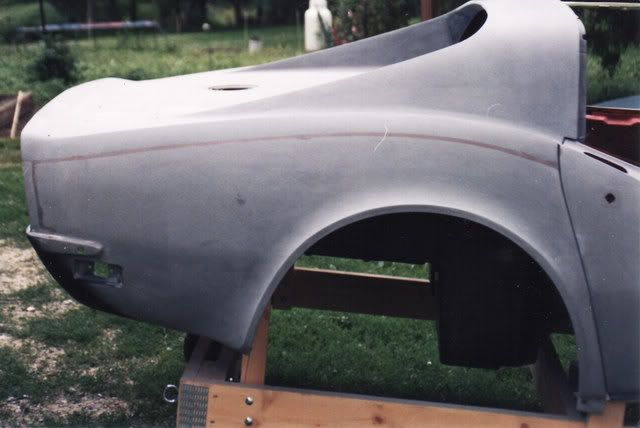
I think it is possible to determine a no hit body.
I do believe it's much easier to tell with an unpainted car. I 'think' I can see a difference in the bonding material used in St.Louis compared to what is used today.
The jig assembled front clips are really good, but I'd think it would be difficult to put a rear clip together without leaving a sign.
Regards,
Alan


I think it is possible to determine a no hit body.
I do believe it's much easier to tell with an unpainted car. I 'think' I can see a difference in the bonding material used in St.Louis compared to what is used today.
The jig assembled front clips are really good, but I'd think it would be difficult to put a rear clip together without leaving a sign.
Regards,
Alan
Thread Starter
Melting Slicks
Joined: Apr 2007
Posts: 3,189
Likes: 111
From: Tolland CT
Hi BB,
I think it is possible to determine a no hit body.
I do believe it's much easier to tell with an unpainted car. I 'think' I can see a difference in the bonding material used in St.Louis compared to what is used today.
The jig assembled front clips are really good, but I'd think it would be difficult to put a rear clip together without leaving a sign.
Regards,
Alan
I think it is possible to determine a no hit body.
I do believe it's much easier to tell with an unpainted car. I 'think' I can see a difference in the bonding material used in St.Louis compared to what is used today.
The jig assembled front clips are really good, but I'd think it would be difficult to put a rear clip together without leaving a sign.
Regards,
Alan
I agree, if the paint were stripped to bare glass it would expose most repairs.
Mine has never been hit since I've owned it, 28 years now. Question in my mind is what may have been done to it by past owners. Materials used would have been from the 70's to very early 80's.
Good looking body in those photos. I assume those are earlier pictures of yours. Thanks for sharing your photos, this thread and many before. They're quite interesting, helpful.
Corvette Stories
The Best of Corvette for Corvette Enthusiasts

Top 10 Most Expensive Corvettes Ever Sold on Bring A Trailer
Brett Foote
10 Things Every Corvette Owner Needs (2026 Edition)
Michael S. Palmer
8 Most "Only Corvette Owners Understand" Quirks and Problems
Pouria Savadkouei
10 Reasons the C6 Z06 is Still A Performance Benchmark After 20 Years
Joe Kucinski
How Much Horsepower Every Corvette Engine "LOST" in 1972
Joe Kucinski
Top 10 DOs and DON'Ts for Protecting Your Convertible Top!
Michael S. Palmer
Top 10 Most Explosive Corvettes Ever Made: Power-to-Weight Ratio Ranked!
Joe Kucinski
150 hp to 1,250 hp: Every Corvette Generation Compared by the Specs That Matter
Joe Kucinski


