When you click on links to various merchants on this site and make a purchase, this can result in this site earning a commission. Affiliate programs and affiliations include, but are not limited to, the eBay Partner Network.
Speaking only of the VIN derivative, looks like a "rebound stamp" not too common but accepted as OK. Tonowanda stamp and broach marks look good to me but I'll let more knowledgeable others comment on them.
Hi,
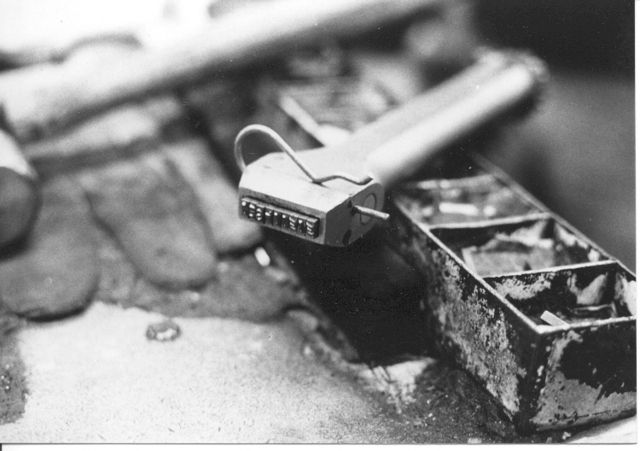
I believe this is the type of 'gang holder' that was used to do the VIN derivative stamp.
Looking at the tool, the hammer, and the gloves, I'd think it's pretty easy to see why there might be a 'bounce' every now and then.
Regards,
Alan
I agree with all the above comments. Has the car ever been judged? If so, it would be nice to see what they indicated about the pad, but again I think it is a typical bounce stamp.
Hi bj,
Shouldn't the pad surface exhibit the unique machined surface pattern typical of being 'broached' rather than a "rough cast surface"?
Regards,
Alan
Hi bj,
Shouldn't the pad surface exhibit the unique machined surface pattern typical of being 'broached' rather than a "rough cast surface"?
Regards,
Alan
the pad has paint on it, which means someone besides the factory painted it.. which means increased potential for hanky panky. the bounced stamp is somewhat abnormal but to some judges, acceptable.. its a car with a abnormal stamp... not worth an absolute original engine car price.. whatever that may be..
Hi bj,
Shouldn't the pad surface exhibit the unique machined surface pattern typical of being 'broached' rather than a "rough cast surface"?
Regards,
Alan
That crossed my mind too. Why does it have the rough cast look ? You would expect to see the broach marks but at least if it is not smooth you can assume that nobody just ground the numbers down and changed them. I'm confused , that's the first time I've seen numbers stamped on a cast surface.
At first I thought it was L 30 8, which is Dec 30 1968 and matches well.
After staring at it and blowing it up, I think it's i 30 8, which is Sep 30 1968, 3.5 months before the assembly date which I guess is possible, but not likely.
Very tough to read.
Even the block casting number is tough to read, but it ends in 270 for sure.
At this point, I'm not sure at all if it is the original block or not.
The 270 block would most likely be the I 30 date. I believe by December they were using the 512 blocks.
The I30 matches with the JAN stamped block just fine.
I can clearly see the parallel broach marks on the stamp pad, looks like the original real pads I've seen. But even those can be reproduced pretty well.
If you really want to confirm the pad then contact Al Grenning. He is not inexpensive but he can match up the broach marks from other engines made at the same time, similar to ballistics. The blades will leave distinguishing cuts in the metal that can be identified.
The fact that its double tapped will always invite scepticism. It may very well be original.
For that stamped date Id be more suspect of a casting date of Dec 30 than Sept 30. Though Dec 30 is possible it's cutting it close.
I disagree. Most blocks casting dates are usually within 7-14 days time of engine build date especially for the more common engines such as the 390hp cars. At least from what I've seen anyway.
The cars with further dates seem to be the rarer engine options but then again those are the most often counterfeited.
They made lots of 390 cars in 69. Roughly 700 per month on average over the 16 month run minus the strike. Turnover was enough to keep the block dates pretty close.
disagree. Most blocks casting dates are usually within 7-14 days time of engine build date especially for the more common engines such as the 390hp cars. At least from what I've seen anyway.
The cars with further dates seem to be the rarer engine options but then again those are the most often counterfeited.
They made lots of 390 cars in 69. Roughly 700 per month on average over the 16 month run minus the strike. Turnover was enough to keep the block dates pretty close.
Good Point, I guess I never thought of it that way. My 68 390hp car has around a 2 month delay between casting and assembly so I guess I assumed they were all similar.
I found a picture of a stamp pad that is on a car that is 22 units away from the one I am looking at buying. This car is local to me and has the original block.
The pad itself looks the same as the one I am looking at, but obviously there is no double stamp.
I was not able to get a pic of the block casting date.
This leads me to believe that the one I am interested in is an original, born with block, even though the casting date is a few months before the assembly date.
paint on the pad, hard to read casting date and block casting number, a bounced stamp strike... all attributes that will come up when you try to sell this car a few years down the road... if you buy it...
you just need to buy it at the right price..
if you require the pedigree, then confirm the pedigree before you buy...
if you are looking for a original engine car with no excuses.. this ain't the one. but keep in mind that it is extremely hard to find a car with no excuses at a reasonable price.
From: PHOENIX AZ. WHAT A MAN WON"T SPEND TO GIVE HIS ASS A RIDE
Originally Posted by bj1k
That crossed my mind too. Why does it have the rough cast look ? You would expect to see the broach marks but at least if it is not smooth you can assume that nobody just ground the numbers down and changed them. I'm confused , that's the first time I've seen numbers stamped on a cast surface.
That is NOT a cast surface. It is broach machine surface. The picture shows lines NOT a sand cast one.
Designer Imagines A Corvette That Looks More Like a Corvette Than the Corvette
Slideshow: A Jaguar designer's personal project imagines what a modern front-engined Corvette might look like if Chevrolet revisited the golden age of the Stingray.







 Stamp Pad Question