When you click on links to various merchants on this site and make a purchase, this can result in this site earning a commission. Affiliate programs and affiliations include, but are not limited to, the eBay Partner Network.
i believe pozidriv is an english "phillips". Jags are a PITA for that reason. the other advantage spousal unit has over you when fighting a screw is mass and testosterone. everything is easier when you know how, but a certain amount of power is still necessary. you are using this urethane bumper over? it is pretty enough? leaving it on and masking carefully may be more prudent. i assume the lower "valence" is removed to give you more room? and your set of front bumpers. you are not going to use them? there is a guy a bit south of you that may want them. still in canada. pale roader. he is about to dump his 73 cuz it isn't a 69. i am trying to convince him a paid-for car that isn't rusty is easier to convert than doing from scratch a beat hulk he hasn't even found yet.
I'm reusing this urethane bumper, it's probably as pretty as it was when it left the factory which of course was a bit ripply. I think I'm going to apply matte black paint to the bumperettes now rather than risk getting black paint on the finished paint job. The thing that concerns me about painting the car with the bumper cover tightly on is that that could result in paint bridging from the front clip to the front bumper cover which would crack as the different materials expand and contract at different rates. The lower valence is removed, I had two bolts break off, I'm not sure what I'm going to do about that yet.
I'd agree with you, I'd rather convert a 73 to a chrome bumper than deal with a total restoration on a beat up car. If I could sell all my stuff to one buyer I think there's a good chance I'd go for that.
i still think you should hold off until i do this conversion on my 75.. the big expense is the bumpers, grilles, hockey sticks, etc. and you already have all that.
Good thinking...6 months from now you may get a case of the Crazies and decide to slap a chrome bumper on it. (There is a much easier way than what I am doing....).
Good thinking...6 months from now you may get a case of the Crazies and decide to slap a chrome bumper on it. (There is a much easier way than what I am doing....).
I tried to raise the headlights with the switch underneath the dash but apparently after sitting a number of months there wasn't enough vacuum left in the system to raise them. I went under the car and pushed them up to the open position and I was able to get at most of the nuts holding the front bumper cover on. I counted 14 of them and I don't think I found any extras when I originally (mis-)counted 12 of them. I spent a few hours Monday reading up on removing the headlight buckets and the front bumper cover by searching the forum. There were two nuts behind the side marker lights I couldn't get at with a socket or a wrench. Someone advised removing the side marker lights and making an access hole in the opening to get at those two bolts so I did so as you can see in the picture below:
On another thread someone said you don't need to do that, he was able to get a box end wrench on it and loosen the nut that way. I got a box end wrench on it but I couldn't get any swing on it to actually loosen it up, so I made the access holes and used a 1/4" drive ratchet with a 3/8 deep socket.
I'm going to avoid removing the bumper cover if I can, There were two studs with nuts on them I had a hard time getting to with the 1/4" socket. You can see one of them and part of the loosened nut in the picture below (blue arrow):
It took a lot of struggle but I managed to loosen those two as well. The thing with those two studs is that they're so difficult to get at and the space is so tight I don't see any way I could get my fingers in there to start the nuts back on the studs if I took them all the way off.
Ward knows a painter that came over tonight to talk about primering the rear of the car. I thought he was going to give the whole rear end a once over to check for any problems but he only felt the driver's side quarter panel and part of the upper rear deck and then asked if I wanted to work in a body shop. He said he wasn't joking, but
So, we're buying a gallon of two part primer and a spray gun next week and I guess we'll have at the rear end in the not too distant future
The ones you have a hard time restarting, don’t bother. Nobody’s gonna know but you this there’s only 10 or 12 nuts on there instead of 14 or 16. Maybe when brand-new they all had to be there to hold it in place but it’s been sitting in place for what nearly 5 decades? And get one of those 3/8 ratcheting box end wrenches.
IF you decide to remove them....LOTS of oenetrating fluid/try to move the not a LITTLE each day/LOTS more penetrating fluid...
(don't ask )
I did loosen them up after spraying penetrating oil on them over a number of days. I was worried about contaminating the exterior of the car because there was so much penetrating fluid. I took a spray bottle with soapy water to all that area under the front end, wiped as many surfaces as I could get at with paper towels, went back to the soapy water a couple more times and wiped with paper towels, then pure water a few times while wiping with the paper towels afterwards. Sure was humid in the garage after that, lol.
You can see in this picture I've got all the nuts loosened and there's now a space between the bumper cover and the body:
I think this is the method that the painter used when the original owner had the car repainted 20 years ago.
When I pulled the front bumper cover off I found several drips, runs of paint and some type of compound or filler smeared between the body and bumper cover.
It looked perfect until I removed the bumper cover, and discovered a total Bubba mess once the two were separated.
I know you are being a perfectionist on the body and paint work on your car, so hopefully you’ll find a way to keep the drips of paint from running down in the gaps.
I know you are wanting to do a perfect job and you are wanting to complete it, but try not to start taking short cuts now.
Last edited by OldCarBum; Aug 19, 2022 at 11:56 AM.
I think this is the method that the painter used when the original owner had the car repainted 20 years ago.
When I pulled the front bumper cover off I found several drips, runs of paint and some type of compound or filler smeared between the body and bumper cover.
It looked perfect until I removed the bumper cover, and discovered a total Bubba mess once the two were separated.
I know you are being a perfectionist on the body and paint work on your car, so hopefully you’ll find a way to keep the drips of paint from running down in the gaps.
I know you are wanting to do a perfect job and you are wanting to complete it, but try not to start taking short cuts now.
There appears to be a lot of crap between my bumper cover and the body, I wouldn't call it runs, it looks more like dirt or dust or something. I know the car was painted once before, perhaps they left the bumper cover in place to do it and what I'm seeing now is sanding residue. Later on I'll have a closer look at it. I'm really not keen on completely removing the bumper cover as there are four studs (including the ones in front of the side marker lamps) that I can't see any way I can get my fingers in there to start the nuts on the studs if I remove the cover completely and some of the other ones look like they'll still be a struggle.
A word of caution to anyone thinking of creating a bumper cover stud access hole in the indentation for the side marker lamps, when I did it I used an extra thick drill bit and I ended up accidentally grinding off a bit of the stud with it. I can still loosen the nuts a bit more, at this time I didn't want to spin them off too far and have them eventually work the the rest of the way off as the bumper cover is jostled over time until I'm ready to primer it.
Glad to see you back at it, it's gonna look so good when you're done! Can we get a 3/4 rear pic of it??
In regards to removing the nuts from any rusted stud or screw, chase as many threads as you can as far as you can BEFORE trying to remove the nuts. Works wonders.
External thread chaser, or a threading die.
Last edited by Pegan2261; Aug 25, 2022 at 01:25 PM.
Glad to see you back at it, it's gonna look so good when you're done! Can we get a 3/4 rear pic of it??
It's a very small garage jam packed with stuff, so I'm not sure I can get far enough back to get a 3/4 picture of the rear, I'll check it out later today.
It's a very small garage jam packed with stuff, so I'm not sure I can get far enough back to get a 3/4 picture of the rear, I'll check it out later today.
You can get THAT much of the car in a single pic ?!?!
After I got the rear of the car ready for primer (again) I was working on the front end and occasionally looking at and feeling the rear end and holding a light at a low angle to re-check my work. It seems like the longer you have to look at it the more you're able to find things to improve on.
I had been checking the quarter panels by putting my head next to the tail light panel and looking forward along the quarter panel which didn't give me a good look at the shape around the rear wheel opening (blue line in picture below). Then I finally figured out where to hold the trouble light rod to see that area much better (green lines in picture below). I was then able to see that 5 or 6 inch border around the wheel openings was not very good.
So I took my sanding blocks with the rounded edges and spent a few days improving that area and I'm much happier with it now. I'd have been pretty disappointed if I had painted the car before doing this additional sanding around the wheel openings.
After I finished that I was comparing the mid quarter panel horizontal body line (purple line in picture above) on each side and while I couldn't see it with the water looking forward along the quarter panel, with the light at a low angle I could see that character line was much sharper on the passenger side than it was on the driver's side. The line seems like 1/4 inch wide on the passenger side and 2 or 3 inches wide on the driver's side. I also noticed that the lower quarter panel on the driver's side kind of bulged out a bit and it would look better and more like the passenger side if that area was a bit flatter. Both quarters looked even and smooth, I just never noticed before that they still looked too different.
I took my flat board with 120 grit on it and sanded below the character line on the driver's side, gradually sanding a bit higher and a bit higher and so on until that sharpened that character line up a fair bit. Then I took the block to the passenger side and sanded directly on top the character line and softened that enough that now the character lines look much more alike on each side I was fortunate that I had enough excess filler yet that I could just remove material to get the quarters right and not have to add any which would have been a much bigger job.
These two areas on either side of the license plate opening (blue circles in picture below)have been bothering me since I finished that area back in February 2017:
I'm pretty sure I didn't sand far enough out with the 80 grit in the area of those circles and that meant I had filler over unsanded gel-coat. All this time I've been wondering if that area would continue to adhere over the years so I decided to bite the bullet and sand away some of the filler, rough up a larger area of the gel-coat with 80 grit and re-do it.
The green arrows in the picture above show the thickest filler which is close to 1/4" thick at those peaks. I ended up with lots of filler there because when I fiberglassed the exhaust filler panel to the tail light panel there was a "V" shaped piece of fiberglass in the license plate area on the tail light panel that was sticking out 2 or 3 inches from where it needed to be to join the exhaust filler panel. I decided to just close up the space by forcing the "V" shaped surface into place by clamping it to the exhaust filler panel. Unfortunately when I did that it bent a large area on the exhaust filler panel out of proper alignment which I then unknowingly fiberglassed into place. I should have just cut away that "V" shaped piece and used mat and resin where it needed to be to join the exhaust filler panel.
Here it is after I sanded back that area to re-do it:
I masked off the area to minimize the area fill would cover and then applied the Vette panel adhesive/filler. I usually have ten or fifteen minutes to get the fill in place before it hardens but this time because I mixed up a much smaller batch I got a lot more hardener in it than I normally do and it set up while I was still trying to spread it on the left side of the license plate opening so I was thinking I probably didn't have enough fill on that side and would have to sand it down some and apply more:
Then went to 80 grit and back and forth between 80 grit and 120 grit depending on how much material I had to remove.
To my surprise I had enough fill on the left side of the license plate opening but not the right. The picture below is after I added another layer of fill to the right side and sanded it down a bit with 36 grit, the purple arrows show the lines from where I removed the tape I applied for the second layer of fill:
And here's the area finished off:
A while back I posted the picture below showing me using a square from a paint stir stick with 120 grit wrapped around it to bring down the edge of fill where there was a tape line without removing any material outside of the repair area:
As I did more of removing that edge of fill along a taped off area I found the square I used in the picture above still resulted in a tendency to sand outside of the edge of high fill and dig a groove where you didn't want to remove any material at all (because that outer area beyond the current application of fill is "done"). What works best is using a thin strip of 120 grit over a large washer as shown in the picture below:
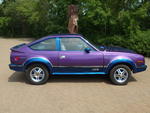
Pegan2261 asked for a 3/4 picture of the rear of the car, I'm not sure if that means 3/4 of the rear of the car, or 3/4 of the car showing the rear, but either way I got as far away from the car as I could and took these two pictures:
My fender openings were so "crooked/out-of-round"...I made 1" oversize cardboard cut-outs and trimmed the cut-outs until I was happy with the shape. Then I sanded the convex bulges and filled in the concave divits until the cardboard fitted the opening.
As you and other members said...Its not the work you "want to do" that wears you out>>>>
It's the work you HAVE to do just to get to the "want-to-do" stuff.
Last edited by doorgunner; Sep 9, 2022 at 12:35 AM.
My fender openings were so "crooked/out-of-round"...I made 1" oversize cardboard cut-outs and trimmed the cut-outs until I was happy with the shape. Then I sanded the convex bulges and filled in the concave divits until the cardboard fitted the opening.
As you and other members said...Its not the work you "want to do" that wears you out>>>>
It's the work you HAVE to do just to get to the "want-to-do" stuff.
I missed that on your project thread - wow that's a huge job!
We got the primer and a spray gun, now I need to round up some paper to mask off the front of the car and to read up on using the spray gun and the primer I've got. The painter said to put 4 coats of it on. I'm feeling really nervous about this, I haven't sprayed primer on a car for perhaps 20 years and I can't do it in 2 or 3 hours in the afternoon so I'll have to work a much longer day than I'm used to. I'll be spraying outside to avoid explosions from the compressor igniting the paint fumes. I'll have to wait until I get a nice day with minimal wind, no chance of rain and temperatures around 70 F. In another 3 weeks I might not get any days near 70 F, I hope I can get the primer sprayed before then.















 )
)