When you click on links to various merchants on this site and make a purchase, this can result in this site earning a commission. Affiliate programs and affiliations include, but are not limited to, the eBay Partner Network.
On dismantling the RH Door for stripping/painting my '73, I found this:
Even the grease coating is cracked with age. I wager this latch has never been cleaned since it left the assembly plant in St. Louis.
It's currently soaking in a solvent bath.
I bought a replacement Door Handle for the LH side, but it's lighter and weakly built compared to this OEM version.
Even the nuts that hold it in the door are heavier than the repro's.
Hi Steve,
Interesting amount of 'gook' on there!!!!
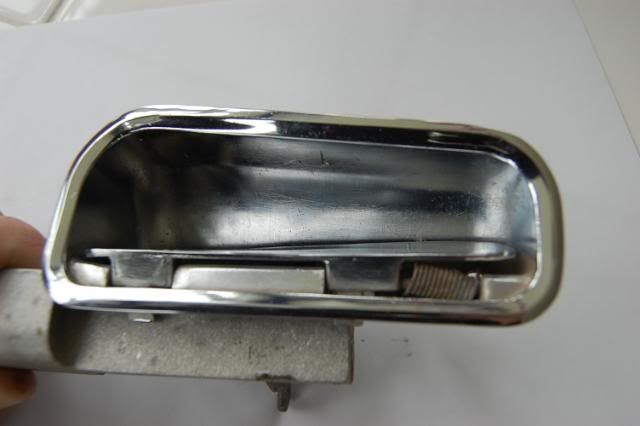
Depending just how concerned you are about 'originality' you might want to take a look in the handle 'cup' with the flapper depressed.
Original handles had the disappearing chrome plating that is typical on parts with tight inside curves, while the reproductions are often painted silver in there.
Don't know just how far you're going?
Regards,
Alan
Fortunately lacquer thinner is able to make the reproduction a little more accurate if you desire.
An original.
Hi Steve,
Interesting amount of 'gook' on there!!!!
Depending just how concerned you are about 'originality' you might want to take a look in the handle 'cup' with the flapper depressed.
Original handles had the disappearing chrome planting that is typical on parts with tight inside curves, while the reproductions are often painted silver in there.
Don't know just how far you're going? Alan, some days I forget where I'm going just as I get into the car!
Seriously, I love the car very much now, and the desire to keep it as original as possible seems to get stronger day by day. I never started out "wanting a Corvette", but wanted some type of muscle car that didn't require California Smog checks! And I got it with this guy.
Fortunately lacquer thinner is able to make the reproduction a little more accurate if you desire. Good tip!
The mechanisms on my '68 basket case looked exactly like the above pic. A day in a solvent bath/ hours of scrubbing....I even applied a satin clearcoat before lubricating the parts to keep them rust-free and fresh-looking.......(resto-mod)
Last edited by doorgunner; Mar 29, 2016 at 02:59 PM.
Hi,
I believe originally the door latches and latching parts, and window operating parts/tracks were zinc (?) plated.
I think Chevrolet realized they needed to keep rust at bay for at least a few years.
Regards,
Alan
The mechanisms on my '68 basket case looked exactly like the above pic. A day in a solvent bath/ hours of scrubbing....I even applied a satin clearcoat before lubricating the parts to keep them rust-free and fresh-looking.......(resto-mod)
Yeah, I'm thinking about coating them with something too Doorgunner. These parts appeared to be anodized just like the sill plates.
Out of the tank, dried out with compressed air, and now.....
What lube to apply?
As I see it, all the caked-on dried out grease I removed did nothing for the smooth operation of the mechanism. It did prevent surface corrosion I suppose. But what thoughts do you guys have on this?
Since my car is a resto-mod I was more concerned about preventing rust and future mechanism binding......I also realize that gobs of grease are good, BUT grease collects more dust and grime than anything else.
I decided to use drops of 10W engine oil yearly on the locking mechanisms. Yearly maintenance goes a long way in preventing problems and also in correcting problems that are just beginning.....At every oil change I spend 5 minutes putting my vehicles on jack stands in order to "eye & touch" chassis components (post-flight scheduled maintenance)
Last edited by doorgunner; Mar 29, 2016 at 08:19 PM.
Hard to beat normal white lithium grease. try to work it in while the latch is out and you can get at the different bits. You can spray some of the aerosol versions with a tube up inside here and there.
Some use silicone spray, maybe OK while it's out of the car but I wouldn't spray once they are installed (bare fiberglass inside the doors can soak it in)
While mine were out I ran out of lubriplate and used a little green lucas grease with a q-tip on the sliding surfaces. Work it a few times and then wipe off any excess, especially around the claw
M
btw
Mine had the original crud AND at least 2 coats of aftermarket overspray
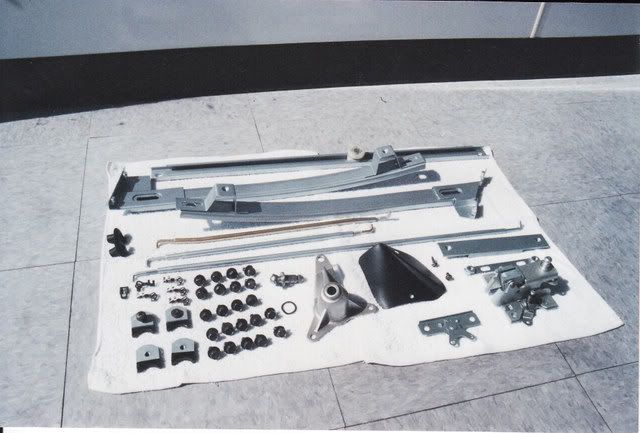
The door latch mechanism came out nice in the parts cleaner.
No substitute for period original parts.
New ones are mostly crap.
I have a box of assorted bad purchases I made for my 68.
Maybe when I retire the NCRS will invite me out to do a seminar on crappy after market parts for dummies. By then I should have a pretty good ensemble of failed part for a sporting discussion.
Lithium grease lasts and works well. We used it at the GM dealership
for lube on all door mechanisms including hinges.
As stated working inside the door is like trying to steal a cookie from Freddie Kruger. Have band aids and electrical tape near by.
Carry On
Marshal
White lithium grease...FROM A TUBE, not a spray can...is what you want to put on moving parts in the locks and on moving window parts. There is not enough real lube in the spray can to do any good. The spray can might be OK for home door hinges...but not for long-term lube on working parts in varying environments.
Out of the tank, dried out with compressed air, and now.....
What lube to apply?
As I see it, all the caked-on dried out grease I removed did nothing for the smooth operation of the mechanism. It did prevent surface corrosion I suppose. But what thoughts do you guys have on this?
Thanks.
Steve
If you can find a place that sells LPS products they make a great spray for this .I think Aircraft Spruce and supply in Calif sell it .It's greaseless and leaves a nice waxy film .
Wes
White lithium grease...FROM A TUBE, not a spray can...is what you want to put on moving parts in the locks and on moving window parts. There is not enough real lube in the spray can to do any good. The spray can might be OK for home door hinges...but not for long-term lube on working parts in varying environments.
I also like the white lithium grease but prefer the spray since it is thinner and more like oil and will get down into where you need the lubrication and will not build up as much causing dust to stick .
Put a spray of the aerosol stuff on a piece of metal; then put a wipe of 'tube' lithium grease next to it. Let the metal piece sit in open air for a couple of days, then compare how the two lube spots appear. I'd bet the sprayed on spot has almost disappeared. There is so little lube in that stuff, I'm not sure anything sprayed with it would work well for more than a week or two. The tube stuff will stay functional for 5-10 years...then it starts drying up, too. But, several years is a lot better than a few weeks. Just sayin'....
Since I drive alone 95% of the time, I probably could get by with the Lithium spray on the right door mechanism (just to cut down on contaminant accumulations), and the tube Lithium on the Driver's door stuff.
How about "Molly-B"? Does it age as well as Lithium?
Not sure what you mean by Molly B but if you mean molybdenum based grease, it'll lube very well but it has a great affinity for dirt and grime. Have a look at the outside of your u-joints. Different environment but you'll get the idea.
Wes mentioned a waxy aircraft lubricant above. I've been using something similar for a few years now and am very happy with it. I'll post a pic if I can find it but it's a bike chain lubricant. It's solvent based and leaves a waxy film. Doesn't lube as well as lithium but doesn't collect dirt either. Seems to work really well on applications like hinges and pivots that don't see much motion.







 Now THIS is






 And I got it with this guy.