




Engine stamp 68 vette
Melting Slicks


Joined: Jul 2006
Posts: 3,103
Likes: 802
From: Massapequa Park NY

I would find it odd that a gang stamp that is routinely used with a partial VIN would have been loaded with the complete VIN. I would check with an NCRS judge as this is not what is considered normal production practice. I just checked my 68/69 NCRS T.I.M. and it references only a partial VIN stamp as being present with the engine stamp. It might still be legit but I would want further clarification or other examples that have been verified as legitimate. Sounds like a nice car though. Good luck.
Even if it did happen, I would need TONS of evidence its legit. You know what they say, extraordinary claims require extraordinary evidence. This would fall into that category if it had a full vin stamped into it.

Drifting

Joined: Jan 2014
Posts: 1,866
Likes: 140
From: Sadieville Kentucky
I'm looking at purchasing a 68 vette and it is advertised as numbers matching. I was sent photos of the engine, tranny. Now they all match up, however my concern is that the engine vin from what I have read is supposed to be a partial and this engine has the entire vin on it. Has anyone ever heard of this before?
Wes
Last edited by 530planeman; Jul 1, 2016 at 08:48 PM.
Melting Slicks
Joined: Jul 2006
Posts: 3,103
Likes: 802
From: Massapequa Park NY
As Wes stated they are reversed on the small blocks versus big blocks, but that's been known a very long time.
The small blocks have the Vin first (on the left when looking at it to read) and date stamp on the right. The big blocks have the date stamp first and vin to the right as Alan's picture demonstrates.
The small blocks have the Vin first (on the left when looking at it to read) and date stamp on the right. The big blocks have the date stamp first and vin to the right as Alan's picture demonstrates.

Team Owner


Joined: Sep 2006
Posts: 31,267
Likes: 4,362
From: Westminster Maryland
Hi,
I believe this is a picture from John Hinkley.
The tray of individual digits, the holder, the hammer, and the glove!
Tough to get more than 9 digits in that holder.
Regards,
Alan
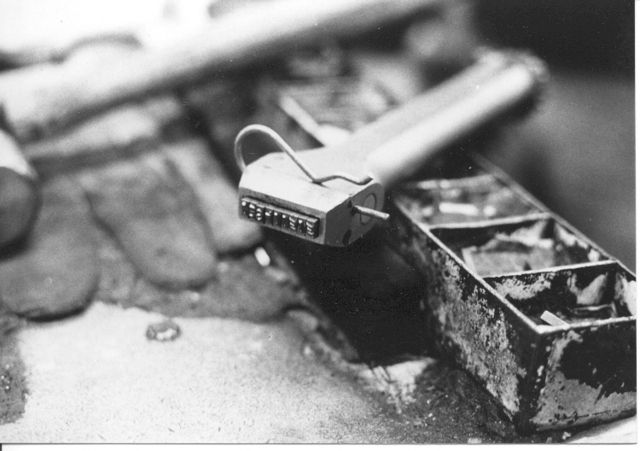
I believe this is a picture from John Hinkley.
The tray of individual digits, the holder, the hammer, and the glove!
Tough to get more than 9 digits in that holder.
Regards,
Alan
Last edited by Alan 71; Jul 2, 2016 at 08:08 AM.

Team Owner


Joined: Jun 2000
Posts: 38,923
Likes: 1,481
From: Southbound
Cruise-In II Veteran

VIN derivative stamps were used on engines, transmissions, and frames, not complete VINs. Gangholder for engines and trannies; machine for the frame stamps. Complete VINs appear on the driver's windshield post and, for applicable years, the vehicle certification label on the driver's door.

Last edited by Easy Mike; Jul 2, 2016 at 08:32 AM.
Safety Car


Joined: May 2008
Posts: 3,753
Likes: 721
From: Lafayette Louisiana
Some additional info
Here is some additional info on this website that might be useful:
http://ccas4vettes.com/pr01.htm
Lots of pad experts on this forum too if you can post some photos.
And finally IMHO, if you really like the Corvette, nothing wrong with buying it, just make sure to pay the price commensurate with matching or non matching.
1968 & 1969 NCRS manual has great info also.
http://ccas4vettes.com/pr01.htm
Lots of pad experts on this forum too if you can post some photos.
And finally IMHO, if you really like the Corvette, nothing wrong with buying it, just make sure to pay the price commensurate with matching or non matching.
1968 & 1969 NCRS manual has great info also.
Last edited by 20mercury; Jul 2, 2016 at 10:29 AM.

Melting Slicks
Joined: Apr 2007
Posts: 3,189
Likes: 111
From: Tolland CT
I believe the stamp used on the engine pad was also used on the transmission. Any slight misalignment of characters, flaws in the characters, should appear on the transmission as well. There are two sets of stamps on the pad, the larger stamp was done in Tonawanda if it's a big block, smaller serial number stamp done at St Louis. Stamp practices and fonts may not have been exactly the same.
Maybe contact Al Grenning? (Not sure of the spelling of his name) He has studied stamps for quite a long time, has a library of legit stamps, knowledge of where the restampers often slip up.
Maybe contact Al Grenning? (Not sure of the spelling of his name) He has studied stamps for quite a long time, has a library of legit stamps, knowledge of where the restampers often slip up.
Last edited by BBCorv70; Jul 2, 2016 at 11:10 AM.
Melting Slicks
Joined: Apr 2007
Posts: 3,189
Likes: 111
From: Tolland CT
Typically 20% discount or more for a non numbers car based on sparse history of resale prices for non numbers Corvettes. For non numbers, condition is especially important when the price gets north of $15K. Less wiggle room for the cost of major repairs if keeping investment near or below market value is important.
Corvette Stories
The Best of Corvette for Corvette Enthusiasts

Top 10 Most Expensive Corvettes Ever Sold on Bring A Trailer
Brett Foote
10 Things Every Corvette Owner Needs (2026 Edition)
Michael S. Palmer
8 Most "Only Corvette Owners Understand" Quirks and Problems
Pouria Savadkouei
10 Reasons the C6 Z06 is Still A Performance Benchmark After 20 Years
Joe Kucinski
How Much Horsepower Every Corvette Engine "LOST" in 1972
Joe Kucinski
Top 10 DOs and DON'Ts for Protecting Your Convertible Top!
Michael S. Palmer
Top 10 Most Explosive Corvettes Ever Made: Power-to-Weight Ratio Ranked!
Joe Kucinski
150 hp to 1,250 hp: Every Corvette Generation Compared by the Specs That Matter
Joe Kucinski
8 Coolest Corvette Pace Cars (and Replicas) of All Time
Verdad Gallardo
Melting Slicks
Joined: Jul 2006
Posts: 3,103
Likes: 802
From: Massapequa Park NY
I believe the stamp used on the engine pad was also used on the transmission. Any slight misalignment of characters, flaws in the characters, should appear on the transmission as well. There are two sets of stamps on the pad, the larger stamp was done in Tonawanda if it's a big block, smaller serial number stamp done at St Louis. Stamp practices and fonts may not have been exactly the same.
Maybe contact Al Grenning? (Not sure of the spelling of his name) He has studied stamps for quite a long time, has a library of legit stamps, knowledge of where the restampers often slip up.
Maybe contact Al Grenning? (Not sure of the spelling of his name) He has studied stamps for quite a long time, has a library of legit stamps, knowledge of where the restampers often slip up.
Al Grennings website is the website 20mercury posted. According to what I understand Al has cataloged not only good stamps but the broach marks on the stamp pads. Similar to ballistics used for matching bullets to barrels they were fired from, he has mapped out the cuts from the broaching machines used to deck the blocks from the factory. Metal has characteristics and they can be seen and quantified. As the blade wears, so does the marks it leaves behind on the stamp pad. So even if you were to have the original stamps, when you shave the block and pad (even if you used the original broaching machine) the cut today, would look different under a microscope that it would from the cut pattern 45 years ago. Thus, he can tell when the block was broached. But this service is not inexpensive. However, it could save you way more money in the long run.

Le Mans Master

Joined: Apr 2008
Posts: 9,433
Likes: 239
From: Powassan ON
Be interesting to ask the current owner if he/she is aware it's a restamp and what thier comments and body language tells you. They may not be aware.
Is the current owner corvette "savvy" or are they selling a "used Chevy"?
Is the current owner corvette "savvy" or are they selling a "used Chevy"?
Melting Slicks
Joined: Apr 2007
Posts: 3,189
Likes: 111
From: Tolland CT
Melting Slicks
Joined: Apr 2007
Posts: 3,189
Likes: 111
From: Tolland CT
Probably the worst restamp I've ever seen. If you're still interested in the car, maybe offer a fair price for a NOM.
Found on the registry. http://www.c3registry.com/index.php?...e&car_id=22221

Found on the registry. http://www.c3registry.com/index.php?...e&car_id=22221
Last edited by BBCorv70; Jul 2, 2016 at 10:49 PM.

Safety Car
Joined: Sep 2007
Posts: 4,458
Likes: 331
From: Indy Indiana
yes, restamp, but that does not guarantee that its not the original engine... just not the original stamp. pretty sure the factory never stamped the full vin on the engine pad.. it was a vin derivitive. they should have spent better money getting it properly counterfeited with a broacher and a gang stamp with the correct fonts.
plus the engine stamp and the vin derivitive on this example are reversed. on a big block, the engine build date and code stamp should be on the left, vin derivitive on the right. do not pay original engine money for that car.
yes, I googled the car and it shows up in several places where its claimed as all original and sold. looks like a very nice 68 435 coupe that would go for high 30's. a correct stamp would put it much higher... if the dates did line up and the claimed doc is legit.
plus the engine stamp and the vin derivitive on this example are reversed. on a big block, the engine build date and code stamp should be on the left, vin derivitive on the right. do not pay original engine money for that car.
yes, I googled the car and it shows up in several places where its claimed as all original and sold. looks like a very nice 68 435 coupe that would go for high 30's. a correct stamp would put it much higher... if the dates did line up and the claimed doc is legit.
Team Owner
Joined: Jun 2000
Posts: 38,923
Likes: 1,481
From: Southbound
Cruise-In II Veteran



 [QUOTE=greybeard56;1592555523]Also looks like the screw in plug in the head was cut down. Never saw one like that before they are rounded on the end and stick out from the head.

Safety Car
Joined: Sep 2007
Posts: 4,458
Likes: 331
From: Indy Indiana
that is why the vin derivitive was always stamped on the right of that plug on all big blocks.
Last edited by joewill; Jul 4, 2016 at 09:05 AM.

Melting Slicks
Joined: May 2009
Posts: 3,079
Likes: 315
2024 C3 of the Year Finalist - Unmodified