When you click on links to various merchants on this site and make a purchase, this can result in this site earning a commission. Affiliate programs and affiliations include, but are not limited to, the eBay Partner Network.
I have a stock 1974 Coupe that has a new heat riser plate on the exhaust manifold. It works fine but just wondering if I should remove it and replace with a plate-only version eliminating the thermostatic coil spring part. Right now I have a Weiand intake and Holley 650 with manual choke but I'm looking to make her stock with the cowl induction again. I have the stock intake and I'm getting the Q-jet soon. Just wondering how others are dealing with the thermostatic coil heat riser. Do most remove or keep it?
Hi JU,
If as you write your intent is to go back to the stock set up then having the heat riser installed below the right side exhaust manifold and the divorced choke installed on the intake manifold would be heading you in that direction.
An operating heat riser warms the choke coil faster which drops the idle down to normal operating rpm sooner.
Regards,
Alan
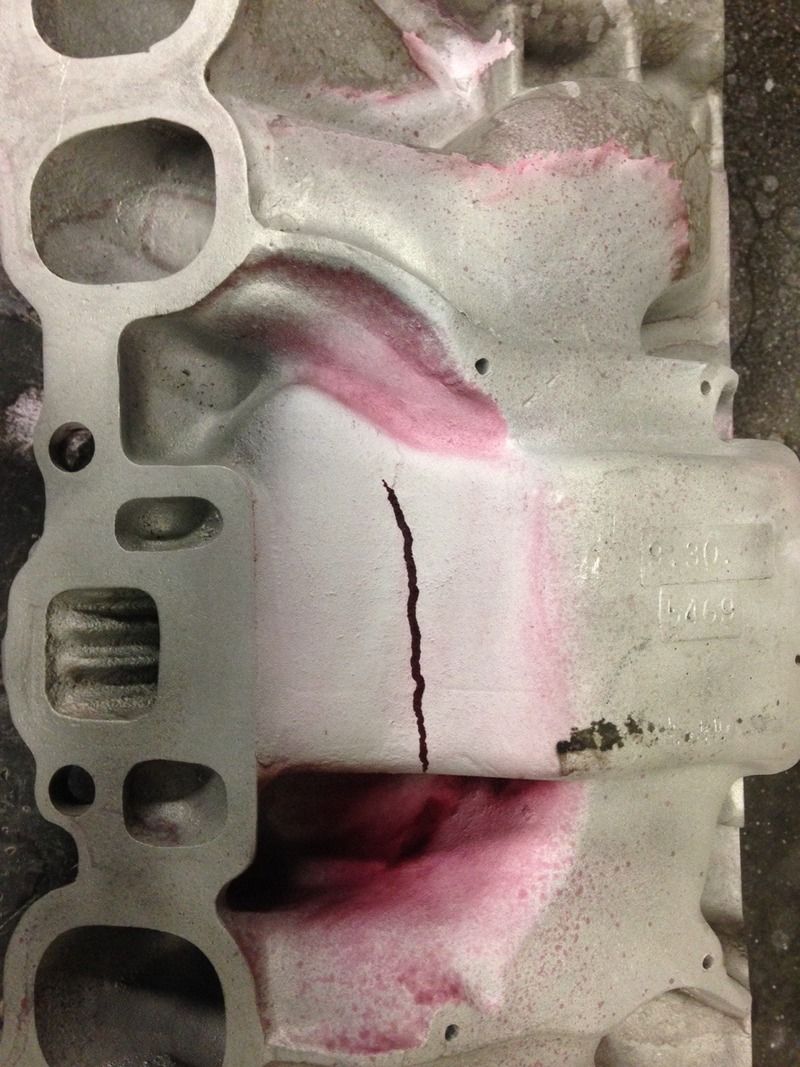
I am not a big fan of running hot exhaust gasses through a cold intake manifold, especially an aluminum one. Below is a pic of the original aluminum "snowflake" manifold off my 69 427 L36 engine. The oil shield has been removed and that crack is right across the exhaust passage. The aluminum is so brittle from heat cycles it is actually falling apart and was not weldable. Heating up an intake manifold hot enough to actually boil the fuel in a carburetor after shutdown is not my idea of a good idea but I guess GM thought so at the time.
I am not a big fan of running hot exhaust gasses through a cold intake manifold, especially an aluminum one. Below is a pic of the original aluminum "snowflake" manifold off my 69 427 L36 engine. The oil shield has been removed and that crack is right across the exhaust passage. The aluminum is so brittle from heat cycles it is actually falling apart and was not weldable. Heating up an intake manifold hot enough to actually boil the fuel in a carburetor after shutdown is not my idea of a good idea but I guess GM thought so at the time.
Yup. Must have been GM's first attempt at exhaust gas recirculation. I always wonder how many years it ran like that and almost didn't find it. I was cleaning out the intake and shone a light into the port and saw a line of light on the inside of the oil shield. With the shield on it isn't visible at all from the outside. There were a few cracks barely visible and only with the magnaflux type spray. You can see them branching off at the top of the big crack.
IMHO, when you use an aluminum intake manifold on a garage kept car, a heat riser is not required. Seems to me we spend a bunch of good money putting free flowing exhaust pipes on the car, and a heat riser closes off half of it (at least until the car warms up). If you have an iron manifold, and the car is an "outside dog", you probably should keep the heat riser operational. My two cents.
IMHO, when you use an aluminum intake manifold on a garage kept car, a heat riser is not required. Seems to me we spend a bunch of good money putting free flowing exhaust pipes on the car, and a heat riser closes off half of it (at least until the car warms up). If you have an iron manifold, and the car is an "outside dog", you probably should keep the heat riser operational. My two cents.
Worse is that the heat riser valve is only 2" diameter on the later models, enough to choke a stock 350, let alone any kind of performance build.
I'm a bit of a newbie to these cars. Do these cars only have one heat riser? I just got my original ram horns removed and replaced with some better flowing headers. There was only one heat riser on the exhaust.
Last edited by Corvetteoz; Jan 6, 2017 at 05:19 AM.
I'm a bit of a newbie to these cars. Do these cars only have one heat riser? I just got my original ram horns removed and replaced with some better flowing headers. There was only one heat riser on the exhaust.
yeah only one , it blocks off one side exhaust pipe and forces the exhaust gas across the intake manifold to help warm the carby(choke) during cold starts. As said above only (in your case) needed if you leave your car outside during a Melbourne winter ! I wired my old 350 one open , then put hooker side pipes on it and that got rid of it altogether.
Unless you leave the car outside and use it regularly in winter weather (I think that leaves 99+% of us out), the heat riser system is more of a risk than a benefit. The downside of having that riser valve freeze in 'closed' position greatly outweighs any gains in warm-up time.
Personally, I cut the valve off its shaft inside the housing. That way it all looks original, but it can never be 'closed'...either intentionally or accidentally.
Unless you leave the car outside and use it regularly in winter weather (I think that leaves 99+% of us out), the heat riser system is more of a risk than a benefit. The downside of having that riser valve freeze in 'closed' position greatly outweighs any gains in warm-up time.
Personally, I cut the valve off its shaft inside the housing. That way it all looks original, but it can never be 'closed'...either intentionally or accidentally.
Personally, I cut the valve off its shaft inside the housing. That way it all looks original, but it can never be 'closed'...either intentionally or accidentally.
Great idea! I was planning to use stock replacement exhaust system.... and thought about that "gap" that would be created by eliminating the heat riser....but I didn`t want to "wire it open".
Designer Imagines A Corvette That Looks More Like a Corvette Than the Corvette
Slideshow: A Jaguar designer's personal project imagines what a modern front-engined Corvette might look like if Chevrolet revisited the golden age of the Stingray.









 Heat Riser vs No Heat Riser











 I always wonder how many years it ran like that and almost didn't find it. I was cleaning out the intake and shone a light into the port and saw a line of light on the inside of the oil shield. With the shield on it isn't visible at all from the outside. There were a few cracks barely visible and only with the magnaflux type spray. You can see them branching off at the top of the big crack.