When you click on links to various merchants on this site and make a purchase, this can result in this site earning a commission. Affiliate programs and affiliations include, but are not limited to, the eBay Partner Network.
AllVettesforMe, thank you for the thread, hope my additions are well received. I have a 75 frame that is tweaked, as well as a 77 that I would like to rework, plus two 81 frames that are “stored”. Hope to correspond and backdate those frames into 1966-67 or 1969 frames...
An overview of the late frame compared to the early. Interestingly the rear area is the same inner clearances for a fuel tank and such, but is wider and further out from the centerline of the frame to the side of the car. Trouble with trying to fit an early body is the fender behind the wheel. It is too tight for that by 1/2 an inch or so. Neat to see the mount position Is the same, but then it widens and changes dramatically.
And that is exactly why I cut the 75 frame at the #4 body mount. The width in the back is accommodated by adding in a 68-74 rear section. Problem solved. Good comparison pictures.
If you look at the front and rear lip area of the front cross member you will see the holes in the 68 frame that are not present in the 81 frame. Those holes are the very holes I use to mount my front cross member jacking plate to. I have seen them missing in the 1980 and your 1981 confirms that they are not there. Easy to drill, but not present stock from the factory it appears. Thank you for these, they help me illustrate the front section better than I could before getting them.
Last edited by vettebuyer6369; Nov 10, 2021 at 11:21 AM.
Reason: Remove NSV part promotion
Is the top of these 1980 tranny crossmembers flat? or is it bowed? I'm wondering because there is a guy on this forum that says the top of his crossmember is bumping up against the manual transmission he is trying to install.....
Last edited by carriljc; Oct 21, 2021 at 11:19 PM.
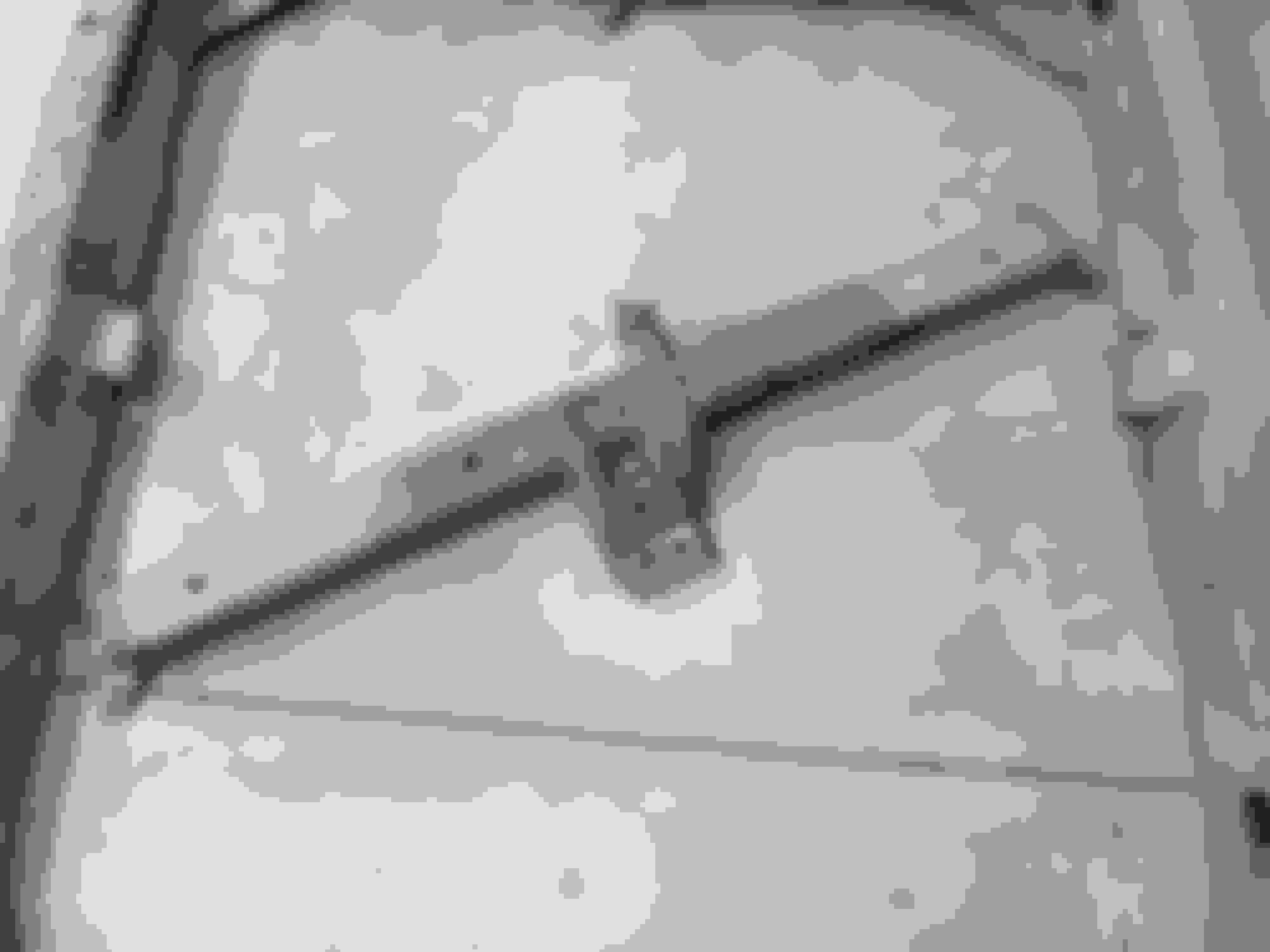
Ok.... as far as the welded-on manual tranny crossmember I have a question.
Looking at the picture below - it would appear that you could bolt on an aftermarket crossmember ii you cut the manual tranny crossmember and left the stub, drilled a "passthrough" hole, ground off the bottom of the manual tranny crossmember, and used some Nutserts (or generic equivalent) to bolt on the bottom side? Does that seem doable?
AllVettes4Me
Yes, thank you. I don't remember seeing this posting before either.
Do you have picture looking at the tranny crossmember from the side? Trying to determine the height difference of the crossmember from the bottom of the frame to see if and aftermarket crossmember could easily be adaptated?
I already made mine removable but I'm looking at those aftermarket crossmember with the large pass under exhaust holes that relocate the exhaust away from the tranny. I'm willing to modify mine even more but this sounds like an interesting experiment..... I would just like to have an idea before blowing 300+ bucks on the aftermarket crossmember.
David...I can't believe I haven't complimented you nor contributed.
1980-82 frames were 20% thinner in steel 'web' section. The early frames,79 being the last year...had web thicknesses of .110".
In 1980 the frames were thinned to .090". This was for two reasons;
1. WEIGHT SAVINGS
2. The torque available from the big blocks was LONG GONE, so with only SBC's available and the batwing lighter duty rear diffy's Chevy figured, why keep them thick?
So the cautionary tale here; If you build up an 80-82 frame, DO NOT PUT A BIG BLOCK IN IT (or high HP/Torque Crate Engines).
You're better off to find a 79 and before.
Additionally, the Batwing rear ends, just can't take that level of torque.
GREAT THREAD
Lots of great info on all the years
Thanks for taking the time to spell out all the up dates
I'm very worried about spitting the body and the frame apart
I'm thinking my frame most likely has rust rot and that's going to make me sick.
I've done a few complete restorations in my life like a 57 - 210 and few pick up's, SS - Chevelle's , Camaros but no Corvettes yet
GREAT THREAD
Lots of great info on all the years
Thanks for taking the time to spell out all the up dates
I'm very worried about spitting the body and the frame apart
I'm thinking my frame most likely has rust rot and that's going to make me sick.
I've done a few complete restorations in my life like a 57 - 210 and few pick up's, SS - Chevelle's , Camaros but no Corvettes yet
BIGMAN 79
Let us know if we can help you with any of your frame work. Glad to assist if we can.
David Howard
AllVettes4Me
Last edited by vettebuyer6369; Jan 18, 2022 at 02:44 AM.
Reason: Edit link to sales
Ok so love your thread. Very informative. However just a little confused. I currently have a 1972 corvette and just recently got it running, however the mechanic is saying it will need a frame. A trusted mechanic. This got me to thinking that the person I purchased the car from which is my dad's neighbor also has a 1982 corvette which is an automatic car, mine is. Manual. He doesn't have the title and for some reason can't acquire it so its basically a parts car that I can get cheap. Would the 1982 frame work for my 1972? This would be a huge help
Hello,
New old Corvette for you!!!
There are some subtle differences in a 1972 frame at each end because the 72 has 'Chrome' bumpers while the 82 has 'Rubber' bumpers.
The differences are required because the bracketry for the bumpers is quite different.
I think it would be wise to get some photos of the frame rust that your mechanic is seeing. It might just be that the frame can be repaired and not replaced
So, some photos Please!
Regards....
Sadly, David Howard has passed away. He was a much loved and respected member.
You might consider starting a new thread of your own.
Hello,
New old Corvette for you!!!
There are some subtle differences in a 1972 frame at each end because the 72 has Chrome bumpers while the 82 has 'rubber bumpers.
The differences are required because the bracketry for the bumpers is quite different.
I think it would be wise to get some photos of the frame rust that your mechanic is seeing. It might just be that the frame can be repaired and not replaced
So, some photos Please!
Regards....
Thank you Alan for the reply so quickly. When I get the car back I will definitely take photos before I make a decision. The othet c3 is not going anywhere so it's not like I need to rush. If I would need to look for one is it possible to change the bracketry? Again I will definitely get pictures before hand, just getting an idea of what I'm into. However I do love the C3's.
The frames got thinner in 1980 to save weight. The rear end assembly completely changed. So with the problems on both ends. The thinner frame and the difference in the rear diff. I just don't think it would be worth the effort.
Frame repair sections are available , basically every part of the frame can be purchased in sections. Cut out the rust. Weld in the repair section. Generally way cheaper than a new frame. But depending on just how bad your frame is.
Great info. Excellent job.
On the 68 the front frame to nose brackets made the frame more enclosed and the radiator support was on the inside fo the frame which made for narrower radiators on the small block automatic transmission/ big block radiators. 69 and later this was changed and the radistors could extend into the frame rail adding 4 inches overall of tank and cooling surface.
Good information. Didn't know this.
.............
The OP mentioned "minor changes" between years. Exactly what they are can be good to know. To repeat my oft made comment about my "1969 NOS" frame that I ordered from GM Parts in the early 80s. When I went to mount my 1970 frame extension horns to my "NOS" frame, they didn't exactly fit. One bolt hole was off. I bought some eBay 69 frame extension horns....once again, no cigar. Next I turned to my 68 and I could see its frame extension horns didn't fit exactly either!!!! WTH? I talked with some vendors...they didn't know. Finally, someone at Volunteer Vette had the answer. When I ordered my 1969 frame in the early 80s, what GM sent me was a "service frame." The service frame for 1968 to 1973 Corvettes was a 1973 frame!!! This even though the 73 was a rubber bumper car. When the 73 frame is used as a replacement for the earlier years, I guess the assumption was that a body shop would be ordering the frame, and the minor modification needed to fit a 73 frame for the earlier years would not be a problem. My now, NOS 73 service frame, is now at home in my 1970 restomod. Anyhow, not many people have a non-factory NOS frame in their Vette.