When you click on links to various merchants on this site and make a purchase, this can result in this site earning a commission. Affiliate programs and affiliations include, but are not limited to, the eBay Partner Network.
I’d like to thank those forum members that provided additional data to me about the frame changes they were aware of from 1963 through 1982. The following information is being provided after working this summer to modify and understand the differences between C-3 frames from 1968 through 1982. I will be using the 1968 frame as the basis for this discussion and changes through 1982. While the information can always be updated and corrected this is what we know to be true as of November 1, 2020.
All 1963 to 1982 frame are of the same basic design. However, changes did occur some easy to change and others not so easy.
Transmission Cross Member Information
1968 - 1979 frames with automatic transmissions had removeable crossmembers. These cross members were held in place by two hidden weld nuts inside the frame rail and two bolts used through cross member flanges into those weld nuts. A single long bolt was also used on each end through the cross member and through a hanger welded to the frame rail. (see picture below).
1968 - 1979 frames with manual transmissions had a welded permanent crossmember. (see picture below).
Various modifications to the manual transmission cross member have been made over the years to provide a removable cross member for fixed permanent manual cars. One such modification is shown below allowing a manual transmission to be removed without removing the engine.
1980 – 1982 frames all had the removeable crossmember regardless of the transmission. In 1982 there was no manual transmission option. Also, there were no holes for the exhaust pipes on these cross members which were smaller in height from previous years.
Frame by Year Information
1968 - Original C-3 frame. Remarkably similar to a 1967 C-2 frame; but that is another discussion for another time. #2 and #3 body mounts are open sided cage nut design welded in two locations. A kick-up support was added in the middle of production to add necessary support to the rear portion of the frame.
There were 28,566 cars manufactured in 1968. Data is incomplete or inaccurate on the mix of manual and automatic frames. Two hidden captured nuts were assembled inside the side rail and one long bolt was used through a hanging bracket.
1969 - Slight inner front horn change made; reinforcement in the kick-up area of the frame was used for the full year and continued. Rear most cross member changed slightly. There were 38,762 cars manufactured in 1969.
1970 - the same as the 1969 frame with a very minor change to the rear most cross member. There were only 17,316 cars manufactured in 1970 due to a factory strike.
1971 - the same frame as the 69 and 70. In 1971 there were 21,801 cars manufactured.
1972 - the same frame as the 69, 70, and 71. In 1972 there were 27,004 cars manufactured.
The 1968, 1969, 1970, 1971, and 1972 frames are all interchangeable.
1973 - In 1973 the front inner frame horn was modified to accommodate a new front bumper extension and design for the front polyurethane bumper design. The kick up area, body mounts, and rear cross member were all left unchanged from the 1972 frame. The #2 and #3 body mounts were lowered to accommodate new rubber bushing body mounts. You can use a 1973 frame on a 1968-1972 car with an inner front horn change; and you can use a 1968-1972 frame on a 1973 with the front inner horn change. No other modifications are required. There were 30,464 cars manufactured in 1973.
1974 - In 1974 the front inner horn was left the same as 1973 even though the front bumper extension changed. The 1974 frame rear section had two changes to it to accommodate a newly designed two-piece rear urethane bumper. And end section was added to the rear most cross member and a plate was added to the side of the frame for strength. An impact absorbing system was then attached to the frame and a rear impact bar was attached to that assembly.
Removing the rounded impact brackets makes this rear section the same as 1968-1972. The frame itself is in essence a 1973 frame with two brackets attached to it. You can use a 1974 frame on 68-73 cars with little modification. You cannot use 1968-1973 frames on a 1974 car without replacing the rear most section of the frame or you will lose your impact capabilities. There were 37,502 cars manufactured in 1974.
1975 - In 1975 they figured out a new and improved front extension system for the bumper and used the same front inner horn on the frame. No change up front. A new impact system was developed and deployed in the rear of the frame changing the rear significantly from earlier years frames. Significant change is required on a 1975 frame in the rear section to be able to use it with earlier year body styles. There were 38,465 cars manufactured in 1975.
1976 - No significant change from 1975. There were 46,558 cars manufactured in 1976.
1977 - No significant changes from 1975 and 1976. In 1977 there were 49,213 cars manufactured.
1978 - No significant frame changes from 75-77. In 1978 there were 46,776 cars manufactured.
1979 - No significant frame changes from 75-78. In 1979 there were 53,807 cars manufactured.
Frames from 1975 through 1979 all used the same front bumper extension, and all used a similar rear impact system under the bumpers. 1975-1979 frames are for the most part interchangeable with one another. 75-79 are not compatible with 68-72; 73; or 74 cars without changing the rear section of the frame.
1980 – Things changed a lot in 1980 with the addition of a batwing style support structure in the rear of the car frame and a different front-end extension design as well. The 80-82 frames are interchangeable between one another but are different than the 75-77 frames in the rear section impact zone of the frame. There were 40,614 cars manufactured in 1980. The automatic transmission cross member design was changed to a lower profile design with no through put holes for exhaust pipes.
1981 – same frame as 1980. There were 40,606 cars manufactured in 1981.
1982 – end of an era. In 1982 there were 25,407 cars manufactured, all of them automatic framed cars.
Modifying a 1980-1982 frame to handle steel bumpers and running a batwing style rear differential is quite possible and would make for a nice structure under any model car. It can be modified to support a 1968-1973; a 1974, and even a 1975-1979 body if you would want the batwing rear in another model year car.
What does all of this add up to really? It means a lot if you are looking to replace your rusted or rotten frame with another frame for your car. It means you have options beyond locating the same year and style frame that came with your car. It means that some years will be tough finding manual frames as production got smaller, and smaller, and smaller as a percentage of the total manufactured.
But the good news is you can get the frame you want, to perform the tasks you want it to perform, if you cannot repair your current frame.
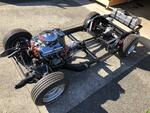
To demonstrate this, I am in the finishing steps of converting a 1975 automatic frame into a 1969 manual frame. It has new inner frame front horns; new body mounts; new removable manual cross member modification; and a new 69 rear end installed on the original 75 frame. You would be hard pressed to distinguish this new 69 frame from an all original 69 frame upon inspection and performance will meet or exceed a 69 frame of the same era.
An updated picture will be included when I have this frame media blasted and powder coated.
Frames can be modified from auto to manual; and manual to auto; and manual to center section removable. Frames can be modified from year to another from 68-79 universally with the right parts and skills making them interchangeable.
I hope you find the data helpful. Please let me know if you find incorrect information or additional information that I can add to this for future use.
Thank you and best regards,
David Howard
AllVettes4Me
For 1968 some point around mid production the reinforcements was added to kick up area of the frame.
Late 1969 added a hole at the trailing arm mount to lock the new designed shims secured with a cotter key. But was not used till late 1970 production last 500 cars.
David,
This is a very informative and interesting thread.
I can see many hours of research were put into it and I would like to thank you for taking your time to share it with us all.
What would it take for this thread to be made into a Sticky, so the information can be easily found and isn’t lost unless someone knows of it’s existence and knows where to specifically look?
Thank you again for your what you dedicate to our hobby.
Greg
2020 Corvette of the Year Finalist (performance mods)
2019 C3 of Year Winner (performance mods)
2016 C3 of Year Finalist
Great info. Excellent job.
On the 68 the front frame to nose brackets made the frame more enclosed and the radiator support was on the inside fo the frame which made for narrower radiators on the small block automatic transmission/ big block radiators. 69 and later this was changed and the radistors could extend into the frame rail adding 4 inches overall of tank and cooling surface.
Great info. Excellent job.
On the 68 the front frame to nose brackets made the frame more enclosed and the radiator support was on the inside fo the frame which made for narrower radiators on the small block automatic transmission/ big block radiators. 69 and later this was changed and the radistors could extend into the frame rail adding 4 inches overall of tank and cooling surface.
I would love to have been an engineer with GM when they were trying to transition from the 67 to the 68 and then again through 69 to see what chaos they may have experienced on the cars. I call certain cars "tweeners" or "in between cars" because they have elements of years prior and new elements in them. I wanted to restore a 68 in my hobby but decided to not try it because of all those little details that made a true early 68 unique and finding original parts, well, just decided to avoid the 68. Looking back I wish I had followed through on the 68 convertible but alas my ship has sailed and I will wrap this up on my 74 convertible.
I appreciate the information and will include it in my Microsoft Word document I have with the data now. Good stuff. Thank you very much.
David
Various modifications to the manual transmission cross member have been made over the years to provide a removable cross member for fixed permanent manual cars. One such modification is shown below allowing a manual transmission to be removed without removing the engine.
I personally have removed a manual transmission out to change a clutch for myself and friends. At least 30 times it is a bit tough but can be done without engine removal.
2020 Corvette of the Year Finalist (performance mods)
2019 C3 of Year Winner (performance mods)
2016 C3 of Year Finalist
Originally Posted by AllVettes4Me
I would love to have been an engineer with GM when they were trying to transition from the 67 to the 68 and then again through 69 to see what chaos they may have experienced on the cars. I call certain cars "tweeners" or "in between cars" because they have elements of years prior and new elements in them. I wanted to restore a 68 in my hobby but decided to not try it because of all those little details that made a true early 68 unique and finding original parts, well, just decided to avoid the 68. Looking back I wish I had followed through on the 68 convertible but alas my ship has sailed and I will wrap this up on my 74 convertible.
I appreciate the information and will include it in my Microsoft Word document I have with the data now. Good stuff. Thank you very much.
David
One of my little secrets is to pay attention to the C2 Parts threads and look for some of those tweener parts. I scored a 66/67 big block Dewitts radiator that is also the 68 big block radiator. It is a bit of a struggle when all those early/ original AIM usually got pulled out and thrown away when the updates came in as well.
1969 Frame and 1969 Clone Frame. Hard to tell the difference. Both came out great. The subtle differences require comparison, but only to the trained eye. Can you see the differences?
Really great stuff...hope I can get a hold of you to talk about having your guy build a frame for me!
wanted to commend you on your post and wanted to add some pictures I had taken comparing an early 68 frame with a mid production 1981 frame...
This was a delivery day, and an opportunity to compare my early 68 frame with a perfect 81 frame...the 81 of course is missing it’s reasonable differential crossmember and rear end, and is on the right..
This is the center of the frame, removable crossmember auto frame 81 next to a fixed crossmember 68 four speed frame. Location of crossmember looks dead on...
An overview of the late frame compared to the early. Interestingly the rear area is the same inner clearances for a fuel tank and such, but is wider and further out from the centerline of the frame to the side of the car. Trouble with trying to fit an early body is the fender behind the wheel. It is too tight for that by 1/2 an inch or so. Neat to see the mount position Is the same, but then it widens and changes dramatically.


























 Frame Data Expanded - I Hope You Enjoy