When you click on links to various merchants on this site and make a purchase, this can result in this site earning a commission. Affiliate programs and affiliations include, but are not limited to, the eBay Partner Network.
Well I made quite the blunder it looks like! I ordered that starter and returned the other one I bought today. Going to try it out to see if I can make it work, and worst case scenario i'm going to have to suck it up and buy ANOTHER flywheel and clutch
I'm confused why all manufacturers specify a 10.5" clutch for the C3 Corvette? I just double checked the SPEC and McLeod websites and they both spec the 10.5"...
Unless y'all have some better suggestions to this SNAFU?
Find a small bellhousing. I saw a few on EBaymotors when I was looking for the larger bellhousing for my swap.
I could send you my small one, I don't know what shipping would run.
How did you end up with the large bellhousing and small flywheel and clutch?
Did you replace a large flywheel and clutch?
Find a small bellhousing. I saw a few on EBaymotors when I was looking for the larger bellhousing for my swap.
I could send you my small one, I don't know what shipping would run.
How did you end up with the large bellhousing and small flywheel and clutch?
Did you replace a large flywheel and clutch?
My car came with the large bellhousing, correct starter, 168 flywheel, and 11" clutch. This is the first SBC i've touched (come from the LS and Jeep world) and didn't know there were two different size flywheels, and accidentally ordered the 153 flywheel with the 10.5" clutch out of ignorance.
changing the bellhousing would certainly be a viable option! doesn't seem like an 11" clutch is a big advantage over the 10.5", we're talking 10%?
Some very special high HP Corvettes came with 10.5" clutches but most came with 11". It would not bother me to run either one on a street car.
I have 11" in the Vette and 10.5" in the Z/28.
I agree with rescue on the mini starter. They are lighter and better than the originals anyway. They use much stronger permanent magnets.
The clutch forks and inspection covers also vary by bellhousing. So if you change the bell, also change the fork.
The 621 casting number is the 11" bell and 403 is the 10.5" bell.
Same parts were used on Camaros, so both are plentiful. SSs, LT-1 Z28s, and BBs got the 11" there.
I see absolutely no reason not to run the parts you have. The 10.5" flywheel will fit in the 11" 621 bell. You need a 153 tooth 10.5" style starter to engage. The starter nose depth is the same.
The starter bolts to the block, not to the bell what-so-ever.
I see no reason the 621 bell would not work with the 403 style starter. It just fits 1/2" closer to the block, in the same bell "opening". Because of the block mounting, the opening has to be clocked the same.
You will have a gap on both the outside of the starter and the inside, and neither of the correct sheet metal inspection covers will fit.
I have never done this, but if you search online, some have.
You could cobble up a correct fitting inspection cover, (it's just sheetmetal), but many guys I know do not even run them at all anyway.
Back in the day a motor like yours needed the extra 15% disc area of the 11" clutch, but with today's friction compounds a good 10.5" will hold fine on street tires.
Which model clutch and flywheel did you get? I did not see that mentioned.
I would be more concerned about having a good clutch in there that grabs well, and releases well (some do not release well in a C3), and you need a good flywheel if you are going to rev that thing, not a cast one.
Here are the clutch size notes I saved from this forum:
CORVETTE CLUTCH SIZING
1. All ’56-‘62’s used a 10.5” clutch on a 14” 168-tooth flywheel.
2. All ’63-’68 small-blocks used a 10.5” clutch on a 12-3/4” 153-tooth flywheel. ’65-’74 big-blocks used an 11” clutch on a 14” 168-tooth flywheel, except the ’65 396 (L-78) and ’67-’69 L-88, which used a 10.5” clutch on a lightweight (15#) 12-3/4” 153-tooth flywheel.
3. All ’69-’81 small-blocks (except ’70-’72 ZR-1 and ’78-’79 L-48/Muncie) used an 11” clutch on a 14” 168-tooth flywheel; the ’70-’72 ZR-1’s and the ’78-’79 L-48/Muncie used a 10.5” clutch on a 12-3/4” 153-tooth flywheel.
4. All ’56-‘70’s used a 10-spline clutch disc. ’71-’81 used a 26-spline disc, except ’78-’79 L-48/Muncie, which used a 10-spline disc.
Speaking of splines, I just checked the pic of your Richmond trans. It has the fine spline (26 spline) input shaft. Make sure your clutch disc is also a 26 spline. They are available both ways.
On the starter, GM ones had the bolts straight across or angled to tell the 2 different sizes apart. If your starter is good, you can change just the nose piece to switch from one type to the other. We have done that many times. The nose pieces have the 2 diff bolt setups, and some are aluminum and some are cast iron (more HD). All work.
Last edited by leigh1322; Aug 31, 2023 at 09:22 AM.
I did order the mini starter that is compatible with the 153/168 so hopefully this will work with my setup:
As for clutch I ordered the standard LUK 153 tooth flywheel and for clutch the MPACT 1.5 dual friction (American Made Mcleod copy with good reputation) . Clutch is 26 spline and everything mated together correctly.
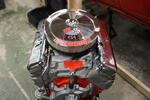
This afternoon I ran battery cables to the starter and made a proper ground, 12V to the HEI, and hooker up my starter trigger: time to make fire!
At first all I got was back firing and it was pretty obvious my firing order was off, or I put the dizzy 180 out... Quickly found out I put it 180 out! After I fixed that, below are the results:
2020 Corvette of the Year Finalist (performance mods)
2019 C3 of Year Winner (performance mods)
2016 C3 of Year Finalist
Originally Posted by Arg0413
This afternoon I ran battery cables to the starter and made a proper ground, 12V to the HEI, and hooker up my starter trigger: time to make fire!
At first all I got was back firing and it was pretty obvious my firing order was off, or I put the dizzy 180 out... Quickly found out I put it 180 out! After I fixed that, below are the results:
Great oil pressure, lifters pumped up, no knocks or odd noises: I think we have a good runner!!!!
SOUNDS GREAT!! what type of cam are you running? Flat tappet or roller, if its a flat tappet you dont want to start and run it like that, you need to break in the cam....
SOUNDS GREAT!! what type of cam are you running? Flat tappet or roller, if its a flat tappet you dont want to start and run it like that, you need to break in the cam....
It's a Howard's Rattler 227/235 Hydraulic Roller - I didn't want to deal with a Flat Tappet and didn't rebuilt back to LT-1 specs. It has 64cc Pro Comp heads, thumping cam, Winters intake, TRW 0.60 over pistons, and a Holley HP 650 DP. Should be a fun little street engine in the 425HP neighborhood.
Thats awesome...once its running with the valve covers on it, you should post a longer video of it idling and a few rips on it....sounds great!!!
Man I'm eager to get it warmed up and play with the timing and carb! I need to rig up the radiator and water pump first, scared to run it more than 30 seconds currently.
Okay you got my curiosity, exactly how would I rig this up?
On a boat it’s extremely simple.
Fill a five gallon bucket with water, drop in the garden hose and turn it on full blast.
DO NOT ATTACH THE GARDEN HOSE DIRECTLY TO THE ENGINE!
On my boats, I would use a hose bib fitting, screw it into the inlet side of the water pump, attached about 6 feet of hose and drop one end of the hose into the bucket.
Start the engine and watch to make sure the water is flowing out the back of the boat and spitting through the water injected headers.
Leigh1322 will have to chime in on how to set this up using an automotive water pump and system
On a boat it’s extremely simple.
Fill a five gallon bucket with water, drop in the garden hose and turn it on full blast.
DO NOT ATTACH THE GARDEN HOSE DIRECTLY TO THE ENGINE!
On my boats, I would use a hose bib fitting, screw it into the inlet side of the water pump, attached about 6 feet of hose and drop one end of the hose into the bucket.
Start the engine and watch to make sure the water is flowing out the back of the boat and spitting through the water injected headers.
Leigh1322 will have to chime in on how to set this up using an automotive water pump and system
I get that on my boats, but on a automotive SBC..? I'm assuming Leigh is directly putting a hose into the thermostat inlet (with t-stat removed) and a bucket under the outlet for the water to dump?
Like OCB said you cannot connect the hose directly to the water pump inlet, it probably does not have enough flow, and it's too cold. So you rig up some hoses into and out of a 5 gallon bucket. And fill that. You actually want the water to get a little warm anyway, not stone cold. You just have "X" amount of time before the water gets too hot. You can add more cold water with the hose to regulate temp. As long as you monitor the water temp you will be fine. Anywhere from 100 to 200 is fine. We had some hose fittings sitting around the shop for test runs...... The dyno room basically uses the same setup. A tall water tank with a thermometer on top.
The big difference is you do not have to worry about a fragile radiator getting damaged.
You can run them dry with air in the block but keep it short to like 30-60 seconds or less, and idle only.