Road Course Junkies, Let's compare notes

Team Owner


Joined: Sep 2002
Posts: 38,351
Likes: 2,077
From: California
 And the C4
Not only angled them up, they also went to a lower and upper trailing arm. Also keep in mind that these were fixed length units. Even the DRM kit sold for the new cars is basically an upper and lower trailing arm setup, but adjustable.
Thus suspension steps to performance are pretty basic. Just related to the rear arms.
Stock
Higher quality bushings
Sphericals on trailing arms/camber rods
Next jump upper and lower trailing arms
Next jump upper and lower trailing arms with top link
Next jump upper and lower trailing arms with top link and telescoping halfshafts.
Next jump upper and lower trailing arms with upper a-arm, etc.
Hell upper and lower a-arms etc.
Now add in the toe adjusters, special strut rod brackets, preferred spring, sway bar if that is your thing, etc.
No secrets!
Just go take a good look at a Vintage Chevron, Lola, McLaren, etc.
Thus suspension steps to performance are pretty basic. Just related to the rear arms.
Stock
Higher quality bushings
Sphericals on trailing arms/camber rods
Next jump upper and lower trailing arms
Next jump upper and lower trailing arms with top link
Next jump upper and lower trailing arms with top link and telescoping halfshafts.
Next jump upper and lower trailing arms with upper a-arm, etc.
Hell upper and lower a-arms etc.
Now add in the toe adjusters, special strut rod brackets, preferred spring, sway bar if that is your thing, etc.
No secrets!
Just go take a good look at a Vintage Chevron, Lola, McLaren, etc.
Last edited by TCracingCA; Dec 17, 2013 at 12:15 AM.
Team Owner
Joined: Sep 2002
Posts: 38,351
Likes: 2,077
From: California
To add to my post just above!
Let's talk to the race cars. I shoot alot of pictures of them at events and I shoot tech shot type pictures. Here is an F-5000 from mid 1970's.
Basically this is what I am shooting for with my Guldstrand set up.
In this picture you have a bottom wishbones, and the Guldstrand has two strut camber rod links, then you can see the top link in the picture as I want to engineer. The problem is that the Guldstrand upright mounts the Disc Brake caliper so welding on to the top is quite restricted on his unit. Whereas the CVC Apex unit that I have provides a bracket for the frame crossbrace and the link mounts to a welded on bracket to the back of the modified trailing arms. The CVC Apex I pictured earlier (last page) changes a conventional Corvette trailing arm into an upright. I don't like how heavy they are and am awaiting Tom Differentials Axle Carrier in aluminum to see if it can be adopted. Thus with both, my delays are from these two areas-- to use the CVC Apex, I would like to lighten it up with the new part being advertised for the last year and to put the Guldstrand (Riley design) I want to add a top link and I have sourced retractable halfshafts from the jeep guys that are inexpensive and bullet proof. I don't have that name handy thou.
Thus this is what I want to model in the rear of my car!!! The F-5000 which is upper and lower trailing links, top link, bottom a-arm or wishbone or two link with retracting halfshafts.

And here is a later 1960's F1 suspension if my notes are right with a fixed length Halfshaft, but the same basic setup as the F-5000 car above, but with just the one difference.

And this one kind of makes me mad, and I will explain in a minute. Thus anyone here want to get real creative and engineer our Corvette Trailing Arms to what you see here with the evolution of the 911 Porsche units! And this can be back adapted to the Vintage 911 LWB cars along with other cheats such as G-50 transmissions and such. Thus the Vintage Class I would be placed in with a multi-link Guldstrand or CVC Apex would be running against 69- mid 70's Carrera RSR Porsches with this crap!

Basically this is what I am shooting for with my Guldstrand set up.
In this picture you have a bottom wishbones, and the Guldstrand has two strut camber rod links, then you can see the top link in the picture as I want to engineer. The problem is that the Guldstrand upright mounts the Disc Brake caliper so welding on to the top is quite restricted on his unit. Whereas the CVC Apex unit that I have provides a bracket for the frame crossbrace and the link mounts to a welded on bracket to the back of the modified trailing arms. The CVC Apex I pictured earlier (last page) changes a conventional Corvette trailing arm into an upright. I don't like how heavy they are and am awaiting Tom Differentials Axle Carrier in aluminum to see if it can be adopted. Thus with both, my delays are from these two areas-- to use the CVC Apex, I would like to lighten it up with the new part being advertised for the last year and to put the Guldstrand (Riley design) I want to add a top link and I have sourced retractable halfshafts from the jeep guys that are inexpensive and bullet proof. I don't have that name handy thou.
Thus this is what I want to model in the rear of my car!!! The F-5000 which is upper and lower trailing links, top link, bottom a-arm or wishbone or two link with retracting halfshafts.
And here is a later 1960's F1 suspension if my notes are right with a fixed length Halfshaft, but the same basic setup as the F-5000 car above, but with just the one difference.
And this one kind of makes me mad, and I will explain in a minute. Thus anyone here want to get real creative and engineer our Corvette Trailing Arms to what you see here with the evolution of the 911 Porsche units! And this can be back adapted to the Vintage 911 LWB cars along with other cheats such as G-50 transmissions and such. Thus the Vintage Class I would be placed in with a multi-link Guldstrand or CVC Apex would be running against 69- mid 70's Carrera RSR Porsches with this crap!
Last edited by TCracingCA; Dec 17, 2013 at 01:24 PM.

Tech Contributor

Joined: Jun 2004
Posts: 20,905
Likes: 962
From: I tend to be leery of any guy who doesn't own a chainsaw or a handgun.
Le Mans Master


Joined: Apr 2001
Posts: 5,436
Likes: 1,253
From: Sarver Pa
2021 C1 of the Year Finalist - Modified
Cool thread ! As I am currently building a grp 6 car for SVRA , I have read the whole 36 pages ! It's a 70 LS-5 car brought back from the dead. As I read all of this I realize I made a couple small mistakes , but nothing serious. The rolling chassis is almost finished and it's time to set the body back on to finalize the fuel cell location and start on the cage.
Instructor


Joined: Dec 2012
Posts: 118
Likes: 2
From: rancho cucamonga ca
Cool thread ! As I am currently building a grp 6 car for SVRA , I have read the whole 36 pages ! It's a 70 LS-5 car brought back from the dead. As I read all of this I realize I made a couple small mistakes , but nothing serious. The rolling chassis is almost finished and it's time to set the body back on to finalize the fuel cell location and start on the cage.
What is a grp 6 car and what is SVRA.
We are looking to use ours at willow springs most of the time.
Ours is a 69 bb, Van Gordon Racing just finished the motor and trans, its now a full roller bb was a ls6 1970
Last edited by colesweat; Mar 24, 2016 at 07:25 PM.
Le Mans Master
Joined: Apr 2001
Posts: 5,436
Likes: 1,253
From: Sarver Pa
2021 C1 of the Year Finalist - Modified
Group 6 is the class where the old road racing Vettes, Camaro's, Mustang's ,etc. run with the SVRA (Sportscar Vintage Racing Assn). All cars have to be prepped to 1972 specs. Except for safety stuff. They run events all over the U.S.
Sounds similar to what I'm building engine wise. What are you going to do for an oiling system? I'd like to stay wet sump.
Sounds similar to what I'm building engine wise. What are you going to do for an oiling system? I'd like to stay wet sump.
Corvette Stories
The Best of Corvette for Corvette Enthusiasts

Top 10 Most Expensive Corvettes Ever Sold on Bring A Trailer
Brett Foote
10 Things Every Corvette Owner Needs (2026 Edition)
Michael S. Palmer
8 Most "Only Corvette Owners Understand" Quirks and Problems
Pouria Savadkouei
10 Reasons the C6 Z06 is Still A Performance Benchmark After 20 Years
Joe Kucinski
How Much Horsepower Every Corvette Engine "LOST" in 1972
Joe Kucinski
Top 10 DOs and DON'Ts for Protecting Your Convertible Top!
Michael S. Palmer
Top 10 Most Explosive Corvettes Ever Made: Power-to-Weight Ratio Ranked!
Joe Kucinski
150 hp to 1,250 hp: Every Corvette Generation Compared by the Specs That Matter
Joe Kucinski
8 Coolest Corvette Pace Cars (and Replicas) of All Time
Verdad Gallardo
Melting Slicks

Joined: Jan 2004
Posts: 3,247
Likes: 210
From: Detroit MI
hello. noise restrictions with sidepipes are a bitch. but good for keeping the neighbors happy of course. since the new headers I'm going to have to assemble or source some 2.5" sidepipes and mufflers before i can return to my local track. until then i'll be in my C5Z but only single lap timed runs. no track days in the c5 yet
gingerman they screwed up by making the back straight longer and thus my 4.56 sucks for anything other than making a lot of noise down the straight. haven't been there since they did the addition
gingerman they screwed up by making the back straight longer and thus my 4.56 sucks for anything other than making a lot of noise down the straight. haven't been there since they did the addition
Last edited by 69autoXr; Mar 25, 2016 at 07:44 PM.
Tech Contributor
Joined: Jun 2004
Posts: 20,905
Likes: 962
From: I tend to be leery of any guy who doesn't own a chainsaw or a handgun.
hello. noise restrictions with sidepipes are a bitch. but good for keeping the neighbors happy of course. since the new headers I'm going to have to assemble or source some 2.5" sidepipes and mufflers before i can return to my local track. until then i'll be in my C5Z but only single lap timed runs. no track days in the c5 yet
gingerman they screwed up by making the back straight longer and thus my 4.56 sucks for anything other than making a lot of noise down the straight. haven't been there since they did the addition
gingerman they screwed up by making the back straight longer and thus my 4.56 sucks for anything other than making a lot of noise down the straight. haven't been there since they did the addition

There's a ton of places they could have added track length, but they did it in the most dangerous part of the course. I was already entering the braking zone at a good clip before, and now there's another ten mph tacked on to boot. I haven't been back to the track in about three years (for assorted reasons), but IIRC there was only two options in case of brake failure there: hit the corner Armco or that damn big hill.

Tech Contributor
Joined: Jun 2004
Posts: 20,905
Likes: 962
From: I tend to be leery of any guy who doesn't own a chainsaw or a handgun.
I beat the hell outta my left side muffler last year due to a big bottoming dip at a right hand corner apex on the track. While messing with the muffler trying to patch it back up, I got kinda grossed out on the weight of it (16# with polished tip and entry elbow). Over the winter I welded up an aluminum lookalike replacement (with internal chambers and muffling material).
Test fit picture prior to polishing the tip and painting the housing black to match the right side.
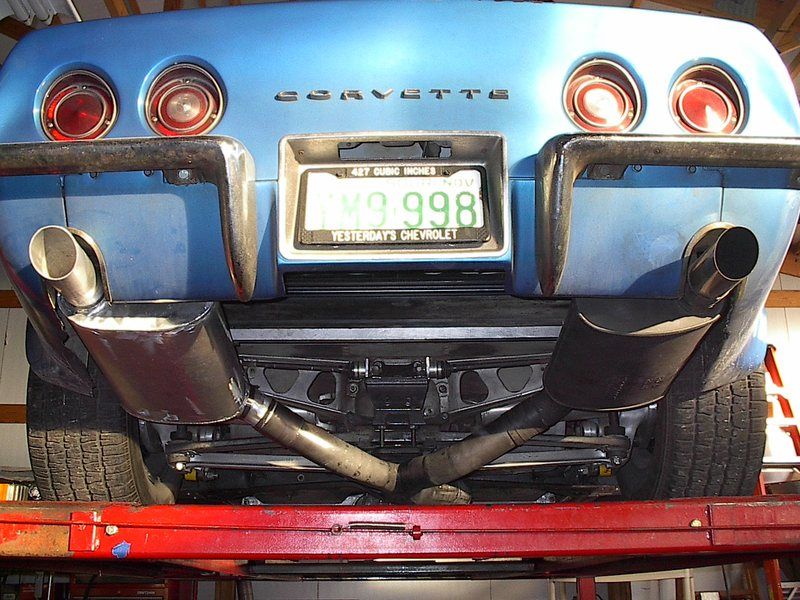
Replacement weight 9.9# (six pounds lighter, off the left side). The sound (at 2000 RPM no load) is thankfully as quiet as the other side, according to my dB sound meter. I've had good durability with the aluminum muffler on my '84 (turbo), so I'm hoping for similar reliability with this, assuming I can keep the exhaust from bottoming out excessively this year.
Next project is to pull the C3 batwing off the car, and replace with a C4 batwing. The late C3 batwing (in place of the stock '69 cast iron cover and steel crossmember) took 15# off the car years ago, and the C4 part should take another 6-7 pounds off. Ideally I would prefer to take weight off the front of the car, but I'll take it where I can get it. It all has to be accelerated and decelerated either way.
Test fit picture prior to polishing the tip and painting the housing black to match the right side.

Replacement weight 9.9# (six pounds lighter, off the left side). The sound (at 2000 RPM no load) is thankfully as quiet as the other side, according to my dB sound meter. I've had good durability with the aluminum muffler on my '84 (turbo), so I'm hoping for similar reliability with this, assuming I can keep the exhaust from bottoming out excessively this year.
Next project is to pull the C3 batwing off the car, and replace with a C4 batwing. The late C3 batwing (in place of the stock '69 cast iron cover and steel crossmember) took 15# off the car years ago, and the C4 part should take another 6-7 pounds off. Ideally I would prefer to take weight off the front of the car, but I'll take it where I can get it. It all has to be accelerated and decelerated either way.