






Best Carb suggestions?

Racer

Joined: Jan 2006
Posts: 323
Likes: 4
From: McKinney Texas

I will start searching the forum for answers, but wanted to post an update on the 4165 swap.
I can see why the rebuild kit is so expensive. Lots of parts, a lot more than in your standard qjet kit. It was not any more complicated to work on than the qjet, just more parts. Since the linkages are simpler, it is easier to take apart than a qjet.
Unfortunately it was not a straight bolt on. The firewall side vacuum port for the power brakes is not threaded, so I had to use a T off the PCV port. No big deal.
Also have to use short studs to bolt it down, but I knew that from the Holley that the car came with.
The big stinger is the factory bracket that hold the throttle cable attaches to the back two carb hold-down bolts, but it will no longer work because of the secondary's accelerator pump. Any ideas, or even better a bolt on solution from O'Reilly's, would be appreciated. I may just rig a bar with holes off each stud, then attach to that, but it will be ugly.
Other than that it seems to run pretty well. The idle seems to vary rpm a little more that the qjet, and it appears that when I blip the throttle the gas come more as liquid than a vapor. Good response however.
I started to adjust the mixture screws to vacuum, but the passenger side screw is blocked by the choke vacuum pull-off. I assume I have to remove that to adjust the screw?
So Matt, it will be a few days before I can report on the road test, but I am really looking forward to it.
I can see why the rebuild kit is so expensive. Lots of parts, a lot more than in your standard qjet kit. It was not any more complicated to work on than the qjet, just more parts. Since the linkages are simpler, it is easier to take apart than a qjet.
Unfortunately it was not a straight bolt on. The firewall side vacuum port for the power brakes is not threaded, so I had to use a T off the PCV port. No big deal.
Also have to use short studs to bolt it down, but I knew that from the Holley that the car came with.
The big stinger is the factory bracket that hold the throttle cable attaches to the back two carb hold-down bolts, but it will no longer work because of the secondary's accelerator pump. Any ideas, or even better a bolt on solution from O'Reilly's, would be appreciated. I may just rig a bar with holes off each stud, then attach to that, but it will be ugly.
Other than that it seems to run pretty well. The idle seems to vary rpm a little more that the qjet, and it appears that when I blip the throttle the gas come more as liquid than a vapor. Good response however.
I started to adjust the mixture screws to vacuum, but the passenger side screw is blocked by the choke vacuum pull-off. I assume I have to remove that to adjust the screw?
So Matt, it will be a few days before I can report on the road test, but I am really looking forward to it.

The ORIGINAL and bestest


Joined: Oct 2000
Posts: 10,009
Likes: 240
From: Toronto Ontario
Toronto Events Coordinator
Thanks, Matt. You can't back up your  , and I'm a jerk. I guess that's an easy way to duck out.
No shop, huh? That explains why you declined my offer. Nope, you're not backing up your claims - because you can't.
Can you put me back on your ignore list, please? I liked it there
, and I'm a jerk. I guess that's an easy way to duck out.No shop, huh? That explains why you declined my offer. Nope, you're not backing up your claims - because you can't.
Can you put me back on your ignore list, please? I liked it there


Team Owner


Joined: Aug 1999
Posts: 30,995
Likes: 99
From: Ontario
I will start searching the forum for answers, but wanted to post an update on the 4165 swap.
I can see why the rebuild kit is so expensive. Lots of parts, a lot more than in your standard qjet kit. It was not any more complicated to work on than the qjet, just more parts. Since the linkages are simpler, it is easier to take apart than a qjet.
Unfortunately it was not a straight bolt on. The firewall side vacuum port for the power brakes is not threaded, so I had to use a T off the PCV port. No big deal.
Also have to use short studs to bolt it down, but I knew that from the Holley that the car came with.
The big stinger is the factory bracket that hold the throttle cable attaches to the back two carb hold-down bolts, but it will no longer work because of the secondary's accelerator pump. Any ideas, or even better a bolt on solution from O'Reilly's, would be appreciated. I may just rig a bar with holes off each stud, then attach to that, but it will be ugly.
Other than that it seems to run pretty well. The idle seems to vary rpm a little more that the qjet, and it appears that when I blip the throttle the gas come more as liquid than a vapor. Good response however.
I started to adjust the mixture screws to vacuum, but the passenger side screw is blocked by the choke vacuum pull-off. I assume I have to remove that to adjust the screw?
So Matt, it will be a few days before I can report on the road test, but I am really looking forward to it.
I can see why the rebuild kit is so expensive. Lots of parts, a lot more than in your standard qjet kit. It was not any more complicated to work on than the qjet, just more parts. Since the linkages are simpler, it is easier to take apart than a qjet.
Unfortunately it was not a straight bolt on. The firewall side vacuum port for the power brakes is not threaded, so I had to use a T off the PCV port. No big deal.
Also have to use short studs to bolt it down, but I knew that from the Holley that the car came with.
The big stinger is the factory bracket that hold the throttle cable attaches to the back two carb hold-down bolts, but it will no longer work because of the secondary's accelerator pump. Any ideas, or even better a bolt on solution from O'Reilly's, would be appreciated. I may just rig a bar with holes off each stud, then attach to that, but it will be ugly.
Other than that it seems to run pretty well. The idle seems to vary rpm a little more that the qjet, and it appears that when I blip the throttle the gas come more as liquid than a vapor. Good response however.
I started to adjust the mixture screws to vacuum, but the passenger side screw is blocked by the choke vacuum pull-off. I assume I have to remove that to adjust the screw?
So Matt, it will be a few days before I can report on the road test, but I am really looking forward to it.
The pic shows a stock cast-iron 1974 intake (ignore the colour). Does the Holley run interference with that vacuum port adaptor at the back? Note the divorced choke as well. I would like to retain that.


Race Director


Joined: Oct 2000
Posts: 15,059
Likes: 79
From: central FL, near the beach.
I will be interested to see your report. But my initial thoughts are that this is not a "bolt on and go". The lack of a threaded hole, firewall side for the brake booster is very odd....perhaps the lack of threads was a defect from the factory.
The pic shows a stock cast-iron 1974 intake (ignore the colour). Does the Holley run interference with that vacuum port adaptor at the back? Note the divorced choke as well. I would like to retain that.
The pic shows a stock cast-iron 1974 intake (ignore the colour). Does the Holley run interference with that vacuum port adaptor at the back? Note the divorced choke as well. I would like to retain that.

Also got some jam nuts! (thin)
Are you guys flustered this easily?
OK, i'm sorry, i should of said "bolt on and go to store for mis. parts to hook everything up"

Team Owner
Joined: Aug 1999
Posts: 30,995
Likes: 99
From: Ontario
Now that u mention it, i did have to buy a fitting for my PB. And once i drilled another hole as i didnt like the linkage ratio. And some studs were too long! Had to cut them
Also got some jam nuts! (thin)
Are you guys flustered this easily?
OK, i'm sorry, i should of said "bolt on and go to store for mis. parts to hook everything up"
Also got some jam nuts! (thin)
Are you guys flustered this easily?
OK, i'm sorry, i should of said "bolt on and go to store for mis. parts to hook everything up"
I have followed the thread with interest or else I would not have jumped in. The 4165 seemed like a reasonable alternative to a Q-Jet. I liked some of your thoughts.
My questions were well-intentioned as changing from a Q-Jet to the Holley will run me here in Canada about $600.00 with all the bells-and-whistles assuming I can find them on-line. I can't just go to a store or ask a machine shop to fab something up. I know some mods will be necessary: those are inevitable. It's a matter of cost and possible lack of function of some crucial systems (e.g. emissions). And the PB booster tied into a PCV line makes no sense to me; crankcase gases into the booster?? (not your suggestion). Back manifold vacuum picks up general vacuum services and the TH350/400 modulator with automatics; the back of the carb does the brake work. The PCV is at the front of the car. These are all separate systems.

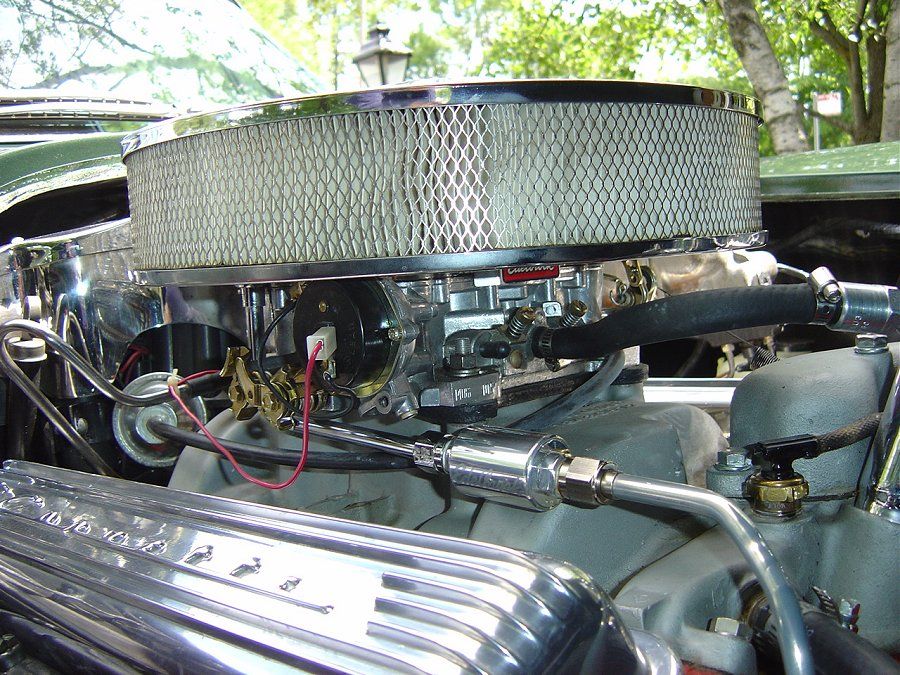
Your reply implies some of us are mechanical twits. I am not a genius but I converted my 1967 327/300 from a fire hazard Holley to an Edelbrock #1406. I did all the tube bending work by hand complete with 37* -AN flares and fittings/adaptors. No rubber and it worked very fine and safely.
So you have chosen to poo-poo my comments. OK, this is a Forum and that fair ball but not reason for unnecessary ridicule as shown by the "rolleyes" pics. I have no further comment and will not contribute further to this thread.
I wish you well with your 4165 campaign. Your credibility would be enhanced by a shopping list of parts/prices for that conversion. No one at this point has done that.
Last edited by Paul L; Dec 13, 2009 at 04:00 PM.

Advanced
Joined: Apr 2006
Posts: 87
Likes: 0
From: Finly IN
Four hole gasket or spacer for Edellbrock
Paul or Matt,
I am running an Edelbrock 1406 carb with a 2104 Intake manifold. I added a 5 speed with overdrive have been using my vette for a daily driver. Paul, What is gas mileage are you getting with your 1406 Edelbrock?
Matt,
You said in previous posts that a four hole spacer or gasket would improve mileage. I am getting around 13 mpg. Do you thing adding a 4 hole gasket/spacer would improve mileage?
Thanks,
I am running an Edelbrock 1406 carb with a 2104 Intake manifold. I added a 5 speed with overdrive have been using my vette for a daily driver. Paul, What is gas mileage are you getting with your 1406 Edelbrock?
Matt,
You said in previous posts that a four hole spacer or gasket would improve mileage. I am getting around 13 mpg. Do you thing adding a 4 hole gasket/spacer would improve mileage?
Thanks,

Le Mans Master


Joined: Jun 2004
Posts: 6,231
Likes: 65
From: Seattle WA
St. Jude Donor '14
Paul, that's a very nice conversion and super job on the hardlines. Very nice looking engine!
Corvette Stories
The Best of Corvette for Corvette Enthusiasts

Top 10 Most Expensive Corvettes Ever Sold on Bring A Trailer
Brett Foote
10 Things Every Corvette Owner Needs (2026 Edition)
Michael S. Palmer
8 Most "Only Corvette Owners Understand" Quirks and Problems
Pouria Savadkouei
10 Reasons the C6 Z06 is Still A Performance Benchmark After 20 Years
Joe Kucinski
How Much Horsepower Every Corvette Engine "LOST" in 1972
Joe Kucinski
Top 10 DOs and DON'Ts for Protecting Your Convertible Top!
Michael S. Palmer
Top 10 Most Explosive Corvettes Ever Made: Power-to-Weight Ratio Ranked!
Joe Kucinski
150 hp to 1,250 hp: Every Corvette Generation Compared by the Specs That Matter
Joe Kucinski
8 Coolest Corvette Pace Cars (and Replicas) of All Time
Verdad Gallardo
Team Owner
Joined: Aug 1999
Posts: 30,995
Likes: 99
From: Ontario
My last-last point is thus the true cost of conversion can be very expensive. Not only in terms of parts but my time. We have five months of Corvette driving in Canada. I want to be on the road, not in the garage.
As to mileage check the old magazines of the day. About 12-14 in the city was normal and about 16-18 on the highway. That is what I get and consider it normal.

Racer
Joined: Jan 2006
Posts: 323
Likes: 4
From: McKinney Texas
[QUOTE=paul 74;1572415603]I will be interested to see your report. But my initial thoughts are that this is not a "bolt on and go". The lack of a threaded hole, firewall side for the brake booster is very odd....perhaps the lack of threads was a defect from the factory.
The pic shows a stock cast-iron 1974 intake (ignore the colour). Does the Holley run interference with that vacuum port adaptor at the back? Note the divorced choke as well. I would like to retain that.
[QUOTE]
Don't bail yet Paul, this thread can be of use.
My '74 is a BB, so the intake looks different, in particular the EGR is in the front. The "vacuum port adapter" could be a problem, as it looks kind of close. Maybe someone who has installed the carb on a small block can chime in, but the 4165 goes back about two inches from the back carb bolts.
The lack of a threaded hole is not a defect, as the tube has a lip around it, like it is supposed to have a rubber vacuum line over the top. That line would be way bigger than the 11/32 coming off the brake booster however. It does have a threaded plug inside, which I left in.
Using a T with the PCV vacuum port should not make a difference (I think?), as the line is always under vacuum, so no fumes from the PCV should ever enter the brake booster. Also, the front and rear vacuum lines of the carb open straight through the carb base to the intake manifold, so there should not be a pressure difference.
I also have a divorced choke, and the 4165 lined right up with that.
After looking at different threads, the throttle cable bracket for a '73 qjet shown in the Corvette Central website should work perfect for my application. Unfortunately it is about $40 w/ clamp and shipping, which keeps increasing the cost of my test. O'Reilly's has a generic bracket for $13, that also looks like it will work, so I am going to try that first.
This project does not have me flustered, Matt, or even discouraged. Flustered is when I have to make three runs to Home Depot for a plumbing project. Wrenching on the car is 99% fun.
I know it is all a learning curve, which is why I am listing what I had to get so the next guy does not have to make as many runs to the auto parts store. Matt we need you to stay positive on this as your guidance can make this easier.
Paul, I think you could do the swap for a lot less than $600, plus a few hours of jerking around. Assuming the bracket is the last of my surprises, I will in it for around $100.
The pic shows a stock cast-iron 1974 intake (ignore the colour). Does the Holley run interference with that vacuum port adaptor at the back? Note the divorced choke as well. I would like to retain that.
[QUOTE]
Don't bail yet Paul, this thread can be of use.
My '74 is a BB, so the intake looks different, in particular the EGR is in the front. The "vacuum port adapter" could be a problem, as it looks kind of close. Maybe someone who has installed the carb on a small block can chime in, but the 4165 goes back about two inches from the back carb bolts.
The lack of a threaded hole is not a defect, as the tube has a lip around it, like it is supposed to have a rubber vacuum line over the top. That line would be way bigger than the 11/32 coming off the brake booster however. It does have a threaded plug inside, which I left in.
Using a T with the PCV vacuum port should not make a difference (I think?), as the line is always under vacuum, so no fumes from the PCV should ever enter the brake booster. Also, the front and rear vacuum lines of the carb open straight through the carb base to the intake manifold, so there should not be a pressure difference.
I also have a divorced choke, and the 4165 lined right up with that.
After looking at different threads, the throttle cable bracket for a '73 qjet shown in the Corvette Central website should work perfect for my application. Unfortunately it is about $40 w/ clamp and shipping, which keeps increasing the cost of my test. O'Reilly's has a generic bracket for $13, that also looks like it will work, so I am going to try that first.
This project does not have me flustered, Matt, or even discouraged. Flustered is when I have to make three runs to Home Depot for a plumbing project. Wrenching on the car is 99% fun.
I know it is all a learning curve, which is why I am listing what I had to get so the next guy does not have to make as many runs to the auto parts store. Matt we need you to stay positive on this as your guidance can make this easier.
Paul, I think you could do the swap for a lot less than $600, plus a few hours of jerking around. Assuming the bracket is the last of my surprises, I will in it for around $100.
Advanced
Joined: Apr 2006
Posts: 87
Likes: 0
From: Finly IN
Thanks for information
Paul,
As well, nice mod, my conversion from 4 to 5 speed took much more time than I thought. I lost a summer, but I do like it better. That's why I'm driving now and will stick with the Edelbrock 1406 that I bought. It was supposed to go quicker.
I might try a spacer in case it is boiling over in the summer.
As well, nice mod, my conversion from 4 to 5 speed took much more time than I thought. I lost a summer, but I do like it better. That's why I'm driving now and will stick with the Edelbrock 1406 that I bought. It was supposed to go quicker.
I might try a spacer in case it is boiling over in the summer.

Thread Starter
Burning Brakes


Joined: Jan 2009
Posts: 1,224
Likes: 1
From: Clarksville Indiana
I got my spark restored <for about 5 min.> fired right up on fast idle cam and ran great, kicked right down to normal idle, engine sounded great, very responsive and smooth.. I was lovin it until spark went south again, back to diag on ignition system for little or no spark..
Racer
Joined: Jan 2006
Posts: 323
Likes: 4
From: McKinney Texas
I got it in, and it really does run well. It cruises along nicely and the idle quality is about the same as the qjet. I did notice that the Holley seems to start faster, since I think the gas was syphoning back out of the qjet. So a nice side benefit.
What I really like is the mechanical secondaries. Much better response, and a whole lot easier to chirp the tires. It feels like it runs out of breath earlier, say around 4500rpm, but the response is worth it. Much quicker.
The only other downside is missing the qjet secondaries sound. I do like the sound when those kick in, and the Holley sounds different, though not bad.
The generic bracket from O'Reilly's worked fine. I had to bend up the tang on the front (see in front of the bolt) and the designed location for the cable was too close, so I flipped over one of the kick-down cable brackets. Works great and I now have an adjustable throttle cable (not that I need it).
Bottom line is I would recommend doing the swap for the mechanical secondaries.

What I really like is the mechanical secondaries. Much better response, and a whole lot easier to chirp the tires. It feels like it runs out of breath earlier, say around 4500rpm, but the response is worth it. Much quicker.
The only other downside is missing the qjet secondaries sound. I do like the sound when those kick in, and the Holley sounds different, though not bad.
The generic bracket from O'Reilly's worked fine. I had to bend up the tang on the front (see in front of the bolt) and the designed location for the cable was too close, so I flipped over one of the kick-down cable brackets. Works great and I now have an adjustable throttle cable (not that I need it).
Bottom line is I would recommend doing the swap for the mechanical secondaries.

Le Mans Master
Joined: Aug 2003
Posts: 7,720
Likes: 12
From: Chattanooga TN
Doesn't the 4165 have power valves and basically the same float bowl vent (see photo is post above) as the square bore Holleys?
Race Director


Joined: Jun 2000
Posts: 10,046
Likes: 675
From: FL
I got it in, and it really does run well. It cruises along nicely and the idle quality is about the same as the qjet. I did notice that the Holley seems to start faster, since I think the gas was syphoning back out of the qjet. So a nice side benefit.
What I really like is the mechanical secondaries. Much better response, and a whole lot easier to chirp the tires. It feels like it runs out of breath earlier, say around 4500rpm, but the response is worth it. Much quicker.
The only other downside is missing the qjet secondaries sound. I do like the sound when those kick in, and the Holley sounds different, though not bad.
The generic bracket from O'Reilly's worked fine. I had to bend up the tang on the front (see in front of the bolt) and the designed location for the cable was too close, so I flipped over one of the kick-down cable brackets. Works great and I now have an adjustable throttle cable (not that I need it).
Bottom line is I would recommend doing the swap for the mechanical secondaries.
What I really like is the mechanical secondaries. Much better response, and a whole lot easier to chirp the tires. It feels like it runs out of breath earlier, say around 4500rpm, but the response is worth it. Much quicker.
The only other downside is missing the qjet secondaries sound. I do like the sound when those kick in, and the Holley sounds different, though not bad.
The generic bracket from O'Reilly's worked fine. I had to bend up the tang on the front (see in front of the bolt) and the designed location for the cable was too close, so I flipped over one of the kick-down cable brackets. Works great and I now have an adjustable throttle cable (not that I need it).
Bottom line is I would recommend doing the swap for the mechanical secondaries.
Also, you have found the issue with having a 650cfm on a big block with running out of steam at 4500 rpm. To me, that would be an unacceptable compromise.

CF Community Team


Joined: Oct 2004
Posts: 19,366
Likes: 5,244
From: Cape Cod, Mass.
2025 C6 of the Year Finalist - Unmodified
2025 C8 Z06/7/E-Ray of the Year Finalist - Unmodified
2023 C3 of the Year Finalist - Unmodified
2021 C8 of the Year Finalist Unmodified
2020 Corvette of the Year Finalist (performance mods)
2019 C1 of Year Winner (performance mods)
2017 Corvette of the Year Finalist
2016 C2 of Year
2015 C3 of Year Finalist
Looks like you are using the stock steel line. What are you doing for a filter since the Holley does not have an internal filter?
Also, you have found the issue with having a 650cfm on a big block with running out of steam at 4500 rpm. To me, that would be an unacceptable compromise.
Also, you have found the issue with having a 650cfm on a big block with running out of steam at 4500 rpm. To me, that would be an unacceptable compromise.
Racer
Joined: Jan 2006
Posts: 323
Likes: 4
From: McKinney Texas
Looks like you are using the stock steel line. What are you doing for a filter since the Holley does not have an internal filter?
Also, you have found the issue with having a 650cfm on a big block with running out of steam at 4500 rpm. To me, that would be an unacceptable compromise.
Also, you have found the issue with having a 650cfm on a big block with running out of steam at 4500 rpm. To me, that would be an unacceptable compromise.
I understand the unacceptable compromise, and I am still not sure what I am going to do. I definately want mechanical secondaries, as it really is way more responsive. Using the forumla rpmXci/3456*.8 (from another thread), the carb should be good to 6000rpm, but it does not feel like it.
The real problem is I do not know what a '74 BB is supposed to feel like from the factory. The car ran terrible when I bought it, so I do not have a baseline for comparison. My old '68 427/390 was much quicker, but it had a built engine. I have made several changes to the car since I purchased it, and all have been a performance improvement. The car feels much quicker with the Holley, though I may have lost some top end speed (not a factor for me).
Since all this "tuning" started because the car ran terrible, and now it runs well, I will probably stop messing with the tuning and start focusing on other areas.......though what would happen if I pulled those top plates off the secondaries on a qjet? Wouldn't that now be straight mechanical secondaries?
Racer
Joined: Jan 2006
Posts: 323
Likes: 4
From: McKinney Texas
I'm running the stock. metal, inline filter on my 68 390 horse. Mine does not run out of steam at 4,500 RPM's and is good to 5500 very easily. Don't forget, back in 66 the factory 390 horse carb was only 580 CFM. They ran fine. I would suspect an electrical/ignition problem if the car won't rev past 4,500 RPM's.
I was so happy with the qjets performance over the Holley that the car came with that I did not do any quantitative testing. If we get a stretch of warm weather over the Holidays (70 yesterday, 45 today) and I get motivated, I will get some 0-60 and quarter mile numbers with both carbs. Just seat of the pants, though, the Holley is probably more than a second quicker to 60.
Le Mans Master
Joined: Oct 2002
Posts: 7,098
Likes: 378
From: Las Vegas - Just stop perpetuating myths please.
Nice conversion and thx for posting.
There is a filter in the carb, just like in the qjet. Actually I used the same filter since I only put about 40 miles on it.
I understand the unacceptable compromise, and I am still not sure what I am going to do. I definately want mechanical secondaries, as it really is way more responsive. Using the forumla rpmXci/3456*.8 (from another thread), the carb should be good to 6000rpm, but it does not feel like it.
The real problem is I do not know what a '74 BB is supposed to feel like from the factory. The car ran terrible when I bought it, so I do not have a baseline for comparison. My old '68 427/390 was much quicker, but it had a built engine. I have made several changes to the car since I purchased it, and all have been a performance improvement. The car feels much quicker with the Holley, though I may have lost some top end speed (not a factor for me).
Since all this "tuning" started because the car ran terrible, and now it runs well, I will probably stop messing with the tuning and start focusing on other areas.......though what would happen if I pulled those top plates off the secondaries on a qjet? Wouldn't that now be straight mechanical secondaries?
I understand the unacceptable compromise, and I am still not sure what I am going to do. I definately want mechanical secondaries, as it really is way more responsive. Using the forumla rpmXci/3456*.8 (from another thread), the carb should be good to 6000rpm, but it does not feel like it.
The real problem is I do not know what a '74 BB is supposed to feel like from the factory. The car ran terrible when I bought it, so I do not have a baseline for comparison. My old '68 427/390 was much quicker, but it had a built engine. I have made several changes to the car since I purchased it, and all have been a performance improvement. The car feels much quicker with the Holley, though I may have lost some top end speed (not a factor for me).
Since all this "tuning" started because the car ran terrible, and now it runs well, I will probably stop messing with the tuning and start focusing on other areas.......though what would happen if I pulled those top plates off the secondaries on a qjet? Wouldn't that now be straight mechanical secondaries?
) - jet plate only. But now i wonder if the vac sec operation is more similar to a Qjet with an air valve.Well the argument for the mechanical sec's is the second pump shot (as they say is for "come'n out'a the corners) gives a little burst response - rather than what your getting with yours now.
 Maybe a bigger sec pump shot would help. Holley sells cams and plungers for this.
Regardless its nice to see your clean looking conversion worked out - and on a real hotrodders budget.

cardo0

Drifting


Joined: Mar 2007
Posts: 1,936
Likes: 1
From: Winston-Salem NC
Whether FI gives better MPG than a carb is dependant a lot on usage and driving style.
Where carbs use lots of fuel is on cold start and stop start driving. If you live in the city and do short journeys then FI will whip a carb. Particularly if you like to sprint between intersections.
If you do long, constant speed highway runs, then a well chosen/set-up carb can equal an FI system.
TBH though most of the bolt on FI systems for V8's don't make the most of the change of system.
I central 4 barrel intake is a terrible design for many reasons, individual port injection would show a vast improvement in performance and MPG.
Junk this:-

In favour of this:-

Where carbs use lots of fuel is on cold start and stop start driving. If you live in the city and do short journeys then FI will whip a carb. Particularly if you like to sprint between intersections.
If you do long, constant speed highway runs, then a well chosen/set-up carb can equal an FI system.
TBH though most of the bolt on FI systems for V8's don't make the most of the change of system.
I central 4 barrel intake is a terrible design for many reasons, individual port injection would show a vast improvement in performance and MPG.
Junk this:-
In favour of this:-
What is this intake, and where can I get it ??? (The one that says in favor of)
