







Hot engine bubbled paint?
Thread Starter
Racer


Joined: Oct 2006
Posts: 306
Likes: 1
From: Burnaby BC
 Hot engine bubbled paint?
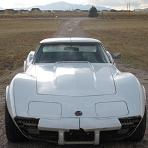
I have a small bubble in my new paint and the paint shop told me it is because my engine is too hot.
I agree that my motor and headers run hot, but so do a lot of Vette's.
Would this cause a bubble or are they just looking for excuses?
I have some Reflect-A-Cool, constructed of fiberglass material backed with a layer of aluminized reflective foil to handle direct continuous temperature of 400°F and was thinking of sticking it under the hood.

I am fighting for them to strip and re-paint at the mo ment.
ment.
I agree that my motor and headers run hot, but so do a lot of Vette's.
Would this cause a bubble or are they just looking for excuses?
I have some Reflect-A-Cool, constructed of fiberglass material backed with a layer of aluminized reflective foil to handle direct continuous temperature of 400°F and was thinking of sticking it under the hood.
I am fighting for them to strip and re-paint at the mo
ment.
Thread Starter
Racer
Joined: Oct 2006
Posts: 306
Likes: 1
From: Burnaby BC
It is smaller than half a penny and under the motion stripe on the driver side right above the valve cover.

Stock insulation no longer fit with this motor, so I guess the Reflect a cool will be used.
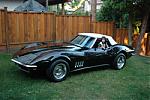
Note the stinger was added by me and it was glassed in and allows the engine to breath better.
Stock insulation no longer fit with this motor, so I guess the Reflect a cool will be used.
Note the stinger was added by me and it was glassed in and allows the engine to breath better.

Melting Slicks

Joined: Mar 2008
Posts: 2,023
Likes: 6
From: Austin Tx
Thread Starter
Racer
Joined: Oct 2006
Posts: 306
Likes: 1
From: Burnaby BC
I have seen top fuel drag cars that run way hotter with fiberglass bodies and the paint does not bubble.
Thanks
Thread Starter
Racer
Joined: Oct 2006
Posts: 306
Likes: 1
From: Burnaby BC

Lets hope it does not bubble this time, but I might also wrap my exhaust to keep heat in.
I am still curious to how hot you can get paint on fiberglass before you get problems.
Thanks
Corvette Stories
The Best of Corvette for Corvette Enthusiasts

Top 10 Most Expensive Corvettes Ever Sold on Bring A Trailer
Brett Foote
10 Things Every Corvette Owner Needs (2026 Edition)
Michael S. Palmer
8 Most "Only Corvette Owners Understand" Quirks and Problems
Pouria Savadkouei
10 Reasons the C6 Z06 is Still A Performance Benchmark After 20 Years
Joe Kucinski
How Much Horsepower Every Corvette Engine "LOST" in 1972
Joe Kucinski
Top 10 DOs and DON'Ts for Protecting Your Convertible Top!
Michael S. Palmer
Top 10 Most Explosive Corvettes Ever Made: Power-to-Weight Ratio Ranked!
Joe Kucinski
150 hp to 1,250 hp: Every Corvette Generation Compared by the Specs That Matter
Joe Kucinski
8 Coolest Corvette Pace Cars (and Replicas) of All Time
Verdad Gallardo



Team Owner


Joined: Jan 2006
Posts: 37,637
Likes: 3,118
From: Crossville TN
My 'opinion' is that the paint folks used some sort of volatile cleaner/prep fluid prior to paint and that some of it stayed in the glass. That stuff has to be purged by heat before painting or what you are seeing will be the result. Putting an insulating blanket under the hood is probably a good idea, because more of the same could occur.
Melting Slicks

Joined: May 2006
Posts: 3,438
Likes: 41
From: Raleigh NC
St. Jude Donor '13-'14
My 'opinion' is that the paint folks used some sort of volatile cleaner/prep fluid prior to paint and that some of it stayed in the glass. That stuff has to be purged by heat before painting or what you are seeing will be the result. Putting an insulating blanket under the hood is probably a good idea, because more of the same could occur.
 Thats exactly what it sounds like.
Pro

Joined: Jun 2009
Posts: 613
Likes: 3
From: Fleetwood PA
I agree with the prep problem. I had the same thing on my 68 and it wasn't on the hood. It would only happen on hot days when the car was in the sun(black car), and would shrink back down to unnoticeable once it was back in the garage and cool. If it was engine heat, 1/3 of your hood would bubble, not just one tiny spot.


Advanced
Joined: May 2009
Posts: 65
Likes: 0
From: La Pine Oregon
Kool that the shop is standing behind their work . I tend to agree on the fact that if engine heat caused it ; a lot bigger area would be affected. Some of the new "thin " high tech insulation might be a good idea . I have a set of Chrome Hooker sidepipe headers on my '74 L82
and the radiant heat is no problem except for me when trying to mess with stuff before the engine cools. You just got to be real
careful routing plug wires !!! I do not agree with wrap for headers
as I have heard it can create problems under the wrap by confining
the heat instead of it dispensing normally.
And also that stinger in the middle of your hood looks really ,
really nasty!!!! Good job !!! Love your car.
and the radiant heat is no problem except for me when trying to mess with stuff before the engine cools. You just got to be real
careful routing plug wires !!! I do not agree with wrap for headers
as I have heard it can create problems under the wrap by confining
the heat instead of it dispensing normally.
And also that stinger in the middle of your hood looks really ,
really nasty!!!! Good job !!! Love your car.
Intermediate
Joined: Sep 2009
Posts: 26
Likes: 0
From: Wichita KS
I recently purchase a thin insulating product called "Lava Mat". It works great, AND it is a dark carbon fiber in color as opposed to the foil look. I'll warn that it IS expensive, but... here is the webpage:
http://www.heatshieldproducts.com/lava_mat.php
http://www.heatshieldproducts.com/lava_mat.php
Thread Starter
Racer
Joined: Oct 2006
Posts: 306
Likes: 1
From: Burnaby BC
I recently purchase a thin insulating product called "Lava Mat". It works great, AND it is a dark carbon fiber in color as opposed to the foil look. I'll warn that it IS expensive, but... here is the webpage:
http://www.heatshieldproducts.com/lava_mat.php
http://www.heatshieldproducts.com/lava_mat.php

Do you know if it sticks well under the hood and what the cost is for the product?
Also a picture of the underside of your hood would be great
(with the Lava Mat)

I figure if it sticks well and looks good I will buy one of the following:
770003
Lava Mat™; 36" x 48" with adhesive
770005
Lava Mat™; 60" x 48"; with adhesive
I do not like the silver look under the hood as much as this look.
Intermediate
Joined: Sep 2009
Posts: 26
Likes: 0
From: Wichita KS
There is a link on the webpage I originally posted for PACE. That is where I bought mine. They shipped promptly and no problems. I used it to isolate the starter and solenoid. However, it has a very good adhesive (I'm sure it is same as used on Dynamat and other similar products). I can't imagine it would be a problem on the underside of the hood. As I said, it is very pricey. If I recall, the 4'x6' piece is around $150. !!!
Intermediate
Joined: Sep 2009
Posts: 26
Likes: 0
From: Wichita KS
Following up.... here is the PACE webpage for Lava Mat:
http://paceperformance.com/search.html?q=lava+mat
http://paceperformance.com/search.html?q=lava+mat
Thread Starter
Racer
Joined: Oct 2006
Posts: 306
Likes: 1
From: Burnaby BC
Following up.... here is the PACE webpage for Lava Mat:
http://paceperformance.com/search.html?q=lava+mat
http://paceperformance.com/search.html?q=lava+mat
Someone is making money
I am looking at this now:
http://hoodliners.blogspot.com/
http://cgi.ebay.ca/1977-1982-Corvett...item2c588e8f21

The 3M 80 spray glue is not sold in Canada so I need to find a replacement or drive across the border to get it.
This post talks about it but no one really says how much heat it cuts down or how well it sticks after a few years.http://forums.corvetteforum.com/c3-g...post1575820111
I would hate it to drop on the engine while driving a few years down the line and catch fire.