



Check Valve vacuum

Thread Starter
Intermediate


Joined: Mar 2004
Posts: 26
Likes: 0
From: Ojai CA
 Check Valve vacuum
Hi, I've gotten a lot of help from the forum but have never posted so here goes. I've changed all the vacuum hoses in my 72 and am now starting at the manifold to verify vacuum. My question; I'm at the check valve and there's more vacuum on the large connection (15inHg) than the small (5inHg). Is that what is expected?

Safety Car


Joined: Oct 2007
Posts: 3,729
Likes: 267
From: Austin Texas
Corvette of the Year Winner 2017
2016 C3 of Year Finalist
the check valve is a 1 way valve, 1 small port is for your A/C heat controls,
the other goes to your reservoir for your lights, and wipers.
sounds like you have a leak.
the large port is the vacuum your motor is generating.
you should NOT be able to blow into the large port, air should NOT exit either small ports.
you should be able to blow thru either small port, with 1 small port blocked.
and air pressue should come out the large end.
the other goes to your reservoir for your lights, and wipers.
sounds like you have a leak.
the large port is the vacuum your motor is generating.
you should NOT be able to blow into the large port, air should NOT exit either small ports.
you should be able to blow thru either small port, with 1 small port blocked.
and air pressue should come out the large end.

Race Director

Joined: Jul 2001
Posts: 15,892
Likes: 42
Hi, I've gotten a lot of help from the forum but have never posted so here goes. I've changed all the vacuum hoses in my 72 and am now starting at the manifold to verify vacuum. My question; I'm at the check valve and there's more vacuum on the large connection (15inHg) than the small (5inHg). Is that what is expected?

Team Owner


Joined: Sep 2006
Posts: 31,316
Likes: 4,421
From: Westminster Maryland
Hi,
I've always thought the large hose coming off the check valve was for the actuator part of the system, and the small hose was for the control/relay side of the system.
On my 71 the vacuum source for the heater/defroster control is a very small hose that tee's off the large hose near the wiper actuator/male hood latch bumper.
?
Regards,
Alan
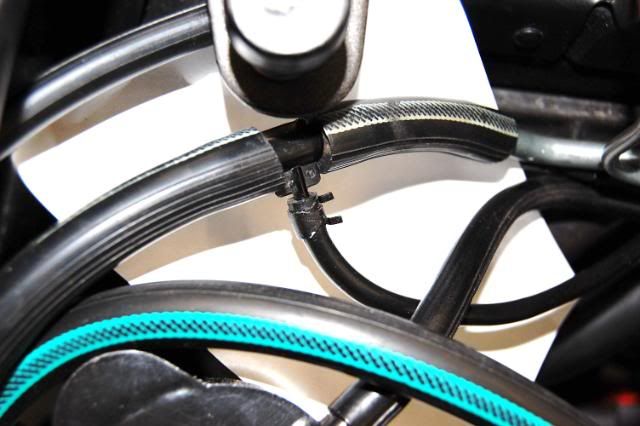
I've always thought the large hose coming off the check valve was for the actuator part of the system, and the small hose was for the control/relay side of the system.
On my 71 the vacuum source for the heater/defroster control is a very small hose that tee's off the large hose near the wiper actuator/male hood latch bumper.
?
Regards,
Alan
Last edited by Alan 71; Jul 26, 2011 at 05:55 PM.
Race Director
Joined: Jul 2001
Posts: 15,892
Likes: 42

Team Owner

Joined: Jan 2006
Posts: 37,637
Likes: 3,118
From: Crossville TN
How are you measuring from that check valve? Are you just T-ing into each line and leaving the rest of the circuit still connected? If so, there is a big vacuum leak in your smaller line...or the check valve is bad. You can remove the check valve and check it by blowing on the 'inlet' end while holding a finger on each outlet...one at a time. With both tests, there should be very little (if any) air that will pass through the valve. You should be able to suck air through the valve each way, when doing that same test.
Last edited by 7T1vette; Jul 26, 2011 at 09:48 PM.
Thread Starter
Intermediate
Joined: Mar 2004
Posts: 26
Likes: 0
From: Ojai CA
Well, Alan came the closest I think. 7T1 - I'm setting the base reading by disconnecting the hose from the manifold connection to the filter. 15inHg. I then go for the next reading on the outlet side (2 ports) of the check valve. The large port shows 15inHg, the small port shows 5inHg. My question is: what is the expected vacuum on both of the ports. The check valve is brand new.
Thanks all for your replies. Still looking for an expected reading on both ports of the check valve.
Thanks all for your replies. Still looking for an expected reading on both ports of the check valve.
Team Owner
Joined: Sep 2006
Posts: 31,316
Likes: 4,421
From: Westminster Maryland
Hi d72,
Not to de-rail your testing but I don't see that the operation of the valve has anything to do with vacuum amount. Doesn't it really just acts as a 'plug' to hold the vacuum in the system when you shut the engine off?
With the single large port plugged each of the 2 ports on the other side should hold vacuum.
I believe I've read reports of many reproduction valves that don't work well.
Regards,
Alan
Not to de-rail your testing but I don't see that the operation of the valve has anything to do with vacuum amount. Doesn't it really just acts as a 'plug' to hold the vacuum in the system when you shut the engine off?
With the single large port plugged each of the 2 ports on the other side should hold vacuum.
I believe I've read reports of many reproduction valves that don't work well.
Regards,
Alan
Corvette Stories
The Best of Corvette for Corvette Enthusiasts

5 Best & 5 Worst Corvette Daily Drivers
Joe Kucinski
The Headlights of Every Corvette Generation Explained
Joe Kucinski
5 Best & 5 Most Overrated Corvette Track Packages of All Time!
Joe Kucinski
Every 2027 Corvette Engine Explained
Joe Kucinski
Designer Imagines A Corvette That Looks More Like a Corvette Than the Corvette
Verdad Gallardo
10 Ugly Corvettes That We Still Kinda Love
Joe Kucinski
Top 10 Most Expensive Corvettes Ever Sold on Bring A Trailer
Brett Foote
10 Things Every Corvette Owner Needs (2026 Edition)
Michael S. Palmer
8 Most "Only Corvette Owners Understand" Quirks and Problems
Pouria Savadkouei
Race Director
Joined: May 2006
Posts: 16,528
Likes: 53
From: Dayton, Ohio
Well, Alan came the closest I think. 7T1 - I'm setting the base reading by disconnecting the hose from the manifold connection to the filter. 15inHg. I then go for the next reading on the outlet side (2 ports) of the check valve. The large port shows 15inHg, the small port shows 5inHg. My question is: what is the expected vacuum on both of the ports. The check valve is brand new.
Thanks all for your replies. Still looking for an expected reading on both ports of the check valve.
Thanks all for your replies. Still looking for an expected reading on both ports of the check valve.

Team Owner
Joined: Jan 2006
Posts: 37,637
Likes: 3,118
From: Crossville TN
Roger...
If that test were made with only the gauge on the line being tested, but the other line hooked up as usual, then I would agree with you...the leak would be in the large line side. But, if the gauge were T-ed into the small line, with all the rest of the stuff on that line connected, then I would suspect the leak to be in the small line side. The lower vacuum reading would be on the side with the larger leak path. [Hence, why I asked about how he had it hooked up..]
If that test were made with only the gauge on the line being tested, but the other line hooked up as usual, then I would agree with you...the leak would be in the large line side. But, if the gauge were T-ed into the small line, with all the rest of the stuff on that line connected, then I would suspect the leak to be in the small line side. The lower vacuum reading would be on the side with the larger leak path. [Hence, why I asked about how he had it hooked up..]
Thread Starter
Intermediate
Joined: Mar 2004
Posts: 26
Likes: 0
From: Ojai CA
Mike, Roger, 7T1, thanks a lot. I am trying to be as specific as possible, just missed the last part of post #3. It looks like my new check valve is not behaving. 7T1 - what I'm doing it taking the large outlet hose off and, using a short piece of hose, putting the vacuum gauge on the large outlet port of the check valve - I get 15inHg. I then put the large hose back on the check valve and pull the small hose off, put a piece of small hose on the small port and I get 5inHg. According to MIke's post #3, they should both be the same.
Team Owner
Joined: Jan 2006
Posts: 37,637
Likes: 3,118
From: Crossville TN
....and if pinching that large hose makes the vacuum level rise, then you just need to pinch nearer, and nearer, and nearer to the headlight actuator cans until you find where the vacuum drops to the 5" Hg level. There's your leak! (Nicely done, Roger...)
Thread Starter
Intermediate
Joined: Mar 2004
Posts: 26
Likes: 0
From: Ojai CA
Roger & 7T1, that was the trick, just a pinch and it jumped to 15 like it knew what to do. I'm ahead of you on going nearer & nearer to the actuator cans. It's the right hand side. I've read posts on how to repair them rather than buy new, sounds fun.
Thanks a load!
Thanks a load!
Race Director
Joined: Jul 2001
Posts: 15,892
Likes: 42
You may still need to verify the primary function of the check valve, if not already done. The test you've done confirms flow through both posts but does not confirm whether the 'check valve' part is working.
Remove all three hoses from the valve, hook the vacuum pump to one of the two ports on the outlet side and plug the other. The valve should hold vacuum with little or no leakage. Most modern repros don't work well at all.
Remove all three hoses from the valve, hook the vacuum pump to one of the two ports on the outlet side and plug the other. The valve should hold vacuum with little or no leakage. Most modern repros don't work well at all.
