



Gas Tank Vapor Return

Thread Starter
Heel & Toe

Joined: Oct 2009
Posts: 16
Likes: 0
 Gas Tank Vapor Return
So today my father and I removed the fuel tank in our 71 vette. I had ordered the return lines for the vapor return as well as a canister from a salvage yard since ours was missing. The problem is when we pulled the tank the top openings are fully blocked. On further inspection there is currently no line to return the tank vapors with. I have a new line for the fuel and on this car it just hugs the frame all the way back with one verticle area. I have no clue on what to do with the vapor return. We never had a problem with the car fuel pick up or anything previously but the car has just been sitting and we are just going to upgrade things of concern.
Should I put the vapor return in? Or should I just plug the new tank like the one I pulled out? And if I do that I thought I had read that I should switch to a vented gas cap? Any help would be appreciated.
At this point we are planning for the winter and getting the tank and fuel out will allow us to work in the garage without concern of the smell getting in the house.

Should I put the vapor return in? Or should I just plug the new tank like the one I pulled out? And if I do that I thought I had read that I should switch to a vented gas cap? Any help would be appreciated.
At this point we are planning for the winter and getting the tank and fuel out will allow us to work in the garage without concern of the smell getting in the house.
Thread Starter
Heel & Toe
Joined: Oct 2009
Posts: 16
Likes: 0
I tried to post my image of the tank pulled but could not. Here is the URL
https://picasaweb.google.com/afloate...94366048049666
.

https://picasaweb.google.com/afloate...94366048049666
.

Team Owner


Joined: Jan 2006
Posts: 37,637
Likes: 3,118
From: Crossville TN
You are using the term "vapor return" line. There is a [bypassed] fuel return line; it's a metal line that runs with the fuel [feed] line from the tank. The return line send 'excess' fuel back to the tank. There is also a "fuel vapor" line which runs from the outlet of the fuel separator unit (the black gizmo that is on the left side of your tank--you can see it at the right side of the photo). It transfers fuel vapors from the tank to the vapor recovery canister on the left side of the car.
Which one are you describing?
Which one are you describing?
Thread Starter
Heel & Toe
Joined: Oct 2009
Posts: 16
Likes: 0
The black gizmo was not hooked up to anything that I recall but I can check with my father in the AM.
The only line connected to the tank was the metal line running down the passenger side. If I am not mistaken I believe it was from the sending unit to the fuel pump.
That is why I am confused. From all the manuals/books/pdfs the two lines on the top side of the tank should be connected and the black gizmo should be involved. Needless to say when we pulled it and looked around and saw this we were not sure what the plan of action should be.
Thank for the reply.
The only line connected to the tank was the metal line running down the passenger side. If I am not mistaken I believe it was from the sending unit to the fuel pump.
That is why I am confused. From all the manuals/books/pdfs the two lines on the top side of the tank should be connected and the black gizmo should be involved. Needless to say when we pulled it and looked around and saw this we were not sure what the plan of action should be.
Thank for the reply.

Team Owner

Joined: Sep 2006
Posts: 31,301
Likes: 4,389
From: Westminster Maryland
Hi f,
Here are a couple of pictures of an original 71 tank with the fuel supply and return line on the right-side, and the separator with vapor line on the left-side as 7T1 described.
The base engine had this configuration, but with the LT-! option the tank didn't have the fuel return line on the right side, just the supply line. So 1 less nipple on the LT-! tank.
Hope this helps!
Regards,
Alan
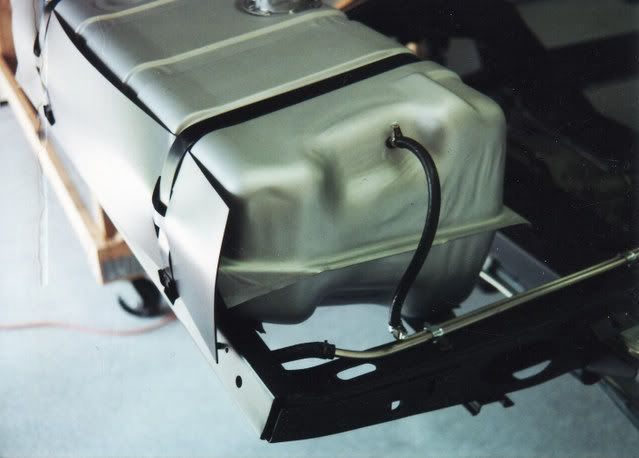
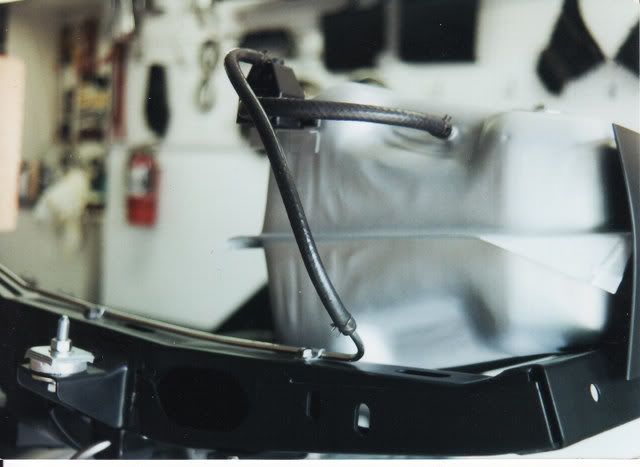
Here are a couple of pictures of an original 71 tank with the fuel supply and return line on the right-side, and the separator with vapor line on the left-side as 7T1 described.
The base engine had this configuration, but with the LT-! option the tank didn't have the fuel return line on the right side, just the supply line. So 1 less nipple on the LT-! tank.
Hope this helps!
Regards,
Alan
Last edited by Alan 71; Sep 19, 2011 at 06:04 PM.

Race Director


Joined: Apr 2011
Posts: 11,183
Likes: 3,335
From: North of Toronto - Ontario
As Alan71 pointed out (with excellent images) the LT1 only has a single line to the fuel pump running along the pass frame.
All others (I believe even the LS?) have 2 lines, the pressure line and a return line.
The pressure line is under the tank at the sending unit and the return line from the pump dumps back in at the top on the pass side.
The black gizmo is a gravity type valve The tank nipple (right beside it) connects to it and then from there to the canister. From what I remember it's there in-case the car flipped over and would prevent gas from running through that vent line up to the canister and pouring out onto the motor
On my car (72) PO changed the pump to a single port (no return) and removed the second line along the frame. The tank still has the return nipple, just closed off with a short piece of hose, clamp and bubba-bolt.
Hope it helps
Mooser
All others (I believe even the LS?) have 2 lines, the pressure line and a return line.
The pressure line is under the tank at the sending unit and the return line from the pump dumps back in at the top on the pass side.
The black gizmo is a gravity type valve The tank nipple (right beside it) connects to it and then from there to the canister. From what I remember it's there in-case the car flipped over and would prevent gas from running through that vent line up to the canister and pouring out onto the motor
On my car (72) PO changed the pump to a single port (no return) and removed the second line along the frame. The tank still has the return nipple, just closed off with a short piece of hose, clamp and bubba-bolt.
Hope it helps
Mooser
The black gizmo was not hooked up to anything that I recall but I can check with my father in the AM.
The only line connected to the tank was the metal line running down the passenger side. If I am not mistaken I believe it was from the sending unit to the fuel pump.
That is why I am confused. From all the manuals/books/pdfs the two lines on the top side of the tank should be connected and the black gizmo should be involved. Needless to say when we pulled it and looked around and saw this we were not sure what the plan of action should be.
Thank for the reply.
The only line connected to the tank was the metal line running down the passenger side. If I am not mistaken I believe it was from the sending unit to the fuel pump.
That is why I am confused. From all the manuals/books/pdfs the two lines on the top side of the tank should be connected and the black gizmo should be involved. Needless to say when we pulled it and looked around and saw this we were not sure what the plan of action should be.
Thank for the reply.

Drifting

Joined: Mar 2011
Posts: 1,886
Likes: 9
Try to duplicate the stock setup. The black plastic doohickey on the left side of the gas tank is a vapor separator. The tank is designed to breathe through the vapor separator and the (charcoal filled) vapor canister. Which means if everything is working correctly, the car won't stink up your garage. Which will keep both your wife and the EPA happier.
Thread Starter
Heel & Toe
Joined: Oct 2009
Posts: 16
Likes: 0
Thanks everybody for the posts and the great pictures Alan!
This is starting to clear the fog and I appreciate it. I am a definite nooby and using my Dads guidance on this as well as this great forum.
My goal is to keep the fumes down and a stock setup would be nice however I am not sure how I am going to get there.
The side in the pics that contains the fuel supply and return line I have.
The side with the vapor separator I do not have the return line.
The frame was replaced once many years ago and the mechanic at the time appears to have blocked the vapor release on the tank. The canister was probably removed as well and the return vapor line never installed. So when bringing it in the garage one would have to let it cool down and then bring it in because of the gas fumes as stated.
This is starting to clear the fog and I appreciate it. I am a definite nooby and using my Dads guidance on this as well as this great forum.
My goal is to keep the fumes down and a stock setup would be nice however I am not sure how I am going to get there.
The side in the pics that contains the fuel supply and return line I have.
The side with the vapor separator I do not have the return line.
The frame was replaced once many years ago and the mechanic at the time appears to have blocked the vapor release on the tank. The canister was probably removed as well and the return vapor line never installed. So when bringing it in the garage one would have to let it cool down and then bring it in because of the gas fumes as stated.
Corvette Stories
The Best of Corvette for Corvette Enthusiasts

Every 2027 Corvette Engine Explained
Joe Kucinski
Designer Imagines A Corvette That Looks More Like a Corvette Than the Corvette
Verdad Gallardo
10 Ugly Corvettes That We Still Kinda Love
Joe Kucinski
Top 10 Most Expensive Corvettes Ever Sold on Bring A Trailer
Brett Foote
10 Things Every Corvette Owner Needs (2026 Edition)
Michael S. Palmer
8 Most "Only Corvette Owners Understand" Quirks and Problems
Pouria Savadkouei
10 Reasons the C6 Z06 is Still A Performance Benchmark After 20 Years
Joe Kucinski
How Much Horsepower Every Corvette Engine "LOST" in 1972
Joe Kucinski
Top 10 DOs and DON'Ts for Protecting Your Convertible Top!
Michael S. Palmer
Team Owner
Joined: Jan 2006
Posts: 37,637
Likes: 3,118
From: Crossville TN
The vapor return line was only there for purposes of minimizing hydrocarbon emissions and for limiting fuel smell when the car is turned OFF. If you can't...or don't want to...maintain that line, just put a cap on the tank fitting (left side) and make sure you have a "vented" gas cap. Cars with the vapor canister had a non-vented cap installed, as the venting was provided by the vapor canister.
Thread Starter
Heel & Toe
Joined: Oct 2009
Posts: 16
Likes: 0
What does the vented gas cap provide? I am guessing an escape for gases/vapors trapped in the tank if there is too much pressure?
I am pretty sure that was the existing setup with the line capped but there currently is not a vented gas cap being used.
I am pretty sure that was the existing setup with the line capped but there currently is not a vented gas cap being used.
Team Owner
Joined: Jan 2006
Posts: 37,637
Likes: 3,118
From: Crossville TN
You can't just pump fluid out of the tank with no way to equalize pressure with that loss of fluid volume. So, you need to vent it. The vapor canister and line going to is provided the venting when it was intact. Now that it is gone, you have to allow air to get into the tank somehow. A vented gas cap is the easiest way to do that. The '63-70 C3's had vented caps. You can buy one of those or just drill a small hole in your cap.
Note: If you have a good condition '71 gas cap with the red label still attached to the cap, you would be better off selling that 'original' cap on eBay, etc. Those caps are not being made with the red tag and are highly sought after by the 'primo' NCRS folks for 1971 cars. You can buy a new '63-70 cap for about $25. Who knows what a good condition, original 1971 cap (with the red label) might go for?
Note: If you have a good condition '71 gas cap with the red label still attached to the cap, you would be better off selling that 'original' cap on eBay, etc. Those caps are not being made with the red tag and are highly sought after by the 'primo' NCRS folks for 1971 cars. You can buy a new '63-70 cap for about $25. Who knows what a good condition, original 1971 cap (with the red label) might go for?

Safety Car

Joined: May 2003
Posts: 3,814
Likes: 105
From: Dearborn Heights Michigan
Do 70's have vented caps because there is no vent pipe on the tank like the one in the above pic?
My 70 doesn't seem to have a vent tube on the drivers side tank top.
Do have a gas smell when Autocrossing the car.
My 70 doesn't seem to have a vent tube on the drivers side tank top.
Do have a gas smell when Autocrossing the car.
Race Director
Joined: Apr 2011
Posts: 11,183
Likes: 3,335
From: North of Toronto - Ontario
The tank has to get air in somehow to replace the gas going out.
On the tanks with the drivers side c-canister it acts as the vent.
The return line on the pass-side is only to spill off excess fuel from the pump (possibly cooling it, not 100% if that's effective, maybe just a side effect) back into the tank but doesn't vent the tank.
So, IMO if there is no line on the drivers side, the cap would have to be vented.
I have no proof of the above statement other than it seems to make sense
Mooser
On the tanks with the drivers side c-canister it acts as the vent.
The return line on the pass-side is only to spill off excess fuel from the pump (possibly cooling it, not 100% if that's effective, maybe just a side effect) back into the tank but doesn't vent the tank.
So, IMO if there is no line on the drivers side, the cap would have to be vented.
I have no proof of the above statement other than it seems to make sense
Mooser

Race Director
Joined: Jul 2001
Posts: 15,892
Likes: 42
The return line on the pass-side is only to spill off excess fuel from the pump (possibly cooling it, not 100% if that's effective, maybe just a side effect) back into the tank but doesn't vent the tank.
So, IMO if there is no line on the drivers side, the cap would have to be vented.
So, IMO if there is no line on the drivers side, the cap would have to be vented.
You are correct that the line on the drivers side is the tank vent. In the absence of that, a vented cap must be used.
I'm not sure exactly when the first sealed caps were used on Corvettes.
Thread Starter
Heel & Toe
Joined: Oct 2009
Posts: 16
Likes: 0
Well after digesting this forum and talking with my father. I still have some confusion go figure.
There is no vapor hookup as stated previously on the driver side everything is capped and there are no lines to the front of the car. Further more there is nothing connecting to the vapor splitter.
On the passenger side I only have the fuel line. The return line is not present. I asked my father to check this and what the setup is at the fuel pump. Is this bad? So now all the ports out of the top of the tank are capped and I have one line going to the front of the car.
The problem for me is the car is 2hrs away one way so my work is done primarily on the weekends and this is an off weekend. I am just trying to get my next parts list together.
There is no vapor hookup as stated previously on the driver side everything is capped and there are no lines to the front of the car. Further more there is nothing connecting to the vapor splitter.
On the passenger side I only have the fuel line. The return line is not present. I asked my father to check this and what the setup is at the fuel pump. Is this bad? So now all the ports out of the top of the tank are capped and I have one line going to the front of the car.
The problem for me is the car is 2hrs away one way so my work is done primarily on the weekends and this is an off weekend. I am just trying to get my next parts list together.


Safety Car
Joined: May 2003
Posts: 3,814
Likes: 105
From: Dearborn Heights Michigan
After talking to several C3 people at Sunday's Motor City Corvette Concours Show, my 70 did not come with a vapor return line. I will drill a small hole in the unvented cap on the car.
It did have a fuel pump return line with the original pump. Replacement pump had none, so plugged the return line.
It did have a fuel pump return line with the original pump. Replacement pump had none, so plugged the return line.
Race Director
Joined: Jul 2001
Posts: 15,892
Likes: 42
Well after digesting this forum and talking with my father. I still have some confusion go figure.
There is no vapor hookup as stated previously on the driver side everything is capped and there are no lines to the front of the car. Further more there is nothing connecting to the vapor splitter.
On the passenger side I only have the fuel line. The return line is not present. I asked my father to check this and what the setup is at the fuel pump. Is this bad? So now all the ports out of the top of the tank are capped and I have one line going to the front of the car.
There is no vapor hookup as stated previously on the driver side everything is capped and there are no lines to the front of the car. Further more there is nothing connecting to the vapor splitter.
On the passenger side I only have the fuel line. The return line is not present. I asked my father to check this and what the setup is at the fuel pump. Is this bad? So now all the ports out of the top of the tank are capped and I have one line going to the front of the car.
1) hook everything up as per original, meaning running a line on the drivers side back to the gas tank and attaching the charcoal canister.
2) leave everything 'plugged' as-is and use a vented gas cap.
I'd invest the time an money and do 1).


