







Electrical question Fuseable link

Thread Starter
Race Director


Joined: Dec 1999
Posts: 19,610
Likes: 778
From: Forked River NJ
 Electrical question Fuseable link
Going through the engine harness today I pulled it all apart and removed some of the wiring I will not be using with the LS swap and the Vintage AC unit. I now have rerouted the large red (power) and the large purple (start) wire and they are way to long. If I shorten them I will remove some of the fuseable link. Is it possible to put an in line fuse in there instead of the fuseable link? This would be way easier to replace also if it ever blew the fuse/link. Anyone ever done this. I am ordering my LS harness this week and will mate the two once it arrives.

Le Mans Master


Joined: Jun 2004
Posts: 6,231
Likes: 65
From: Seattle WA
St. Jude Donor '14
Gordon, I'm far from a skilled auto electric guy but you may find this link interesting.
I've chosen to always keep a fuseable link installed; just one guy's take.
http://www.madelectrical.com/catalog/fusible-link.shtml
I've chosen to always keep a fuseable link installed; just one guy's take.
http://www.madelectrical.com/catalog/fusible-link.shtml
Thread Starter
Race Director
Joined: Dec 1999
Posts: 19,610
Likes: 778
From: Forked River NJ
Just thought I'd ask. If any electrical engineers out there I'd sure like to know for a fact. I have no problem going with a fuseable link, it would probably wire in better and stay in a loom better. Any problem with soldering the link in or will this harm the link.

Team Owner


Joined: Jan 2006
Posts: 37,637
Likes: 3,118
From: Crossville TN
You should install the fusible link. The links are designed for specific application. Yes, they are just smaller wire (usually one or two wire sizes smaller than the 'parent' wire; but, they are terminated by non-flammable junctions (bakelite pieces) and covered with non-flammable insulation. They are intended to melt when an over-current condition appears. This is a very unusual condition, usually brought on by a dead-short, very high current draw due to 'owner cockpit error' or a failure of a major electical component. Otherwise they should NEVER blow. Most of the original C3 fusible links are likely still in service.
A regular fuse will blow much more easily than a fusible link...so will a circuit breaker. So, if you substitute with one of those, carry several spares--you'll need them.
I would suggest that you just insert replacement fusible links in the same general location as the originals. Use the original electrical diagram to determine what sizes were used and just do likewise. That's my .02. (P.S. I'm not an electrical engineer...but I stayed at a Holiday Inn Express last night. ) [but I do have a Bachelor's degree in Engineering, if that helps]
A regular fuse will blow much more easily than a fusible link...so will a circuit breaker. So, if you substitute with one of those, carry several spares--you'll need them.
I would suggest that you just insert replacement fusible links in the same general location as the originals. Use the original electrical diagram to determine what sizes were used and just do likewise. That's my .02. (P.S. I'm not an electrical engineer...but I stayed at a Holiday Inn Express last night.
) [but I do have a Bachelor's degree in Engineering, if that helps]

Race Director
Joined: Mar 2006
Posts: 14,112
Likes: 28
From: Florida
To solder use good butt or parallel connectors, solder, wipe with silicone then heatshrink 1 or 2 coats just over the connector. Will last forever, save for a short.
Modern cars use slow blow which serve the same purpose as links, but are more suitable near the alt protecting high draw items. The proper mounts also make nice junctions mounted on an inner fender. Napa or a boat supply for ANL type.
Here is a guide on how to size them.
Here is welding cable and their ends (better than automotive), with the ends crimped and soldered. Best bang for the buck. You can smear with silicone when done and add heatshrink too.

You can get the anl fuses and mounts at NAPA or any boat supply.
It's best to fuse all high amp power wires. Battery cables are about the only ones that never are.
Here is a crude wire sizing calculator. Check the difference between 0 and 1 ga with the cable at 8foot.
http://www.supercircuits.com/resourc...ls/voltageDrop
Here is a chart for sizing anl fuses.
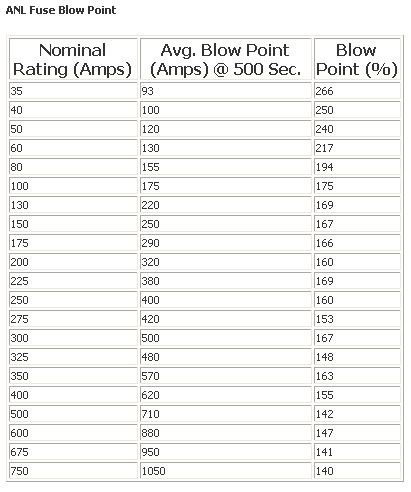
You can get the anl fuses and mounts at NAPA or any boat supply.
It's best to fuse all high amp power wires. Battery cables are about the only ones that never are.
Here is a crude wire sizing calculator. Check the difference between 0 and 1 ga with the cable at 8foot.
http://www.supercircuits.com/resourc...ls/voltageDrop
Here is a chart for sizing anl fuses.
Corvette Stories
The Best of Corvette for Corvette Enthusiasts

Top 10 Most Expensive Corvettes Ever Sold on Bring A Trailer
Brett Foote
10 Things Every Corvette Owner Needs (2026 Edition)
Michael S. Palmer
8 Most "Only Corvette Owners Understand" Quirks and Problems
Pouria Savadkouei
10 Reasons the C6 Z06 is Still A Performance Benchmark After 20 Years
Joe Kucinski
How Much Horsepower Every Corvette Engine "LOST" in 1972
Joe Kucinski
Top 10 DOs and DON'Ts for Protecting Your Convertible Top!
Michael S. Palmer
Top 10 Most Explosive Corvettes Ever Made: Power-to-Weight Ratio Ranked!
Joe Kucinski
150 hp to 1,250 hp: Every Corvette Generation Compared by the Specs That Matter
Joe Kucinski
8 Coolest Corvette Pace Cars (and Replicas) of All Time
Verdad Gallardo
Thread Starter
Race Director
Joined: Dec 1999
Posts: 19,610
Likes: 778
From: Forked River NJ
Ok I will keep the links. I should probably just shorten the wire then and solder with a connector and leave the link in the same position. Some of my suppliers have the butt end connectors now with the solderright in them. You use the butt connector and heat the butt connector and the solder melts inside the connector and you have a good joint. They are quite expensive but what isn't anymore. 

Melting Slicks

Joined: Apr 2001
Posts: 2,030
Likes: 363
From: Lubbock Texas
It's a good choice to stay with fusible links.
As a general rule, fusible links should be two gauge sizes smaller than the wire they are protecting. So, if you are protecting 12 gauge wire, the fusible link should be 16 gauge.
DC
As a general rule, fusible links should be two gauge sizes smaller than the wire they are protecting. So, if you are protecting 12 gauge wire, the fusible link should be 16 gauge.
DC

Le Mans Master
Joined: Oct 2006
Posts: 7,123
Likes: 433
From: Gladstone MO
C3 of Year Finalist (appearance mods) 2019
Ok I will keep the links. I should probably just shorten the wire then and solder with a connector and leave the link in the same position. Some of my suppliers have the butt end connectors now with the solderright in them. You use the butt connector and heat the butt connector and the solder melts inside the connector and you have a good joint. They are quite expensive but what isn't anymore.

Le Mans Master

Joined: Dec 2003
Posts: 5,727
Likes: 38
From: Fremont CA
You could also replace them with circuit breakers. GM now puts master fuses on alternator charging wires. I just went through hell finding the one on a 98 S10. Sucker was below the battery tray corroded with acid. We found our charging system problem after hours of troubleshooting.