




Quadrajet Question

Thread Starter
3rd Gear

Joined: Jun 2011
Posts: 3
Likes: 0
From: Pittsboro NC
 Quadrajet Question
I recently had the following additions installed on my '79 L48 engine, 492(double hump) heads(mildly ported and milled) performer intake, 1.6 roller rocker arms, 1 5/8 cermic headers(dualed out), roller timing chain, and a decent cam was already installed when i bought the car(a little lopey). I currently have a new QJ on the car but was wondering if I needed to upgrade the existing QJ or upgrade to another type such as a holley.

Tech Contributor


Joined: Aug 1999
Posts: 14,379
Likes: 6,390
From: At my Bar drinking and wrenching in Lafayette Colorado
Your engine is a mild street build, and the Q-Jet will handle it just fine in near-stock trim. Set the carb up per the "Quickie Performance Setup" section of my Q-Jet paper, and you'll have a carb that will outperfrom the Holley across the rpm range for your street engine.
To prove that point, I just finished up another dyno test of a mildly-built 400, and the results follow…
The engine was a stock-block 400 with stock factory cast iron heads. I got compression ratio up to 10.08:1 with flat-top pistons and the stock deck height. The bottom-end was kept stock with some good rod bolts, and the heads were given a good 3-angle valve job. The restrictive EGR intake was scrapped and an Edelbrock “Performer” intake was used to keep overall engine height near-stock so that there would be no hood interference problems. The owner wanted a very mild cam to maintain engine vacuum and power brakes, so a mild hydraulic roller was used. No other trick parts – the engine was pretty much a modest compression 400 with a mild roller in it.
The real purpose of the dyno run was to get good numbers for the owner and to get a good tune on the engine, but we also wanted to get a back-to-back comparison of a well-tuned Q-Jet to a properly set up Holley of similar size. Those results came in as expected…
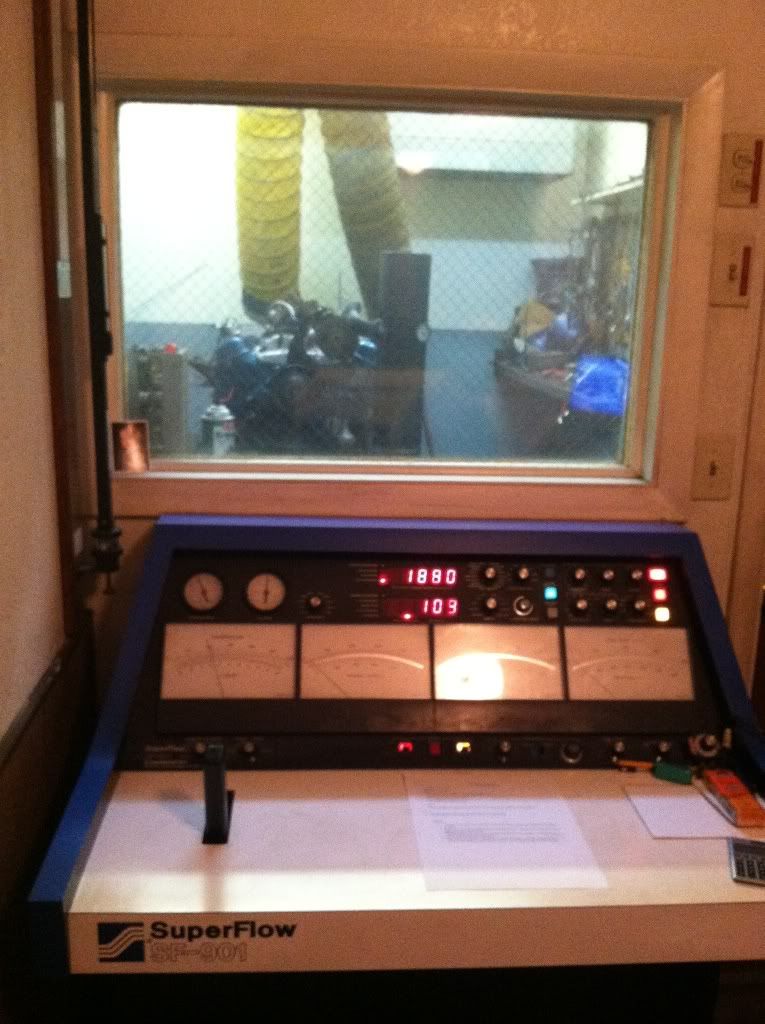
For the first “out-of-the-box” dyno pull, the Q-Jet was used (17056263). This carb is factory jetted at 70/42/DB, which is awfully lean. I re-jetted the carb to 76/42/DB with a 3/8” float level and .640 secondary rod height. Other carb tuning and parameters were set up exactly as outlined in my Q-Jet Tuning Paper under the “Quickie Performance Setup” section.
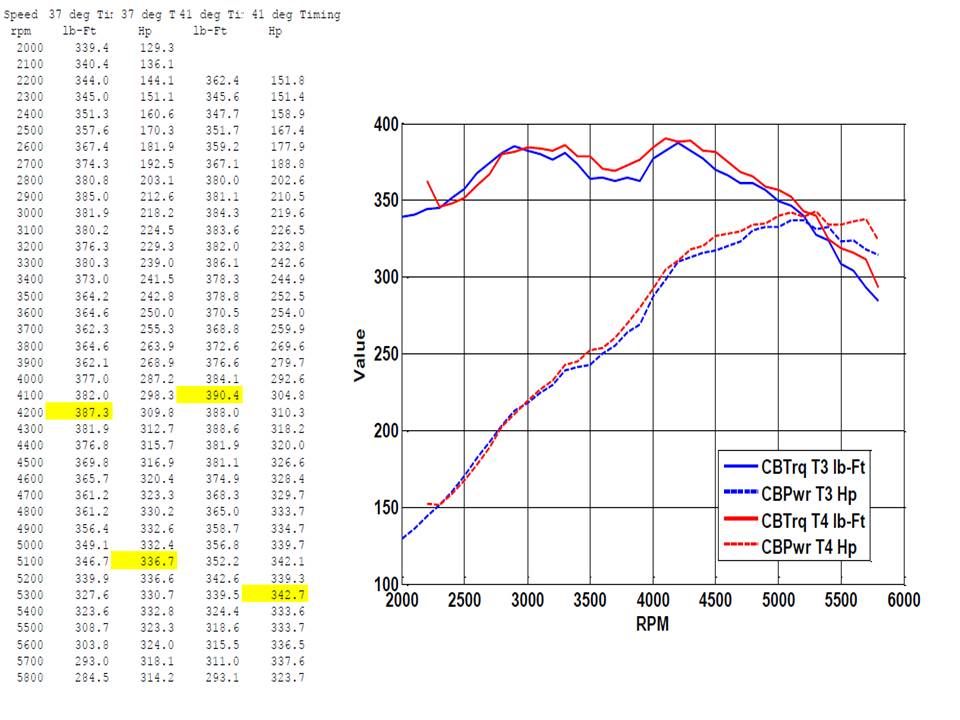
After getting the timing optimized (the inefficient chambers in the iron heads took 41 degrees total timing for best power and torque without detonation – an increase from my initial setting of 37). We were using 91-octane pump gas with 10% ethanol – right out of the gas station down the street. Total timing was coming in before 2000 rpm – a very quick curve.
Curve showing effect of 37 vesus 41 degrees of timing. Red line is 41 degrees timing:
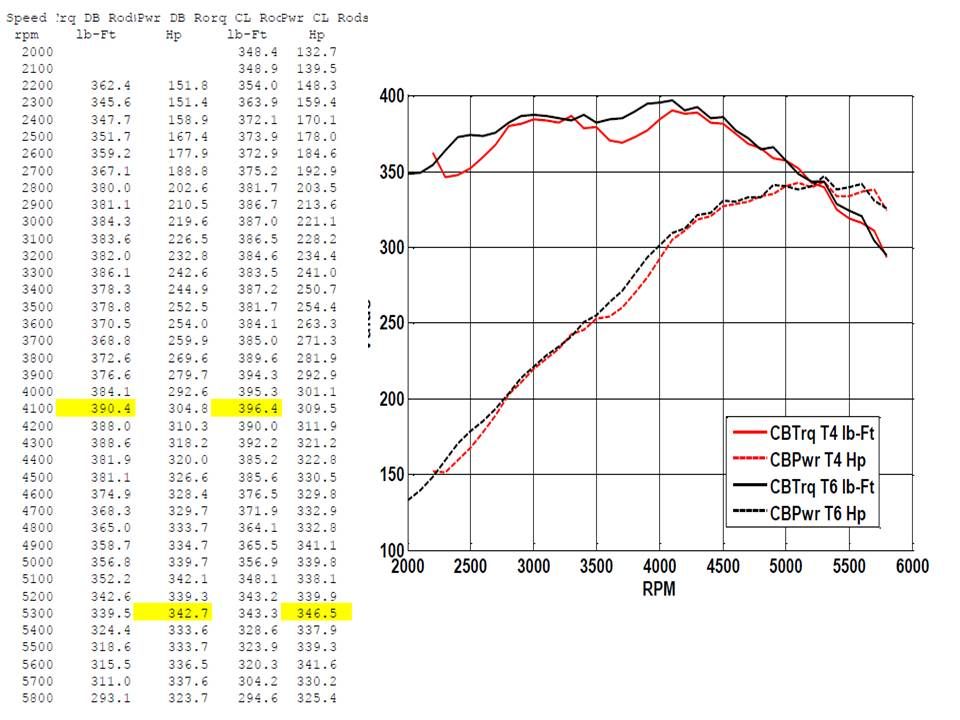
The 4 initial pulls we did on the engine showed a “dip” in the torque curve (with resulting “sag” in the power curve) between 3500 and 4000. This is right where the Q-Jet secondary airvalve is starting to open up, and the air/fuel numbers were showing a lean condition right at the tip-in of the secondaries. The stock “DB” secondary rods in the carb have the “short” power tips, which delay fuel enrichment. We installed a pair of Edelbrock “CL” rods which have about the same diameter (just a small tad richer), but they have the “long” power tips. Richening up the secondary tip-in point really flattened out the torque curve and made the power curve a near straight-line shot towards the top.
Curve showing effect of "tweaking" the Q-Jet secondary rods:
Once this had been sorted out and the Q-Jet was correctly tuned, I wanted to do the final run just to prove one of my pet-peeve points: Q-Jets are garbage, and any Holley will outperform a Q-Jet… blah, blah, blah… As I state in all my seminars and papers, a properly tuned Q-Jet will perform almost identical to a properly tuned Holley, except that the Q-Jet tends to produce better torque and throttle response in the low and mid range in a street driven vehicle than the Holley. Now that we had our Q-Jet pretty well dialed in, it was time for a switch to the Holley.
The Holley I selected was a 3310-1, which is a 750 vacuum secondary with the secondary metering block (not the cheap plate). The carb was set up and tuned to spec with 72 primary jets, 80 secondary, and the “tall yellow” secondary spring was selected to assure that the secondaries would actually open. Choke system was removed to give it all the airflow advantage it could get. Float levels, shooters, and all tuning parameters were all set up correctly and verified and “blessed” by noted NASCAR engine builder Steve Yacki (who was also our dyno operator this day). The Holley was given 2 pulls on the dyno, and we verified that the air/fuel ratio on the Holley was virtually identical to the Q-Jet: The A/F numbers matched exactly at many data points, and were never different by more than 0.5:1 at any time through the entire rpm range – the 2 carbs were metering air and fuel at exactly the same ratio, so there was no “fudging” any numbers on these pulls.
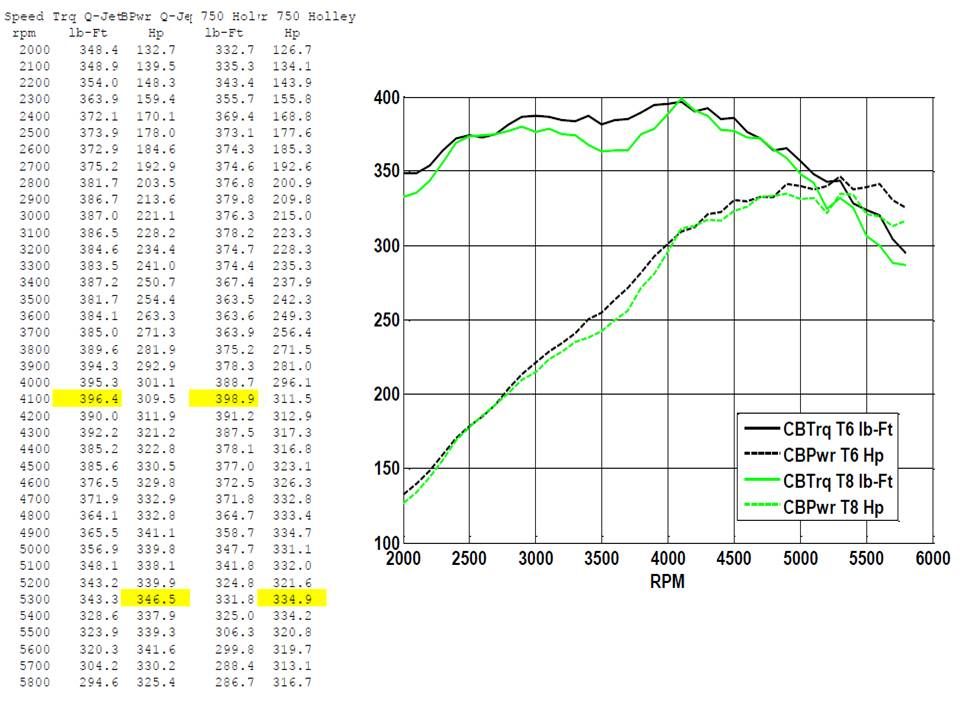
The Q-Jet bettered the Holley by 15 ft/lbs of torque on the bottom end, and pulled more than 20 ft/lbs at many data points, with a 10 to 20 horsepower gain over the Holley at many points through the range. The Holley produced a couple of peak numbers at limited points, but not enough to give it any advantage over the Q-Jet. The mass airflow numbers through the Holley were also lower than the airflow numbers through the Q-Jet at high rpm, and this can be seen by the drop-off in the Holley performance at the top of the curve. We even did one Holley run with me forcing the secondaries fully open for the top ½ of the rpm range, but this killed all the top-end numbers completely: The carb liked the “tall yellow” spring.
The numbers between the two carbs are fairly close, but if these 2 engines had been installed in 2 identical street cars, the Q-Jet car would have come across the finish line ahead of the Holley car by a significant margin.
This is not to say that either carb is “better.” But the fact is, that if you set these carbs up correctly, and know how to tune them, they can be made to run very well. There is no point in replacing a badly-tuned Q-Jet with a badly-tuned Holley or vice versa. A well-tuned Holley will run better than a badly-tuned Q-Jet, and this is what is usually the case in the “Holley is better than that crap Q-Jet” argument. If you have a good Q-Jet and know how to set it up, run it on your street car. If you don’t have a carb, or don’t know how to tune a Q-Jet, a Holley will run fine, but you better be able to tune it, too. Black lines are Q-Jet, green lines are Holley:
Lars
To prove that point, I just finished up another dyno test of a mildly-built 400, and the results follow…
The engine was a stock-block 400 with stock factory cast iron heads. I got compression ratio up to 10.08:1 with flat-top pistons and the stock deck height. The bottom-end was kept stock with some good rod bolts, and the heads were given a good 3-angle valve job. The restrictive EGR intake was scrapped and an Edelbrock “Performer” intake was used to keep overall engine height near-stock so that there would be no hood interference problems. The owner wanted a very mild cam to maintain engine vacuum and power brakes, so a mild hydraulic roller was used. No other trick parts – the engine was pretty much a modest compression 400 with a mild roller in it.
The real purpose of the dyno run was to get good numbers for the owner and to get a good tune on the engine, but we also wanted to get a back-to-back comparison of a well-tuned Q-Jet to a properly set up Holley of similar size. Those results came in as expected…
For the first “out-of-the-box” dyno pull, the Q-Jet was used (17056263). This carb is factory jetted at 70/42/DB, which is awfully lean. I re-jetted the carb to 76/42/DB with a 3/8” float level and .640 secondary rod height. Other carb tuning and parameters were set up exactly as outlined in my Q-Jet Tuning Paper under the “Quickie Performance Setup” section.
After getting the timing optimized (the inefficient chambers in the iron heads took 41 degrees total timing for best power and torque without detonation – an increase from my initial setting of 37). We were using 91-octane pump gas with 10% ethanol – right out of the gas station down the street. Total timing was coming in before 2000 rpm – a very quick curve.
Curve showing effect of 37 vesus 41 degrees of timing. Red line is 41 degrees timing:
The 4 initial pulls we did on the engine showed a “dip” in the torque curve (with resulting “sag” in the power curve) between 3500 and 4000. This is right where the Q-Jet secondary airvalve is starting to open up, and the air/fuel numbers were showing a lean condition right at the tip-in of the secondaries. The stock “DB” secondary rods in the carb have the “short” power tips, which delay fuel enrichment. We installed a pair of Edelbrock “CL” rods which have about the same diameter (just a small tad richer), but they have the “long” power tips. Richening up the secondary tip-in point really flattened out the torque curve and made the power curve a near straight-line shot towards the top.
Curve showing effect of "tweaking" the Q-Jet secondary rods:
Once this had been sorted out and the Q-Jet was correctly tuned, I wanted to do the final run just to prove one of my pet-peeve points: Q-Jets are garbage, and any Holley will outperform a Q-Jet… blah, blah, blah… As I state in all my seminars and papers, a properly tuned Q-Jet will perform almost identical to a properly tuned Holley, except that the Q-Jet tends to produce better torque and throttle response in the low and mid range in a street driven vehicle than the Holley. Now that we had our Q-Jet pretty well dialed in, it was time for a switch to the Holley.
The Holley I selected was a 3310-1, which is a 750 vacuum secondary with the secondary metering block (not the cheap plate). The carb was set up and tuned to spec with 72 primary jets, 80 secondary, and the “tall yellow” secondary spring was selected to assure that the secondaries would actually open. Choke system was removed to give it all the airflow advantage it could get. Float levels, shooters, and all tuning parameters were all set up correctly and verified and “blessed” by noted NASCAR engine builder Steve Yacki (who was also our dyno operator this day). The Holley was given 2 pulls on the dyno, and we verified that the air/fuel ratio on the Holley was virtually identical to the Q-Jet: The A/F numbers matched exactly at many data points, and were never different by more than 0.5:1 at any time through the entire rpm range – the 2 carbs were metering air and fuel at exactly the same ratio, so there was no “fudging” any numbers on these pulls.
The Q-Jet bettered the Holley by 15 ft/lbs of torque on the bottom end, and pulled more than 20 ft/lbs at many data points, with a 10 to 20 horsepower gain over the Holley at many points through the range. The Holley produced a couple of peak numbers at limited points, but not enough to give it any advantage over the Q-Jet. The mass airflow numbers through the Holley were also lower than the airflow numbers through the Q-Jet at high rpm, and this can be seen by the drop-off in the Holley performance at the top of the curve. We even did one Holley run with me forcing the secondaries fully open for the top ½ of the rpm range, but this killed all the top-end numbers completely: The carb liked the “tall yellow” spring.
The numbers between the two carbs are fairly close, but if these 2 engines had been installed in 2 identical street cars, the Q-Jet car would have come across the finish line ahead of the Holley car by a significant margin.
This is not to say that either carb is “better.” But the fact is, that if you set these carbs up correctly, and know how to tune them, they can be made to run very well. There is no point in replacing a badly-tuned Q-Jet with a badly-tuned Holley or vice versa. A well-tuned Holley will run better than a badly-tuned Q-Jet, and this is what is usually the case in the “Holley is better than that crap Q-Jet” argument. If you have a good Q-Jet and know how to set it up, run it on your street car. If you don’t have a carb, or don’t know how to tune a Q-Jet, a Holley will run fine, but you better be able to tune it, too. Black lines are Q-Jet, green lines are Holley:
Lars
Last edited by lars; Apr 9, 2012 at 11:06 AM.

Racer
Joined: Nov 2004
Posts: 485
Likes: 1
From: Oakville ON
question for Lars
"The 4 initial pulls we did on the engine showed a “dip” in the torque curve (with resulting “sag” in the power curve) between 3500 and 4000. This is right where the Q-Jet secondary airvalve is starting to open up, and the air/fuel numbers were showing a lean condition right at the tip-in of the secondaries. The stock “DB” secondary rods in the carb have the “short” power tips, which delay fuel enrichment. We installed a pair of Edelbrock “CL” rods which have about the same diameter (just a small tad richer), but they have the “long” power tips. Richening up the secondary tip-in point really flattened out the torque curve and made the power curve a near straight-line shot towards the top."
I don't understand why you say 'the air valve is STARTING to open up', but the rod tips were too lean. Doesn't the air valve have to be half-way open to get on the tips?
Thanks.
I don't understand why you say 'the air valve is STARTING to open up', but the rod tips were too lean. Doesn't the air valve have to be half-way open to get on the tips?
Thanks.
Tech Contributor
Joined: Aug 1999
Posts: 14,379
Likes: 6,390
From: At my Bar drinking and wrenching in Lafayette Colorado
We're talking symantics here... to me, it's "starting to open" up until the time it's open. Point is, the secondary went lean part-way into the secondary opening cycle, and I fixed it by bringing in the fuel enrichment a little sooner. See the graph.
lars
lars
Last edited by lars; Apr 9, 2012 at 07:08 PM.

Safety Car


Joined: Oct 2000
Posts: 3,593
Likes: 103
From: Southern Indiana
If you want to go faster right out of the box and feel more power then switch to a Holley, like a 750 vacuum secondary and add an adjustable secondary pod, or if you like to sit at the work bench and tinker for days then run your quadrajet.
Not everyone has a dyno at their disposal.
Not everyone has a dyno at their disposal.
Last edited by Tim H; Apr 10, 2012 at 03:42 AM.
Corvette Stories
The Best of Corvette for Corvette Enthusiasts

Top 10 Most Expensive Corvettes Ever Sold on Bring A Trailer
Brett Foote
10 Things Every Corvette Owner Needs (2026 Edition)
Michael S. Palmer
8 Most "Only Corvette Owners Understand" Quirks and Problems
Pouria Savadkouei
10 Reasons the C6 Z06 is Still A Performance Benchmark After 20 Years
Joe Kucinski
How Much Horsepower Every Corvette Engine "LOST" in 1972
Joe Kucinski
Top 10 DOs and DON'Ts for Protecting Your Convertible Top!
Michael S. Palmer
Top 10 Most Explosive Corvettes Ever Made: Power-to-Weight Ratio Ranked!
Joe Kucinski
150 hp to 1,250 hp: Every Corvette Generation Compared by the Specs That Matter
Joe Kucinski
8 Coolest Corvette Pace Cars (and Replicas) of All Time
Verdad Gallardo
Tech Contributor
Joined: Aug 1999
Posts: 14,379
Likes: 6,390
From: At my Bar drinking and wrenching in Lafayette Colorado
I think I just demonstrated that a Q-Jet with a simple jet and rod change, in a mild street engine, will outperform a 750 Holley, even after the Holley has been set up and verified on the dyno. Installing an adjustable secondary diaphragm isn't going to give the Holley any more power.
That's why I share the data, and the tuning setup, I obtain from my factual testing.
Lars

Racer

Joined: Aug 2007
Posts: 267
Likes: 0
From: Springdale Arkansas
Give up Lars
Lars,
you can give up now, you can't sway this guy he chooses to remain uninformed no matter the converstation. He has attacked some of my post more than once, Ignorance is bliss.
Average Joe would be shocked if he saw the numbers put up by a Q-jet. I have seen one of the most reputable race engine builder in the U.S shake his head and laugh in the HP and TQ difference of the two when he Dynoed them back to back.
As you know, success in any endeavor is in the details.
Best Regards,Jim
you can give up now, you can't sway this guy he chooses to remain uninformed no matter the converstation. He has attacked some of my post more than once, Ignorance is bliss.
Average Joe would be shocked if he saw the numbers put up by a Q-jet. I have seen one of the most reputable race engine builder in the U.S shake his head and laugh in the HP and TQ difference of the two when he Dynoed them back to back.
As you know, success in any endeavor is in the details.
Best Regards,Jim

Le Mans Master


Joined: Jun 2004
Posts: 6,231
Likes: 65
From: Seattle WA
St. Jude Donor '14

Lars, nice to see you posting here again - and what a great post; thank you! Nice to see such an excellent comparision!
I've also caught Hell for noting my standard refrain:
In general, ANY properly sized carb that's properly tuned, in the proper configuration and working correctly will deliver within a few HP of each other. ...
So I tend towards Q-Jets on cars that are going to be a "one and done"; a build or upgrade that's not going to see a lot of changes during it's operational life, and Holley on cars that are going to see a lot of changes...just because tuning expertise and parts are (mostly) readily available, and the guy is going to have his hands in the engine on a regular basis anyway. Just one guy's $.02.
Last edited by billla; Apr 10, 2012 at 11:06 AM.
Racer
Joined: Nov 2004
Posts: 485
Likes: 1
From: Oakville ON
Thanks Lars
Welcome back. I hope your shoulder is healing well.
Rich


Le Mans Master
Joined: Feb 1999
Posts: 8,351
Likes: 75
From: Tampa Bay FL
Lars,
Glad you're back. Always a pleasure to read about your tuning sessions.
Any plans for 'Tuning for Beer' tour in the future?
Lars has built two q-jets and a points-style distributor for my C3's (a '69 L46 and my '80 L48). I remember Lars relating how he tested the q-jet for my '69 on his convertible mid-year... in cold weather!!!
Glad you're back. Always a pleasure to read about your tuning sessions.
Any plans for 'Tuning for Beer' tour in the future?
Lars has built two q-jets and a points-style distributor for my C3's (a '69 L46 and my '80 L48). I remember Lars relating how he tested the q-jet for my '69 on his convertible mid-year... in cold weather!!!
Last edited by TedH; Apr 10, 2012 at 07:58 PM.

Race Director

Joined: Jul 2001
Posts: 15,892
Likes: 42


Team Owner


Joined: Aug 1999
Posts: 30,995
Likes: 99
From: Ontario
Yes, it certainly nice to see Lars back. As to whether a Q-Jet is OK, I have one on my 1974 L-48 that is an Energizer Bunny. Yep, a rebuilt #7044206 (for you correct folks, AT with L-48, non-CA) that just keeps going...and...going...and going. I can't give Lars credit for that. Our Club has a person who can still do those jobs.
When I had a 1967 327/300 the Holley gave me a lot of misery...and fire hazards. I would not go near one again.
When I had a 1967 327/300 the Holley gave me a lot of misery...and fire hazards. I would not go near one again.
Racer

Joined: Apr 2011
Posts: 471
Likes: 3
The 4 initial pulls we did on the engine showed a “dip” in the torque curve (with resulting “sag” in the power curve) between 3500 and 4000. This is right where the Q-Jet secondary airvalve is starting to open up, and the air/fuel numbers were showing a lean condition right at the tip-in of the secondaries. The stock “DB” secondary rods in the carb have the “short” power tips, which delay fuel enrichment. We installed a pair of Edelbrock “CL” rods which have about the same diameter (just a small tad richer), but they have the “long” power tips. Richening up the secondary tip-in point really flattened out the torque curve and made the power curve a near straight-line shot towards the top.
Looking at Quadrajetparts website, it seems long tips make leaner situations...
Last edited by Iron_dog; Apr 11, 2012 at 04:16 AM.

Safety Car

Joined: Sep 2011
Posts: 4,118
Likes: 1,230
From: Madeira Beach, FL
2024 C8 of the Year Finalist - Unmodified
2024 C2 of the Year Finalist - Unmodified
2023 C2 of the Year Finalist - Unmodified
2020 C3 of the Year Finalist - Unmodified
Lars,
glad to see you back and in good spirits.
The power of prayer!
I have a rebuilt q-jet on my 427/390hp and I love the sound
when the secondaries start to open.
My carb delivers around 10 mpg around the suburbs.
It performs amazing at 0-90mph smoothly.
I need to work out a WOT issue.
At around 4100 rpms it sounds like its looking for more fuel?
Other than that if driven casually it performs perfect.
I know your going to cringe; but I purchased it off ebay.
The seller assembled several and sold them. No painted parts either.
So far so good. I'll check my ignition as you and John always rec 1st
than I'll see how she performs. I may need to richen up my secondaries to come in earlier as you did. Great info!!!
I'm stickin with my q-jet.
Lars, you should start an apprenticeship for young gear heads as
we will need future tuners when we are wheelchair racers
Welcome Back!!
Thee Marshal
glad to see you back and in good spirits.
The power of prayer!
I have a rebuilt q-jet on my 427/390hp and I love the sound
when the secondaries start to open.
My carb delivers around 10 mpg around the suburbs.
It performs amazing at 0-90mph smoothly.
I need to work out a WOT issue.
At around 4100 rpms it sounds like its looking for more fuel?
Other than that if driven casually it performs perfect.
I know your going to cringe;
but I purchased it off ebay.The seller assembled several and sold them. No painted parts either.
So far so good. I'll check my ignition as you and John always rec 1st
than I'll see how she performs. I may need to richen up my secondaries to come in earlier as you did. Great info!!!
I'm stickin with my q-jet.
Lars, you should start an apprenticeship for young gear heads as
we will need future tuners when we are wheelchair racers
Welcome Back!!
Thee Marshal
Tech Contributor
Joined: Aug 1999
Posts: 14,379
Likes: 6,390
From: At my Bar drinking and wrenching in Lafayette Colorado
For the setup and tuning part of your concern, I have written the "Quickie Performance Setup" section of my Q-Jet setup paper: If a guy just does these simple setups to his Q-Jet (assuming the Q-Jet is a non-screwed-up original carbs that has not been molested and altered by a commercial builder), the carb will run very well on almost any street driven engine.
The second part of your concern regarding the parts availability is very real: Only a few secondary rods are available, other than the narrow selection offered by Edelbrock. Primary jets are readily available in any size, and primary rods for the pre-'75 (divorced choke) carbs are available from several sources. But primary rods for the '75+ (integral choke) carbs are impossible to find (K-series rods for passenger cars), making good tuning of the cruise mixture difficult on the popular '75-'79 Q-Jets. This puts fine-tuning of a Q-Jet (or the correct repair of one that's been mis-jetted) beyond the capability of the average garage tuner who does not have access to a bunch of "donor carbs" for parts.
The carb used for the testing done above was simply re-jetted on the primary side with no rod change, and then I installed the "long taper" secondary rods to correct that lean-out dip. Other than that, the carb was simply set up per my tuning paper recommendation, resulting in some really great performance with a very simple setup. If the engine owner wants to lean it out a little at cruise, there is the option to use the APT adjustment and simply lower the primary rods into the jets a little deeper without a rod change. So there are ways to do the tuning and setup without extensive parts changes.
...and thanks for the kind words: Good to see an enthusiastic group here!
Lars