




70-72 Emissions?

Thread Starter
Intermediate

Joined: May 2011
Posts: 31
Likes: 0
From: Longwood Florida
 70-72 Emissions?
I read that the 70-72 Corvettes were very underpowered due to emissions. What did they do to decrease the horsepower? Just wondering if it would be something that would easily be reversed. And if there is a thread or link to this that would be great!

Burning Brakes


Joined: Jun 2003
Posts: 1,079
Likes: 1
From: Niagara Falls ON
The catalytic converters of the day did flow very well. Aftermarket ones today flow better so you won't get the power loss that you would with the original cat.
AIR pumps add drag to the engine so that can take away from power.
Keep in mind that in 1972 the measurement of HP went from gross to net. The numbers seem like less HP but that isn't always the case.
The difference in HP by removing that stuff is minimal. If you really want HP, get a C6. These cars are old technology and there are kids today with modified Hondas that will blow C3s and C4s away.
My opinion, keep it original and enjoy the drive.
AIR pumps add drag to the engine so that can take away from power.
Keep in mind that in 1972 the measurement of HP went from gross to net. The numbers seem like less HP but that isn't always the case.
The difference in HP by removing that stuff is minimal. If you really want HP, get a C6. These cars are old technology and there are kids today with modified Hondas that will blow C3s and C4s away.
My opinion, keep it original and enjoy the drive.

Le Mans Master


Joined: Nov 2004
Posts: 5,253
Likes: 768
From: Waterford WI
In 71 they reduced compression ratios because of emissions requirements. In 72 the horsepower was essentially the same but rated net (rather than gross). The real drops in performance actually came in 74-up. 75 was extremely low.
Thread Starter
Intermediate
Joined: May 2011
Posts: 31
Likes: 0
From: Longwood Florida
Thanks for the tip! I have college to get through before I can even start thinking about a vette but why not learn while I can? By the way, I really like your Stingray and Z06. Very clean!

Team Owner


Joined: Jan 2006
Posts: 37,637
Likes: 3,118
From: Crossville TN
The 1970 Corvette had some of the most powerful engines GM ever built. The emissions systems on the 70-72 Corvettes did not rob the engines of much power. In '71, the compression ratio lowered so that all GM engines could run on unleaded gasoline. In '72, the method of rating engine horsepower was changed to a "net" value (minus losses from attached engine 'accessories') instead of the "gross" HP method used previously. But, the engines in the '72 C3's were [essentially] identical to those in '71.
When at WOT, the emissions 'add-ons' had little impact on the engine's performance...other than the reduced compression ratio, which was required by GM. [And that can be easily altered with new heads.]
When at WOT, the emissions 'add-ons' had little impact on the engine's performance...other than the reduced compression ratio, which was required by GM. [And that can be easily altered with new heads.]

Race Director


Joined: Sep 1999
Posts: 11,361
Likes: 383
From: Plano TX
We use SAE Net today.
SAE gross: Cold inlet air, recurved distributor, dyno headers, no waterpump, alternator etc.
SAE Net: Realistic inlet air temp, distributor, carb, exhaust the same as installed in car and all accessories driven.
Cars were rated both SAE Gross and Net in 1971. The 454 in the 'vette was 365 hp gross and 285 net.
SAE gross: Cold inlet air, recurved distributor, dyno headers, no waterpump, alternator etc.
SAE Net: Realistic inlet air temp, distributor, carb, exhaust the same as installed in car and all accessories driven.
Cars were rated both SAE Gross and Net in 1971. The 454 in the 'vette was 365 hp gross and 285 net.

Race Director

Joined: Jul 2001
Posts: 15,892
Likes: 42
The actual decrease in HP was due to a combination of reduced compression ratio, milder cam and conservative ignition maps- all of which was required to meet smog regulation and to run on the brand new unleaded low octane gas.
The simultaneous change in how HP was advertised just added to the confusion and perception. Crate engines are still sold with gross HP ratings- the so-called 300HP engines area really about 225-250HP.
Corvette Stories
The Best of Corvette for Corvette Enthusiasts

Top 10 Most Expensive Corvettes Ever Sold on Bring A Trailer
Brett Foote
10 Things Every Corvette Owner Needs (2026 Edition)
Michael S. Palmer
8 Most "Only Corvette Owners Understand" Quirks and Problems
Pouria Savadkouei
10 Reasons the C6 Z06 is Still A Performance Benchmark After 20 Years
Joe Kucinski
How Much Horsepower Every Corvette Engine "LOST" in 1972
Joe Kucinski
Top 10 DOs and DON'Ts for Protecting Your Convertible Top!
Michael S. Palmer
Top 10 Most Explosive Corvettes Ever Made: Power-to-Weight Ratio Ranked!
Joe Kucinski
150 hp to 1,250 hp: Every Corvette Generation Compared by the Specs That Matter
Joe Kucinski
8 Coolest Corvette Pace Cars (and Replicas) of All Time
Verdad Gallardo
Melting Slicks

Joined: Feb 2006
Posts: 3,428
Likes: 5
From: Japan
1970 was really the peak in terms of performance for American cars in the 'Musclecar era'. The enviro-**** crusade actually began in 1965 with minimal measures like PCV valves vs. open breather tubes, etc. but most 1970 cars still had minimal smog equipment. As Mike stated when low-lead gas was introduced in 1971 automakers had to reduce compression ratios to accomodate the new gasoline and by 1975 all new cars had to run unleaded gas which required low compression ratios along with catalytic converters.
I actually de-compressed my '70 from 10.25:1 down to 9.25:1 in order to get it to run without protest on modern swill...somewhat of a drastic measure and actually pulling it off turned out to be one of the biggest headaches of my entire life but in the end I'm glad I did it.
I actually de-compressed my '70 from 10.25:1 down to 9.25:1 in order to get it to run without protest on modern swill...somewhat of a drastic measure and actually pulling it off turned out to be one of the biggest headaches of my entire life but in the end I'm glad I did it.

Le Mans Master
Joined: Dec 2003
Posts: 5,727
Likes: 38
From: Fremont CA
Our 1970 LT-1 Vette makes 370HP on 350 cu/in. I think that is a pretty good HP per cu/in rating. The 72 LT-1 was rated SAE net HP of 255 I think the 70 would be around 305-320HP tested in the same manner.



Team Owner

Joined: Sep 2006
Posts: 31,285
Likes: 4,374
From: Westminster Maryland
Hi,
Here are the published S.A.E. net numbers for the 1971 engines.
They really don't seem to be very widely known, and NOTE; they're different than the 1972 numbers.
Regards,
Alan
The base sb and bb engines are pleasant to work on because they didn't have the AIR equipment.
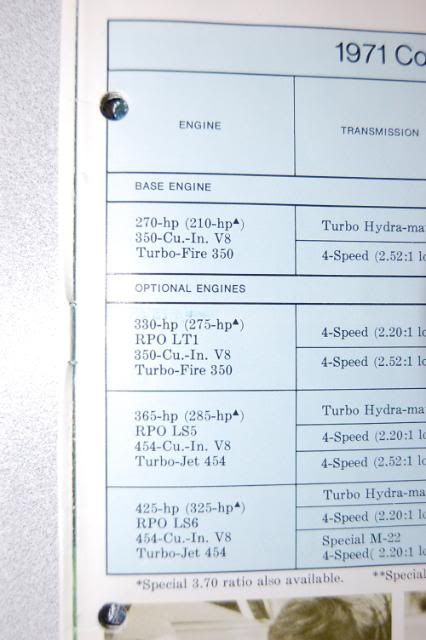
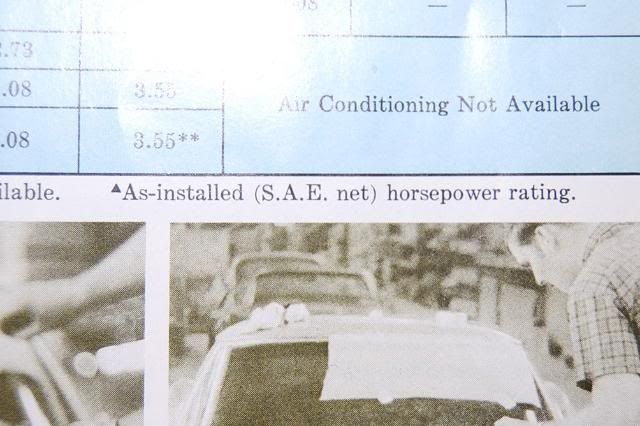
Here are the published S.A.E. net numbers for the 1971 engines.
They really don't seem to be very widely known, and NOTE; they're different than the 1972 numbers.
Regards,
Alan
The base sb and bb engines are pleasant to work on because they didn't have the AIR equipment.
Last edited by Alan 71; Apr 16, 2012 at 02:24 PM.


Thread Starter
Intermediate
Joined: May 2011
Posts: 31
Likes: 0
From: Longwood Florida