



Full manifold vac?
Thread Starter
Racer

Joined: Mar 2012
Posts: 396
Likes: 13
From: New Bern NC
 Full manifold vac?
Where is the full manifold vac ports on a Quadrajet at IDLE? (1975 L48, all original)
Are those the conenctions along the base or the ones higher up near the middle/top of the front of the carb?
I think I messed up my vac lines so I need to reverify all of them as being connected to the correct spot... my idle INCREASES as the car warms up which is backwards. LOL
Are those the conenctions along the base or the ones higher up near the middle/top of the front of the carb?
I think I messed up my vac lines so I need to reverify all of them as being connected to the correct spot... my idle INCREASES as the car warms up which is backwards. LOL
Last edited by ATIS; May 31, 2012 at 03:48 PM.

Race Director


Joined: Apr 2011
Posts: 11,183
Likes: 3,334
From: North of Toronto - Ontario
Properly, yes
But if you read through (mainly Lars' papers) if the advance unit meets certain criteria, the car may like full manifold vacuum on the advance.
I did mine (timing, carb, etc) last weekend and it does seem ok with full vac on the advance and although only two days (maybe 4 hours) driving, it is running cooler around town (go figure)
Mooser
But if you read through (mainly Lars' papers) if the advance unit meets certain criteria, the car may like full manifold vacuum on the advance.
I did mine (timing, carb, etc) last weekend and it does seem ok with full vac on the advance and although only two days (maybe 4 hours) driving, it is running cooler around town (go figure)
Mooser
Thread Starter
Racer
Joined: Mar 2012
Posts: 396
Likes: 13
From: New Bern NC
My issue is I cant get the idle under control. Currently it is 800 on cold start and climbs to 1200 when warm! I must have put a vac line back in the wrong place on the carb so I am going to go back through them all.
Corvette Stories
The Best of Corvette for Corvette Enthusiasts

150 hp to 1,250 hp: Every Corvette Generation Compared by the Specs That Matter
Joe Kucinski
8 Coolest Corvette Pace Cars (and Replicas) of All Time
Verdad Gallardo
Top 10 Corvette Engines RANKED by Peak Torque (70+ Years of Muscle!)
Joe Kucinski
Corvette ZR1X Will Be Pacing the Indy 500, And Could Probably Race, Too!
Verdad Gallardo
Top 10 Corvettes Coming to Mecum Indy 2026!
Brett Foote
Top 10 C9 Corvette MUST-HAVES to Fix These C8 Generation Flaws!
Michael S. Palmer
10 Revolutionary 'Corvette Firsts' Most People Don't Know
Joe Kucinski
5 Reasons to Upgrade to an LS6-Powered Corvette; 5 Reasons to Stay LT2
Michael S. Palmer
2027 Corvette vs The World: Every C8 vs Its Closest Competitor
Joe Kucinski
Team Owner


Joined: Jan 2006
Posts: 37,637
Likes: 3,116
From: Crossville TN
For 'testing' purposes, you need to pull off all vacuum lines feeding other systems and plug their outlets, so that you can set the carb up and determine if there is a carb problem or a vacuum leak somewhere. By plugging off all the possible leakage points (except for intake manifold and carb gaskets), pulling the hoses and plugging them off will limit possible leakage points to intake and carb gaskets. You can check for gasket leaks by shooting very small puffs of carb cleaner at potential leak areas (while the engine is idling) and listen for rpm increases [which would indicate that the carb cleaner is being ingested via that area of gasketing]. Check around carb base, along the sides of the intake manifold, and at the [valley] ends.
If you do this and are successful with getting the carb to idle well, then put the hoses back on and see what happens. Problem? It's in the vacuum system somewhere. No problem? High five!
If you do this and are successful with getting the carb to idle well, then put the hoses back on and see what happens. Problem? It's in the vacuum system somewhere. No problem? High five!

Melting Slicks


Joined: Sep 2010
Posts: 2,405
Likes: 59
From: Emerald Isle NC
The only manif. vac source I could find on my Q-jet was on the pass. side, coming out by the choke/fast idle cam. The carb is a service replacement. The correct number, date code carb I replaced it with does not have this port. I replaced the brake booster port with a part for a GTO with ram air. It has a small nipple on it that I hooked my dist. to for manif. vac. Check Dr. Rebuild catalog for vac. hose routing.
Somehow, I don't think your prob. is vac. related.
Make sure your fast idle cam isn't repositioning/hanging up in a higher idle setting. Might try a little lube in that area first, but I'm no expert...
Somehow, I don't think your prob. is vac. related.
Make sure your fast idle cam isn't repositioning/hanging up in a higher idle setting. Might try a little lube in that area first, but I'm no expert...

Team Owner


Joined: Jun 2000
Posts: 38,923
Likes: 1,481
From: Southbound
Cruise-In II Veteran

Tech Contributor


Joined: Aug 1999
Posts: 14,373
Likes: 6,370
From: At my Bar drinking and wrenching in Lafayette Colorado
On the 1975+ M4M (integral choke) Q-Jets used with the EGR systems, the only ported vacuum source is the nipple coming out of the carb throttle baseplate on the front passenger side corner at a 45-degree angle. All other ports are manifold vacuum. The ported source and the direct manifold vacuum ports were routed to a temperature control valve which "decided" which "type" of vacuum to route to the distributor and the EGR, depending on engine temperature: When the engine was dead cold, there was no vacuum at all to the distributor. This retarded timing heated the engine up quickly and lowered emissions. Once the engine got up to normal operating temp, the valve switched the distributor to ported vacuum to keep emissions low at idle, yet allow vacuum advance at cruise. If the engine got hot, the valve switched over to full manifold vacuum to advance the timing and cool the engine down. The EGR always ran off ported vacuum so that the EGR would stay closed at idle and only open at cruise.
If you eliminate the temperature valve, you can run the EGR right off the ported vacuum nipple and hook up vacuum advance to any of the other nipples, which will be manifold vacuum.
Lars
If you eliminate the temperature valve, you can run the EGR right off the ported vacuum nipple and hook up vacuum advance to any of the other nipples, which will be manifold vacuum.
Lars

Team Owner
Joined: Aug 1999
Posts: 30,995
Likes: 98
From: Ontario
On the 1975+ M4M (integral choke) Q-Jets used with the EGR systems, the only ported vacuum source is the nipple coming out of the carb throttle baseplate on the front passenger side corner at a 45-degree angle. All other ports are manifold vacuum. The ported source and the direct manifold vacuum ports were routed to a temperature control valve which "decided" which "type" of vacuum to route to the distributor and the EGR, depending on engine temperature: When the engine was dead cold, there was no vacuum at all to the distributor. This retarded timing heated the engine up quickly and lowered emissions. Once the engine got up to normal operating temp, the valve switched the distributor to ported vacuum to keep emissions low at idle, yet allow vacuum advance at cruise. If the engine got hot, the valve switched over to full manifold vacuum to advance the timing and cool the engine down. The EGR always ran off ported vacuum so that the EGR would stay closed at idle and only open at cruise.
If you eliminate the temperature valve, you can run the EGR right off the ported vacuum nipple and hook up vacuum advance to any of the other nipples, which will be manifold vacuum.
Lars
If you eliminate the temperature valve, you can run the EGR right off the ported vacuum nipple and hook up vacuum advance to any of the other nipples, which will be manifold vacuum.
Lars
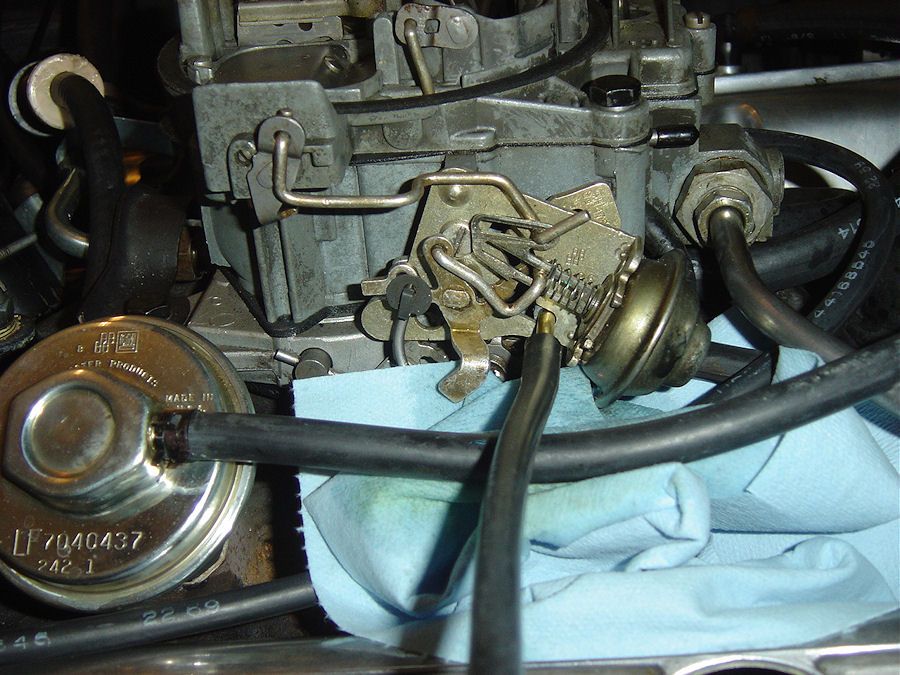
I do use ported vacuum for the distributor (again I think). In any case the car runs well and temps are normal. The carb is #7044206.

This is where I thought manifold vacuum is but I get no constant vacuum there. The rebuilder may have used a wrong base gasket. And given that the car runs well I am not going to fool about.
Last edited by Paul L; Jun 1, 2012 at 07:09 PM.
Thread Starter
Racer
Joined: Mar 2012
Posts: 396
Likes: 13
From: New Bern NC
Thanks for the info eveyone. I get her back from the painter tomorrow (front cover shifted and chipped the edge so they repainted the entire front cover and it will be ready for pick up tomorrow at 9am... I have a show at 11 so it will be close if the weather holds out) then I will get back to fixing the idle issue.