



'70 454 vs. '71 454

Thread Starter
Racer


Joined: Jun 2014
Posts: 495
Likes: 69
Racer
Joined: May 2011
Posts: 484
Likes: 10
From: Newcastle NSW

Not as much as you'd think. The open chamber heads in the '71 have much less shrouded valves and decent airflow. This goes a long way to obviating the power loss from the decreased compression ratio.

Racer

Joined: Nov 2014
Posts: 463
Likes: 129
The only major difference is the compression ratio. Bump it up and you can be at the 1970 rating with no other changes.
The big drop in HP from 1971 to 1972 is only because of how the HP was rated. In 1970 the rating is gross HP, and in 1971 it is net HP.
Gross HP testing was done on a blueprinted engine running headers and no accessories attached. This gave manufacturers a lot of room to play with the numbers.
Net HP testing was done on the engine as actually installed in the car with accessories attached.
The big 3 all agreed to use net HP figures starting in 1972.
John
Thread Starter
Racer
Joined: Jun 2014
Posts: 495
Likes: 69
sbaba
The only major difference is the compression ratio. Bump it up and you can be at the 1970 rating with no other changes.
The big drop in HP from 1971 to 1972 is only because of how the HP was rated. In 1970 the rating is gross HP, and in 1971 it is net HP.
Gross HP testing was done on a blueprinted engine running headers and no accessories attached. This gave manufacturers a lot of room to play with the numbers.
Net HP testing was done on the engine as actually installed in the car with accessories attached.
The big 3 all agreed to use net HP figures starting in 1972.
John
The only major difference is the compression ratio. Bump it up and you can be at the 1970 rating with no other changes.
The big drop in HP from 1971 to 1972 is only because of how the HP was rated. In 1970 the rating is gross HP, and in 1971 it is net HP.
Gross HP testing was done on a blueprinted engine running headers and no accessories attached. This gave manufacturers a lot of room to play with the numbers.
Net HP testing was done on the engine as actually installed in the car with accessories attached.
The big 3 all agreed to use net HP figures starting in 1972.
John

Team Owner


Joined: Sep 2006
Posts: 31,303
Likes: 4,391
From: Westminster Maryland
Hi s,
Here's a chart from 1971 that lists the SAE hp for the 71 engines.
It helps one do a better job of comparing the 70-71-72 numbers for both the rating method and the changes in the engines.
Regards,
Alan
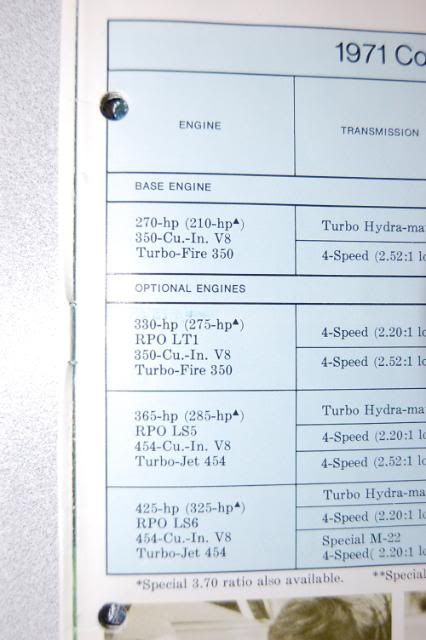
Here's a chart from 1971 that lists the SAE hp for the 71 engines.
It helps one do a better job of comparing the 70-71-72 numbers for both the rating method and the changes in the engines.
Regards,
Alan
Corvette Stories
The Best of Corvette for Corvette Enthusiasts

Every 2027 Corvette Engine Explained
Joe Kucinski
Designer Imagines A Corvette That Looks More Like a Corvette Than the Corvette
Verdad Gallardo
10 Ugly Corvettes That We Still Kinda Love
Joe Kucinski
Top 10 Most Expensive Corvettes Ever Sold on Bring A Trailer
Brett Foote
10 Things Every Corvette Owner Needs (2026 Edition)
Michael S. Palmer
8 Most "Only Corvette Owners Understand" Quirks and Problems
Pouria Savadkouei
10 Reasons the C6 Z06 is Still A Performance Benchmark After 20 Years
Joe Kucinski
How Much Horsepower Every Corvette Engine "LOST" in 1972
Joe Kucinski
Top 10 DOs and DON'Ts for Protecting Your Convertible Top!
Michael S. Palmer
Drifting

Joined: Oct 2005
Posts: 1,615
Likes: 150
From: Forth Worth TX
At the end of the day there is only about a 25hp difference between the 70 (10.25 c/r) and the 71/72 (8.5 c/r) engines. The reason there's a small difference between the 71 and 72 NET HP ratings is that GM retarded the mechanical advance of the timing even more for emissions control. The timing was lazy in all of the engines to begin with.
If you had all thee (70/71/72) and reset the timing to 36* @ 2800rpm, they would all be just about the same. While the 70 had a bit more compression, the larger heads in the 71/72 flowed better.
If you were going to go through all of the trouble of rebuilding a 71/72, you wouldn't want your goal to be just the 25hp difference. Just a set of headers will wake these engines up.
Gross/Net with GM marketing in BOLD.
1970 454-cid 390-hp/304-hp 10.25:1 (22% loss from Gross to Net)
1971 454-cid 365-hp/285-hp 8.5:1 (22% loss from Gross to Net)
1972 454-cid 345-hp/270-hp 8.5:1 (22% loss from Gross to Net)
Here are some dyno results from CF members cars. This is RWHP, not to be confused with Gross or Net.
72ragtop
I had my 72 LS5 dynoed on a Dynojet Research.
Rear wheel numbers on a completely stock motor, auto and 3'08's was 236hp and 326tq at rear wheels. Hope this helps
Zwede
My '71 LS5 (4-speed) back when it was almost stock dynoed 255 rwhp on a Dynojet. Only mod was a close to stock cam (comp 219/229 flat tappet hydraulic). Everything else was stock incl exhaust.
My '71 LS5 ran a 14.1 @101 and dynoed 255 rwhp when it was almost totally stock. Only change was a cam with about 3-4 degrees more duration than stock. Everything else (exhaust, intake, carb, aircleaner, etc) was stock.
Revi (me) mostly stock 70 L-46 (350/350), Slightly bigger cam and ported stock heads.
341hp/387tq (Gross/Engine dyno)
245hp/305tq (RWHP/Dynojet) Everything else (exhaust, intake, carb, aircleaner, etc) was stock.
If you had all thee (70/71/72) and reset the timing to 36* @ 2800rpm, they would all be just about the same. While the 70 had a bit more compression, the larger heads in the 71/72 flowed better.
If you were going to go through all of the trouble of rebuilding a 71/72, you wouldn't want your goal to be just the 25hp difference. Just a set of headers will wake these engines up.
Gross/Net with GM marketing in BOLD.
1970 454-cid 390-hp/304-hp 10.25:1 (22% loss from Gross to Net)
1971 454-cid 365-hp/285-hp 8.5:1 (22% loss from Gross to Net)
1972 454-cid 345-hp/270-hp 8.5:1 (22% loss from Gross to Net)
Here are some dyno results from CF members cars. This is RWHP, not to be confused with Gross or Net.
72ragtop
I had my 72 LS5 dynoed on a Dynojet Research.
Rear wheel numbers on a completely stock motor, auto and 3'08's was 236hp and 326tq at rear wheels. Hope this helps
Zwede
My '71 LS5 (4-speed) back when it was almost stock dynoed 255 rwhp on a Dynojet. Only mod was a close to stock cam (comp 219/229 flat tappet hydraulic). Everything else was stock incl exhaust.
My '71 LS5 ran a 14.1 @101 and dynoed 255 rwhp when it was almost totally stock. Only change was a cam with about 3-4 degrees more duration than stock. Everything else (exhaust, intake, carb, aircleaner, etc) was stock.
Revi (me) mostly stock 70 L-46 (350/350), Slightly bigger cam and ported stock heads.
341hp/387tq (Gross/Engine dyno)
245hp/305tq (RWHP/Dynojet) Everything else (exhaust, intake, carb, aircleaner, etc) was stock.
Last edited by Revi; Apr 4, 2015 at 09:00 AM.
Le Mans Master


Joined: May 2003
Posts: 8,878
Likes: 3,556
From: Fernandina Beach FL
2023 Restomod of the Year finalist
2020 C3 of the Year Winner - Modified
The 73 HP rating was a 4000 vs the LS5 at 5400
There was a cam change and different heads-
LS5 camshaft - lobe lift = .2741/.2824 I/E
LS4 camshaft - lobe lift = .2588/.2588 I/E
Here's some info have saved -found on the interweb...
1) All 70-74 Corvette 454 cid engines were two bolt main configuration EXCEPT 1971 LS-6;
2) Most, if not all, 70-72 Corvette 454 cid engines used a forged steel crankshaft. There may have been some exceptions, though, with those using a cast nodular iron crankshaft;
3) All 73-74 Corvette 454 cid engines used a cast nodular iron crankshaft;
4) All 70-74 Corvettes with 454 cid engines, except 71 LS-6, used the same size intake and exhaust valves which, as I recall, were 2.06" intake and 1.72" exhaust.
5) 1970 LS-5 cylinder heads were unique to that year. For 1971-72 LS-5 engines, although different castings were used for each year, the cylinder heads were, essentially, the same. 1973 and 1974 LS-4 engines used cylinder heads specific to each year which were different for each year. As I recall, all 1970-72 LS-5 engines used cylinder heads which had about the same intake and exhaust port volumes. 73-74 LS-4 cylinder heads had smaller intake and exhaust ports, although I believe that 73 and 74 were about the same. All cylinder heads, except 71 LS-6, were cast iron material. 70-72 cylinder heads did not use induction hardened exhaust valve seats, including the valve seat inserts used on 71 LS-6 aluminum heads. 73-74 LS-4 cylinder heads used induction hardened exhaust valve seats;
6) All 70-72 LS-5 engines used the same camshaft, GM #3883986, which was also used on 66-69 L-36 427 engines. 1973 and 1974 LS-4 engines used a different camshaft, GM #353040, which was the same for both years. This camshaft was an "emissions profile" camshaft;
7) All 70-74 454 LS-4 and LS-5 engines used the same connecting rods which were forged steel with 3/8", knurled shank rod bolts;
All 70-74 LS-4 and LS-5 engines used cast aluminum pistons. The piston dome configuration was unique to each specific year, however, even though compression ratios may have been the same (72-74). 1970 LS-5 used 10.25:1 compression ratio; 1971 LS-5 used 8.5:1 compression ratio; 1972 LS-5 used 8.25:1 compression ratio; 1973-74 LS-4 used 8.25:1 compression ratio.
9) All 1970-74 Corvettes with 454 cid engine used the same oil pan, including LS-6;
10) 70-72 LS-5 engines used unique-to-each-year cast iron intake manifolds. However, all of the manifolds were similar. 73-74 LS-4 intake manifolds were also cast iron but had smaller port size to match the 73-74 cylinder heads. 73-74 manifolds also incorporated provisions for EGR.
11) All 70-74 Corvettes with 454 cid engines used the same side-specific exhaust manifold castings. 1971 with LS-6 and all 73-74 LS-4 manifolds were drilled and tapped for A.I.R. fittings.
12) All 70-74 Corvettes with 454 used the same valve springs except the 73-74 exhaust valve springs which were shorter to accomodate the rotators used during those years.
13) All 70-74 Corvettes with LS-5/LS-4 engines and manual transmissions used a 14" cast nodular iron flywheel with an 11" clutch. LS-6 used a 14" flywheel with a special dual disc clutch;
14) All 70-74 Corvettes with LS-5/LS-4 used the same oil pump
15) 1970-72 with LS-5 used the CCS (controlled combustion system) exhaust emissions control system. All 1971 LS-6 and all 73-74 LS-4 used the AIR (air injection reactor system) exhaust emissions control system.
There was a cam change and different heads-
LS5 camshaft - lobe lift = .2741/.2824 I/E
LS4 camshaft - lobe lift = .2588/.2588 I/E
Here's some info have saved -found on the interweb...
1) All 70-74 Corvette 454 cid engines were two bolt main configuration EXCEPT 1971 LS-6;
2) Most, if not all, 70-72 Corvette 454 cid engines used a forged steel crankshaft. There may have been some exceptions, though, with those using a cast nodular iron crankshaft;
3) All 73-74 Corvette 454 cid engines used a cast nodular iron crankshaft;
4) All 70-74 Corvettes with 454 cid engines, except 71 LS-6, used the same size intake and exhaust valves which, as I recall, were 2.06" intake and 1.72" exhaust.
5) 1970 LS-5 cylinder heads were unique to that year. For 1971-72 LS-5 engines, although different castings were used for each year, the cylinder heads were, essentially, the same. 1973 and 1974 LS-4 engines used cylinder heads specific to each year which were different for each year. As I recall, all 1970-72 LS-5 engines used cylinder heads which had about the same intake and exhaust port volumes. 73-74 LS-4 cylinder heads had smaller intake and exhaust ports, although I believe that 73 and 74 were about the same. All cylinder heads, except 71 LS-6, were cast iron material. 70-72 cylinder heads did not use induction hardened exhaust valve seats, including the valve seat inserts used on 71 LS-6 aluminum heads. 73-74 LS-4 cylinder heads used induction hardened exhaust valve seats;
6) All 70-72 LS-5 engines used the same camshaft, GM #3883986, which was also used on 66-69 L-36 427 engines. 1973 and 1974 LS-4 engines used a different camshaft, GM #353040, which was the same for both years. This camshaft was an "emissions profile" camshaft;
7) All 70-74 454 LS-4 and LS-5 engines used the same connecting rods which were forged steel with 3/8", knurled shank rod bolts;
All 70-74 LS-4 and LS-5 engines used cast aluminum pistons. The piston dome configuration was unique to each specific year, however, even though compression ratios may have been the same (72-74). 1970 LS-5 used 10.25:1 compression ratio; 1971 LS-5 used 8.5:1 compression ratio; 1972 LS-5 used 8.25:1 compression ratio; 1973-74 LS-4 used 8.25:1 compression ratio.
9) All 1970-74 Corvettes with 454 cid engine used the same oil pan, including LS-6;
10) 70-72 LS-5 engines used unique-to-each-year cast iron intake manifolds. However, all of the manifolds were similar. 73-74 LS-4 intake manifolds were also cast iron but had smaller port size to match the 73-74 cylinder heads. 73-74 manifolds also incorporated provisions for EGR.
11) All 70-74 Corvettes with 454 cid engines used the same side-specific exhaust manifold castings. 1971 with LS-6 and all 73-74 LS-4 manifolds were drilled and tapped for A.I.R. fittings.
12) All 70-74 Corvettes with 454 used the same valve springs except the 73-74 exhaust valve springs which were shorter to accomodate the rotators used during those years.
13) All 70-74 Corvettes with LS-5/LS-4 engines and manual transmissions used a 14" cast nodular iron flywheel with an 11" clutch. LS-6 used a 14" flywheel with a special dual disc clutch;
14) All 70-74 Corvettes with LS-5/LS-4 used the same oil pump
15) 1970-72 with LS-5 used the CCS (controlled combustion system) exhaust emissions control system. All 1971 LS-6 and all 73-74 LS-4 used the AIR (air injection reactor system) exhaust emissions control system.

Team Owner

Joined: Jan 2006
Posts: 37,637
Likes: 3,118
From: Crossville TN
Comparing these engines via GM marketing (and sales) specs is pretty useless. These specs were selectively determined for best benefit to GM and the customer. In that era, high horsepower specs meant high insurance rates and EPA/Gov't concerns. So, forget those specs.
The 70 engines had higher compression ratios and some cam and emissions differences, so it was the best performing of the 70-72 years. The actual differences between the '71 and '72 engines was negligible. The rating difference was due to the SAE standard used to develop those specs; '71 was "gross" HP rated, '72 was "net" HP rated. No actual difference in engine performance.
The 70 engines had higher compression ratios and some cam and emissions differences, so it was the best performing of the 70-72 years. The actual differences between the '71 and '72 engines was negligible. The rating difference was due to the SAE standard used to develop those specs; '71 was "gross" HP rated, '72 was "net" HP rated. No actual difference in engine performance.