




Dyno testing Corvette Manfolds against headers

Thread Starter
Race Director


Joined: Jan 2000
Posts: 13,018
Likes: 2,262
From: Corsicana, Tx
2020 C2 of the Year - Modified Winner
2020 Corvette of the Year (performance mods)
C2 of Year Winner (performance mods) 2019
2017 C2 of Year Finalist
 Dyno testing Corvette Manfolds against headers
Thought this was very interesting data. Big cube, mild engine with headers vs manifolds.
http://www.chevelles.com/forums/showthread.php?t=842601
JIM
http://www.chevelles.com/forums/showthread.php?t=842601
JIM

Melting Slicks

Joined: Apr 2009
Posts: 2,632
Likes: 112
From: Great Plains Iowa
Thought this was very interesting data. Big cube, mild engine with headers vs manifolds.
http://www.chevelles.com/forums/showthread.php?t=842601
JIM
http://www.chevelles.com/forums/showthread.php?t=842601
JIM
Thanks for finding and posting this information because I have been wanting to know the actual gain from running headers over the stock iron manifolds. Its good information but I want to know how well they would perform when mufflers are installed because we HAVE to run mufflers on the street.

Race Director


Joined: Apr 2009
Posts: 19,294
Likes: 2,754
From: Charlotte NC
YEAH...but did you look close at the read-out. The devil is in the details. Does not seem to be 'real world'. The coolant temp was rather LOW ...if you ask me. 138 degrees Fahrenheit.....that wont last long when being driven on the street.
I would love to see it at the temp the coolant usually is when driving it on the street and see if it changed the results.
 ...which is why you need to put your car on a chassis dyno and know exactly what is being put on the pavement. Basically anything else is a guesstimate.
And for what it is worth:
I often times get customers who want to get the MAX out of their engine.....and in doing so.... seem to never use it. And these are engine that are already quite impressive. They rarely are revving it up to where the power is....and spending a lot of $$$ to gain more HP and torque that seems to just sit there. I am sorry...when I am driving a car that is rather awesome in power...I can not feel the horsepower/torque gain when I am already being planted back in the seat BEFORE any improvements were made. Just 'saying'. There is a limit to what I personally feel is usable for the street.
But people can obviously do as they wish.
DUB
I would love to see it at the temp the coolant usually is when driving it on the street and see if it changed the results.
Thanks for finding and posting this information because I have been wanting to know the actual gain from running headers over the stock iron manifolds. Its good information but I want to know how well they would perform when mufflers are installed because we HAVE to run mufflers on the street.
...which is why you need to put your car on a chassis dyno and know exactly what is being put on the pavement. Basically anything else is a guesstimate.And for what it is worth:
I often times get customers who want to get the MAX out of their engine.....and in doing so.... seem to never use it. And these are engine that are already quite impressive. They rarely are revving it up to where the power is....and spending a lot of $$$ to gain more HP and torque that seems to just sit there. I am sorry...when I am driving a car that is rather awesome in power...I can not feel the horsepower/torque gain when I am already being planted back in the seat BEFORE any improvements were made. Just 'saying'. There is a limit to what I personally feel is usable for the street.
But people can obviously do as they wish.
DUB
Thread Starter
Race Director
Joined: Jan 2000
Posts: 13,018
Likes: 2,262
From: Corsicana, Tx
2020 C2 of the Year - Modified Winner
2020 Corvette of the Year (performance mods)
C2 of Year Winner (performance mods) 2019
2017 C2 of Year Finalist
Not really a big deal with the temp...the two tests were run at similar temps for consistency.
I think we're missing the point of the post...it wasn't about the peak power the engine made...it was about the difference in headers and manifolds throughout the curve. If you've got 60 more HP on the engine dyno...you're going to have more power to the wheels at whatever loss the drivetrain has. Doesn't matter...more power is more power.
Add mufflers? Depends on what mufflers you use. I have Pypes Race mufflers on mine with full exhaust out the back. It's quieter than the Flowmasters I had on it before. When it was naturally aspirated it ran just as fast capped up as it did uncapped. (9's@142mph). With the twin turbos it made just as much power capped up as it did uncapped...which REALLY surprised me since it makes 1140 RWHP with a mild tuneup.
When I dyno test I run it at various temps..but I can guarantee you I always test at low temps also as part of the series because when I go racing I pull to the line with low coolant temps and hot oil. I want to know what it's capable of. No doubt it will put out a little less as it warms up on the street...big deal....
This was a 600 HP big block...easily usable on the street especially with the RPM range it makes.
JIM
I think we're missing the point of the post...it wasn't about the peak power the engine made...it was about the difference in headers and manifolds throughout the curve. If you've got 60 more HP on the engine dyno...you're going to have more power to the wheels at whatever loss the drivetrain has. Doesn't matter...more power is more power.
Add mufflers? Depends on what mufflers you use. I have Pypes Race mufflers on mine with full exhaust out the back. It's quieter than the Flowmasters I had on it before. When it was naturally aspirated it ran just as fast capped up as it did uncapped. (9's@142mph). With the twin turbos it made just as much power capped up as it did uncapped...which REALLY surprised me since it makes 1140 RWHP with a mild tuneup.
When I dyno test I run it at various temps..but I can guarantee you I always test at low temps also as part of the series because when I go racing I pull to the line with low coolant temps and hot oil. I want to know what it's capable of. No doubt it will put out a little less as it warms up on the street...big deal....
This was a 600 HP big block...easily usable on the street especially with the RPM range it makes.
JIM
Last edited by 427Hotrod; Jan 7, 2016 at 07:28 PM.
Thread Starter
Race Director
Joined: Jan 2000
Posts: 13,018
Likes: 2,262
From: Corsicana, Tx
2020 C2 of the Year - Modified Winner
2020 Corvette of the Year (performance mods)
C2 of Year Winner (performance mods) 2019
2017 C2 of Year Finalist
Yes...thermodynamics says the hot cylinder makes more power....and if things are tuned that way for WOT long distance running...or even for low speed cruising...it would help.
But on a hard dyno pull or a standing start drag race it usually works the other way.
Within reason of course....50* coolant temp might not do so well...but probably because oil temp would be low too most likely. It's hard to get the two at opposite extremes. 130*-140* works well. 160* isn't bad...and we're not talking huge numbers either way...maybe 5-10 tops.
JIM
JIM
Corvette Stories
The Best of Corvette for Corvette Enthusiasts

Top 10 Most Expensive Corvettes Ever Sold on Bring A Trailer
Brett Foote
10 Things Every Corvette Owner Needs (2026 Edition)
Michael S. Palmer
8 Most "Only Corvette Owners Understand" Quirks and Problems
Pouria Savadkouei
10 Reasons the C6 Z06 is Still A Performance Benchmark After 20 Years
Joe Kucinski
How Much Horsepower Every Corvette Engine "LOST" in 1972
Joe Kucinski
Top 10 DOs and DON'Ts for Protecting Your Convertible Top!
Michael S. Palmer
Top 10 Most Explosive Corvettes Ever Made: Power-to-Weight Ratio Ranked!
Joe Kucinski
150 hp to 1,250 hp: Every Corvette Generation Compared by the Specs That Matter
Joe Kucinski
8 Coolest Corvette Pace Cars (and Replicas) of All Time
Verdad Gallardo
Race Director
Joined: Apr 2009
Posts: 19,294
Likes: 2,754
From: Charlotte NC
if you are looking to get the MAX out of your engine...and a person plans on using it. I guess that is up to the person and what they want for whatever reason. Putting headers on ...there is a 'trade off' because they usually require some modification to be used to get them in and all accessories to connect correctly. Depends on the engine....depends on the person who owns the car and what they want.
DUB
Melting Slicks
Joined: Apr 2009
Posts: 2,632
Likes: 112
From: Great Plains Iowa
I have never run headers and probably never will because cast iron manifolds are so much more durable and long-lasting. Yes, long tube headers will produce more torque but by the time that increased torque gets eaten up with drive train losses and exhaust restrictions the gain isn't worth the expense. And then there's the increased engine compartment heat that shortens the life of all plastic and rubber components and adds to the interior heat.
I want to see chassis dyno tests showing the differences between cast iron manifolds and headers when using stock or near stock mufflers to get a real world comparison.
Race Director
Joined: Apr 2009
Posts: 19,294
Likes: 2,754
From: Charlotte NC
Not really a big deal with the temp...the two tests were run at similar temps for consistency.
I think we're missing the point of the post...it wasn't about the peak power the engine made...it was about the difference in headers and manifolds throughout the curve. If you've got 60 more HP on the engine dyno...you're going to have more power to the wheels at whatever loss the drivetrain has. Doesn't matter...more power is more power.
I think we're missing the point of the post...it wasn't about the peak power the engine made...it was about the difference in headers and manifolds throughout the curve. If you've got 60 more HP on the engine dyno...you're going to have more power to the wheels at whatever loss the drivetrain has. Doesn't matter...more power is more power.
Which is why I would have liked to see what the numbers would have been at street driving coolant temps. I understand if this engine was a drag engine only...then the numbers would reflect how it would be for it in its 'real world' scenario of usage.
When I dyno test I run it at various temps..but I can guarantee you I always test at low temps also as part of the series because when I go racing I pull to the line with low coolant temps and hot oil. I want to know what it's capable of. No doubt it will put out a little less as it warms up on the street...big deal....
But when I am having Corvettes dyno'd....becasue they are usually a street car...having it be at the operating temp so the results are what they are can be shown. YES...some pulls are made when we get it to the 140-160 degree Fahrenheit range to see what is going on and compare it to when it is at 195-210 degrees.
The main reason...when the Corvette is dyno'd before the exhaust or modification has been performed and we have baseline data.....then it is dyno'd again to see what is going on. This is also depending on if the owner is all caught up in the numbers of what the engine will do....and IF the money they just spent for this modification actually was cost effective or not. Spending $100 and getting 30 HP increase is a good thing (for example)...but spending $1000 and gaining 20 HP...might not be to some people.

DUB

Race Director

Joined: Sep 1999
Posts: 11,361
Likes: 383
From: Plano TX
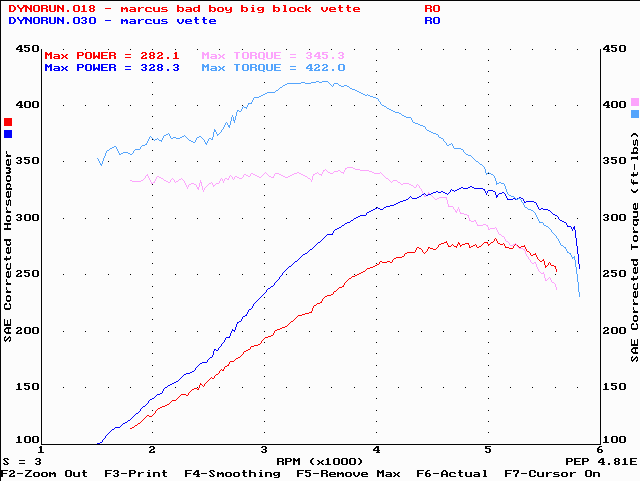
Stock except Torker II intake, Holley 750 VS. Comp cams hydraulic flat tappet cam 219/229.
Red run: Stock exhaust manifolds.
Blue run: Hooker super comp 1 7/8" primary full length headers.
Both runs were with full exhaust, stock configuration under car pipes 2.5". Same mufflers.

Le Mans Master


Joined: Apr 2006
Posts: 5,403
Likes: 95
Someone spends $800.00 on a hydraulic roller cam and its related parts for more power over a flat tappet and piece of mind longevity. Then they want those nice $1500.00 AFR heads. Then stick exhaust manifolds on there new 383 build. That would be very foolish. For most a ceramic coated header can be bought for less then $500.00 that gets rid of any temp under hood concerns. Were not living in the 1970s anymore.
If all you want to do is stick a small cam in your dead stock l 48 for a little more power then your not after much power anyway. Then you would have a valid reason not to use headers.
If all you want to do is stick a small cam in your dead stock l 48 for a little more power then your not after much power anyway. Then you would have a valid reason not to use headers.
Last edited by Little Mouse; Jan 8, 2016 at 07:01 PM.
Le Mans Master
Joined: Apr 2006
Posts: 5,403
Likes: 95
Le Mans Master
Joined: May 2006
Posts: 9,993
Likes: 1,136
From: League City Tx
Lots of members here are sadly mistaken about headers and the performance they offer over manifolds.

Race Director

Joined: Jan 2000
Posts: 12,399
Likes: 247
From: San Jose CA
If you like to mat the throttle at all, headers are the biggest bang-for-buck outside of proper fuel and spark tuning.
Race Director
Joined: Apr 2009
Posts: 19,294
Likes: 2,754
From: Charlotte NC
Someone spends $800.00 on a hydraulic roller cam and its related parts for more power over a flat tappet and piece of mind longevity. Then they want those nice $1500.00 AFR heads. Then stick exhaust manifolds on there new 383 build. That would be very foolish. For most a ceramic coated header can be bought for less then $500.00 that gets rid of any temp under hood concerns. Were not living in the 1970s anymore.
If all you want to do is stick a small cam in your dead stock l 48 for a little more power then your not after much power anyway. Then you would have a valid reason not to use headers.
If all you want to do is stick a small cam in your dead stock l 48 for a little more power then your not after much power anyway. Then you would have a valid reason not to use headers.
100%.or... when a person has a Corvette that is blowing smoke...and you can manually spin the engine easily by using the alternator belt and it has no ring drag when it is not running...and they want to put headers on it to give it more power and better sound....

DUB