




Engine stamp

Burning Brakes


Joined: Dec 2006
Posts: 979
Likes: 254
From: Bethlehem, PA

It's like a blackboard that's been wiped clean. Only thing you can check is the casting date behind the distributor and block cast number; rear left. Also, you can check the heads, exhaust manifolds, intake, etc to see if they may be the original components.

Team Owner


Joined: Sep 2006
Posts: 31,267
Likes: 4,362
From: Westminster Maryland
Hi r44,
The partial VIN sequence was stamped on the side of the front transmission case using the SAME stamp as was used to stamp the engine pad in St.Louis.
So, check there, if it's the proper transmission for this car you'll feel a little better.
Also, there were numerous parts on the engine that had part numbers and date code stamps or castings as Toyl mentioned.
I'll add carburetor, starter, alternator, distributor and fan clutch.
If at least some of those things are still in attendance it'll be a good thing!
Regards,
Alan
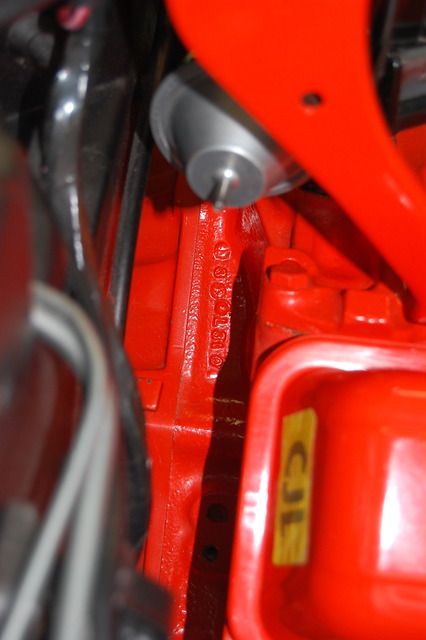
Casting date location. L 31 0…. December 31, 1970, for a mid-January built car.
The partial VIN sequence was stamped on the side of the front transmission case using the SAME stamp as was used to stamp the engine pad in St.Louis.
So, check there, if it's the proper transmission for this car you'll feel a little better.
Also, there were numerous parts on the engine that had part numbers and date code stamps or castings as Toyl mentioned.
I'll add carburetor, starter, alternator, distributor and fan clutch.
If at least some of those things are still in attendance it'll be a good thing!
Regards,
Alan
Casting date location. L 31 0…. December 31, 1970, for a mid-January built car.
Last edited by Alan 71; May 14, 2016 at 12:11 PM.

Safety Car

Joined: Oct 2007
Posts: 3,729
Likes: 267
From: Austin Texas
Corvette of the Year Winner 2017
2016 C3 of Year Finalist
standard machine shop DECKING, REMOVES YOUR ORGINAL #'s
Never do this with an original block, you just lost your matching numbers motor.
Never do this with an original block, you just lost your matching numbers motor.

Melting Slicks


Joined: Sep 2004
Posts: 3,225
Likes: 667
From: Northeast
An alternative location for the vin derivative is near/aft the oil filter & is mentioned in my NCRS judging manual. They point out it is "RARE" but some have been observed. Not a flat surface like the stamp pad but worth a look while you are scanning the transmission.

Le Mans Master


Joined: Mar 2001
Posts: 5,738
Likes: 644
From: Lincoln, CA
Did you remove the paint? With it completely done I bet they zero decked it.
Best way to make sure it's flat and straight. Pretty much all the machines shops by me won't attempt to leave the numbers. You either deck it flat or they won't touch it.
Best way to make sure it's flat and straight. Pretty much all the machines shops by me won't attempt to leave the numbers. You either deck it flat or they won't touch it.
Corvette Stories
The Best of Corvette for Corvette Enthusiasts

Top 10 Most Expensive Corvettes Ever Sold on Bring A Trailer
Brett Foote
10 Things Every Corvette Owner Needs (2026 Edition)
Michael S. Palmer
8 Most "Only Corvette Owners Understand" Quirks and Problems
Pouria Savadkouei
10 Reasons the C6 Z06 is Still A Performance Benchmark After 20 Years
Joe Kucinski
How Much Horsepower Every Corvette Engine "LOST" in 1972
Joe Kucinski
Top 10 DOs and DON'Ts for Protecting Your Convertible Top!
Michael S. Palmer
Top 10 Most Explosive Corvettes Ever Made: Power-to-Weight Ratio Ranked!
Joe Kucinski
150 hp to 1,250 hp: Every Corvette Generation Compared by the Specs That Matter
Joe Kucinski
8 Coolest Corvette Pace Cars (and Replicas) of All Time
Verdad Gallardo
Thread Starter
Instructor

Joined: Feb 2013
Posts: 192
Likes: 54
I'm not too concerned just curious! It's not an investment I bought the car to drive it. When I'm too old to get in and out my son gets it !

Team Owner

Joined: Jan 2006
Posts: 37,637
Likes: 3,118
From: Crossville TN
If the machinist didn't take off too much stock from the block, you might still get lucky. You can apply nital etch (nitric acid and alcohol mix) to the metal surface where the stamp used to be. Afterwards, you might be able to make out the original numbers in the etched surface.
When the numbers are stamped in the block, the metal under the numbers is 'work hardened' and becomes harder material than the other metal surrounding the numbers/letters. The etch "eats" the softer metal a bit faster and there is a discoloration difference that you MAY be able to detect.
I wouldn't recommend that you do this with a pristine pad...but, unless you can convince yourself that the engine is original, I would have to assume that it is not.
If you want to check out nital etch, just do a Wiki on it.
P.S. If you do this and the etching shows the correct numbers, take some high quality photos of the process and the final surface. That way, you can demonstrate that the engine in the car IS the original engine...even though it has no stamped numbers on the pad. There might still be someone out there might accept that evidence and still pay you a premium for a numbers-matching car. [doubtful...but possible]
When the numbers are stamped in the block, the metal under the numbers is 'work hardened' and becomes harder material than the other metal surrounding the numbers/letters. The etch "eats" the softer metal a bit faster and there is a discoloration difference that you MAY be able to detect.
I wouldn't recommend that you do this with a pristine pad...but, unless you can convince yourself that the engine is original, I would have to assume that it is not.
If you want to check out nital etch, just do a Wiki on it.
P.S. If you do this and the etching shows the correct numbers, take some high quality photos of the process and the final surface. That way, you can demonstrate that the engine in the car IS the original engine...even though it has no stamped numbers on the pad. There might still be someone out there might accept that evidence and still pay you a premium for a numbers-matching car. [doubtful...but possible]
Last edited by 7T1vette; May 14, 2016 at 06:41 PM.

Team Owner

Joined: Jun 2000
Posts: 38,923
Likes: 1,481
From: Southbound
Cruise-In II Veteran




Burning Brakes

Joined: Apr 2008
Posts: 1,222
Likes: 93
From: shelbyville West Michigan
if the FBI can use some sort of chemical to view filed off serial #'s from guns used in a crime, seems there ought to be a way to do the same with an engine block...my block was decked and vin portion removed and maybe 35% of the engine stamp is legible. would love to find out if it was original too.
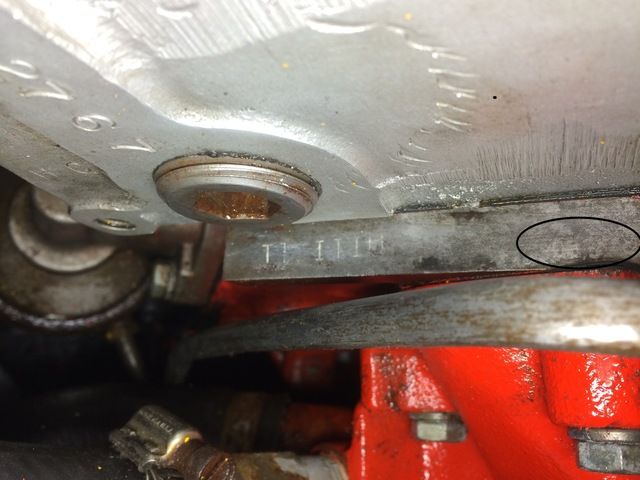
best I could ever read with a magnifier was T 10 11 IU which would be oct 11 date when the car was Nov 14, which would jive. only problem is my tank sheet lists L71 but the IU indicates L89, even though I 've obviously got '67 alum heads....the mystery may never be solved...
best I could ever read with a magnifier was T 10 11 IU which would be oct 11 date when the car was Nov 14, which would jive. only problem is my tank sheet lists L71 but the IU indicates L89, even though I 've obviously got '67 alum heads....the mystery may never be solved...

Administrator
Joined: Jul 2000
Posts: 53,982
Likes: 6,209
From: About 1100 miles from where I call home.
Numbers dont prove originality. Numbers are restamped all the time.

Burning Brakes

Joined: Nov 2012
Posts: 788
Likes: 100
From: Indianapolis IN
if the FBI can use some sort of chemical to view filed off serial #'s from guns used in a crime, seems there ought to be a way to do the same with an engine block...my block was decked and vin portion removed and maybe 35% of the engine stamp is legible. would love to find out if it was original too.
best I could ever read with a magnifier was T 10 11 IU which would be oct 11 date when the car was Nov 14, which would jive. only problem is my tank sheet lists L71 but the IU indicates L89, even though I 've obviously got '67 alum heads....the mystery may never be solved...
best I could ever read with a magnifier was T 10 11 IU which would be oct 11 date when the car was Nov 14, which would jive. only problem is my tank sheet lists L71 but the IU indicates L89, even though I 've obviously got '67 alum heads....the mystery may never be solved...

Melting Slicks
Joined: Dec 2009
Posts: 3,232
Likes: 656
From: Thunder Bay
 Al Grenning has developed a database of factory stamps which can be used to compare a block stamp to a known original. When the factory stamped a block with the VIN, they would use the same stamp on every car, just changing the last digit. Therefore the stamping on two consecutive cars on the assembly line would be virtually identical, with the exception of the last digit. He showed me some of his collection years ago, and its pretty cool. If its a valuable car, he can often provide confirmation of an original block. If its not a particularly valuable car, who cares?

Team Owner
Joined: Jul 1999
Posts: 65,492
Likes: 230
From: Orange Park Florida
 YUP, sure are.....found that out some 18 years ago down at NCRS Orlando, from some club members....

Burning Brakes
Joined: Feb 2005
Posts: 894
Likes: 91
I would just add some info here with respect to decking these OEM/numbers matching builds. For years we've done "tons" of these resto's and have always "squared-up-the-decks" and NEVER removed a single original digit, not a single one.
We've milled as much as .025" off numerous builds and still never lost an original stamped number. It's easier today than in the past but we still managed to get it done back then also! You just need the right equipment?
Thanks, Gary in N.Y.
P.S. When you begin the build process make absolutely certain the machinist is aware if it's an original numbers deal and if they have ANY issue with getting it done correctly, move on to another shop!
We've milled as much as .025" off numerous builds and still never lost an original stamped number. It's easier today than in the past but we still managed to get it done back then also! You just need the right equipment?
Thanks, Gary in N.Y.
P.S. When you begin the build process make absolutely certain the machinist is aware if it's an original numbers deal and if they have ANY issue with getting it done correctly, move on to another shop!