When you click on links to various merchants on this site and make a purchase, this can result in this site earning a commission. Affiliate programs and affiliations include, but are not limited to, the eBay Partner Network.
9 inch long bolts would just mean that you might have 1-2 inches of thread hanging down below the nut.
My bolts have non threaded shafts. So you have to buy them at nearly the correct length. My 7 inch bolts did not have enough thread to crank up the rear of my car to keep the tires out of contact with the body.
my 26 inch tall tires 2.5 inches clearance. and my 28 inch tall slicks have about 1.5 clearance without tightening the bolts
On 4 corner scales my total weight was right on 3000 lbs. About 630 lbs on each front and 870 lbs each rear. I can crank up or down each corner to jack the weight around.
To compress a 520# spring an additional 1.5 inches is 780 lbs. When you hit the inside rumble strips going around a track you can see cars actual only on the two outer wheels. With the inner tires airborne. After scraping my tires on nearly every turn I cranked up the rear to be safe at nearly 2 inches.
For just street tires I should lower my front and rear to keep the correct body nose down rake. I just never took my car back to the shop to do the 4 corner adjustment on scales.
ok thanks for info, whats the reason for the "correct body nose down rake" ??
8" bolts here, with shortened leaf spring for additional clearance.
The longer bolts will allow you to lower the rear stance. The problem is how close they come to the ground. Will they strike the pavement if you get a flat tire? I left the bolts as long as I dared, then cut off the exposed threads. Still wish my rear was lower. The bolts I ordered were for a C4 Vette. Good Luck!
From: Graceland in a Not Correctly Restored Stingray
Typically, a slight nose-down rake will help reduce any lift generation at speed.
I highly suggest measuring C3 ride heights for any true performance oriented application by the "Z" and "D" specs (illustrated below). Utilizing these references will negate suspension geometry errors due to non-stock wheel/tire combinations or body/chassis mount issues. In any event, whether or not lowering all the way down to Chevy Power Book ride height recommendations is practical in your circumstance (Z @ 1.00"-1.25", D @ 1.25"), setting static Z higher than static D is to be avoided, unless accounting for having altered diff height in the chassis and/or inner camber strut height relative to the diff. Hope that helps.
Typically, a slight nose-down rake will help reduce any lift generation at speed.
I highly suggest measuring C3 ride heights for any true performance oriented application by the "Z" and "D" specs (illustrated below). Utilizing these references will negate suspension geometry errors due to non-stock wheel/tire combinations or body/chassis mount issues. In any event, whether or not lowering all the way down to Chevy Power Book ride height recommendations is practical in your circumstance (Z @ 1.00"-1.25", D @ 1.25"), setting static Z higher than static D is to be avoided, unless accounting for having altered diff height in the chassis and/or inner camber strut height relative to the diff. Hope that helps.
just my local track in scotland, 140 mph max for a short time
So 4.11 rear end and only using the first 4 gears would work out great with 28 inch rear road racing slicks. On my front i use 295/17 hoosier R1 on 10 inch wheels. Depending on the tracks I went to. You could get maybe two hours of total track time per set. Your location is so much cooler. Some of the summer races were as high as 105 F degrees and abrasive pavement.
To keep the rear slicks up to temp on the straights during cold temp you have to run additional rear toe in so that the rear tires scrub and generate heat on the straights. cold slicks are like grease until you have them up over 140 F and then to around 175+ F. degrees for optimum. I only used like .48 degrees of neg front and rear camber to get equal ware and temps across the face of the tires.
I found that my vette liked about Zero toe front and up to .180 inch rear toe in cold tracks and .070 during hot weather. 7 degrees front Castor. Front toe out I found my vette to be too darty. like in open wheel cars very nervous, you never have time to relax and think about the entry point to the next turn
From: Graceland in a Not Correctly Restored Stingray
Good observation by gkull about utilizing scrub to help manage tire temps. Tho increased toe may seem a bit of a cheat to produce more heat in them, whatever it takes to make those black round things happy is definitely worth considering.
So 4.11 rear end and only using the first 4 gears would work out great with 28 inch rear road racing slicks. On my front i use 295/17 hoosier R1 on 10 inch wheels. Depending on the tracks I went to. You could get maybe two hours of total track time per set. Your location is so much cooler. Some of the summer races were as high as 105 F degrees and abrasive pavement.
To keep the rear slicks up to temp on the straights during cold temp you have to run additional rear toe in so that the rear tires scrub and generate heat on the straights. cold slicks are like grease until you have them up over 140 F and then to around 175+ F. degrees for optimum. I only used like .48 degrees of neg front and rear camber to get equal ware and temps across the face of the tires.
I found that my vette liked about Zero toe front and up to .180 inch rear toe in cold tracks and .070 during hot weather. 7 degrees front Castor. Front toe out I found my vette to be too darty. like in open wheel cars very nervous, you never have time to relax and think about the entry point to the next turn
Good observation by gkull about utilizing scrub to help manage tire temps. Tho increased toe may seem a bit of a cheat to produce more heat in them, whatever it takes to make those black round things happy is definitely worth considering.
Much smarter people than me thought up using toe in to create tire temperature. I was working on a IMSA race car and the boss told me to increase the rear toe in to. 250 per side so I asked why so much. Rear tire heating was the answer toe in also causes a car to go straight
A year or two later some client bought a historical racing vette and it had adjustable trailing arm toe bolts. I thought what a great idea over dumb *** me changing out stacks of stainless steel washers
to change my vettes rear toe
I can't remember where I bought the trailing arm toe adjust bolt kit
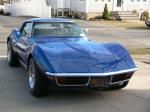
thats the new longer bolts installed, 9 inch ones, just drops it alittle, looks nice anyway, could go lower again, but fear of hitting flares, the spring and washer etc, is a good 10 mm away from wheel, so should be good there??