When you click on links to various merchants on this site and make a purchase, this can result in this site earning a commission. Affiliate programs and affiliations include, but are not limited to, the eBay Partner Network.
After smelling gas in the garage I realized that I'm missing the line from the canister (bottom port) to the PCV along with the small one from the top of the canister to the carb on my 74.
Do you happen to know where can I find, if exists, this kind of PCV with the tee fitting.... but with both ports 3/8 ?
Last edited by corvetero; Aug 10, 2017 at 02:21 AM.
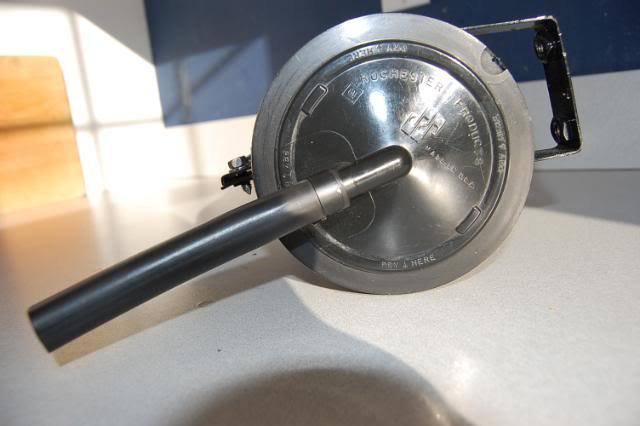
If you mean the port on the bottom end of the canister, no hose connects to that on the 74. That's a drain in case the canister should fill with fuel. On the top of the 74 canister I'm pretty sure there is only two ports. The hoses are different sizes, that's why the T pcv valve you show has two different sizes. Here are a couple pics showing the bottom of the canister and the top where the hoses connect.
Hope this helps,
Tooch
If you mean the port on the bottom end of the canister, no hose connects to that on the 74. That's a drain in case the canister should fill with fuel. On the top of the 74 canister I'm pretty sure there is only two ports. The hoses are different sizes, that's why the T pcv valve you show has two different sizes. Here are a couple pics showing the bottom of the canister and the top where the hoses connect.
Hope this helps,
Tooch
You are absolutely right with that picture, that's the canister I have.
The 2 top ports are supposed to be connected to the tank (left one on the picture) and to the carb vaccuum ( right one on the picture), so no Tee on the PCV is initially designed/needed for the 74.
In regards to the port on the botton, I read from others topics that should be connected to the PCV valve, and since my carb is not the original one, the current single PCV valve is currently just connected to a Vaccum carb port.
My question is why the rest of years has no free port when the EVAP system supossed to work in the same way with gas fumes?
Hi c,
As far as I'm aware the 'vent' at the bottom of the canister didn't ever connect to anything.
I think it's there only to allow gas to drain if the system failed in someway and the canister actually ended up with liquid gas in it rather than just gas vapor.
On earlier year cars there was a short hose on the pipe coming out of the bottom of the canister.
Regards,
Alan
Top and bottom of a 71 canister. One line is dedicated to run to the pcv valve and then continue on to the carburetor.
I think this is how Tooch's 73 is?
Hi c,
As far as I'm aware the 'vent' at the bottom of the canister didn't ever connect to anything.
I think it's there only to allow gas to drain if the system failed in someway and the canister actually ended up with liquid gas in it rather than just gas vapor.
On earlier year cars there was a short hose on the pipe coming out of the bottom of the canister.
Regards,
Alan
Top and bottom of a 71 canister. One line is dedicated to run to the pcv valve and then continue on to the carburetor.
I think this is how Tooch's 73 is?
Thanks Alan,
So not being the carb line from canister plugged can cause a strong gas smell?
When I was smelling line per line the one at the bottom of the canister was the stinky one.
Hi C,
If you're getting a strong gasoline odor at the bottom port of the canister it's likely one of two things…. the charcoal in the canister may have been become over saturated, or the small 'pancake' filter right at the bottom of the canister, (pull the bottom cap off to see it), might need to be replaced.
If the charcoal needs to be replaced that's a bit of a job, but do-able.
If just the pancake filter needs to be replaced that's an easy one.
Have you removed the bottom cap yet?
Regards,
Alan
Hi C,
If you're getting a strong gasoline odor at the bottom port of the canister it's likely one of two things…. the charcoal in the canister may have been become over saturated, or the small 'pancake' filter right at the bottom of the canister, (pull the bottom cap off to see it), might need to be replaced.
If the charcoal needs to be replaced that's a bit of a job, but do-able.
If just the pancake filter needs to be replaced that's an easy one.
Have you removed the bottom cap yet?
Regards,
Alan
Yes, I removed it yesterday after feel the gasoline odor, the filter is a very good shape...stink though. I will replace one pancake filter and will see...if smell continues then canister will suffer a surgery to replace the charcoil.
Originally Posted by Peterbuilt
You don't need a "T" fitting for the PCV just connect the PCV hose directly to the carb and also the canister hose directly to the carb.
That's how is connected at this moment...only difference is that my carb is a Holley 4160
The "T" was supposed to be for the bottom port in the canister....but I was told that is not where it goes, so now is free.
The "T" connection at the PCV valve was to connect the 'purge' line from the canister with the 'purge' line from the PCV valve. They both needed to be directed into the fuel charge [carb/manifold] so the vapors {fuel/oil} could be burned, rather than sent out into the atmosphere. In the early 70's, they were connected with a "T" at the PCV valve; later, they were separated and an additional port was added to the Q-Jet carb. Don't know why, but if GM did it, there had to be a justifiable reason (suspect EPA involvement).
If the 'signal' line from the carb (from a ported vacuum fitting) to the vacuum switch on the vapor canister is missing, plugged, etc, then the fuel vapors will just continue to collect in that canister until the charcoal filter is saturated with fuel. Then, it would just steadily drip fuel out the bottom, as there would be no signal from the carb to tell the canister to "purge" its contents into the carb base..
Run hoses as was intended from the factory and the system should work just fine....unless the vacuum switch in the vapor canister is defective.
Last edited by 7T1vette; Aug 10, 2017 at 07:51 PM.
The "T" connection at the PCV valve was to connect the 'purge' line from the canister with the 'purge' line from the PCV valve. They both needed to be directed into the fuel charge [carb/manifold] so the vapors {fuel/oil} could be burned, rather than sent out into the atmosphere. In the early 70's, they were connected with a "T" at the PCV valve; later, they were separated and an additional port was added to the Q-Jet carb. Don't know why, but if GM did it, there had to be a justifiable reason (suspect EPA involvement).
If the 'signal' line from the carb (from a ported vacuum fitting) to the vacuum switch on the vapor canister is missing, plugged, etc, then the fuel vapors will just continue to collect in that canister until the charcoal filter is saturated with fuel. Then, it would just steadily drip fuel out the bottom, as there would be no signal from the carb to tell the canister to "purge" its contents into the carb base..
Run hoses as was intended from the factory and the system should work just fine....unless the vacuum switch in the vapor canister is defective.
So Alan, based on your comments...Can I install a 70 "T" pcv valve and plug the canister port mark as "carb" to the smallest port on the PCV valve?
On my '72 there is a about a 1" hose connected to the pvc, and then a tee fitting coming from the end of that very short hose, creating a pvc with a tee fitting.... The hose from the canister goes in one side of the tee and then there is another hose going from the other side of the tee to the carb....
Here is a photo of the hose from the vapor canister to the PCV then to the carb on my 73 when I first purchased it. You can also see the second hose (smaller diameter taped with the PCV hose) that runs directly from the canister, between the valve cover and the intake, then to the front of the carb. You can see the two different hose sizes attached to the PCV valve. It was not very pretty but it worked good. I found that the 73 AIM showed two separate ways to hook up the hoses to the vapor canister. One way was the way my car was and the other did not show the hose from the vapor canister going to the T at the PCV. The PCV had a hose run directly to the carb and the second hose ran directly from the vapor canister to the carb. After rebuilding the canister I still had the fuel smell in my garage. I replaced the gas cap and still had the fuel smell. It ended up being the gasket for the valve on the side of the fuel tank.
Last edited by OldCarBum; Aug 11, 2017 at 06:24 PM.
Hi c,
I would say no.
Since your canister has just 2 ports on it's top one certainly is for the hose connection from the tank, and I'd think the other needs to run directly to the carb (as the canister top notes).
The pcv valve should have it's own line running to the carb as the AIM page you posted indicates.
This seems to be the routing shown in the AIM sheet even though it's difficult to tell what pipe it's attached to on the carb.
It's likely that there will only be one that's that large.
Regards,
Alan
Just for reference… here's the carb base connection for the hose running from the pcv valve on my 71.








 PCV valve with tee fitting