When you click on links to various merchants on this site and make a purchase, this can result in this site earning a commission. Affiliate programs and affiliations include, but are not limited to, the eBay Partner Network.
From: I don't do cities N/W Montana & Nor California
Vacuum hose identification Help
This is the before and after of the same engine but the same hose.
It starts underneath the brake booster in the firewall T's into the valve cover and then plugs in at the base of the carburetor.
My question is what is it for and do I still need it with the new rebuild?
From: I don't do cities N/W Montana & Nor California
Originally Posted by lars
That's your PCV. Yes, you need it - the engine must have crankcase ventilation.
The the opposite valve cover has a PCV that I will vent through the air cleaner, do I need this specific hose?
The reason I ask is because I have nowhere to connect it and since the crankcase will be ventilated on the opposite side I would like to remove it from the mix if possible.?
The pcv gets it's fresh air from the right side with a hose from the air cleaner to the valve cover. The hose you have goes from the pcv valve on the other (left) side to the base of the carb. Inlet and exit.
Last edited by CanadaGrant; Jan 16, 2018 at 11:50 PM.
2025 c3 ('74-'82) of the Year Finalist - Unmodified
2019 C3 of Year Finalist (appearance mods)
Maybe you got the valve covers on the wrong side.
Fresh air is drawn into the crankcase from the right side valve cover.
That fresh air is sucked into the carburetor from the PCV valve on the left side valve cover.
The hose on the other side of the PCV valve connects to a 'vapor canister' down below the master cylinder.
The other connection goes to the gas tank.
From: I don't do cities N/W Montana & Nor California
Originally Posted by Peterbuilt
Maybe you got the valve covers on the wrong side.
Fresh air is drawn into the crankcase from the right side valve cover.
That fresh air is sucked into the carburetor from the PCV valve on the left side valve cover.
The hose on the other side of the PCV valve connects to a 'vapor canister' down below the master cylinder.
The other connection goes to the gas tank.
Here are a few pictures.
Thanks, the valve covers are on the correct sides, the engine builder made it that way on purpose, one side for the PCV and the other is basically just an oil fill.
My main question is do I have to have this hose connected considering I already have a PCV valve ?
From: I don't do cities N/W Montana & Nor California
My main question is, if I don't connect this hose what will happen?
Also there is no connection on my new carburetor like the old one, so, if I have to connect it can I tee off of another hose connection that's already connected to the carburetor base?
2025 c3 ('74-'82) of the Year Finalist - Unmodified
2019 C3 of Year Finalist (appearance mods)
If you don't connect both ends of the PCV you will have a vacuum leak and the car will not run correctly.
You can get a single port PCV valve and connect to a 'manifold' port on your carb.
Not the thing to do in your case.
A manifold port has vacuum at idle.
Ported vacuum is low at idle and the same as manifold vacuum once you are cruising along.
You need to connect the vapor canister or you will get gas fumes when parked.
Be proud of the work that you have done and be proud of doing this correctly.
Hi P,
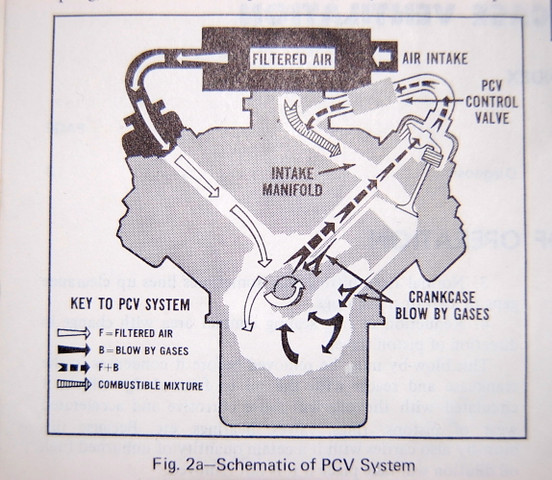
Here's a photo of a diagram showing the typical operation of the pcv system. Note, nothing vents to atmosphere.
As you can see your pcv system isn't hooked up to operate properly in it's present configuration.
Also, as has been mentioned, it doesn't appear the evaporative control system is hooked up either. Your present valve covers don't appear to be set up to allow it to be.
Did you supply these valve covers or did the engine builder?
Is this a car you drive on the street?
Regards,
Alan
Here's a photo showing the pcv valve in it's typical location and the hoses that are part of the pcv and evaporative systems.
They appear in your first photo.
2025 c3 ('74-'82) of the Year Finalist - Unmodified
2019 C3 of Year Finalist (appearance mods)
Look at Alan 71's picture (and your first blurry picture) the left side valve cover has a grommet near the front and that is where the PCV goes.
His oil fill is separate and towards the rear of that cover.
Originally the right side cover has a hose that is connected to the base of the air cleaner.
Can you remove your fill cap and photograph both valve covers?
From: I don't do cities N/W Montana & Nor California
Originally Posted by Peterbuilt
Look at Alan 71's picture (and your first blurry picture) the left side valve cover has a grommet near the front and that is where the PCV goes.
His oil fill is separate and towards the rear of that cover.
Originally the right side cover has a hose that is connected to the base of the air cleaner.
Can you remove your fill cap and photograph both valve covers?
Yes, I can take a pic of the insides.
The Builder assured me that I would only need vent on one side, he did not have the car just the engine.
Driver side where he said the oil fill is. The passenger side where he says the PCV should be vented
From: I don't do cities N/W Montana & Nor California
Originally Posted by Alan 71
Hi P,
Here's a photo of a diagram showing the typical operation of the pcv system. Note, nothing vents to atmosphere.
As you can see your pcv system isn't hooked up to operate properly in it's present configuration.
Also, as has been mentioned, it doesn't appear the evaporative control system is hooked up either. Your present valve covers don't appear to be set up to allow it to be.
Did you supply these valve covers or did the engine builder?
Is this a car you drive on the street?
Regards,
Alan
Here's a photo showing the pcv valve in it's typical location and the hoses that are part of the pcv and evaporative systems.
They appear in your first photo.
This is the engine on the dyno prior to my installation, it ran like a Swiss watch and as you notice neither side is attached to any vacuum hoses.
I understand that it needs to be vented to keep oil from spewing and that's what he set up the right side for.
Hi P,
Both breathers in your photo have nipples on them to attach hoses to.
Part of the purpose of an operating pcv system is to reduce the build-up of sludge in the engine.
I'm surprised the engine builder didn't alert you to that.
Regards,
Alan
Here's a photo of the other side of the engine showing the fitting in the valve cover and the steel elbow which uses a rubber hose to attach to the air cleaner base.
From: I don't do cities N/W Montana & Nor California
Originally Posted by Alan 71
Hi P,
Both breathers in your photo have nipples on them to attach hoses to.
Part of the purpose of an operating pcv system is to reduce the build-up of sludge in the engine.
I'm surprised the engine builder didn't alert you to that.
Regards,
Alan
Here's a photo of the other side of the engine showing the fitting in the valve cover and the steel elbow which uses a rubber hose to attach to the air cleaner base.
So, should I attach that hose to the left side breather or tea it into another hose?
Hi P,
Where is the present pcv valve? I don't see it?
You said it's in the right side valve cover and that you would vent it through the air cleaner. That's not how it works.
Look at the diagram I posted:
The valve cover breather is vented into the air cleaner. Can be on either side.
The pcv valve's hose is attached to a nipple on the carburetor base. Can be either side.
What are you gong to do about venting the vapor canister.... or are you going to use a vented gas cap?
Regards,
Alan
From: At my Bar drinking and wrenching in Lafayette Colorado
Originally Posted by pthor
This is the engine on the dyno prior to my installation, it ran like a Swiss watch and as you notice neither side is attached to any vacuum hoses.
I understand that it needs to be vented to keep oil from spewing and that's what he set up the right side for.
Your engine builder built the engine with vent caps in both valve covers. The vent caps shown in the photo are of a type that are intended to be hooked up to a hose and checkvalve, which then is connected to a welded bung in the header collector on a racecar. The header collector runs at low pressure, so it will "suck" on the hoses and produce a low pressure in the crankcase for evacuation and engine operating efficiency. Running this type of a system on a street car is generally not a good idea.
You can certainly run the engine with only a breather and no PCV system. This has several problems on a street car, even though there are people on this Forum who do so:
The crankcase will be slightly pressurized from engine blowby gasses. This will result in oil vapors in the engine compartment, and the engine is more prone to leaks.
Lack of positive ventilation in the crankcase can cause sludge and moisture buildup inside the engine.
Running the crankcase at positive pressure decreases engine efficiency.
For a street car, you would be much better off installing the PCV system as shown in the diagrams above: Install a suction air breather in the passenger side valve cover with a baffle in the valve cover. Your valve covers do not appear to have baffles in them, which will cause oil ejection out of the vents. In the driver's side valve cover, install a baffle, a grommet, and the PCV you have shown in your first photo. Hook up the PCV to a direct manifold vacuum source - you can simply drill and tap a 1/4" pipe tap and nipple into the manifold plenum at the carb base flange either in the front, on the side, or at the rear of the carb. Here is one that I drilled for the PCV in the manifold plenum at the rear:
Use of a PCV has no adverse effect on performance. It will keep your crankcase running at a negative pressure, which actually helps performance. It will keep your engine compartment clean, and it will reduce potential engine gasket leaks. It will also allow you to hook up and retain your charcoal vapor canister (if it's installed - that's the line "tee'd" off your PCV in your first photo) so you can reduce gas fumes in your garage after engine shutdown. All great benefits on street driven cars. We install PCV systems on every performance engine we build.
OT a little. If that MSD coil is oil filled, you need to mount it vertically. They overheat and leak when horizontal.
If it is epoxy filled, it's fine.
I would also add, the newer Chinese units fail, and I would not use it. IMHO.
From: I don't do cities N/W Montana & Nor California
Originally Posted by Alan 71
Hi P,
Where is the present pcv valve? I don't see it?
You said it's in the right side valve cover and that you would vent it through the air cleaner. That's not how it works.
Look at the diagram I posted:
The valve cover breather is vented into the air cleaner. Can be on either side.
The pcv valve's hose is attached to a nipple on the carburetor base. Can be either side.
What are you gong to do about venting the vapor canister.... or are you going to use a vented gas cap?
Regards,
Alan
The the PCV is in the right side breather cap, the left side cap is vented to bring air in. If I can keep from using the canister bye venting the gas cap then I will do that.
the PCV is attached to the black hose at the T in your first picture and that is the left side of the engine.
Why are you saying the PCV is in the right side breather cap?
Look at this link and attach the PCV on the left side of the engine to the nipple on the left side breather cap as was done in the link below.
From: I don't do cities N/W Montana & Nor California
Originally Posted by MelWff
the PCV is attached to the black hose at the T in your first picture and that is the left side of the engine.
Why are you saying the PCV is in the right side breather cap?
Look at this link and attach the PCV on the left side of the engine to the nipple on the left side breather cap as was done in the link below.







 Vacuum hose identification Help