When you click on links to various merchants on this site and make a purchase, this can result in this site earning a commission. Affiliate programs and affiliations include, but are not limited to, the eBay Partner Network.
So basically the only LS6 parts will be the heads, intake and carb?
In my experience.....only the stud bosses break on these heads.....but they sure look thin in areas, scary thin........and the quality of the aluminum was varying.
I probably would have Hyd. Rollered this engine as it will probably quit making power at 6500 with the induction setup....but hey, it is your engine
If the pistons were set at .005......you should have zero slap cold.
Just FYI too.....lightened assemblies are worth zero power but pay inertia dividends on the track....
The info about the hone is correct too as this is how we did it back in the day.
This is basically a stroked L-88...........GM built a few, called it the LT-2, and they made 580 horsepower through a Dominator that was poorly matched to a murdered L-88 intake but it worked.
That is what i am going to say for a number is 580hp@6600 rpm.
Nice build.......
Sorry. Cam Specs: We went with a custom solid roller grind, from Erson cams, 230& 238 dur @ .050 with .629 lift. It's a street roller with 270/280 advertised. 110 LC. May install it straight up. Billet steel core with iron distrib gear and bronze-tip fuel pump pushrod Morrel Ultra Pro Solid Roller Lifters w/ pressurized roller Springs 220#/540# 550# rate dual springs
The intake was port matched. Not going to change the divider or do any flow work. We'll just see what it does. May add a spacer if there is room under the BB hood.
It's a very small solid roller, actually some of the smallest lobes they or Comp Cam make. The lobes shouldn't be too much more aggressive than a good HR. But no lifter pump up worries.
Last edited by leigh1322; Jan 22, 2020 at 09:42 AM.
Yeah it should make some pretty good snot with that. I’m sure you’ll be happy with it and it should drive really nice. Should rev nicely too. 👍🏼
.
Thanks. It's 10 degrees smaller than your old cam and I was careful to keep the valve events stock like. I hope it drives as nice as the numbers indicate.it should. I know my bottleneck is the intake but that is mandantory to keep the stock BBC hood look.
Last edited by leigh1322; Jan 22, 2020 at 09:44 AM.
I missed the file fitting of the rings on my motor, so this is how it's done. Each ring is set perpendicular in it's bore with a ring compressor, Then each gap is measured with a feeler gauge, and after 5-10 spins of the ring grinder, measured again until perfect. This 4.6" dia 522 motor gets gapped at .025 top ring, .020 2nd.. The instructions say a minimum of .015" but they might butt and break if the motor gets hot if they are that tight. Then the rings are carefully kept sorted for each cylinder.
My LS6 got the cam degreed in today:
First the double roller timing gear set got fitted. It had a torrington bearing on the back of it to protect the block..The dots were lined up carefully and the O degree advance setting was chosen for the initial set-up.
This one has a nine position crank gear to more easily degree the cam.
Then the degree wheel was mounted and a dial indicator on the center of the piston top. We measured a few thousandths down on each side and then aligned the degree wheel to the pointer at exactly TDC. The the dial indicator was mounted to a pushrod on a lifter, the high spot on the lobe was found, and we rocked .050 down on both sides, the average of the two degree readings told us we were set at 109ILC. I forgot, we had to make sure we only rotated the engine in normal direction so any chain motion did not affect the timing. The cam was ground at 110LC, but tolerance stack-up frequently causes this to change. In our case by 1 degree. If it would have come up the other way at 111LC we would have corrected it with the crank gear. Jeff says after a little chain stretch we'll be right at 110LC
So while we had TDC figured out very accurately, I measured the piston to deck clearance. This dial indicator was used on both the top and the bottom flat edge of the piston, and we tapped it hard to rock the piston. It measured .010" up and then. 011" down after rocking. I was surprised the piston rocked that much! So we are at less than .001" deck height. Almost zero. Perfect! Tight quench and we'll figure compression later after choosing a gasket
Yesterday was spent buttoning up the timing cover and oil pan. This took way longer than I expected, partly due to all the measuring involved, and partly due to interference issues. All was eventually fine.
..
My flea market prize 72 454 timing cover with correct welded on timing tab, was very rusty and needed sandblaster cleanup. Then it got fitted and bent until the clearance for the roller cam was correct. .010" IIRC. Then new aluminum water pump was fitted and a support was welded to the timing cover to prevent the clearance from changing. That "washer" actually touches the water pump. So ultimately we wound up with a roller bearing behind the timing gear and a button on the front of it. This is the old school way of setting up a roller cam. This block had the two bolt bosses near the cam, so we could have used the newer bolt-in cam nose style, but the block machining was already completed when the switch was made to a roller cam. That's what happens when you change plans on the fly. Oh well, it's done and will be barely visible.
Next was the oil pan. Another area where a non-stock part was a PITA. I used a brand new GM LS6 Vette Oil pan, the internal baffles looked exactly like the banged up one in my LS5. Brand new baffles, Melling oil pump, and oil pickup from Paragon. My builder thought it prudent on this strong build to upgrade from the stock volume pump to a high volume pump. The slight increase in size caused fitment issues. I'll document it here, so those that follow can upgrade their pump or not depending on their build. Four hours later we had the pan on for good. I sure hope that HV pump is worth the effort!! I'm still not 100% happy about it, but it is together.
Oil pan issue update. There was another interference area that I completely missed during assembly. When my builder was first trial fitting the oil pan it was 1-1/2 to 2 inches away from sitting on the block. He used a borescope to see that this section of the oil pump was resting on the pan baffle.
This was a Melling M-77HV. The shape of the M-77 is exactly the same. He remembers the BB oil pumps getting more "robust" over the years because some of the early ones would literally break off the block.
Next Painting:
My job. I scrubbed the entire motor thoroughly with a grey Scotchbright pad to get adhesion. And liberally washed / scrubbed with Lacquer thinner. The original Marine block epoxy was stilll adhearing well in most places, and did not even come off in the tumbler The brand new oil pan was already powder coated.A small stainless brush and I became good friends. After scuffing and taping, I shot some primer to gain maximum adhesion.
These are the two products I used. Color was Eastwood 2 part Urethane high temp engine paint. The hardener/activator should enhance durability.
I would have used their 2 part primer as well, but they were backordered for a month. They suggested that using a primer would adhere much better than none at all, and since they were out of stock, the only one they would recommend would be VHT high temp primer. Both of these are good for 650 degrees or more. And should resist gas and oil leaks due to the activator.
One can of the Eastwood was just enough for 2 light coats, since this was only a short block.
All the other pieces are aluminum, I'm still deciding what to coat them with, or not.
Last edited by leigh1322; Aug 30, 2019 at 11:09 AM.
It's really starting to look like an Vette LS6 now.
I missed most of the cylinder head prep shots. I am back teaching now, so I'll have much less free time for my vette hobby. Heads got:
.002" deck cut to eliminate scratches from handling. These were well-prepped but some of this was done a long time ago on these 45 year old "074" Snowflake heads..
All the following was double-checked or re-set: Mutli-angle valve job, back cut valves, bowl blended, smooth short radius, viton/teflon valve stem seals, guides measured, bronze guides, clearance checked, valve seat set for width and distance from valve edge
ARP type head bolts with washers for alum heads
Rocker geometry checked via sharpie wear pattern method, and centered on valve stem, pushrods selected
Stock length pushrods were perfect length, since most measurements are very close to factory original
Stainless roller rockers, 1.72 ratio, all tight lashed at .012" and .014"
Morel Solid Roller Lifters with pressure fed oiling
This looks like a glued on timing tape, but it is actually a laser etched degreed balancer, mostly painted, except for the masked off section.
Wow. Have had a few delays but...Engine build is complete! Hooray.
The intakes lower oil splash shield would not fit with the Morrell roller lifters so that was left off. The exhaust heat passage was blocked off with stainless to keep from heating the oil splashed on the manifold underside. This modification will cause it to warm up a little more slowly, and be be more balky when cold.
We did get the stock height valve covers to fit over the roller rockers and the .629 lift roller cam & roller rockers. They polyloks had to be milled 5/16". And then the studs had to be removed again and milled a like amount. The $75 spent here let me keep the stock look going. But now it all fits with only one standard cork valve cover gasket. The valve cover drippers were retained but they also had to be bent a slight amount. Tight!!
Distrib & Carb are ready. We are negotiating for a dyno slot, they are extremely busy. Hope to dyno it over the holidays. The dyno shop has eight C2 L71 builds in process!
Last edited by leigh1322; Jan 22, 2020 at 10:08 AM.
get the dyno on vid!! See this is the stuff you dont get with ebay crate engines. No way!
This will make crazy torque with manners you can drive all day.
get the dyno on vid!! See this is the stuff you dont get with ebay crate engines. No way!
This will make crazy torque with manners you can drive all day.
That's the plan. Hope it works out. Probably will.
Jeff has built over 5000 engines, since 1978, mostly BBC. Mine was #4999
Mine and Dan's Vette 454s may be some of his last.... retiring...
Anyone want to guess at idle vacuum? I'm really not sure myself.....
Last edited by leigh1322; Dec 20, 2019 at 03:04 PM.
FYI: My calculating says a BBC with aluminum heads, manifold, and water pump should weight 535 lbs. Only 40 lbs more than an all-iron SBC. A lot better than it's original all iron fat boy 655 lbs. Dieting is good! I should try the same tricks with the driver! LOL
And I finally got a quote from my engine builder, he expects this LS6 manifold to hold this engine back by about 30-40 HP compared to a really good high rise dual plane manifold. I am more than willing to give that up 'cause I love the stock BB hood. Pretty sure I'll have tire issues anyway......
Last edited by leigh1322; Jan 1, 2020 at 01:39 PM.
The engine builder helping me with my 496 recommended against a HP or HV oil pump on any street engine.
I am not being critical, but it is a well known fact that HV pumps suck a stock pan dry at over 6500 in a quarter mile.....
Moroso has been making restrictors for 40 years because of this.....the Mark 4 will shoot all the oil upstairs with an HV pump and it has no time to drain back.....makes for a mess too on the street if the valve covers aren’t baffled and sealed VERY well.....
Aftermarket blocks are priority main oiling so not needed.....
Also, the clearances need to be run a little looser on an HV motor that is restricted as the oil has to go somewhere.....









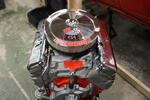


 I sure hope that HV pump is worth the effort!! I'm still not 100% happy about it, but it is together.