


stroking a 350


Team Owner


Joined: Apr 1999
Posts: 21,953
Likes: 1,445
From: Reno Nevada
2024 C3 of the Year Finalist- Modified

64 cc are better. You just buy pistons with more cc of dish. Or up the cam lobe duration to get the Dynamic Compression Ratio down to pump gas level
Le Mans Master


Joined: May 2007
Posts: 5,025
Likes: 1,120
From: North tonawanda NY
I wasnt sure if I would lose the advantages of a good quench area with dished pistons but it sounds like the advantages with outweigh it if there is. The cam im running now was chosen to give the ideal dynamic compression for my current setup so I understand that part well enough.
Team Owner
Joined: Apr 1999
Posts: 21,953
Likes: 1,445
From: Reno Nevada
2024 C3 of the Year Finalist- Modified
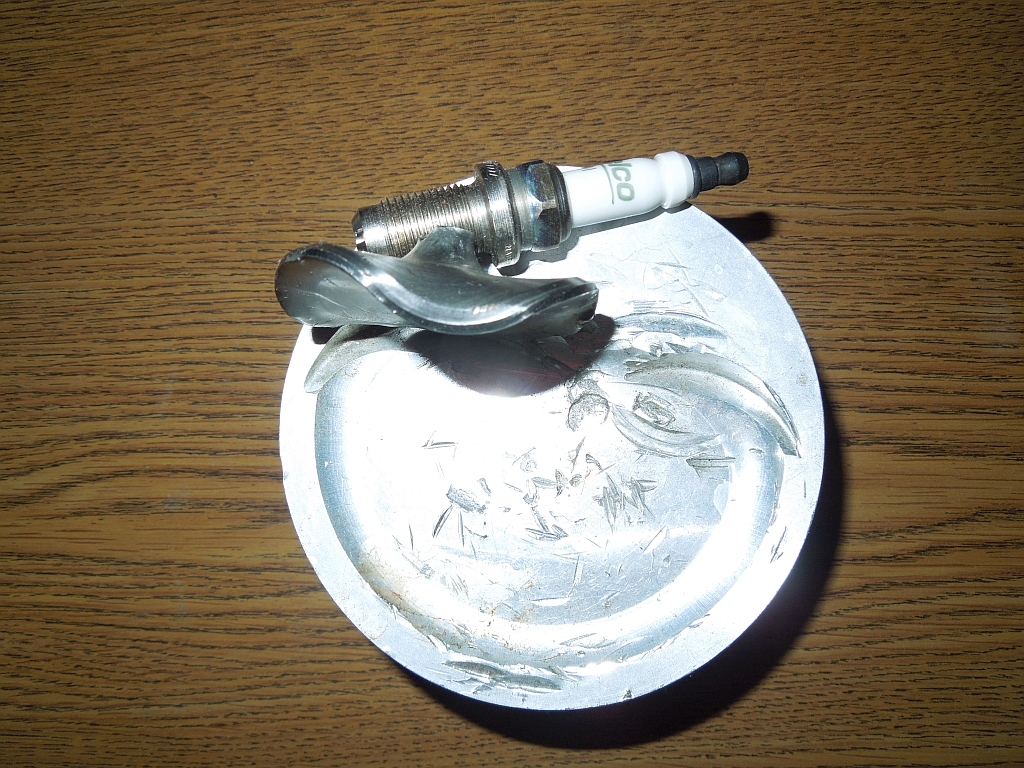
I wasn't going to open a new box, But this is an example of one of my 4 inch stroker pistons. The cylinder head quench is on the intake side of both the head and pistons. This is a -22 cc dish. With valve reliefs for up to .800 lift and 2.15 intake valves. I had some problems with the motor and snapped a 2.08 valve off and kinda destroyed the AFR head. lots of things go very wrong when you are working on SBC's that do 8000 rpm all the time.


Thread Starter
Team Owner

Joined: Jan 2007
Posts: 53,648
Likes: 878
From: Southern Cal Ca
St. Jude Donor '22
I have a 383 in my 77. It has 13,000 miles on the bottom end with over 330 quarter mile passes on it as quick as 12.18 and 110 mph. It won't idle at 550 but it will at 800, in gear (TH350 with 3K stall). It uses my original L48 block, bored .030 and an Eagle cast steel crank with the original connecting rods with the big ends resized and ARP bolts. I have JE forged pistons with about 9.7:1 CR.
I have iron Vortec heads with a lot of work in them. If I was building this now I would go with some type of aluminum heads. Cam is a hyd roller with Morrel lifters (I splurged on those.) Specs are 225/232 with .535/.550 lift at 112 LSA.
It has an RPM air gap manifold and a Lars Qjet.
This combination has excellent street manners. It doesn't run hot, doesn't detonate, starts easily hot or cold.
It has excellent throttle response from idle up to 5,800 rpm shift points.
You can't go wrong with this type of combination, and it is cost effective too.
I have iron Vortec heads with a lot of work in them. If I was building this now I would go with some type of aluminum heads. Cam is a hyd roller with Morrel lifters (I splurged on those.) Specs are 225/232 with .535/.550 lift at 112 LSA.
It has an RPM air gap manifold and a Lars Qjet.
This combination has excellent street manners. It doesn't run hot, doesn't detonate, starts easily hot or cold.
It has excellent throttle response from idle up to 5,800 rpm shift points.
You can't go wrong with this type of combination, and it is cost effective too.
I just finished my 383 build and from my research, this was about as big as I would comfortably go with a stock 350 block.
Couple of important important pieces missing from your puzzle.
1) what’s your budget?
2) what do you plan on doing with it?
3) how much power do you want to make?
If you want a smooth idle and power, well you’re either going to have to go large displacement $$$ or turbo/supercharger $$$ or…. LS/LT swap it.
Blueprint has one of the cheapest 396’s you can buy @ $5,720 for the long block, but it has a 230 @ .050 cam on a 110 LSA so it will have some lope to it. My buddy has one of these so I can confirm it doesn’t have a smooth idle.
The other option is maybe you can have a custom cam made for your engine with very little overlap and a wider LSA???
Couple of important important pieces missing from your puzzle.
1) what’s your budget?
2) what do you plan on doing with it?
3) how much power do you want to make?
If you want a smooth idle and power, well you’re either going to have to go large displacement $$$ or turbo/supercharger $$$ or…. LS/LT swap it.
Blueprint has one of the cheapest 396’s you can buy @ $5,720 for the long block, but it has a 230 @ .050 cam on a 110 LSA so it will have some lope to it. My buddy has one of these so I can confirm it doesn’t have a smooth idle.
The other option is maybe you can have a custom cam made for your engine with very little overlap and a wider LSA???
I quit building 3.750 strokers for 383 when I realized that for the same price you could buy the high end all forged 6 inch rod 3.875 rotating assembly kits. My first 396 was just the longer stroke and I used everything else from my solid roller 383. I could tell the difference in power even though I only gained @ 13 cubic inches. The torque was impressive. I use .027 Cometic MLS gaskets with -7 cc pistons to get @11.2 C/R. I learned a long time ago that with enough cam you can get your DCR down to allow your engine to run fine on our local unleaded premium. Heads are the utmost importance when you have long stroke, small bore, and relatively small valves compared to it's bigger BBC brothers. So I have used both AFR 210 cc and Dart racing 227 cc on my 383 and 396 motors. I kind of settle in on the AFR 210 for my 396. You can look up head intake port CFM of flow to potential HP calculators. AFR 210 heads are something like 314 cfm. You will also see that you want to lift the valves as high as practical and keep it open as long as possible at the higher CFM of flow. That's why I use custom solid billet steel roller cams. My third solid roller was the best for 383 and 396 when combined with 210 cc heads and a Weiand team "G" single planes and a 1/2 inch 4 hole wood thermal spacer. 236/242 112 and something like .644 and .664 lift. I also had the cam ground 4 degrees retarded when compared to the equivalent Comp Cams Extreme grind solid roller. I found that I had a power band over 3500 rpm wide. It was a wonderful road racing motor when combined with a 5 speed and 4.11 rearend.
Oh, my idle is more like 1050 or 1100 rpm and back when I had a 3500 stall 9.5 inch 700R4 it had negligible rpm drop putting it in gear.
Aftermarket blocks like the Dart SHP with the 350 crank main bearing size then become 415 ci with the 4.125 standard bore.
Oh, my idle is more like 1050 or 1100 rpm and back when I had a 3500 stall 9.5 inch 700R4 it had negligible rpm drop putting it in gear.
Aftermarket blocks like the Dart SHP with the 350 crank main bearing size then become 415 ci with the 4.125 standard bore.
I have built standard 350's to strong runners.
even passed smog a couple times on cars that no longer require it.
problem is I need to pass smog on this engine
I have ideas and should work things I will try.
now that stroking is the rule not exception, it is very tempting to go there.
I appreciate the posts and like to hear peoples real experiences and thinking.


Racer


Joined: May 2020
Posts: 498
Likes: 167
Very familiar with CA smog. What year is your Vette??
Again, I would find a cam with little over lap because it would not scavenge as much, thus the engine will burn cleaner. You might also try fuel injection and lean it out during the smog test to get a better reading.
https://www.enginebuildermag.com/201...-back-session/
The cam is the key, not the displacement.
This marine cam from Comp only has 49 degrees of overlap.
https://www.compcams.com/xtreme-marine-218-224-hydraulic-roller-cam-for-chevrolet-small-block.html
Again, I would find a cam with little over lap because it would not scavenge as much, thus the engine will burn cleaner. You might also try fuel injection and lean it out during the smog test to get a better reading.
https://www.enginebuildermag.com/201...-back-session/
The cam is the key, not the displacement.
This marine cam from Comp only has 49 degrees of overlap.
https://www.compcams.com/xtreme-marine-218-224-hydraulic-roller-cam-for-chevrolet-small-block.html
Last edited by JC 1975; Mar 19, 2023 at 12:15 AM.
Thread Starter
Team Owner
Joined: Jan 2007
Posts: 53,648
Likes: 878
From: Southern Cal Ca
St. Jude Donor '22
Very familiar with CA smog. What year is your Vette??
Again, I would find a cam with little over lap because it would not scavenge as much, thus the engine will burn cleaner. You might also try fuel injection and lean it out during the smog test to get a better reading.
https://www.enginebuildermag.com/201...-back-session/
The cam is the key, not the displacement.
This marine cam from Comp only has 49 degrees of overlap.
https://www.compcams.com/xtreme-mari...all-block.html
Again, I would find a cam with little over lap because it would not scavenge as much, thus the engine will burn cleaner. You might also try fuel injection and lean it out during the smog test to get a better reading.
https://www.enginebuildermag.com/201...-back-session/
The cam is the key, not the displacement.
This marine cam from Comp only has 49 degrees of overlap.
https://www.compcams.com/xtreme-mari...all-block.html
the idea, in your link, is opposite of the LS motor that doesn't have egr valves.
NOX, has always been my hold up.
to control nox the LS uses exhaust timing to keep ex gases in the cyl instead of intake timing to suck it in through a valve.








