When you click on links to various merchants on this site and make a purchase, this can result in this site earning a commission. Affiliate programs and affiliations include, but are not limited to, the eBay Partner Network.
I’m still looking into some new heads + cam. Goal is mainly more torque (I want to feel it more when I go full throttle) and about 300 BHP, if that is possible?
I only drive it on the streets and highway.
My car now:
- 1977 L48 350 with TH350 automatic
- Edelbrock Performer 2101 intake
- Original Q-jet (already bought a Cliff Ruggles rebuild kit)
- Open element air filter
- Flowtec cerm. coated longtube headers
- 2.5” dual exhaust (+ very small cherrybombs)
- No more EGR or other emissions equipment
- Original L48 heads
- Original L48 block
- Original water pump
Side note:
- Totally restored front and rear suspension + poly bushings new fiberglass rear spring and new front springs
- total A/C delete
- hot air Shoke blockoff + new electric shoke
- Original miles: 98123 (Too many?)
- Pump gas in Belgium is: 95 or 98 octane
Searching the forum and some websites I thought of this combo:
- Edelbrock 5089 E-Street cylinder heads (€ 1583 incl. tax & shipping)
- Comp Cams Xtreme Hyd. RollerXR276HR Camshaft (€ 657 incl. tax & shipping)
Will this give me the desired results?
What about:
Roller rocker???
Push rods???
Head gaskets???
Pan and timing cover bolts???
ARP bolts & studs?
Special tools???
I want to do it all myself (like I did with the rest of the car). Is that possible or will a machine shop be necessary?
Can I do the whole job with the engine still in the bay? Or is an engine lift inevitable?
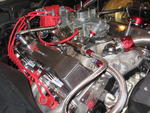
Engine at the moment...
Last edited by Novusuhu; Aug 12, 2024 at 09:03 AM.
If you purchase aluminum heads, special head gaskets will be mandatory to mate aluminum w/cast iron. (different expansion / contraction rates)
If you purchase aluminum heads, special pushrods will be mandatory. (longer)
If you purchase a roller cam kit, there are hidden costs involved:
shorter pushrods
cam sprocket button
maybe distributor gear
maybe different timing cover
maybe different fuel-pump pushrod
Your desired H.P. request is doable. Easily. Thick checkbook.
The main thing is to get that old 8.5 (or less) compression ratio up around 9.7 (or more)
Do your homework. Find a Dynamic Compression Ratio calculator on line and crunch some numbers.
A DCR of 8.1 - 8.5 is ideal for big powers gains w/o detonation / pinging.
And yes, the whole short-block-on-up, rebuild, can be done yourself (front on ramps is easier)
You will need roller rockers, and longer hardened push rods. With stock gears (3.08), it’s going to feel pretty soft at the lower rpm’s.
with stock pistons and deck height, you are probably going to be around 9:1 compression which should be ok. That might be too much cam without adding a stall converter, ~2200-2500 range.
You will want to check on the required distributor gear for that cam.
I wanted to do myself also so I bought some bare 64/ 190 aluminum bare castings on ebay for $350 shipped. they are the chinese castings that AFR also uses for the enforer line of heads and they perform well. anyway, with the help of many you tube videos I learned to port and assemble them correctly with all the quality hardware. I use steel .015 coated shim gaskets which are the same type I used on my old iron eagle heads. I sprayed them with copper coat as others here suqqested and had had no issues. the shim gaskets help with compression. they wont do much for quench on a dished l48 piston.
It will be a job for this winter. So I better be prepared and have al the parts needed.
Do you guys have part numbers for good value for money hardened pushrods and roller rockers?
I live in Belgium, so I will be buying from Ebay and Amazon...
Forget about buying pushrods right now....the engine has to be assembled and almost ready to go before selecting pushrods. Instead you should buy one of these so you can measure what length pushrods you need. COMP Cams 7702-1 COMP Cams Hi-Tech Pushrod Length Checking Tools | Summit Racing
As for heads, I'm not up with the latest and greatest, but if you're looking for torque, stick with a 64cc head (to get the compression up) and a 180cc intake runner so port velocity is kept up to improve cylinder filling. Don't get swayed by large ports and big flow numbers....that all happens at an RPM you won't even be close to.
Search the threads on here from @Jebbysan he does this daily and provides the forum with great information....he'll have a great head recommendation.
As for the cam....that 276HR is to much for a 350 if you want torque.
For Torque I'd look for a cam with around 212/218 duration with a 110 LSA....this kind of cam will work great on the street, and combined with 64 cc heads with 180cc intake runners it will give you the kick your looking for.
No one can or should give you a part number for pushrods. They have to be measured and may require custom ordering.
So, one of the first tools you need with the new heads is a Pushrod Length Checker, about $25.
On all cylinder heads, is a machined pad where the rocker-arm stud either is pressed in or threaded in.
With aluminum heads, that pad is usually a little higher than stock. So, your standard SBC 7.8 inch pushrods are no longer able to keep the proper rocker geometry. They will be too short.
Guide plates also raise the rocker stud, changing the geometry somewhat.
If you go for the roller cam kit, roller lifters are much taller than stock tappets. Now your former std 7.8 inch pushrods are too long. So you need to measure.
Some aluminum head companies will suggest a pushrod around 0.100 longer. Thats assuming Flat Tappet cam installed.
But again, you must measure.
Forget about buying pushrods right now....the engine has to be assembled and almost ready to go before selecting pushrods. Instead you should buy one of these so you can measure what length pushrods you need. COMP Cams 7702-1 COMP Cams Hi-Tech Pushrod Length Checking Tools | Summit Racing
As for heads, I'm not up with the latest and greatest, but if you're looking for torque stick with a 64cc head (to get the compression up) and a 180cc intake runner so port velocity is kept up to improve cylinder filling. Don't get swayed by large ports and big flow numbers....that all happens at an RPM you won't even be close to.
Search the threads on here from @Jebbysan he does this daily and provides the forum with great information....he'll have a great head recommendation.
As for the cam....that 276HR is to much for a 350 if you want torque.
For Torque I'd look for a cam with around 212/218 duration with a 110 LSA....this kind of cam will work great on the street, and combined with 64 cc heads with 180cc intake runners it will give you the kick your looking for.
OMF is dead on target about the cam. A 212 dur @ .050" with those heads will give you more than 300HP, but not kill the low end TQ like the 224 will.
The compression is the key to your TQ.
The 212 cam will not kill it below 2000rpm.
You will like the 212 much better on the street.
OMF is dead on target about the cam. A 212 dur @ .050" with those heads will give you more than 300HP, but not kill the low end TQ like the 224 will.
The compression is the key to your TQ.
The 212 cam will not kill it below 2000rpm.
You will like the 212 much better on the street.
Hm okay so a 212. I will look in to that.
I will search the forum for some info/posts of Jebbysan regarding heads.
Will post what I found.
OMF is dead on target about the cam. A 212 dur @ .050" with those heads will give you more than 300HP, but not kill the low end TQ like the 224 will.
The compression is the key to your TQ.
The 212 cam will not kill it below 2000rpm.
You will like the 212 much better on the street.
OK guys, so I did some more searching and came to this:
- When comparing prices etc… Rollers are ineed more costly (very much when adding all the other parts needed). So I will go for a Hydraulic Flat Cam.
- I found this kit with a duration @ 0.050" of 212/218 like some suggested.
Do I best buy a complete ‘K-kit’ or am I better off with just the cam and buying the rest seperately?
HEADS: - Edelbrock 5089
Their price is still the best choice because the other brands are just so expensive when I take ship^ping and import costs into account.
There should be an asterisk * after the price of Roller Cams.
And that asterisk should footnote:
* does not include hidden costs.
Nothing wrong with a Flat Tappet cam. There are millions of them out there.
I figured I saved around $800 going with the Flat Tappet. That's money well spent on something more important.
Novusuhu, if I could give you three pieces of advise, it would be:
1. Use plenty of Zinc in the oil.
2. Watch your valve-spring open pressure.
3. Go with the new Comps Cam Diamond Like Coated lifters. (CCA-812D-16)
Last edited by HeadsU.P.; Aug 13, 2024 at 07:53 PM.
Also, look at all the new head specifications, especially check if they have raised exhaust ports and straight or angled spark plug threads.
Raised exhaust ports may cause fitment issues with your headers, the frame or other components.
Angled or straight plugs could also cause fitment issues with your headers.
If you are on any type of budget, keep in mind that a roller set up will cost more than a hydraulic flat tappet cam.
Flat tappet cams have been around for decades and there is nothing wrong with them!
hmm,
as mentioned- comp ratio is the key to power.
unfortunately stock dished pistons kill it.
seems a better investment would be to deal with that.
more choices and options when flat top pistons are used.
granted, a head and cam swap will get some more power but
to a point.
you might look into a short block, naked as a starting point.
I have another question before I start buying the heads...
Are there things I can 'test' to see if the 'insides of the block' (pistons, rings, crankshaft, etc...) are still in good shape? (Without removing the heads.)
It would be a waste of money if the original parts in the block have had their best time.
Leak or compression test?
I don't know if that makes sense, because the engine runs 'fine and easy' (It's just not performance oriented with the original cam and heads.)
I have another question before I start buying the heads...
Are there things I can 'test' to see if the 'insides of the block' (pistons, rings, crankshaft, etc...) are still in good shape? (Without removing the heads.)
It would be a waste of money if the original parts in the block have had their best time.
Leak or compression test?
I don't know if that makes sense, because the engine runs 'fine and easy' (It's just not performance oriented with the original cam and heads.)
Sure can, a compression, leak down test, and seeing how much oil pressure you have with a good oil pump are pretty good indicators. You could also drop the oil pan and check the condition of the rod/main bearings.
I’ve done the whole heads cam and intake thing with the engine in the car, and with hindsight I can tell you it’s much easier to do everything if you pull the whole thing out. It also gives you an opportunity to clean the engine, frame, and firewall better than if you leave the engine in. Although your engine bay looks pretty good already, it’s something to consider as far as ergonomics goes.
2020 Corvette of the Year Finalist (performance mods)
2019 C3 of Year Winner (performance mods)
2016 C3 of Year Finalist
set your timing to 14 to 16 degrees and see how it feels...that wil usually get you to the performance timing of 36 degrees all in before 3000 rpm....
what this is, is your base timing which is usually around 6 degrees, plus your mechanical advance, should stop advancing before 3000 rpm with the vacuum advance disconnected and plugged. The mechanical advance is a set unit amount with the weights of the distributor that pendulum out as rpms increase, so advancing the timing from the initial base setting up to about 14 degrees or 16 degrees added to that mechanical advance reading will give you 36 degrees total....this usually gives most cars a better seat of the pants acceleration feeling from a stop or when flooring the pedal from a lower rpm. Try that, its free. if you need more then look into good aluminum heads, intake headers and cam. YOu can get power with 8.5:1 compression
Last edited by Rescue Rogers; Aug 14, 2024 at 02:19 PM.
Another tip I will throw out there is, do not purchase the heads complete with valves and springs installed.
You really want to get the heads checked by a professional machine shop before you install them.
Even brand new heads may need the deck surfaced and they will need to be disassembled before they can be checked.
Also the springs installed in the new heads may have to much or to little spring pressure to work with your camshaft choice.
If that happens, then you end up purchasing another set of correct springs at additional costs plus the labor to swap them out.
Buy your head bare and match them with the proper components the first time.
Yes a leak down test is much better than a compression tester.
If it is 94% or better your ring seal is still good.
And if it is leaking, you can tell if it is heads or rings just by listening.
Leaky valves, due to worn valve guides, are much easier to fix, and pretty common on old SBCs.
Rings & bearings usually last much longer than valve guides.
Oil psi, at idle and hot, is a great indication of good bearing health. Over 20psi is a good number, over 25 or 30 even better.
10 is bare minimum. And probably means you need to at least look at the bearings.
If it will do that on 10-30 oil even better.
20-50 will bump the numbers ~10psi or so.
Should be around 40 psi above 2500rpm with a std oil pump. But that does not usually change. It just tells you which spring someone put in there.
Another tip I will throw out there is, do not purchase the heads complete with valves and springs installed.
You really want to get the heads checked by a professional machine shop before you install them.
Even brand new heads may need the deck surfaced and they will need to be disassembled before they can be checked.
Also the springs installed in the new heads may have to much or to little spring pressure to work with your camshaft choice.
If that happens, then you end up purchasing another set of correct springs at additional costs plus the labor to swap them out.
Buy your head bare and match them with the proper components the first time.
Professional machine shops for engine parts don't exist in Belgium (as far as I know). There is (sadly) just not enough demand in this country. Also if it would exist, it would be very very expensive (€40/working hour is the minimum in that labour and that is tax exc....)
I can tell what I see in the country, and it's not good at all. Small businesses are closing because almost everything is made and done in Taiwan, China, ... Material and energy costs a fortune here it's just so sad.
Tax is 21% on most products and some labour. It's crazy.
As some of you guys suggested, I'll do a leak test and see what that gives me.
Last edited by Novusuhu; Aug 14, 2024 at 04:06 PM.
I think some posters take for granted the easy access to car parts & machine shops. Here in the U.S., we can throw bare cyl heads in our pickup truck and drive 20 miles or so and have the heads gone through.
In Europe, everything has to be overseas shipped. You could order bare heads, then find you need certain valve springs, then retainers, valves, etc.
Each shipment could take weeks. Good luck on returns. Not cost efficient.
And if brand new heads need to be milled due to imperfections, they would be going right back to where they came from. That's nonsense to pay all that money and have to add hundreds in parts & labor. Double that effort and cost in Belgium.
Novusuhu, you said everything will be coming from Amazon or Ebay. Then buy complete heads and be done with it.
Read the reviews on what other buyers are saying about certain heads.










 Heads + cam upgrade