When you click on links to various merchants on this site and make a purchase, this can result in this site earning a commission. Affiliate programs and affiliations include, but are not limited to, the eBay Partner Network.
All new spark plugs.......idles fine, at 600 rpm, starts right up with just a turn of the key.
Originally Posted by Rebelyell
Also, valve(s) Not sealing; via bent or burned or Both.
Additionally, perhaps some valve(s) adjusted too tight.
systematic compression checks; both dry & wet can help rule in-rule out.
Rebel, Wouldn't bent/burned valves and broken spring show up in the idle characteristics and spark plug appearance?
Azmuscle, did the engine operate well up to a point with the problem appearing after intake change, or has your ownership always had this issue? Did you do anything to the valve lash when the intake was changed?
Valve covers are pretty easy to do in these cars. That would at least tell you if you have a broken valve spring, which is an easy fix.
My LS6 had bad compression on two cylinders. It was a lot easier to diagnose with the engine out of the car, but here's my journey. Turns out two (exhaust) valves were sticking open due to something the engine had "eaten" (likely the smashed plastic intake manifold).
A leakdown test, and a borescope, both confirmed the diagnosis. I ended up pulling the heads to clean the valves. Again, a lot easier with the engine out of the car. Hopefully your car doesn't need that.
Rebel, Wouldn't bent/burned valves and broken spring show up in the idle characteristics and spark plug appearance?
Azmuscle, did the engine operate well up to a point with the problem appearing after intake change, or has your ownership always had this issue? Did you do anything to the valve lash when the intake was changed?
I recently purchased the car a few months ago and all the change to Edelbrock was done by the owner before the owner i purchased it from.
i didn't notice any idle issues like a miss or anything on the initial inspection and drive.
The really odd thing was I heard a POP as I was leaving the seller's home and just thought it was an anomoly. The Vette needed all new rbakes so I drove it home and
spent a month installing all new brakes. I'm old I work slow.
I didn't think much of the POP until it did it again. So I started investigating asking questions, watching You Tube videos and posting here. Most replies came back it's a
timing issue so I plugged the vacuum advance and used a dial back timing light and tried several suggestions. The timing mark with the light was okay at idle but when
I began to increase the revs to see what the all in was, the popping happened. It ONLY HAPPENS when the rpms are increased RAPIDLY. You can slowly raise the
RPMs and eventually at a point it pops. But if you do a hit of throttle it pops almost instantly. I did install a new accel pump in the carb.
So that is where it sits. I can drive it if I need to using slow rpms increase. I drove it 75 mph and the tach read 2200 and no pops. But try to add quick throttle and the POPS returns.
Sorry for the long story but I'm trying to give as much info as I can.
Valve covers are pretty easy to do in these cars. That would at least tell you if you have a broken valve spring, which is an easy fix.
My LS6 had bad compression on two cylinders. It was a lot easier to diagnose with the engine out of the car, but here's my journey. Turns out two (exhaust) valves were sticking open due to something the engine had "eaten" (likely the smashed plastic intake manifold).
A leakdown test, and a borescope, both confirmed the diagnosis. I ended up pulling the heads to clean the valves. Again, a lot easier with the engine out of the car. Hopefully your car doesn't need that.
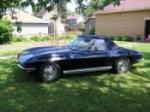
I'm hoping its JUST a broken valve spring. The engine only has 61K on it. If, and only IF the engine comes out, I need to consider a crate install since the enemic 190 HP on the 1981 is dismal BUT at my age I just wanted to end my days left with a nice driving Corvette WITH A/C and a 4 speed. As I said, I hope and pray it's only a broken spring.
I recently purchased the car a few months ago and all the change to Edelbrock was done by the owner before the owner i purchased it from.
i didn't notice any idle issues like a miss or anything on the initial inspection and drive....
...
I didn't think much of the POP until it did it again. So I started investigating asking questions, watching You Tube videos and posting here. Most replies came back it's a
timing issue...
...
So that is where it sits. I can drive it if I need to using slow rpms increase. I drove it 75 mph and the tach read 2200 and no pops. But try to add quick throttle and the POPS returns.
I don't think it's timing -- you'd have other things going on with pinging, "trailer hitching", poor idle, poor high speed, or the like.
Someone suggested a vacuum leak; would be easy to see if you can snug the intake bolts and carb mount bolts.
I'm unfamiliar with Edelbrock AVS so can't offer anything specific, but if the valves and springs check out, it seems like a transfer problem from primary circuit to secondary (mechanical or vacuum activation?).
I don't think it's timing -- you'd have other things going on with pinging, "trailer hitching", poor idle, poor high speed, or the like.
Someone suggested a vacuum leak; would be easy to see if you can snug the intake bolts and carb mount bolts.
I'm unfamiliar with Edelbrock AVS so can't offer anything specific, but if the valves and springs check out, it seems like a transfer problem from primary circuit to secondary (mechanical or vacuum activation?).
I made sure all the intake bolts are torqued to the correct spec and no vacuum leak there. The AVS series has vacuum secondaries. A plate covers the secondaries and then when called for that plate tilts and allows the vacuum to pull the fuel from the secondaries. I've adjusted that plate and no change. The valve cover removal is the next in sequence to see how the valve train is.
Is it just one big pop, or multiple pops in a row?
The 2000-3000 rpm range where where you get your "quick throttle" pop, is also about where the secondaries cut in.
It could be going very lean. Just momentarily.
That would usually just give one big pop.
Check the Eddy directions on how to adjust the secondary air valve.
"Looser" is not faster.
This is a pretty critical setting, your prior owner could have "messed" with it.
But there is a lot of guessing going on here.
It sounds like you need to do some basic trouble-shooting.
Multiple pops could be a valve / combustion / firing issue.
In that case, the first thing I would do would be a compression test, and then a leak down test. Any valve sealing problems would show up.
Then I would measure the valve lift on all valves with a micrometer.
Those test should rule out any mechanical, ring seal, valve seal, cam lobe issues, or help identify them.
One pop could be so much simpler....
Last edited by leigh1322; Apr 20, 2026 at 05:13 PM.
Corvette Stories
The Best of Corvette for Corvette Enthusiasts
10 Ugly Corvettes That We Still Kinda Love
Joe Kucinski
Top 10 Most Expensive Corvettes Ever Sold on Bring A Trailer
Brett Foote
10 Things Every Corvette Owner Needs (2026 Edition)
Michael S. Palmer
8 Most "Only Corvette Owners Understand" Quirks and Problems
Pouria Savadkouei
10 Reasons the C6 Z06 is Still A Performance Benchmark After 20 Years
Joe Kucinski
How Much Horsepower Every Corvette Engine "LOST" in 1972
Joe Kucinski
Top 10 DOs and DON'Ts for Protecting Your Convertible Top!
Michael S. Palmer
Top 10 Most Explosive Corvettes Ever Made: Power-to-Weight Ratio Ranked!
Joe Kucinski
150 hp to 1,250 hp: Every Corvette Generation Compared by the Specs That Matter
Joe Kucinski
8 Coolest Corvette Pace Cars (and Replicas) of All Time
Is it just one big pop, or multiple pops in a row?
The 2000-3000 rpm range where where you get your "quick throttle" pop, is also about where the secondaries cut in.
It could be going very lean. Just momentarily.
That would usually just give one big pop.
Check the Eddy directions on how to adjust the secondary air valve.
"Looser" is not faster.
This is a pretty critical setting, your prior owner could have "messed" with it.
But there is a lot of guessing going on here.
It sounds like you need to do some basic trouble-shooting.
Multiple pops could be a valve / combustion / firing issue.
In that case, the first thing I would do would be a compression test, and then a leak down test. Any valve sealing problems would show up.
Then I would measure the valve lift on all valves with a micrometer.
Those test should rule out any mechanical, ring seal, valve seal, cam lobe issues, or help identify them.
One pop could be so much simpler....
It's multiple pops......and yes I watched the you tube on setting the AVS spring pressure. I'll go rent a compression tester and see what that tells.
Well ladies and gentlemen..........the grim reaper with his compression test results visited my 81.
Not good,not good at all.........
Dry Test:
1-78
2-77
3-78
4-73
5-75
6-72
7-73
and least but not last
8-60-62
Looks like I done bought me a worn out engine......and how can you wear an engine out in 61K ORIGINAL MILES??????????
Maybe a fat running carb dumping fuel washed the cylinder walls down and the rings paid the price. With these numbers, I wasn't about
to do a wet test.
So the buck stops here trying to figure out where to go and what to do. My car buying history reads like EPIC FURY.......the seller wins and
I'm the one paying the price. If you think education is costly, try stupidity.
No more posts until I figure out what to do and NO LS SWAP! My money at age 75 can't handle that but a free donation and install will be accepted.
And appreciated..........thank to all........who offered help.
I didn't see if you pulled the valve covers. That low across all cylinders doesn't seem right for worn out. I'd back off all rockers to see if they valves are not seating due to too much preload. On each cylinder when one valve is pushed down, back off the other rocker until you can rotate the pushrod. Then when complete do another compression check. Do both valves on one cylinder first to see if it changed.
Your engine starts and runs. As for the compression test. Squirt a couple of shots of oil into each cylinder and redo the compression test. Take the other rocker cover off and check the lift of each rocker on all eight cylinders. Make sure throttle is open like it is on fast idle cam while doing compression test. Take a break. Frustration, the wrong conclusion, and guessing will cost you money. JP
I'd certainly redo with a wet test before giving up. And make sure the battery is charged. If you tested 1,3,5,7, waited a bit, then 2,4,6,8, your compression drop follows the battery discharge.
But if you have a lead on a crate engine, that might be the fastest way to get back on the road, if you can find someone to swap it.