


Rear Diffuser
Burning Brakes


Joined: Apr 2006
Posts: 1,218
Likes: 7
From: Burleson Texas

It means, the effect of the rear diffuser (our C4s would likely be example 'b') would be a less coefficient of lift per degree of increase, BUT above 3.5-4* the coefficient of drag increases almost exponentially.
basically, the more angle you have on the diffuser, the lower the lift (good) but the more drag (bad). Seems a 3*-8* rake from the base of the level area of the car (belly) just behind the lower control arm would be best.
I too have been looking into this... there was much discussion on a mini cooper forum and a (dont laugh) prius forum. They are obviously doing it for different reasons than a person with a corvette... but they saw the best improvements in gas mileage with a 2.5-3.5* rake.
It is imparitive that the lowest level, or the beginning of the rake is as low as the lowest level surface under the car...and crucial that the air under the car remain moving while under speed. An investigation into why indy/formula cars have banned the use of "ground effects" http://en.wikipedia.org/wiki/Ground_effect_(cars) would help you understand how it all works... and what happens when it doesnt.
you will find though, that without a wind tunnel, or high speed test track, its going to be difficult to measure gains. Some people were only able to record results from a standing mile or top speed run. (those results on a ZR-1 in Germany was something like 8-15mph, I dont remember)
As mentioned there is another thread on this here on the forum, where it was installed on a red ZR-1 in europe, and there is some discussion there, but not much more.

Race Director


Joined: Jul 2003
Posts: 12,742
Likes: 43
From: Color my life with the chaos of trouble.
Here is a picture of the nose taken at ~140 mph.
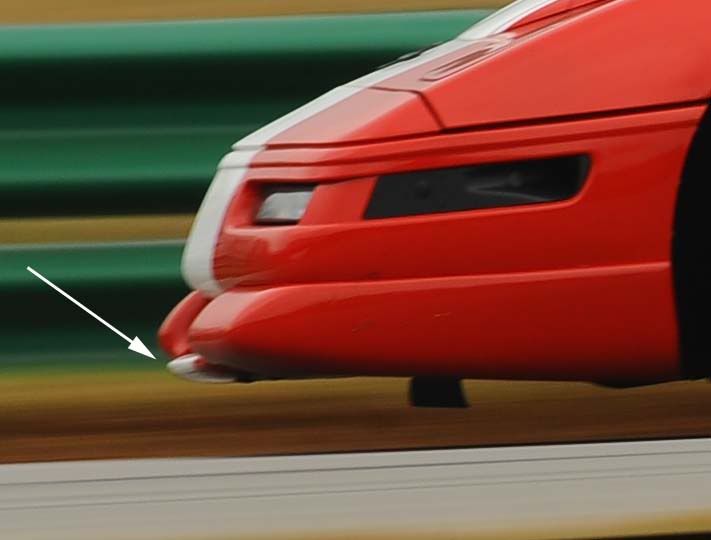
I weigh 200lbs and I can stand on that piece without it bending that far. I also tried removing it as an experiment and the difference in front grip was VERY noticible.
The airflow out of the hood louvers adds quite a bit as well based on what I saw when I had an oil line break and smoke coming up through them. I never would have guessed, but it was a near perfect laminar flow with a HUGE high pressure area right above the wheels.
Why is this at all important? Because at speed, it gets a bit *** happy. The underside of these things is a giant parachute, especially with the spare tire gone.
I keep putting it off because of not having time, but I have one drawn up that I think would make a pretty big difference.
I do have the factory Greenwood piece that was discussed but with my exhaust routing it won't fit as designed. From looking at it (and yes, I do have some aero knowledge) I don't think it would necessarily add downforce per sey, but it would most definitely reduce lift and drag.

Race Director


Joined: Jun 2004
Posts: 13,969
Likes: 710
From: WI
I have done a lot of looking at C4 aero over the last couple of years. What I have found is that ith the Greenwood nose and fender louvers add a lot more downforce than you might think.
Why is this at all important? Because at speed, it gets a bit *** happy. The underside of these things is a giant parachute, especially with the spare tire gone.
I keep putting it off because of not having time, but I have one drawn up that I think would make a pretty big difference.
I do have the factory Greenwood piece that was discussed but with my exhaust routing it won't fit as designed. From looking at it (and yes, I do have some aero knowledge) I don't think it would necessarily add downforce per sey, but it would most definitely reduce lift and drag.
Why is this at all important? Because at speed, it gets a bit *** happy. The underside of these things is a giant parachute, especially with the spare tire gone.
I keep putting it off because of not having time, but I have one drawn up that I think would make a pretty big difference.
I do have the factory Greenwood piece that was discussed but with my exhaust routing it won't fit as designed. From looking at it (and yes, I do have some aero knowledge) I don't think it would necessarily add downforce per sey, but it would most definitely reduce lift and drag.

Thread Starter
Safety Car


Joined: Dec 2008
Posts: 3,588
Likes: 10
From: North New Jersey
It means, the effect of the rear diffuser (our C4s would likely be example 'b') would be a less coefficient of lift per degree of increase, BUT above 3.5-4* the coefficient of drag increases almost exponentially.
basically, the more angle you have on the diffuser, the lower the lift (good) but the more drag (bad). Seems a 3*-8* rake from the base of the level area of the car (belly) just behind the lower control arm would be best.
I too have been looking into this... there was much discussion on a mini cooper forum and a (dont laugh) prius forum. They are obviously doing it for different reasons than a person with a corvette... but they saw the best improvements in gas mileage with a 2.5-3.5* rake.
It is imparitive that the lowest level, or the beginning of the rake is as low as the lowest level surface under the car...and crucial that the air under the car remain moving while under speed. An investigation into why indy/formula cars have banned the use of "ground effects" http://en.wikipedia.org/wiki/Ground_effect_(cars) would help you understand how it all works... and what happens when it doesnt.
you will find though, that without a wind tunnel, or high speed test track, its going to be difficult to measure gains. Some people were only able to record results from a standing mile or top speed run. (those results on a ZR-1 in Germany was something like 8-15mph, I dont remember)
As mentioned there is another thread on this here on the forum, where it was installed on a red ZR-1 in europe, and there is some discussion there, but not much more.
basically, the more angle you have on the diffuser, the lower the lift (good) but the more drag (bad). Seems a 3*-8* rake from the base of the level area of the car (belly) just behind the lower control arm would be best.
I too have been looking into this... there was much discussion on a mini cooper forum and a (dont laugh) prius forum. They are obviously doing it for different reasons than a person with a corvette... but they saw the best improvements in gas mileage with a 2.5-3.5* rake.
It is imparitive that the lowest level, or the beginning of the rake is as low as the lowest level surface under the car...and crucial that the air under the car remain moving while under speed. An investigation into why indy/formula cars have banned the use of "ground effects" http://en.wikipedia.org/wiki/Ground_effect_(cars) would help you understand how it all works... and what happens when it doesnt.
you will find though, that without a wind tunnel, or high speed test track, its going to be difficult to measure gains. Some people were only able to record results from a standing mile or top speed run. (those results on a ZR-1 in Germany was something like 8-15mph, I dont remember)
As mentioned there is another thread on this here on the forum, where it was installed on a red ZR-1 in europe, and there is some discussion there, but not much more.
Im tempted to make one that covers the whole bottom of my car (except for exhaust and engine due to heat). It would be something unique and can only help aerodynamics...
Race Director
Joined: Jun 2004
Posts: 13,969
Likes: 710
From: WI
You've been around awhile have you seen speed holes on any Corvettes? There was one in the race section awhile back. It was red and had three vents in the rear bumper instead of the speed holes that are common in Honda etc cars.
I talked to KB Aero Biscuit about it back then and he didn't think it would help. Since then I've kept an eye out for more info on the topic. I've seen some results where there was a gain and some with no gains at all. Interested in more about this.
I talked to KB Aero Biscuit about it back then and he didn't think it would help. Since then I've kept an eye out for more info on the topic. I've seen some results where there was a gain and some with no gains at all. Interested in more about this.
Drifting


Joined: Jun 2001
Posts: 1,704
Likes: 459
From: Mass Mass
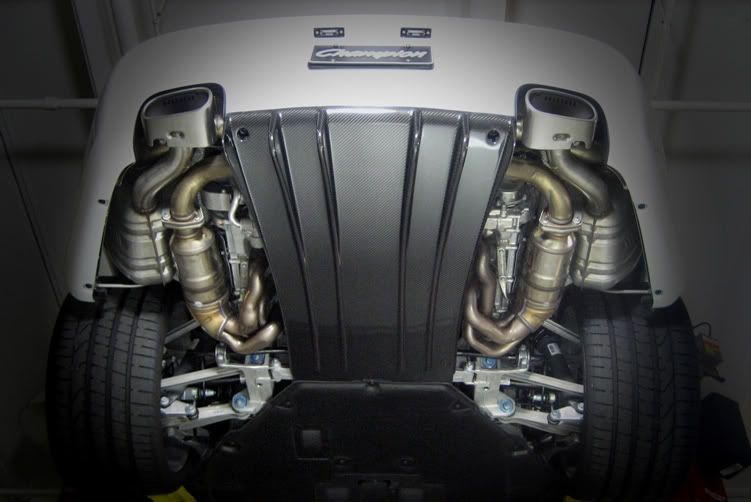
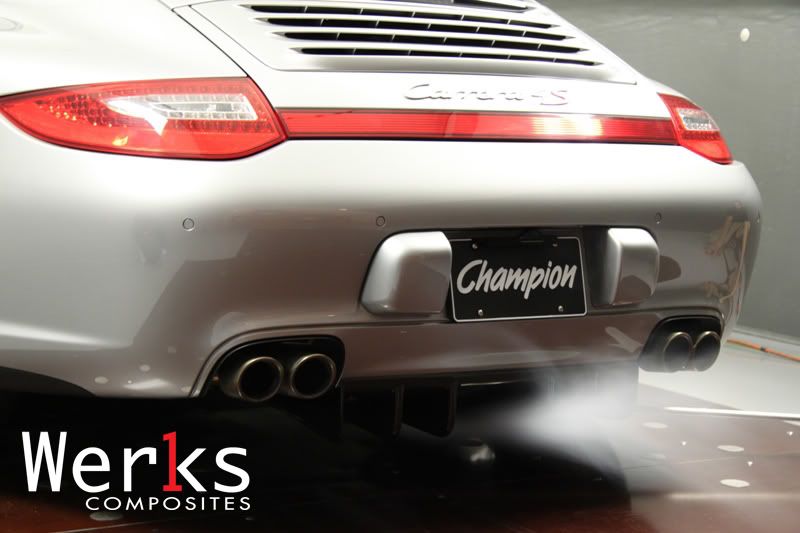
Some real world data, from the Werks 997 Carrera Diffuser, done in the A2 wind tunnel.
Not exactly like a C4, cleaner and flatter bottom, but close to what you might fit under the C4 rear.
Comparing the Yellow & Red lines, the diffuser is generating about 50 lbs of down force at 175 mph, more than offsetting the 40 lbs of lift (STD wing raised).
Just a visual of how much down force a diffuser can produce on a "stock type" sports car.
Guess 50 lbs isn't that much at 175 mph.
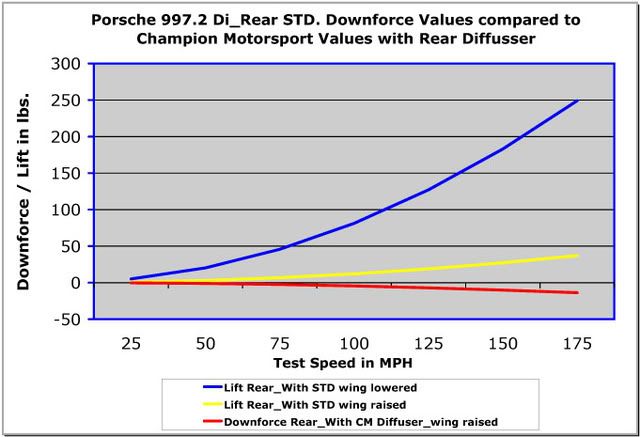
From this graph of the rear lift on a C4 corvette, a diffuser that produced 50 lbs of down force might actually negate most of the rear lift.

Not exactly like a C4, cleaner and flatter bottom, but close to what you might fit under the C4 rear.
Comparing the Yellow & Red lines, the diffuser is generating about 50 lbs of down force at 175 mph, more than offsetting the 40 lbs of lift (STD wing raised).
Just a visual of how much down force a diffuser can produce on a "stock type" sports car.
Guess 50 lbs isn't that much at 175 mph.
From this graph of the rear lift on a C4 corvette, a diffuser that produced 50 lbs of down force might actually negate most of the rear lift.
Corvette Stories
The Best of Corvette for Corvette Enthusiasts

5 Best & 5 Worst Corvette Daily Drivers
Joe Kucinski
The Headlights of Every Corvette Generation Explained
Joe Kucinski
5 Best & 5 Most Overrated Corvette Track Packages of All Time!
Joe Kucinski
Every 2027 Corvette Engine Explained
Joe Kucinski
Designer Imagines A Corvette That Looks More Like a Corvette Than the Corvette
Verdad Gallardo
10 Ugly Corvettes That We Still Kinda Love
Joe Kucinski
Top 10 Most Expensive Corvettes Ever Sold on Bring A Trailer
Brett Foote
10 Things Every Corvette Owner Needs (2026 Edition)
Michael S. Palmer
8 Most "Only Corvette Owners Understand" Quirks and Problems
Pouria Savadkouei
Race Director
Joined: Jun 2004
Posts: 13,969
Likes: 710
From: WI
I found a three year old thread with the speed holes. SDF posted pix back then. Maybe he covered the holes sometime and tested it. Here is a link:
http://forums.corvetteforum.com/auto...-c4-racer.html
Also the thread from the ZR1 above:
http://forums.corvetteforum.com/c4-z...-diffuser.html
http://forums.corvetteforum.com/auto...-c4-racer.html
Also the thread from the ZR1 above:
http://forums.corvetteforum.com/c4-z...-diffuser.html
Last edited by Aardwolf; Mar 5, 2012 at 08:41 PM.
Race Director
Joined: Jul 2003
Posts: 12,742
Likes: 43
From: Color my life with the chaos of trouble.
I'm not so sure. A parachute isn't like the back of the car, there is no hole for the air to escape. It has been my theory that the gap without the spare creates more low pressure, and down force, than a for looks diffuser would. The whole under body really needs to work with the rear diffuser. And also the suspension if you want the down force in corners and not just in a straight line. I wonder if vortex generators on the bottom of the bumper would help.
Laminar flow is what creates low pressure... not a giant open pocket.
Le Mans Master

Joined: Jul 2009
Posts: 7,182
Likes: 101
From: Pendleton IN
I have done a lot of looking at C4 aero over the last couple of years. What I have found is that ith the Greenwood nose and fender louvers add a lot more downforce than you might think.
Here is a picture of the nose taken at ~140 mph.
I weigh 200lbs and I can stand on that piece without it bending that far. I also tried removing it as an experiment and the difference in front grip was VERY noticible.
The airflow out of the hood louvers adds quite a bit as well based on what I saw when I had an oil line break and smoke coming up through them. I never would have guessed, but it was a near perfect laminar flow with a HUGE high pressure area right above the wheels.
Why is this at all important? Because at speed, it gets a bit *** happy. The underside of these things is a giant parachute, especially with the spare tire gone.
I keep putting it off because of not having time, but I have one drawn up that I think would make a pretty big difference.
I do have the factory Greenwood piece that was discussed but with my exhaust routing it won't fit as designed. From looking at it (and yes, I do have some aero knowledge) I don't think it would necessarily add downforce per sey, but it would most definitely reduce lift and drag.
Here is a picture of the nose taken at ~140 mph.
I weigh 200lbs and I can stand on that piece without it bending that far. I also tried removing it as an experiment and the difference in front grip was VERY noticible.
The airflow out of the hood louvers adds quite a bit as well based on what I saw when I had an oil line break and smoke coming up through them. I never would have guessed, but it was a near perfect laminar flow with a HUGE high pressure area right above the wheels.
Why is this at all important? Because at speed, it gets a bit *** happy. The underside of these things is a giant parachute, especially with the spare tire gone.
I keep putting it off because of not having time, but I have one drawn up that I think would make a pretty big difference.
I do have the factory Greenwood piece that was discussed but with my exhaust routing it won't fit as designed. From looking at it (and yes, I do have some aero knowledge) I don't think it would necessarily add downforce per sey, but it would most definitely reduce lift and drag.

Race Director
Joined: Jun 2004
Posts: 13,969
Likes: 710
From: WI
A diffuser in that area would smooth the air and also aid in its transition from slow to fast creating less drag.
Not sure which one would be better performance. Those have been my thoughts and haven't gone further. I would like to make something for that area.
I also have the theory that those popular tuner car speed holes are being thought of backwards. The idea isn't that they are reducing some parachute effect. It's that they could be adding air to the back of the bumper to reduce vacuum effect. With a large square rear there becomes a vacuum from the car passing through the air and that area will try to pull the car backwards. Fast back body styles helped this.
Aero is interesting but tough to learn. Maybe I could do some testing.
Race Director
Joined: Jul 2003
Posts: 12,742
Likes: 43
From: Color my life with the chaos of trouble.
From what I understand of it, that is what you want. High pressure air in back. The front spoiler creates low pressure fast moving air, the open rear spare tire area plus other parts create drag which slow the air/make high pressure. I've seen percent charts on drag created by the exhaust, drive shaft, etc etc. The bottom of the C4 has a lot of parts making drag. With the spare removed you wind up with down force on the rear of the car. This is like the rake effect which creates a suction on the bottom of the car.
A diffuser in that area would smooth the air and also aid in its transition from slow to fast creating less drag.
Not sure which one would be better performance. Those have been my thoughts and haven't gone further. I would like to make something for that area.
I also have the theory that those popular tuner car speed holes are being thought of backwards. The idea isn't that they are reducing some parachute effect. It's that they could be adding air to the back of the bumper to reduce vacuum effect. With a large square rear there becomes a vacuum from the car passing through the air and that area will try to pull the car backwards. Fast back body styles helped this.
Aero is interesting but tough to learn. Maybe I could do some testing.
A diffuser in that area would smooth the air and also aid in its transition from slow to fast creating less drag.
Not sure which one would be better performance. Those have been my thoughts and haven't gone further. I would like to make something for that area.
I also have the theory that those popular tuner car speed holes are being thought of backwards. The idea isn't that they are reducing some parachute effect. It's that they could be adding air to the back of the bumper to reduce vacuum effect. With a large square rear there becomes a vacuum from the car passing through the air and that area will try to pull the car backwards. Fast back body styles helped this.
Aero is interesting but tough to learn. Maybe I could do some testing.
If you look at the "real" diffusers out there, you will see that they start low and have an upwards slant as they exit the rear. Think of it this way... at the start of the diffuser you have X amount of air with an area of Y between the car bottom and the road. If you go farther back, you still have X amount of air, but the area between the road and bottom of the car is now greater because of the upward slant. The same amount of air in a larger space comes out to a lower pressure which "sucks" the car down.
On the other hand, if you have a high pressure area, that air is trying to expand to equalize pressure and is pushing outward in all directions. When this happens, the air pushes up on the bottom of the car and down on the road. Of course only 1 of those things moves, so you are left with an up force (as well as drag). If that high pressure is on TOP of the car... it pushes down. If you consider a static wing on a car, you create not only a high pressure area on top of it, but also a low pressure area on the bottom. The flow stays laminar (assuming a well designed wing) so you are getting this pressure differential, i.e. downforce, without a large amount of drag.
Last edited by RedLS1GTO; Mar 6, 2012 at 11:07 AM.
Burning Brakes
Joined: Apr 2006
Posts: 1,218
Likes: 7
From: Burleson Texas
From what I understand of it, that is what you want. High pressure air in back. The front spoiler creates low pressure fast moving air, the open rear spare tire area plus other parts create drag which slow the air/make high pressure. I've seen percent charts on drag created by the exhaust, drive shaft, etc etc. The bottom of the C4 has a lot of parts making drag. With the spare removed you wind up with down force on the rear of the car. This is like the rake effect which creates a suction on the bottom of the car.
A diffuser in that area would smooth the air and also aid in its transition from slow to fast creating less drag.
Not sure which one would be better performance. Those have been my thoughts and haven't gone further. I would like to make something for that area.
I also have the theory that those popular tuner car speed holes are being thought of backwards. The idea isn't that they are reducing some parachute effect. It's that they could be adding air to the back of the bumper to reduce vacuum effect. With a large square rear there becomes a vacuum from the car passing through the air and that area will try to pull the car backwards. Fast back body styles helped this.
Aero is interesting but tough to learn. Maybe I could do some testing.
A diffuser in that area would smooth the air and also aid in its transition from slow to fast creating less drag.
Not sure which one would be better performance. Those have been my thoughts and haven't gone further. I would like to make something for that area.
I also have the theory that those popular tuner car speed holes are being thought of backwards. The idea isn't that they are reducing some parachute effect. It's that they could be adding air to the back of the bumper to reduce vacuum effect. With a large square rear there becomes a vacuum from the car passing through the air and that area will try to pull the car backwards. Fast back body styles helped this.
Aero is interesting but tough to learn. Maybe I could do some testing.
As air speed decreases, pressure increases.
(with respect given to like volume)
Now pause for a moment and re-read what you wrote....
While, yes, you want the air under the car to move faster than the air above the car, and yes you want it to escape the rear of the car freely... the escaping of the air is not purposed to increase pressure at the rear underside of the car....
Take an exaggeration for example... if the goal was to raise pressure at the back of the car, why not block all the air from leaving the underside-back of the car? I mean this would raise the pressure, wouldnt it? WAIT, that will cause the rear end to LIFT off the ground...
This is exactly what you DO NOT want to happen.
You are thinking the 'suction' effect is that the air enters fast and leaves slow... this is exactly opposite. The air under the car must remain at a lower pressure- across the entire underside of the car- than the top of the car to attain down force. Think airfoil, up-side-down. The air entering the front lower area of the car must be MINIMAL amount, travelling as fast as we can get it. It must travel beneath the car, as fast as we can get it. It must exit the rear of the car AS DIFFUSED AS POSSIBLE so it does not raise pressure at the back of the car.
How does suction work? Venturi effect. Air enters at a low speed, volume is decreased, and air exits at a high speed... the because the air exits at a faster speen then it entered, there is now a pressure void left behind the fast moving slug of air... for that air to continue in its motion, it must draw more air behind it... this creates suction. For suction to continue, there has to be a pressure difference in comparisson to atmosphere.... and then we get off track...
(for more, read http://en.wikipedia.org/wiki/Venturi_effect)
So lets try to relate that to your thoughts... if the car was raked, rear being higher, the air in front of the car is going to be HIGH VELOCITY/LOW PRESSURE. The volume under the car is going to be gradually greater than the volume of air entering the front of the vehicle, so it becomes LOW VELOCITY/HIGH PRESSURE. Again, raising pressure of the rear, decreasing down force on the rear.
Diffuse. v. dif·fused, dif·fus·ing, dif·fus·es. v.tr. 1. To pour out and cause to spread freely. 2. To spread about or scatter; disseminate. 3. To make less brilliant; soften. v.intr.
A diffuser does not smooth out airflow. It DIFFUSES. A diffuser on a light, does not smooth the light or focus it in a single direction, does it?
Apply these same principles to your bumper speed holes, fast backs, and what not.
(and a btw, most of the hondas with holes in the bumpers, are trying to reduce weight- when steel bumpers weighed alot, they tried to punch holes in them to lighten them. For what ever reason, this became a fad to the ricer crowd, making thier plastic and stryofoam bumpers "light weight")
Last edited by merlot566jka; Mar 6, 2012 at 12:08 PM.
Race Director
Joined: Jun 2004
Posts: 13,969
Likes: 710
From: WI
So what should be made is something that speeds the air creating more low pressure in that area. Seal the area at the correct angle and reduce drag sources in the rest of the under body. Would that ZR1 piece pictured above be ideal?
Burning Brakes
Joined: Apr 2006
Posts: 1,218
Likes: 7
From: Burleson Texas


Race Director
Joined: Jul 2003
Posts: 12,742
Likes: 43
From: Color my life with the chaos of trouble.
"Stage I" would be to seal the area off and prevent the high pressure pocket (like the Greenwood piece does). It would be an improvement over stock due to the reduced lift, which would actually have the same end effect as adding downforce.
"Stage II" would be an actualy diffuser that would...well... diffuse, and create downforce. as talked about before.
To the last part of your question, I am at work and can't see the picture you are referencing so I am no help there.

Racer

Joined: Oct 2007
Posts: 321
Likes: 0
Yep RedLs1GTO. I think I am gonna follow up Dogfish's lead and attempt to make a 'full' underbody paneling system or atleast a rear diffuser that goes from the diff back. The bottom of C4's is definitely not as smooth and flat as C5's but it by no means bad so I think the entire underbody paneling would be extra and the main gains you will see is from the rear diffuser.
Now... on another subject... Fiberglass... anybody work with it? I've looked around and got some knowledge on it but was wondering if I could make a template out of preferrably cardboard or thin wood and use it as a mold for the fiberglass. Any thoughts?
Thanks.
-Will
Now... on another subject... Fiberglass... anybody work with it? I've looked around and got some knowledge on it but was wondering if I could make a template out of preferrably cardboard or thin wood and use it as a mold for the fiberglass. Any thoughts?
Thanks.
-Will
Burning Brakes
Joined: Apr 2006
Posts: 1,218
Likes: 7
From: Burleson Texas
Yep RedLs1GTO. I think I am gonna follow up Dogfish's lead and attempt to make a 'full' underbody paneling system or atleast a rear diffuser that goes from the diff back. The bottom of C4's is definitely not as smooth and flat as C5's but it by no means bad so I think the entire underbody paneling would be extra and the main gains you will see is from the rear diffuser.
Now... on another subject... Fiberglass... anybody work with it? I've looked around and got some knowledge on it but was wondering if I could make a template out of preferrably cardboard or thin wood and use it as a mold for the fiberglass. Any thoughts?
Thanks.
-Will
Now... on another subject... Fiberglass... anybody work with it? I've looked around and got some knowledge on it but was wondering if I could make a template out of preferrably cardboard or thin wood and use it as a mold for the fiberglass. Any thoughts?
Thanks.
-Will
Might want to start another thread on that... but google "plug and fiberglass moulding"
there is a book out there on the basics of composites.... at almost every reputable book store, and amazon. high Performance Composites... or something like that.
Ive seen rear diffusers fabricated from wood, styrofoam, plastic, metal, clay and all kinds of other stuff. Fiberglass moulds are as much artwork as skill. Not to discourage, but look into a bit more. I have made fiberglass kick pannel speakers for my C4, and a suburban... not as easy as it looks! and it is MESSY!! But you cannot argue with the results and the pride of doing it yourself.