


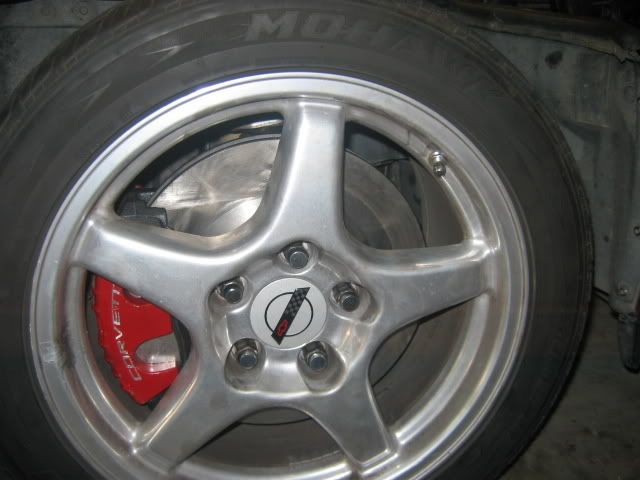

Why big brakes?

Le Mans Master


Joined: Dec 2002
Posts: 5,270
Likes: 3
From: Seattle Area WA

Stocks are not even close to being adequate under heavy braking. I witness this my self in a will game of tag with a camaro ss. My brakes failed me and braking was greatly reduced. And all this was done on a street application. It matters how hard you ride them and what your doing. Im running the J55 with slotted rotors and hawks pads. Its all matters how your driving at the time. Street or track.
I was replying to the specific scenario you claimed in your post. Someone running A-stock in an 86 shouldn't read that and go change their brakes and bump into BSP or whatever because they are worried about their brakes. It isn't true.
if you were out screwing around on the street doing stop after stop, you could have definitely had brake fade. Which is not necessarily due to the size of the brake setup but more due to the temperature of the pads/rotors and the temperature range the material is designed to operate within.
If you overdrive your setup, you should change it. Just trust me, run the same pads on the bigger setup and get up to the same temperature and the same thing will happen. Maybe it takes a bit longer to get there but the problem remains the same. The big benefit if you are actually out there racing and beating up your brakes is going to a floating caliper for better pad wear and a good stiff caliper so that you don't end up tossing your C5 calipers at the end of the season because they got warped. If you need that stuff, you're probably going to have to deal with heat just as you would've done with the smaller brakes...ducting.
Look at what StopTech says and a few other posters here.
Look at Chatman, he isn't overwhelming his setup and feels comfortable with his brakes. How'd he do it? I'd bet a properly maintained system, pads with a high temperature operating range that fits his braking, and sticky tires (increasing the amount of potential friction available for braking prior to lock up.) Like I said before, if you really wanted to stop faster, run stickies. You'll stop a hell of a lot faster than the 1ft difference you see with a brake upgrade.
I'm not against brake upgrades, I have them! I just want to clarify the reason why one should upgrade, if it is for looks, do it! If it is for stopping power, try pads and sticky tires first. If it is for heat, look at spindle/brake ducts.
Last edited by USAsOnlyWay; Mar 12, 2009 at 12:23 AM.

Melting Slicks

Joined: Jun 2004
Posts: 3,253
Likes: 2
From: Castro Valley CA
Other than exotic carbon-carbon or ceramic brakes, I believe all automotive rotors are gray cast iron. Motorcycles are steel or stainless steel, hence minimal or no cracking.
Le Mans Master

Joined: Jan 2006
Posts: 5,621
Likes: 206
From: Orlando FL
If the stock brakes are fading that is more of a function of your poor heat tolerant pad, and fluid. Put track pads and high temp fluid in then try all that stopping. I've watched C4's race on the stock calipers, lap after lap. So don't be telling me they can't handle it.
fc_soldier were those Hawk HPS that faded? They are a terrible track pad and quickly faded when I tested them. They are not at all suitable for pushing the brakes. They are a decent street pad if not pushed.
fc_soldier were those Hawk HPS that faded? They are a terrible track pad and quickly faded when I tested them. They are not at all suitable for pushing the brakes. They are a decent street pad if not pushed.
I my previous posts I was talking about street driving and not pushing anything. I just wanted to stop at the red lights, or decelerate quickly enough from 70 mph on the expressway if traffic slows down rapidly. Just driving the car normally and having adequate stopping power to be safe. This, at the lower level is the braking problem with the C4 that I am talking about.
Although I initially did extensive work on my braking system, some others had gone further than me in actually measuring the hydraulic pressure (psi) at the front calipers and found it to be normal. That might indicate some sort of caliper engineering problem but that is just a theory.
Currently after 3 or so years my ceramic pads have warn down. These pads came with the rotors and really ate the rotors so bad that they can not be cut. They are already below the allowable thickness. So I have already bought 2 new front rotors and a set of Hawk HPS pads. Since the current pads and rotors are a throw out, I am going to wait and get as much life out of the current brakes I can. I hope the Hawks work as well as the current ceramic pads which I actually hate because they dust so terribly.
Before the J55s I worried about hitting the car in front of me. Now with the J55s I worry about the car hitting me from behind. I like it the second way better.

Last edited by pcolt94; Mar 12, 2009 at 10:45 AM.
Melting Slicks


Joined: May 2006
Posts: 3,385
Likes: 4
From: King George VA
Like I said before its all on application. I think stock is alttle soft for my liking. DO I trust my brakes totally when something happens on the street? I would have to say not really that why Im going to be upgradeing. I expect more out of a brake system than what Ive felt so far.
Le Mans Master
Joined: Aug 2004
Posts: 5,141
Likes: 7
From: Metairie Louisiana
What is the stock stopping distance for a C4 with J55 brakes? What about a C4 with the C5 brake upgrade? DRM sells a Wilwood kit that is capable of 60–0 in 102 ft. and 80–0 in 200 ft. stopping distances. That's got to be a huge improvement over stock. I would not mind having those in an emergency stopping situation on the street.
Corvette Stories
The Best of Corvette for Corvette Enthusiasts

Top 10 Most Expensive Corvettes Ever Sold on Bring A Trailer
Brett Foote
10 Things Every Corvette Owner Needs (2026 Edition)
Michael S. Palmer
8 Most "Only Corvette Owners Understand" Quirks and Problems
Pouria Savadkouei
10 Reasons the C6 Z06 is Still A Performance Benchmark After 20 Years
Joe Kucinski
How Much Horsepower Every Corvette Engine "LOST" in 1972
Joe Kucinski
Top 10 DOs and DON'Ts for Protecting Your Convertible Top!
Michael S. Palmer
Top 10 Most Explosive Corvettes Ever Made: Power-to-Weight Ratio Ranked!
Joe Kucinski
150 hp to 1,250 hp: Every Corvette Generation Compared by the Specs That Matter
Joe Kucinski
8 Coolest Corvette Pace Cars (and Replicas) of All Time
Verdad Gallardo
Supporting Vendor


Joined: Jun 2008
Posts: 2,199
Likes: 119
From: tempe Arizona
It's somewhat pointless to go too deep into some of this as it always takes off on a related tangent that begs as many new questions as it answers....
That being said, I'd call the base need for bigger brakes based upon a desire for an increase in efficiency and a decrease in duty cycle. More often than not you're looking for gains in long term use and not one-stop applications.
The keys to this vary by both manufacture and application as well as fitment. Variable run from total rotor mass and design, rotor width, to pad compound, pad thickness, caliper design, piston sizing, piston material, hat mounting, ducting (or not) to fluid use and weight. There's no "right" answer to any of this other than to buy and use to the levels you feel best meet your needs.
That being said, I'd call the base need for bigger brakes based upon a desire for an increase in efficiency and a decrease in duty cycle. More often than not you're looking for gains in long term use and not one-stop applications.
The keys to this vary by both manufacture and application as well as fitment. Variable run from total rotor mass and design, rotor width, to pad compound, pad thickness, caliper design, piston sizing, piston material, hat mounting, ducting (or not) to fluid use and weight. There's no "right" answer to any of this other than to buy and use to the levels you feel best meet your needs.
Safety Car

Joined: Jul 2001
Posts: 4,871
Likes: 15
From: Detroit's West Side MI

A few more comments:
The tire is the only contact between your car and the road. Ultimate braking performance is 100% affected by tires. That's another reason why race cars burn up brakes - the tires provide significantly more grip than worn out 10 year old street tires.
The biggest improvement you can make to your braking feel is different (notice I didn't say "better") pads. But they don't look cool, so nobody buys them.
Each individual pad compound has specific characteristics: initial bite (fc wants strong initial bite), heat range (Aardwolf and Brian want a higher heat range), modulation capability (again, more for racing or repeated stops), wear characteristics (street cars hate dusty wheels), noise factors (metals injected into pads for better heat squeal when cold), etc. There is no easy answer. Get a street pad and lose brakes after two laps on track, or get a track pad and have blackened wheels and school-bus squeal on the way to work.
Regardless of size, caliper quality can affect braking performance. C4 calipers (the PBR's) are notorious for spreading under load which reduces caliper force (for a specific pedal load). This is a reason to get better calipers, but not necessarily bigger ones.
Other than that, other things being equal, bigger brakes do what Stealth mentioned in post #6 - provide greater torque at the hub to slow the car, and dissipate the heat energy created from braking. Cross drilling and slotting are cosmetic.
Oh, and like Steve says...chix dig 'em.
Supporting Vendor
Joined: Jun 2008
Posts: 2,199
Likes: 119
From: tempe Arizona
What? You don't like my unsexy, simplified description?? lol
I'd probably have more sales if I used cool terms like; aircraft aluminum, brake power, shorter distances, monobloc and ten pistons....chicks dig more pistons.
I'd probably have more sales if I used cool terms like; aircraft aluminum, brake power, shorter distances, monobloc and ten pistons....chicks dig more pistons.

Drifting

Joined: Sep 2002
Posts: 1,642
Likes: 0
From: Suwanee,Ga
Why Bigger brakes??
'Cause brakes are designed to make heat, via friction.
The amount of stopping power is directly related to how much friction can be generated [ e.g. the best pads] and that relates to how much heat you can make.
SO........... the Bigger heat sinks [ mass and surface area] and the better they also can shed heat [ cast iron does a great good] the better they will work
But if you have 23 year old brake fluid you just might have a problem???????
TJM
'Cause brakes are designed to make heat, via friction.
The amount of stopping power is directly related to how much friction can be generated [ e.g. the best pads] and that relates to how much heat you can make.
SO........... the Bigger heat sinks [ mass and surface area] and the better they also can shed heat [ cast iron does a great good] the better they will work
But if you have 23 year old brake fluid you just might have a problem???????
TJM
 ....but things are changing soon
Melting Slicks

Joined: Sep 2008
Posts: 2,376
Likes: 111
From: Cherokee National Forest TN
With all things being equal: Just changing rotor size from a 12" to a 13" will yield approximately a 10% increase in brake performance simply due to the extra amount of rotor surface area the 13's have over the 12's. For each revolution of the wheel you will pass 10% more rotor area across the brake pads. This is considered the swept area.
The torque factor i.e.: moving the brake caliper outboard 1/2" from the wheel centerline to accommodate the larger rotor is not a consideration in the above.
Rotors: Drilled, slotted, or a combination of both actually do serve a purpose. Non ceramic brake pads will "gas" under severe braking loads resulting in what is commonly referred to as brake fade. The phenomenon occurs when the pads get extremely hot & emit a gas from the pad surface that will not allow the pad to have full contact with the rotor surface. Symptom is a hard to medium hard brake pedal & decreasingly less brake performance. The drilled/slotted rotors help eliminate the gassing effect & help keep the pads in contact with the rotor simply by giving the gas that is emitted from the pads an escape route.
The torque factor i.e.: moving the brake caliper outboard 1/2" from the wheel centerline to accommodate the larger rotor is not a consideration in the above.
Rotors: Drilled, slotted, or a combination of both actually do serve a purpose. Non ceramic brake pads will "gas" under severe braking loads resulting in what is commonly referred to as brake fade. The phenomenon occurs when the pads get extremely hot & emit a gas from the pad surface that will not allow the pad to have full contact with the rotor surface. Symptom is a hard to medium hard brake pedal & decreasingly less brake performance. The drilled/slotted rotors help eliminate the gassing effect & help keep the pads in contact with the rotor simply by giving the gas that is emitted from the pads an escape route.
Team Owner


Joined: Mar 2001
Posts: 30,856
Likes: 293
From: Boston, Dallas, Detroit, SoCal, back to Boston MA
They definitely help for road racing.
I've crewed for some World Challenge (now SpeedGT) cars.
I've also boiled my stock brakes on a road course.
The stock pads are garbage for any kind of performance driving.
Changing pads when you go to an event is the best bet.
With a fresh set of racing pads, this is what my friends wheels looked like after a weekend at Road America.

I've crewed for some World Challenge (now SpeedGT) cars.
I've also boiled my stock brakes on a road course.
The stock pads are garbage for any kind of performance driving.
Changing pads when you go to an event is the best bet.
With a fresh set of racing pads, this is what my friends wheels looked like after a weekend at Road America.
Safety Car
Joined: Oct 2008
Posts: 4,689
Likes: 4
From: Yucaipa CA
I drove my friends 90 and was amazed at how poor his brakes were and how quikly they faded. His has the standard brakes, now this wasnt racing the car just quik california gridlock panic stops. I was amazed actually that my 1982 corvette brakes way better then his 90 but at the same time with the 90 project I am doing I forsee caliper changes or something since I intend mountain driving a lot with my 1990.
My 1982 vette has I think 4 piston calipers at all corners wonder if this caliper could be adapted to a 90 vette.
My 1982 vette has I think 4 piston calipers at all corners wonder if this caliper could be adapted to a 90 vette.
Safety Car
Joined: Jul 2001
Posts: 4,871
Likes: 15
From: Detroit's West Side MI
With all things being equal: Just changing rotor size from a 12" to a 13" will yield approximately a 10% increase in brake performance simply due to the extra amount of rotor surface area the 13's have over the 12's. For each revolution of the wheel you will pass 10% more rotor area across the brake pads. This is considered the swept area.
Rotors: Drilled, slotted, or a combination of both actually do serve a purpose. Non ceramic brake pads will "gas" under severe braking loads resulting in what is commonly referred to as brake fade. The phenomenon occurs when the pads get extremely hot & emit a gas from the pad surface that will not allow the pad to have full contact with the rotor surface.
Safety Car
Joined: Jul 2001
Posts: 4,871
Likes: 15
From: Detroit's West Side MI
It certainly could, but for the cost and effort you'd be better off just buying a good aftermarket caliper, like a Wilwood superlite, and making it fit. They're around $150 each and will perform better and have cheaper replacement pads than a 30 year old caliper.


Pro

Joined: Sep 2008
Posts: 694
Likes: 27
From: St James New York
Since this is a series of opinions and anecdotes, I'll join in. If anyone starts to use real research then I withdraw the following.
I use HP Plus pads on a stock 86 system and keep the brakes in top condition. I have run over a dozen track days and am in HPDE3, usually with a passenger, at Infineon, Thunderhill and Laguna Seca. I haven't had a fade problem yet. That is not competition driving but it is pushing your car for 20 minutes on road courses.
When I go to ceramic street pads I feel like I need to use both feet to stop the same car, but those pads make very little dust and last a long time. It takes a few days to mentally/physically make the transition and I would never use those pads on the track. Same goes for the older Dunlops on the car. With those tires and street pads, it is just not safe to drive on a track. Put on the slicks and Plus pads and it's OK for my level of driving.
Maybe it is the usually pleasant temperatures or the fact that a stock 86 will only go so fast, but I don't think that a new braking system is required. As I understand things, you should try to drive fast, brake really hard, and then get off the frigging brakes. Under those conditions, there should be time for the disks to cool enough for a decent, recently changed fluid and appropriate pads.
In my opinion, most braking upgrades are auto bling bling, including stainless steel wrapped lines. Especially useless and actually damaging are things like drilling, grooves, and freezing treatments. A good thick iron disk handles heat really well. Drill holes, make grooves, and add alloys to keep the disk pretty and you have made things worse. The SS wrapped lines are to prevent external, physical damage to the lines. The wrapping does nothing for brake line hardness and resistance to pressure, that's a function of the tube carrying the fluid.
However, I do believe that additional pistons allow for better brake feel and would rather have them. But I don't think that they can stop the car any faster.
Yes, I have seen the glowing ceramic disks of Formula 1, but that ain't me or my car.
I use HP Plus pads on a stock 86 system and keep the brakes in top condition. I have run over a dozen track days and am in HPDE3, usually with a passenger, at Infineon, Thunderhill and Laguna Seca. I haven't had a fade problem yet. That is not competition driving but it is pushing your car for 20 minutes on road courses.
When I go to ceramic street pads I feel like I need to use both feet to stop the same car, but those pads make very little dust and last a long time. It takes a few days to mentally/physically make the transition and I would never use those pads on the track. Same goes for the older Dunlops on the car. With those tires and street pads, it is just not safe to drive on a track. Put on the slicks and Plus pads and it's OK for my level of driving.
Maybe it is the usually pleasant temperatures or the fact that a stock 86 will only go so fast, but I don't think that a new braking system is required. As I understand things, you should try to drive fast, brake really hard, and then get off the frigging brakes. Under those conditions, there should be time for the disks to cool enough for a decent, recently changed fluid and appropriate pads.
In my opinion, most braking upgrades are auto bling bling, including stainless steel wrapped lines. Especially useless and actually damaging are things like drilling, grooves, and freezing treatments. A good thick iron disk handles heat really well. Drill holes, make grooves, and add alloys to keep the disk pretty and you have made things worse. The SS wrapped lines are to prevent external, physical damage to the lines. The wrapping does nothing for brake line hardness and resistance to pressure, that's a function of the tube carrying the fluid.
However, I do believe that additional pistons allow for better brake feel and would rather have them. But I don't think that they can stop the car any faster.
Yes, I have seen the glowing ceramic disks of Formula 1, but that ain't me or my car.
S/S are superior to OEM rubber lines for more than their ability to resist abrasion and protect the line from debris damage. Even brand new OEM rubber lines will deflect slightly outward with heavy brake pedal pressure application. As these rubber lines age this deflection will increase, growing greater over time, in some cases eventually outright deformation of the line will occur. This will substantially adversely effect braking performance. The use of S/S or Kelvar wrapped brake lines will eliminate this issue and allow all of the pedal pressure to be applied to your calipers and rotors resulting in better braking performance. That is not an opinion it is a fact!
Now on to those rotors, you both claim that cross-drilling damages the rotor or the pads and does nothing to increase braking performance. That may be your opinion but it too, is not based in fact. Brake rotors do their job by dissipating the heat produced from braking, in effect they are large circular heat sinks and to work effectively they must lose the heat they gather after braking. When they cannot be cooled enough after long, hard, repeated stops, your brakes will begin to fail. Since all C4 rotors are ventillated and air cooled with circular pillar vanes that force air though the rotor as it spins, the use of cross-drilling will increase rotor ventillation which helps cooling efficiency, as well as dealing with any pad out gassing that may occur. (Even if out gassing isn't the issue it once was with newer, better, pad friction materials available today). The SAE (society of automotive engineers) did a study on cross-drilled rotors and found them to increase braking performance across the board on all applications they tested! Do a search and read it for yourself! Now if your inclined to dismiss the SAE, what about the engineers that design and build braking systems at every major automobile manufacturer in the world. When they want the very best in braking they always choose to equip their very best vehicles with cross-drilled rotors! Engineers at Mercedes, Porche, Lamborgini, Astin Martin, Chevy (ZO6 & ZR1 vettes), Ferrari, Acura...... ect all choose cross-drilled rotors as OEM parts! Do you think they do that for looks? The added bling factor? Or possibly for the increased performance these cross-drilled rotors provide??
Lets not forget the aftermarket. Braking engineers at manufacturers like Baer, Brembo, Wilwood, AP Racing, Movit......ect all use cross-drilling for their very best rotors. Why do you think that is? For the added bling factor? Because "chicks dig 'em"?
 Or possibly because cross-drilling has been found to increase braking performance enough to employ it on all of their very best products.
Last edited by mako41; May 14, 2009 at 06:49 PM.