



Question regarding engine power and physics...

Thread Starter
Melting Slicks

Joined: Jun 2013
Posts: 3,065
Likes: 39
 Question regarding engine power and physics...
Hello everyone, I was just thinking to myself of a possible way to make more horsepower using only what's available us on what we already have to work with.
So, this is essentially what I was thinking. This is the fundamental question of the whole idea: Does momentum help with building more horsepower up top?
For instance, on a motor that makes power between 3000-6000ish RPMs, could we make more PEAK horsepower by optimizing the torque produced at low RPMs? I'm not talking about changing heads, intake manifolds, cam etc. What I am talking about is mostly in regards to tuning; maximizing the torque at low RPMs.
In my theory, if you could tune the engine to make more torque at a lower RPM by increasing spark timing and adjusting air/fuel ratio, could that as a side effect, create more momentum to make it easier for the engine to make power up top, and thus putting out more peak horsepower?
So, this is essentially what I was thinking. This is the fundamental question of the whole idea: Does momentum help with building more horsepower up top?
For instance, on a motor that makes power between 3000-6000ish RPMs, could we make more PEAK horsepower by optimizing the torque produced at low RPMs? I'm not talking about changing heads, intake manifolds, cam etc. What I am talking about is mostly in regards to tuning; maximizing the torque at low RPMs.
In my theory, if you could tune the engine to make more torque at a lower RPM by increasing spark timing and adjusting air/fuel ratio, could that as a side effect, create more momentum to make it easier for the engine to make power up top, and thus putting out more peak horsepower?

Racer

Joined: May 2015
Posts: 265
Likes: 21
From: Grand Rapids MI
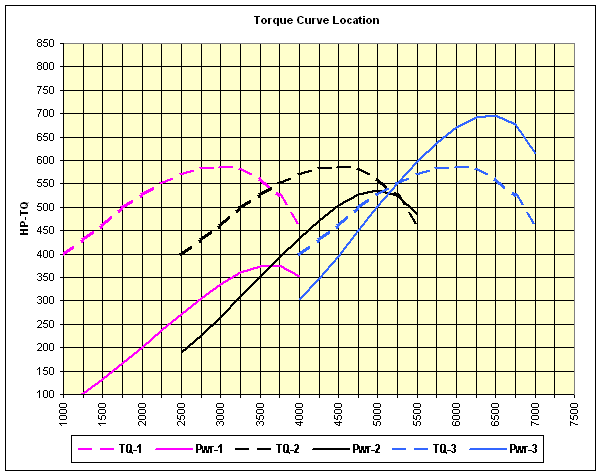
All other things being equal, shifting the TQ curve to significantly lower RPMs will reduce peak HP and the RPM at which it occurs, but provide more immediate off-the-line "grunt" (and vice versa). Good tuning will place your peak TQ/HP at ideal numbers & engine speeds ("ideal" depends on volumetric efficiency & application/load, of course), while providing the broadest possible area beneath the curve.
Last edited by 84Z51J; Jan 29, 2016 at 06:32 PM.

Safety Car


Joined: Sep 2001
Posts: 4,157
Likes: 554
From: Glenbeulah Wi
Short answer is no. Optimizing the power at every rpm position will maximize the power output of the engine over the rpm band but max power at 2000 rpm will not cause a higher power output at 4000 rpm, or whatever rpm you pick. Each rpm position is independent on the other.
Le Mans Master

Joined: Oct 2002
Posts: 7,098
Likes: 378
From: Las Vegas - Just stop perpetuating myths please.
Not sure what the question is but it reads like u want to use the tune to make more low rpm torque and see if that increases the higher rpm torque and power.
Well u need to get the car to a dyno and watch what the tuner is trying to do Danny. On a street car the tuner will be trying to tune for max torque using optimum fuel mixture and optimum timing adv. Using the newer eddy current dyno's that hold the load accurately at desired rpm u can optimize fuel and timing for every 50rpm increment if desired - most will use every 500rpm. So what im saying is tuners are already doing this optimize maximize torque - but at all rpms, much like 84Z is trying to say.
An exception to this is some types of race engines and race circuit classes make to much low rpm torque and have to much wheel spin producing a lack of traction control - my camaro included. Many of these motors will reduce timing adv to kill some low end torque to prevent spin-outs.
FYI Greg Banish has some good books on EFI tuning. Hope this helps ya.
Well u need to get the car to a dyno and watch what the tuner is trying to do Danny. On a street car the tuner will be trying to tune for max torque using optimum fuel mixture and optimum timing adv. Using the newer eddy current dyno's that hold the load accurately at desired rpm u can optimize fuel and timing for every 50rpm increment if desired - most will use every 500rpm. So what im saying is tuners are already doing this optimize maximize torque - but at all rpms, much like 84Z is trying to say.
An exception to this is some types of race engines and race circuit classes make to much low rpm torque and have to much wheel spin producing a lack of traction control - my camaro included. Many of these motors will reduce timing adv to kill some low end torque to prevent spin-outs.
FYI Greg Banish has some good books on EFI tuning. Hope this helps ya.
Thread Starter
Melting Slicks
Joined: Jun 2013
Posts: 3,065
Likes: 39

Melting Slicks
Joined: May 2013
Posts: 2,692
Likes: 349
From: Sacramento California
I think we need to revisit the meaning of momentum. An object in motion stays in motion unless acted on by an outside force. So any force applied in lower RPMs only, will affect the crank (output) at lower RPMs only. High RPM output depends on its own point in the power curve, not any earlier point in the curve.

Safety Car


Joined: Nov 2009
Posts: 3,973
Likes: 341
From: Adelaide South Australia
https://www.corvetteforum.com/forums...sepower-6.html
volkswagons for life was copping a real beating in this one, things were starting to get very personal !
Corvette Stories
The Best of Corvette for Corvette Enthusiasts

Top 10 Most Expensive Corvettes Ever Sold on Bring A Trailer
Brett Foote
10 Things Every Corvette Owner Needs (2026 Edition)
Michael S. Palmer
8 Most "Only Corvette Owners Understand" Quirks and Problems
Pouria Savadkouei
10 Reasons the C6 Z06 is Still A Performance Benchmark After 20 Years
Joe Kucinski
How Much Horsepower Every Corvette Engine "LOST" in 1972
Joe Kucinski
Top 10 DOs and DON'Ts for Protecting Your Convertible Top!
Michael S. Palmer
Top 10 Most Explosive Corvettes Ever Made: Power-to-Weight Ratio Ranked!
Joe Kucinski
150 hp to 1,250 hp: Every Corvette Generation Compared by the Specs That Matter
Joe Kucinski
8 Coolest Corvette Pace Cars (and Replicas) of All Time
Verdad Gallardo
Thread Starter
Melting Slicks
Joined: Jun 2013
Posts: 3,065
Likes: 39
I was talking about this one,
https://www.corvetteforum.com/forums...sepower-6.html
volkswagons for life was copping a real beating in this one, things were starting to get very personal !
https://www.corvetteforum.com/forums...sepower-6.html
volkswagons for life was copping a real beating in this one, things were starting to get very personal !
