When you click on links to various merchants on this site and make a purchase, this can result in this site earning a commission. Affiliate programs and affiliations include, but are not limited to, the eBay Partner Network.
Well...sort of. The front spring is trying to lift the frame (sprung mass) up and away from the front wheel, but it's not trying to lift the tire off the ground. The tire's contact with the ground is purely down to the vertical component of the acceleration force vs the weight (load) on the front tires. The tires will stay on the road as long as the acceleration force trying to lift the front is not greater than the weight on the front tires trying to hold them down. But when that force exceeds the weight on the front tires and they leave the ground, then all spring and shock actions become moot because they have to act through the tires' contact with the ground, which no longer exists. If the front tires could be tied or clamped to the ground it would still matter, but otherwise they are coming off the ground no matter how you have the front shocks set. The only ways to prevent the tires coming off the ground at that point is to add weight to them or reduce the force trying to lift them.
Think of a weight lifter deadlifting a 200lb barbell. We can put springs or dampers between the barbell and the floor, but if the weight lifter can apply more upward force than 200lb, that barbell is coming off the floor no matter what.
One thing you need to understand Matthew is that the rate that the tire extends away from the body during the initial hit makes a difference. During launch, the rear tires bite causing the front of the car to rise. If the front shocks were loose on extension, the front end would be free to rise without the weight of the tires holding the front end down. Once the extended limit of the shocks is reached, the tires would be yanked off the ground. This is great for lesser horsepower cars that can barely pull the fronts off the ground. On higher horsepower cars, during the initial hit if the front tires can be "tied" to the front of the car as the front end rises, the weight of the wheels/tires will help hold the front of the car down. When trying to control the height of a wheelie, tightening the extension on a front shock will reduce the front lift.
So, I'm not into this level of racing at all but... I have a question I suppose. It would seem like the concept is to keep the rear driven into the ground as hard as possible on launch per say, as well as slowing down the fronts rate of rise as much as possible and then transitioning back without upsetting everything in the process? Ie rear compress as quick as possible then controlled and never maxing out and front as slow as possible on extension? I think that's what I'm understanding from reading all this? I'm going to thumb through again...
So, I'm not into this level of racing at all but... I have a question I suppose. It would seem like the concept is to keep the rear driven into the ground as hard as possible on launch per say, as well as slowing down the fronts rate of rise as much as possible and then transitioning back without upsetting everything in the process? Ie rear compress as quick as possible then controlled and never maxing out and front as slow as possible on extension? I think that's what I'm understanding from reading all this? I'm going to thumb through again...
Sort of. A lot of people think that the rear of a car needs to squat to plant the rear tires. A squatting rear helps with weight transfer of a car, but a rear squat actually unloads the rear tires off the ground. If you have ever seen a 60s Mopar launch, the rear tires actually do the opposite. They extend away from the body actually "planting" the tires into the ground. Every car is different and different suspensions require different rates of extension and compression of shocks. There, that should confuse you.
2025 C2 of the Year ('64-'66) Finalist - Unmodified
2025 C3 of the Year Finalist - Modified
2025 C4 of the Year Finalist - Modified
2024 C4 of the Year Finalist - Modified
2023 C2 of the Year Finalist - Unmodified
2023 C4 of the Year Finalist- Modified
2022 C4 of the Year Finalist - Modified
2022 C3 of the Year Finalist - Modified
2021 C7 of the Year Winner -- Modified
2020 C4 of the Year Finalist - Modified
Maybe more wheel speed needed @ launch, to break traction for the first couple of feet?
I have never had to experience this problem before (mine will not wheelie)
One thing you need to understand Matthew is that the rate that the tire extends away from the body during the initial hit makes a difference. During launch, the rear tires bite causing the front of the car to rise. If the front shocks were loose on extension, the front end would be free to rise without the weight of the tires holding the front end down. Once the extended limit of the shocks is reached, the tires would be yanked off the ground. This is great for lesser horsepower cars that can barely pull the fronts off the ground. On higher horsepower cars, during the initial hit if the front tires can be "tied" to the front of the car as the front end rises, the weight of the wheels/tires will help hold the front of the car down. When trying to control the height of a wheelie, tightening the extension on a front shock will reduce the front lift.
That's a fair point. I don't think of front skinnies as weighing enough to matter, but they probably still weigh 25lbs each (tire+wheel), so it's something. So yeah, increasing front rebound would help at least a little.
Originally Posted by 84 4+3
So, I'm not into this level of racing at all but... I have a question I suppose. It would seem like the concept is to keep the rear driven into the ground as hard as possible on launch per say, as well as slowing down the fronts rate of rise as much as possible and then transitioning back without upsetting everything in the process?
Yep.
Ie rear compress as quick as possible then controlled and never maxing out and front as slow as possible on extension? I think that's what I'm understanding from reading all this? I'm going to thumb through again...
Actually, in back, think of "rear compressing" more as "rear tires trying to lift off the ground." That hurts forward traction. So for a straight-ahead launch, we want to the rear to not compress at all, or even to rise up with greater-than-100% anti-squat geometry (liie C409 is using). If the rear end of the sprung mass rises on acceleration, then it's actually driving the rear tires into the ground even harder than gravity alone can do that. This can only happen while the rate of acceleration is rising, though: once we reach a constant amount then the rear stays at the height where it is. And once the acceleration starts decreasing (after an upshift in particular), then the rear ride height has to come back down and it will actually take traction away again. This is where lots of rear compression damping can really help slow that "coming back down" process and minimize the traction loss.
ETA: I just now realized that 383vett and I were typing the same thing at the same time.
Last edited by MatthewMiller; Feb 18, 2022 at 09:39 PM.
One thing you need to understand Matthew is that the rate that the tire extends away from the body during the initial hit makes a difference. During launch, the rear tires bite causing the front of the car to rise. If the front shocks were loose on extension, the front end would be free to rise without the weight of the tires holding the front end down. Once the extended limit of the shocks is reached, the tires would be yanked off the ground. This is great for lesser horsepower cars that can barely pull the fronts off the ground. On higher horsepower cars, during the initial hit if the front tires can be "tied" to the front of the car as the front end rises, the weight of the wheels/tires will help hold the front of the car down. When trying to control the height of a wheelie, tightening the extension on a front shock will reduce the front lift.
As Matthew said this is a fair point but once the tires are off the ground the wheelie is allowed to continue as normal, looking totally awesome! But not helping on the actual assignment.
So with the front shocks set at a slow rate of extension the OP can play with weight in the front to reduce the wheelies. Since the car is headed for track use only, maybe, I would make a hatch under the front bumper and add and reduce weight there on a fixture of some sort. I have seen others do this often on other cars. Or remove weight from inside the car and add that same amount to a fixture on the front inside the bumper.
From the pics he has little "squat" and it is firmly planted so it doesn't seem to have any rear suspension problems at all. For this HP/Torque application it could be as simple as weight distribution...but then again nothing with a C4 is ever simple..... Heck maybe just going back to stock front wheels and tires would help. But that reduces the fine tuning option of having adjustable weight in the front of the car.
Sort of. A lot of people think that the rear of a car needs to squat to plant the rear tires. A squatting rear helps with weight transfer of a car, but a rear squat actually unloads the rear tires off the ground. If you have ever seen a 60s Mopar launch, the rear tires actually do the opposite. They extend away from the body actually "planting" the tires into the ground. Every car is different and different suspensions require different rates of extension and compression of shocks. There, that should confuse you.
No that actually makes perfect sense oddly enough. I can picture a force balance on the read axle where the rear lifts while the axle is driven down. Visually makes sense that way. Thanks!
..... Its less about the weight of the front tires & wheels as it is about the extra lift that the 5-600 inlb spring provides to an already upward front end ... this is what the tight extension helps with ... that , and limiting just how high/far the front wheels can travel to minimize the spring assist in boosting the front of the car ... I currently have about 3 1/2" of downward movement of the front tires and can tighten that up some more .....
..... Wheel speed ... radials are unforgiving when it comes to traction ... they will hook or spin and not much in between .....
..... Went to TnT last night and the front is still coming up about the same as the second pic in my original post ... TnT pics aren't available yet from the track photog ... we have 2 points races this weekend so I can't really make any more adjustments until after (just in case traction goes away) ... gotta try to maintain consistency .....
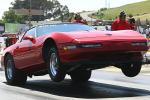
..... After making some changes to the car , I find it necessary to quelch the tendency to lift the front end at launch ... a couple weeks ago at Gainesville , it was going for the rear bumper . Kinda scary when all you see is sky and the nose is still climbing . I pedaled it and brought it down but the landing was pretty hard ... fortunately there was no damage .
..... So I adjusted the 4 Link bars and installed an improved front suspension limiter and made a hit at Bradenton "Street Heat" last Saturday to get this .....
..... Made some more adjustments to the link bars and moved the Instant Center back another 10" ... that's 26" total since Gainesville ... will go to the TnT at Bradenton on Thursday and we have points races on Saturday and Sunday . Hopefully I will get the front down without losing rear bite ... all adjustments made are keeping the I/C above the anti-squat line to plant the radials and not lose traction .....
I'm guessing that your battery is mounted behind the rear axle. Any thought of moving it forward a bit, like just ahead of the rear axle. Or changing to a lightweight battery. Maybe moving the drivers seat ahead and inch or so? Just something to try until you change front shocks and get the front held down. My 2 cents.
I'm guessing that your battery is mounted behind the rear axle. Any thought of moving it forward a bit, like just ahead of the rear axle. Or changing to a lightweight battery. Maybe moving the drivers seat ahead and inch or so? Just something to try until you change front shocks and get the front held down. My 2 cents.
..... The battery is in the stock location ... still have the factory horns ... about the only parts removed for weight reduction were the headlights and passenger seat , and the seat is behind the center of gravity ... I scaled the car yesterday and it weighs 3420# with me in it ... 1760# of that is on the rear axle ... works out to 48.5% front 51.5% rear ... I expected the rear to be heavier with the 9" axle and all the steel parts holding it in vs the D44 .....
..... After making some changes to the car , I find it necessary to quelch the tendency to lift the front end at launch ... a couple weeks ago at Gainesville , it was going for the rear bumper . Kinda scary when all you see is sky and the nose is still climbing . I pedaled it and brought it down but the landing was pretty hard ... fortunately there was no damage .
..... So I adjusted the 4 Link bars and installed an improved front suspension limiter and made a hit at Bradenton "Street Heat" last Saturday to get this .....
..... Made some more adjustments to the link bars and moved the Instant Center back another 10" ... that's 26" total since Gainesville ... will go to the TnT at Bradenton on Thursday and we have points races on Saturday and Sunday . Hopefully I will get the front down without losing rear bite ... all adjustments made are keeping the I/C above the anti-squat line to plant the radials and not lose traction .....
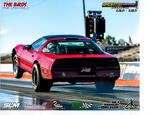
..... Well ... back to the drawing board ... Saturday , I had a little luck but it ran out 3rd round when I went .004 red ... the car was still picking them up so I changed the angle of the dangle on the link bars again pulling the I/C further back and a little higher above anti-squat and this is what I got on Sunday ... a front came through overnight and drier air moved in ... there was a large turnout for the races so they decided on no time runs except for new arrivals ... then we raced ... 1st round I drew the winner of Saturday's race and lucky for me , he went red by .001 so I got to run it out and see what the car would do ... ran .032 R/T , dialed 6.58 and went dead on with an 8 ... got to the 2nd round and was .015 R/T but dialed 6.62 figuring that I was holding .02 because it was much hotter than rd 1 ... went 6.595 off the gas and took too much stripe ... but this is what the launch looked like .....
Do you have any pics like this with the suspension compressed, because the bars in this have you with an incredibly high instant center if it is actually compressed here.
Do you have any pics like this with the suspension compressed, because the bars in this have you with an incredibly high instant center if it is actually compressed here.
I agree. I think overall all your shortening of the swing arm length by pulling the IC back is actually making things worse, especially if the anti-squat percentage is being increased as a result. With greater-than-100% anti-squat, the IC rises when you accelerate and the rear ride height rises, and the shorter you make the virtual swing arm, the more it increases (even if anti-squat stays the same).
If you can lower rear ride height safely (with respect to tire clearance), I'd try that along with maybe raising the top link one hole or two (looks like the lower links are already as low as they go?). Another thing that could help would be to lengthen the wheelbase by both upper and lower links the same amount. Even 1/2" would help if you can do that safely.
C409,
Comparing the different pictures of your car, including the one in your signature, we can see that the gap is huge between the back tire and the lip of the quarter panel in the latest one. Obviously, the car is doing different things now on the launch but not what you desire. Can you post a picture of the four link bars with the car on the ground and possibly with you sitting in the drivers seat?
Mike.
I agree. I think overall all your shortening of the swing arm length by pulling the IC back is actually making things worse, especially if the anti-squat percentage is being increased as a result. With greater-than-100% anti-squat, the IC rises when you accelerate and the rear ride height rises, and the shorter you make the virtual swing arm, the more it increases (even if anti-squat stays the same).
.
I agree with Matthew. If you make the bars closer to parallel, it will move the ic toward the front of the car and will make the front of the car harder to lift off the ground.
I agree with Matthew. If you make the bars closer to parallel, it will move the ic toward the front of the car and will make the front of the car harder to lift off the ground.
This is exactly along the lines of what the guy said in the video link posted earlier in this thread.
Here is another link to suspension setup video. He is showing the 4 link setup with the rear end in the drive position, jack under the rear end. His lower bars are level. Informative stuff for sure.