When you click on links to various merchants on this site and make a purchase, this can result in this site earning a commission. Affiliate programs and affiliations include, but are not limited to, the eBay Partner Network.
From: San Diego , CA Double Yellow DirtBags 1985..Z51..6-speed
Re: (dizwiz24)
This is because his greater mass allows himself to have less drag to the air resistance therby achieving a higher terminal velocity. Terminal velocities are different for different shaped (shape affects drag in air), different density (if its lighter than air, it will float ex. a blimp), and diferent mass objects.
You see, theres some equation for calculating drag for falling objects in air that takes weight into effect. I cant remember it though.
Yes, that's all true, but doesn't apply for a car, or anything moving horizontally. The reason weight is a factor for your case, is because the force acting on a falling object (in its direction of movement) IS its weight. With a car, the force acting on it in its direction of movement is a result of engine power. When this force equals the aero and other drag forces opposing it, terminal velocity is reached.
I bet these gearheads are getting sick of all these physics by now! :jester
Weight has virtually nothing to do with top speed.
The only affect it has would be a insignificantly larger tire contact patch with the road.. and possibly lower ride height (better for aero).
An object in motion will remain in motion unless acted upon by an external force. Gravity has no affect on the cars horizontal speed or acceleration, assuming flat ground. Gravity only affects the car in the vertical direction.. sidewall flex and tire friction.
What altitude you are at also makes a huge difference. By going from sea level to 7,000ft the air pressure can drop enough that you need 75+rwhp less to reach 200mph depending on drag coef. Factor in friction loss from the drivetrain and that can mean over 100hp less required at the flywheel. Also keep in mind, it is generally cooler at higher altitudes producing slightly more horsepower, if you can adjust for the lack of air into your engine.
Also keep in mind, it is generally cooler at higher altitudes producing slightly more horsepower, if you can adjust for the lack of air into your engine.
I did achieve 200 MPH with 460 HP 2.73 RIng and Pinion with a Doug Nash 5 speed, 1 to 1 ratio at 6,900 rpm at Silver State in 1991 with optimal conditions considering the altitude.
The greater the mass, the greater the amount of energy necessary to keep it in motion.
Besides, I can’t imagine that the drag coefficiency is that much greater (or less as the case may be) between a Vette and a Lamb Diablo. That being said, the 500-600 or so lbs between the two would surly require that much less horsepower to bring a Vette (which weighs less) to 200 MPH than it would a heavier Diablo.
But then again I’m no physics expert – although I do have a theory that defines in detail the relationship between the number of Long Island Ice Tea’s I consume, and my ability to walk.
Weight is much less of a factor than aero. Air resistance increases exponentially with speed. Mass does not. It's also not just about peak power, but where the peak is made in the RPM range, and where your gearing places you in your power curve at speed. Horsepower is the ability to produce torque at high RPMs, but the amount of torque that is there is important. You have to have enough twisting force to the drive wheels to keep accelerating. This is why you see a lot of land speed cars getting pushed to start. They don't have enough gearing to get going, but once the mass is moving and they have the engine in it's power curve, they can accelerate to insane speeds. These cars are built with top speed, not acceleration in mind.
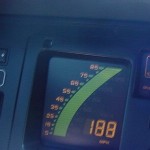
KyleF: Acceleration was not the focus but top speed. The 84 weighed in at 2,900 pounds empty. With the 1:1 5th gear and and peak HP at 7,000 rpm it took more than 1.5 miles to achieve 192 MPH with a 2.73 gear at just shy of 6,800 rpm, as the altitude decreased from 6,800 feet and the road continued downhill the car attained 7,100 rpm, right at 200mph. I did not take my eyes off the road at that speed so I referred to the in car video and passenger callouts. The temperature was 50 degrees F and there was no head wind. My 84 is in the 1991 video FLAT OUT on a public highway. Average speed over 92 miles was 176mph, based on the calculated distance at that time. Time for a few Long Island Ice Tea's
I did achieve 200 MPH with 460 HP 2.73 RIng and Pinion with a Doug Nash 5 speed, 1 to 1 ratio at 6,900 rpm at Silver State in 1991 with optimal conditions considering the altitude.
Hmm, that is really fast for 460hp. I would think you would need more like 550hp at sea level.
The advantage the C4 has in this is a very aerodynamic design and little downforce. Downforce kills you both by loading the axles and increasing friction and by generating induced drag. The lack of downforce makes it both easier to do and less stable at speed.
KyleF: Acceleration was not the focus but top speed. The 84 weighed in at 2,900 pounds empty. With the 1:1 5th gear and and peak HP at 7,000 rpm it took more than 1.5 miles to achieve 192 MPH with a 2.73 gear at just shy of 6,800 rpm, as the altitude decreased from 6,800 feet and the road continued downhill the car attained 7,100 rpm, right at 200mph. I did not take my eyes off the road at that speed so I referred to the in car video and passenger callouts. The temperature was 50 degrees F and there was no head wind. My 84 is in the 1991 video FLAT OUT on a public highway. Average speed over 92 miles was 176mph, based on the calculated distance at that time. Time for a few Long Island Ice Tea's
Not sure why this is directed at me. Am I not the one that said you see land speed cars getting pushed to start and the cars were built with top speed in mind, not acceleration?
However, like it or not, acceleration does matter when you are discussing average speed over distance. To increase velocity, you must accelerate. To achieve high speeds, you have to overcome exponentially higher resistance. Mass will stay the same depending on down force designed into the aero, rolling friction remains primarily the same, but wind resistance increases rapidly. So, the engine better be making power were the gearing places it at these speeds.
Diesels have speed records and they don't spin 7100RPMS
Electric Motor vehicles have records and they can be spinning as high as 17,000Rpms
In either case it will matter where it makes the power and how the gearing gets that to the wheels.
To achieve these speeds, just like a good ET at the drag strip, it all has to work in harmony together.
Why in the world would anyone trying to set a top speed goal not gear the car to make peak power at the car's projected top speed? More to the point, the question (16 years ago) was "How much power at the flywheel would it take to achieve 200mph?" That question can be answered without respect to gearing/rpm/blahblahblah: it takes however much power is required to overcome the total friction of the car. Total friction include mechanical friction, parasitic drag, and induced drag. However, much power (crank torque is irrelevant) it takes to equalize all the frictional forces at 200mph is how much power it takes. Let's say it takes 500rhp (it probably doesn't take quite that much): it doesn't matter if it's a diesel churning out 500hp at 2500rpm, or a 1000hp motor that is geared by moron so that it's only outputting 500hp at 200mph, or if it's an electric motor with no transmission, or a steam turbine geared to the wheels - whatever engine is powering the thing, at a steady speed of 200mph the wheels are seeing 500hp under those conditions. And yes, it does matter what altitude we run the car, because it takes less power to overcome the lower aero drag in less dense air. Same thing for ambient temps (hot air is less dense).
A C4 is not only a very slippery car (low drag coefficient), but also a small car in terms of frontal area. It is a pretty good car for top speed attempts. In a recent thread, we were just discussing that a stock L98 C4 could touch 150mph with 240hp or whatever it was rated at SAE net (crankshaft). And yes, this assumes that it was actually at its peak power at top speed (I don't know if it was geared that way, but let's just say it was to keep this simple). The math tells us that the same car would take 78% more power to increase speed to 200mph. So it should hit 200mph with 427 SAE net hp at the crank. This is not unreasonable. After all, a stock C6Z could get close to 200mph with 505hp (~440rwhp), and it is a draggier car than the C4 (it's way wider and has wider rear tires).
That question can be answered without respect to gearing/rpm/blahblahblah: it takes however much power is required to overcome the total friction of the car. Total friction include mechanical friction, parasitic drag, and induced drag. However, much power (crank torque is irrelevant) it takes to equalize all the frictional forces at 200mph is how much power it takes.
This statement couldn't be more backwards and wrong.
Crank torque means everything. The definition of Horsepower is 550ft-lbs. of force per second, That is a rotational force which is torque. Without torque, you make no HP. When a car goes on a dyno, you measure torque and calculate HP. It is torque that is overcoming resistance. Again, Horsepower is the ability to produce torque at RPM and use gearing to multiply available torque.
To solve the problem accurately you would need the sum of all resistances as mentioned that will occur at the speed you want to go. Then you would calculate the force needed to overcome these resistances. That force is generated by torque.
Once you have the torque needed then you look at how to get that torque there. Rear gear, tire diameter, RPM range, and transmission gearing all come into play. You build a combination that is delivering enough torque to the rear wheels.
Then, just like trying to achieve the best ET at a track, you start tweaking your set up to get better.
I was going to guess 600HP approx, and that sounds about right. The C4 has a very slick shape... remember that the stock C5 has a higher top speed than the stock C6 due to better aero.
According to this the 1984 Corvette only needs 97 Bhp to overcome air resistance at 130 mph.
According to physics the airodynamic drag increases with the square of velocity.
200 mph would require 230 Bhp.
230 mph would require 388 Bhp.
Figures might seem low, but this is only to match aerodynamic drag at these speeds. You also have other friction to overcome and you also need something to accelerate with.
This statement couldn't be more backwards and wrong.
Oh, this will be fun...
Crank torque means everything.
Really?
A 3000lb car has an engine that produces 500lb/ft of torque at the crank. How fast does it accelerate (assume it produces 500lb/ft of torque at all times, and you can ignore friction and pick a speed) or complete the quarter mile?
Two C4s have identical friction and drag. One car's engine outputs 250lb/ft at 8000rpm at top speed, and the other car's engine outputs 500lb/ft at 4000rpm at top speed. Which car has the higher top speed?
Why does every quarter-mile ET/speed calculator ask you for the vehicle's power, but never asks for torque?
Crankshaft torque alone tells you nothing about a car's performance. It's meaningless. Sometime way back in history, someone decided we needed a unit of measure that all by itself would tell us how fast work can get done. That unit is power. By definition, power tells us everything we need to know about how fast a car accelerates at any given speed, and what terminal velocity it can achieve against a known total drag/friction. Power is the one and only unit of measure that matters in terms of a car performance. Period.
The definition of Horsepower is 550ft-lbs. of force per second
This is wrong. Power is defined as the rate at which work is done, or force*distance/time. Horsepower is defined as 550lb per ft per second.
That is a rotational force which is torque. Without torque, you make no HP.
Torque is defined as rotational force, yes. But you can make power in all kinds of ways that don't involve rotational force. The original concept for the HP unit was (a horse) lifting a 550lb block 1ft vertically in 1 second using a pulley and rope:
No torque there! But yeah, a piston engine must make torque to make any power. Of course, it also has to make rotational velocity (distance/time). A steam piston engine (external combustion) can make tons of torque on a crank without moving it, and no power is made at all. Same thing happens when you have a small electric motor and turn it on but hold with your fingers so it is stalled (can't turn): torque is produced, but zero power. So again, torque by itself tells us nothing about how fast work gets done. Nothing.
When a car goes on a dyno, you measure torque and calculate HP. It is torque that is overcoming resistance.
ORLY? Then tell me how you can put a car on a Dynojet, leave the rpm connection (ignition sensor) off completely, and still get an accurate power number? You'll get power over mph instead of rpm because the dyno doesn't know rpm, and you won't get torque; but the power curve will be as accurate as ever. How can it know power without knowing torque or rpm? It's because it doesn't measure torque and then calculate power from rpm: it directly measures power and then derives torque from that...if you tell it the rpm of the engine. If you don't tell it the rpm, it still gives you power, but it can't calculate torque.
It's not defying physics. There are lots of ways to measure power without knowing force. Power is the change in energy measured over time. The inertial dyno knows the inertia of its drum and it can sense the drum's angular velocity, so it knows the kinetic energy (K) in the drum at any given time: K = 1/2 * (inertia) * (angular velocity)^2. From there, it just measures the change in kinetic energy over time and it then knows the power that was applied to it: P=(K1-K2)/(T1-T2). It gives zero ***** how fast the engine is spinning or how much torque it has at the crank.
To be fair, an old-school brake bench dyno does directly measure torque at the crank and then calculate power based on rpm. But...what about a brake dyno that is a chassis dyno: what torque is it measuring, and what happens when you don't give it an rpm signal? Yep, you still get a power reading and no torque reading. It's measuring torque at the tire's contact patch, and again it gives zero ***** how much torque the engine has or at what rpm it's spinning.
Again, Horsepower is the ability to produce torque at RPM and use gearing to multiply available torque.
Gearing has nothing to do with the power an engine produces at the crankshaft or at the tires. Except for the subtraction of driveline friction and inertia, a car has the same power at the wheels as it has at the crank.
To solve the problem accurately you would need the sum of all resistances as mentioned that will occur at the speed you want to go. Then you would calculate the force needed to overcome these resistances. That force is generated by torque.
Torque at the what? Wheels or crank? Because one is very different than the other.
And actually, it would be more accurate to say the force you need to calculate is the linear force at the contact patch of the drive tires, which is called "tractive effort." But here's the drop-the-mike moment: if you know the tractive effort (or wheel torque) being produced at the contact patches, and you know the vehicle speed, then you know the power being applied to the wheels. You don't have to know gearing and torque and tire diameter and rpm of the engine. You already know power, and again you don't need to give any ***** about how fast the engine is spinning or how much crank torque it is making at that speed.
All of which means that the tractive effort to overcome all the resistance at any given speed is created by power, not crank torque. The link I provided on tractive even states that explicitly: "Tractive effort available: maximum tractive effort of a vehicle as limited by the available power." That's why literally every chart you'll ever see on attainable road speeds is given in terms of required power, not required torque. Because power is the measure of how fast work gets done, such as how many hours it takes to travel a certain number of miles against a known amount of resistance.
Once you have the torque needed then you look at how to get that torque there. Rear gear, tire diameter, RPM range, and transmission gearing all come into play. You build a combination that is delivering enough torque to the rear wheels.
Then, just like trying to achieve the best ET at a track, you start tweaking your set up to get better.
You're confusing yourself. If you know all the gearing and the road speed and tire diameter (or conversely, the engine's rpm), then you know the power being produced. If you don't know power, you can't know the road speed attainable. Period.
The only tweaking you do for top speed is to set up the total gearing so the engine is making peak power at the terminal velocity. Only an idiot would tune for peak torque. That's why truck commercials talk about torque so much: to sell trucks to ignorant customers even though their truck doesn't make as much power as the competition. Because the only thing that determines how fast you can accelerate a given load is power. Same with locomotives and ships: they're rated in terms of power, not torque. The only reason anyone needs to know peak torque of an engine is to spec a transmission and clutch that won't break under the load.
Last edited by MatthewMiller; Jan 16, 2019 at 10:54 PM.
I was thinking of the small test cell we had for durability testing of our engines. then I cam to the sentence posted above, and thought "ah HA, that's what we had". . It had a water-brake dyno connected to a big dial on the consol. The dial was graduated by units '1, 2, 3, ... to about 20, IIRC. In the center of the dial was the instruction "Horsepower = UNITS X RPM (over) 5.252.
Two questions:
A: What are the "UNITS" calibrated in? FtLbs of torque?
B: What is and WHY the "constant" of 5.252? Because its a constant, it must be part of the conversion of force to work.
The formula for HP (that doesn't involve a horse and pulley, at least) is Torque*RPM/5252. In the formula, the units of torque are lb/ft. So the numbered units on the big dial of your dyno console would have been torque in thousands of pound/feet. So for example, if an engine made 0.1 of those units (100lb/ft) at 3000rpm, it would produce 57hp. I'm wondering if the dial might have read in .1, .2, .3; instead of 1,2,3? Because otherwise it would have been really hard to measure the engines in the power range you were working on. Or was the constant maybe 52.52 (that would make more sense)?
Ah, but its kind of amusing to do the calculation from 102,000 Horsepower at 101 RPM (Wartsilla 14KTA96C) to torque. Lot of zeros.
No doubt, some of that stuff is mind-boggling. 5.3M lb/ft for that Wartsilla! The Delta Queen steam-powered paddle wheel river boat has an even more ridiculous split between torque and power: it makes 2000hp at roughly 12rpm: 875,333lb/ft. But everybody knows that an L98 makes even more torque than either of these!






 Re: (dizwiz24)










 To achieve high speeds, you have to overcome exponentially higher resistance. Mass will stay the same depending on down force designed into the aero, rolling friction remains primarily the same, but wind resistance increases rapidly. So, the engine better be making power were the gearing places it at these speeds.