



The Forced Induction Crankcase Evac Thread

Tech Contributor


Joined: Apr 2007
Posts: 10,924
Likes: 78
From: Forney Texas

Yes. You are mixing the "clean"& the "dirty" side of the crankcase evac system rendering it inoperative. You are venting excess pressure to the air....but no evacuation or flushing is occurring and unless you have a SD tune you have fuel trims hunting for stoic.
Need more details? Just ask and we can guide you through it.
Need more details? Just ask and we can guide you through it.
Unless you have a really crappy, dirty or totally undersized air filter, your system has no vacuum when the vehicle's under boost correct? Having some sort of restriction between the blower inlet and air filter is the only way you're going to have any vacuum there.

Pro

Joined: Jan 2011
Posts: 633
Likes: 6
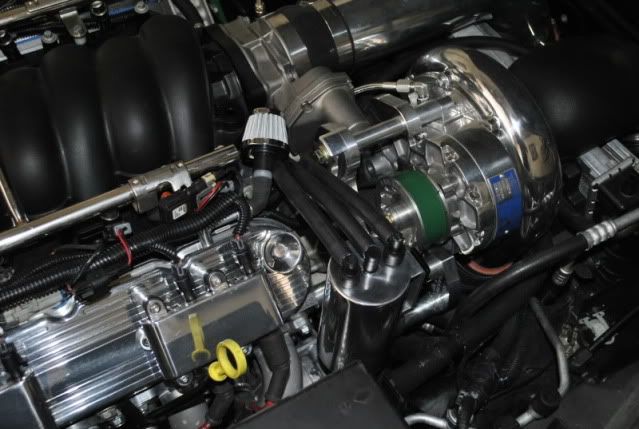
? not following you.......if you are using the RX dual valve system while not under boost the vacuum from the intake manifold provides evacuation. As soon as the intake manifold becomes pressurized from boost, the primary check valve closes and the secondary valve opens using vacuum from the inlet side of the head unit. If you are connecting to the air filter then you are correct as the filter will not allow enough suction to do anything. If you install it correctly you are tapping into a spot just before the inlet turbine on the head unit and the venturi effect will give you between 8-12" of vacuum when measured there (see a few of the others on here that have run vac guages and measured).
Since you have a SD tune you have no MAF related fuel trim issues like those with the clean & dirty sides mixed together do.
You description said you are running both the clean and dirty side together if you described it accurately.
Since you have a SD tune you have no MAF related fuel trim issues like those with the clean & dirty sides mixed together do.
You description said you are running both the clean and dirty side together if you described it accurately.
Pro
Joined: Jan 2011
Posts: 633
Likes: 6
You need fresh air pulling through the motor from the left side valve cover and out the right side valve cover. Right now your just letting the blow by breath so you don't push oil out the front and rear seals, your motor needs to be aired out with fresh air to get the contaminated gases out! Its like your home filled with smoke and only 1 window open! but if you open 2 windows one on each side of the home it will get the cross air flow and blow the smoke out faster  Correct me if I'm wrong just trying to help
Correct me if I'm wrong just trying to help 
Pro
Joined: Jan 2011
Posts: 633
Likes: 6
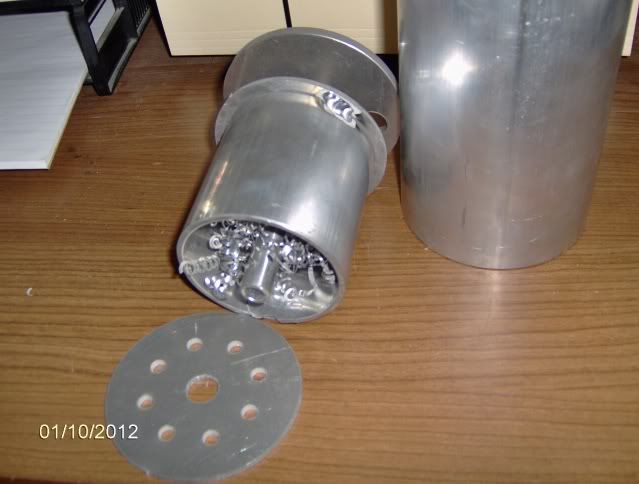
Here are some pictures of the unassembled separating system for big boost turbo or front mount SC's:
Shows the inner components:
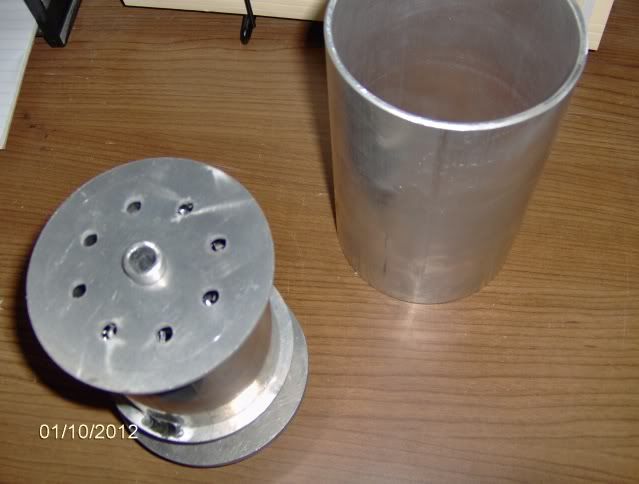
Assembled but not in the canister...the bottom is facing up:
From the top. It comes with -8 or -10 AN fittings and inline flow control checkvalves:
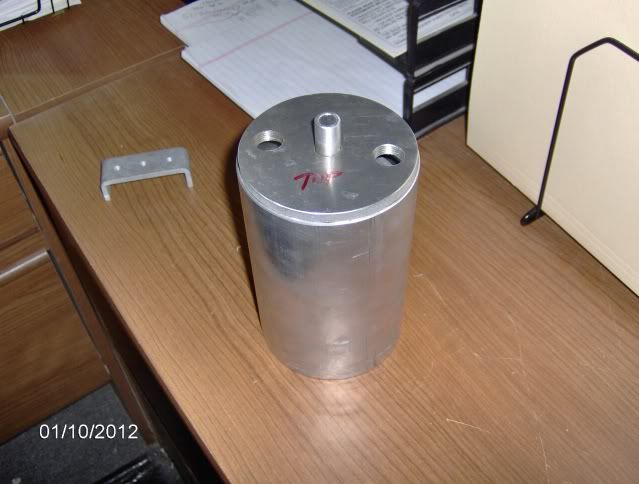
It is large and not for the avg street build.
4" wide x 7.5" high with triple baffleing and good to 1200 hp turbo or front mount SC.
Shows the inner components:
Assembled but not in the canister...the bottom is facing up:
From the top. It comes with -8 or -10 AN fittings and inline flow control checkvalves:
It is large and not for the avg street build.
4" wide x 7.5" high with triple baffleing and good to 1200 hp turbo or front mount SC.
Last edited by The Bat Car; Jan 10, 2012 at 04:50 PM.

Team Owner


Joined: Jan 2007
Posts: 29,063
Likes: 1,839
From: cookeville tennessee
Here are some pictures of the unassembled separating system for big boost turbo or front mount SC's:
Shows the inner components:
Assembled but not in the canister...the bottom is facing up:
From the top. It comes with -8 or -10 AN fittings and inline flow control checkvalves:
It is large and not for the avg street build.
4" wide x 7.5" high with triple baffleing and good to 1200 hp turbo or front mount SC.
Shows the inner components:
Assembled but not in the canister...the bottom is facing up:
From the top. It comes with -8 or -10 AN fittings and inline flow control checkvalves:
It is large and not for the avg street build.
4" wide x 7.5" high with triple baffleing and good to 1200 hp turbo or front mount SC.
 Only kinding man I will be putting the D/cans on the car this weekend. Robert

Drifting


Joined: Feb 2006
Posts: 1,585
Likes: 15
From: New Hartford IA
I guess if you want to run all that oil vapor through the blower, IC, engine at full load go right a head. Catch cans don't do THAT good of a job at oil seperation, especially under high flow. I'd like to see crankcase pressure numbers under load to see if it can actually pull vac on the engine though. Better run a big line.
Factory turbo cars have done this type of thing for years without the catch can in between. For emissions they need to keep a closed system, but end up with oil all over the intake track, not just in the intake manifold.
Factory turbo cars have done this type of thing for years without the catch can in between. For emissions they need to keep a closed system, but end up with oil all over the intake track, not just in the intake manifold.
Safety Car

Joined: Jan 2008
Posts: 4,797
Likes: 52
From: Boise
Why are you talking about fuel trims "hunting for stoich" here?
Unless you have a really crappy, dirty or totally undersized air filter, your system has no vacuum when the vehicle's under boost correct? Having some sort of restriction between the blower inlet and air filter is the only way you're going to have any vacuum there.
Unless you have a really crappy, dirty or totally undersized air filter, your system has no vacuum when the vehicle's under boost correct? Having some sort of restriction between the blower inlet and air filter is the only way you're going to have any vacuum there.
I remember when I first got my breather from ECS I hooked up HPtuners and saw a change but it wasn't a lot. That was a long time ago though...

Premium Supporting Vendor

Joined: Oct 2004
Posts: 23,599
Likes: 1,225
From: Providing the most proven supercharger kits for your C5/6/7 609-752-0321
I have had the discussion with several customers about the use of a breather and tuning. (the unmetered air)
Basically yes it is unmetered air, where as the factory set up pulls it's air from after the MAF-before the TB so it is not. However, the amount of air is so minimal being pulled threw a PCV/check valve.
It is also a constant value, so it is very easily tunable. Definitely not something to be in the least bit concerned about IMO.
Basically yes it is unmetered air, where as the factory set up pulls it's air from after the MAF-before the TB so it is not. However, the amount of air is so minimal being pulled threw a PCV/check valve.
It is also a constant value, so it is very easily tunable. Definitely not something to be in the least bit concerned about IMO.
Corvette Stories
The Best of Corvette for Corvette Enthusiasts

Top 10 Most Expensive Corvettes Ever Sold on Bring A Trailer
Brett Foote
10 Things Every Corvette Owner Needs (2026 Edition)
Michael S. Palmer
8 Most "Only Corvette Owners Understand" Quirks and Problems
Pouria Savadkouei
10 Reasons the C6 Z06 is Still A Performance Benchmark After 20 Years
Joe Kucinski
How Much Horsepower Every Corvette Engine "LOST" in 1972
Joe Kucinski
Top 10 DOs and DON'Ts for Protecting Your Convertible Top!
Michael S. Palmer
Top 10 Most Explosive Corvettes Ever Made: Power-to-Weight Ratio Ranked!
Joe Kucinski
150 hp to 1,250 hp: Every Corvette Generation Compared by the Specs That Matter
Joe Kucinski
8 Coolest Corvette Pace Cars (and Replicas) of All Time
Verdad Gallardo
Tech Contributor
Joined: Apr 2007
Posts: 10,924
Likes: 78
From: Forney Texas
I think what he means is if you add the oil cap valve cover breather and you are still running your MAF, your STFTs are going to change because of the unmetered air.
I remember when I first got my breather from ECS I hooked up HPtuners and saw a change but it wasn't a lot. That was a long time ago though...
I remember when I first got my breather from ECS I hooked up HPtuners and saw a change but it wasn't a lot. That was a long time ago though...
For the record, I completed my changes to my existing valve covers, adding -8AN ports to the valve covers and baffles and have driven the car quite a bit. Now mostly only water comes out when I crack the drain open.
I still have new valve covers in the works. I'll be picking them up next week and off to powder coat.
Bat Car dude, since you're deeper into this than anyone in the thread and have spoken about contaminating the oil by not pulling fresh air through the crankcase and the damage caused by it, I'm wondering where you gathered your evidence from. Oil analysis by chance? I would love to see all of the evidence you've gathered from your studies. I think it would be helpful. So far I've made the decision to stay with my current configuration, but that may change depending on what you bring to the table.
Next issue is: how much flow do we really need? In other words, what size ports is necessary in order to satisfy a purpose-built F/I motor? I'm aware the demand will vary based on ring gaps, displacement and cylinder pressure, but how about a range here?
Say an "average" 346 with .027" ring gap on the top ring, running 17psi boost and making 800RWHP.
Then change to a 434 with a .028" ring gap making 20psi boost and making 1100RWHP.
Pro
Joined: Jan 2011
Posts: 633
Likes: 6
I guess if you want to run all that oil vapor through the blower, IC, engine at full load go right a head. Catch cans don't do THAT good of a job at oil seperation, especially under high flow. I'd like to see crankcase pressure numbers under load to see if it can actually pull vac on the engine though. Better run a big line.
Factory turbo cars have done this type of thing for years without the catch can in between. For emissions they need to keep a closed system, but end up with oil all over the intake track, not just in the intake manifold.
Factory turbo cars have done this type of thing for years without the catch can in between. For emissions they need to keep a closed system, but end up with oil all over the intake track, not just in the intake manifold.
Trims are always bouncing around. They could change with an SD tune as well as MAF tuning. Changes in vacuum more than 1.5" will move you to a different cell at idle. I know you're aware the trims are based on feedback coming from the 02's and while we try to zero them out, they will never stay zero'd out.
For the record, I completed my changes to my existing valve covers, adding -8AN ports to the valve covers and baffles and have driven the car quite a bit. Now mostly only water comes out when I crack the drain open.
I still have new valve covers in the works. I'll be picking them up next week and off to powder coat.
Bat Car dude, since you're deeper into this than anyone in the thread and have spoken about contaminating the oil by not pulling fresh air through the crankcase and the damage caused by it, I'm wondering where you gathered your evidence from. Oil analysis by chance? I would love to see all of the evidence you've gathered from your studies. I think it would be helpful. So far I've made the decision to stay with my current configuration, but that may change depending on what you bring to the table.
Next issue is: how much flow do we really need? In other words, what size ports is necessary in order to satisfy a purpose-built F/I motor? I'm aware the demand will vary based on ring gaps, displacement and cylinder pressure, but how about a range here?
Say an "average" 346 with .027" ring gap on the top ring, running 17psi boost and making 800RWHP.
Then change to a 434 with a .028" ring gap making 20psi boost and making 1100RWHP.
For the record, I completed my changes to my existing valve covers, adding -8AN ports to the valve covers and baffles and have driven the car quite a bit. Now mostly only water comes out when I crack the drain open.
I still have new valve covers in the works. I'll be picking them up next week and off to powder coat.
Bat Car dude, since you're deeper into this than anyone in the thread and have spoken about contaminating the oil by not pulling fresh air through the crankcase and the damage caused by it, I'm wondering where you gathered your evidence from. Oil analysis by chance? I would love to see all of the evidence you've gathered from your studies. I think it would be helpful. So far I've made the decision to stay with my current configuration, but that may change depending on what you bring to the table.
Next issue is: how much flow do we really need? In other words, what size ports is necessary in order to satisfy a purpose-built F/I motor? I'm aware the demand will vary based on ring gaps, displacement and cylinder pressure, but how about a range here?
Say an "average" 346 with .027" ring gap on the top ring, running 17psi boost and making 800RWHP.
Then change to a 434 with a .028" ring gap making 20psi boost and making 1100RWHP.
On builds like your talking we have had success with -6, but if ring seal is not excellent then we go -8 or -10 like the unit above. But for most builds the -6 (3/8"ID) has been fine to 900-1000 rwhp. Problem we see FAR to often are pinched ringlands & pistons damaged by detonation that are allowing far to much blow-by for any system do deal with. These make good power and seem to run well but a leak-down test (not a compression test) will pinpoint the problem cylinder(s).
Of course the tuners that do the damage never seem to acknowledge they went lean or added a little more timing than the combo could stand, and how many see knock sensors desensitized or turned off because the tuner was fight spark knock?
Tech Contributor
Joined: Apr 2007
Posts: 10,924
Likes: 78
From: Forney Texas
Yes, years of oil analysis with the drag motors (Pennzoil was sponsoring one of the cars for a season and did analysis with every oil drain) and we have done them for years as well. The PPM levels of the abarsive carbon particles, unburnt fuel, and acid levels were the ones we look at the closest and then iron, brass, etc. for wear indicators.
On builds like your talking we have had success with -6, but if ring seal is not excellent then we go -8 or -10 like the unit above. But for most builds the -6 (3/8"ID) has been fine to 900-1000 rwhp. Problem we see FAR to often are pinched ringlands & pistons damaged by detonation that are allowing far to much blow-by for any system do deal with. These make good power and seem to run well but a leak-down test (not a compression test) will pinpoint the problem cylinder(s).
Of course the tuners that do the damage never seem to acknowledge they went lean or added a little more timing than the combo could stand, and how many see knock sensors desensitized or turned off because the tuner was fight spark knock?
On builds like your talking we have had success with -6, but if ring seal is not excellent then we go -8 or -10 like the unit above. But for most builds the -6 (3/8"ID) has been fine to 900-1000 rwhp. Problem we see FAR to often are pinched ringlands & pistons damaged by detonation that are allowing far to much blow-by for any system do deal with. These make good power and seem to run well but a leak-down test (not a compression test) will pinpoint the problem cylinder(s).
Of course the tuners that do the damage never seem to acknowledge they went lean or added a little more timing than the combo could stand, and how many see knock sensors desensitized or turned off because the tuner was fight spark knock?
Heck, if you don't have the data retained, I may just sample my oil and send it off and post it up. Then we'll all know what to expect on this side of the fence.
Pro
Joined: Jan 2011
Posts: 633
Likes: 6
Great suggestion....lets get an unbiased example. There are sevral good companies doing this for reasonable $ and results are pretty quick. I would really like to see it from the same car where it is the same amount of serivce on the oil, same driving (as close as possible) that is running kjust breathers or a breathered can and then switch to the proper evac system to show. :thumbsup:
Pro
Joined: Jan 2011
Posts: 633
Likes: 6

Instructor

Joined: Dec 2006
Posts: 168
Likes: 0
From: Minnesota Corn Fields
So in non-boost, the intake manifold & blower inlet will pull vacuum on the outer two fittings?
And in boost the one-way valve in the outer fitting to the intake manifold simply closes and continues to pull vacuum on the other outer fitting from the blower inlet?
And in boost the one-way valve in the outer fitting to the intake manifold simply closes and continues to pull vacuum on the other outer fitting from the blower inlet?
Last edited by No Juice; Jan 12, 2012 at 05:53 PM.
Pro
Joined: Jan 2011
Posts: 633
Likes: 6