




c5 tranny temps

Thread Starter
Pro


Joined: Apr 2004
Posts: 719
Likes: 21
From: Miami Fl
 c5 tranny temps
Guys i need your feedback i recently installed a tranny cooler in front of the a/ccondenser and eliminated the one inside the radiator in an effort to acheive lower tranny temps. Currently it runs at 170-180 on the highway and slightly hotter 200-210 in the city, what to know what you think if it was worth the effort and what your tranny temps are under normaal driving conditions. I also have pics if you would like to see.
Thanks,
ralph
Thanks,
ralph

Safety Car


Joined: Oct 2004
Posts: 4,816
Likes: 132
From: Plano TX
Hi Ralph. I've considered an aftermarket cooler myself and will probably install one this summer. Last year when I bought my C5 I was running 210-225 trans temp in the city and around 200-205 on the highway. Thats between 95-100 degrees outside temp. (Dallas Tx). A few times after hard driving it would climb as high as 235-240. Needless to say the high temps fry ours A4s and I fried mine. The Dealership replaced 4 months ago. I am running a hypertech 180 thermostat and have the hypertech programer, which I reset the temp settings for the fans to come on earlier. The stock setting is way too high in hot climates. My temps on the tranny now run between 170-195 and I may see 200-205 at the most on a hot day and hard driving conditions. the answer to your question is that I think you made somewhat of an improvement but not as much as you were probably expecting. I still think those number are pretty good, however the real hot months are not here yet. Try the thermostat. A 160 degree would be even better, and have your fans adjusted. Any speedshop that does LS-1 tuning can adjust this for you too. I think you will see a BIG difference then.. Good Luck...
Last edited by David426; May 31, 2005 at 07:19 PM.

Le Mans Master


Joined: Dec 2000
Posts: 9,909
Likes: 1,858
From: Hot Springs AR
Ralph,
You might reconsider completely bypassing the cooler in the radiator. It'll do two things: first, it'll assist cooling the tranny, even with the external cooler you've added. Second, it'll help warm up the fluid on cold days (yeah, I know, you don't see much of those in FL, but you could make a road trip or two).
BTW, remember that the t'stat controls the temperature of the coolant in the engine, not in the radiator. Putting a lower temp t'stat will actually raise the coolant temperature in the radiator. Lowering the point where the fans come on will help in traffic, but that's not where you typically see high tranny temps.
HTH, and have a good one,
Mike
You might reconsider completely bypassing the cooler in the radiator. It'll do two things: first, it'll assist cooling the tranny, even with the external cooler you've added. Second, it'll help warm up the fluid on cold days (yeah, I know, you don't see much of those in FL, but you could make a road trip or two).
BTW, remember that the t'stat controls the temperature of the coolant in the engine, not in the radiator. Putting a lower temp t'stat will actually raise the coolant temperature in the radiator. Lowering the point where the fans come on will help in traffic, but that's not where you typically see high tranny temps.
HTH, and have a good one,
Mike
Thread Starter
Pro
Joined: Apr 2004
Posts: 719
Likes: 21
From: Miami Fl
tranny temps
Mike i did bypass the tranny cooler in the radiator for the reason you stated and another very inportant one, that in the event the the tranny cooler in the radiator leaks or cracks (happened to my dad) you will end up with coolant in the tranny. Not cool this equals major expenses.

Safety Car

Joined: Oct 2000
Posts: 4,949
Likes: 10
From: Monticello MN
Originally Posted by Rconce01
Mike i did bypass the tranny cooler in the radiator for the reason you stated and another very inportant one, that in the event the the tranny cooler in the radiator leaks or cracks (happened to my dad) you will end up with coolant in the tranny. Not cool this equals major expenses.
Unless I misinterpreted Mike's post, I believe he's recommending that you do NOT bypass the tranny cooler in the radiator, for the reasons he stated. I had a Hayden cooler installed in mine and also left the radiator tranny cooler hooked up. It works great!
Mike,
I must not understand something here. The engine cooling system is a closed cycle. How will installing a cooler thermostat raise the radiator fluid temperature, while lowering the engine temperature? I realize that a wider open thermostat would increase fluid flow through the radiator, perhaps lowering the amount of cooldown time spent there, however, if the fluid exiting the engine to the radiator is cooler than with the previous thermostat, how could it gain heat while passing through a cooling medium (i.e., radiator)? Thanks!
Ed
Corvette Stories
The Best of Corvette for Corvette Enthusiasts

Top 10 Most Expensive Corvettes Ever Sold on Bring A Trailer
Brett Foote
10 Things Every Corvette Owner Needs (2026 Edition)
Michael S. Palmer
8 Most "Only Corvette Owners Understand" Quirks and Problems
Pouria Savadkouei
10 Reasons the C6 Z06 is Still A Performance Benchmark After 20 Years
Joe Kucinski
How Much Horsepower Every Corvette Engine "LOST" in 1972
Joe Kucinski
Top 10 DOs and DON'Ts for Protecting Your Convertible Top!
Michael S. Palmer
Top 10 Most Explosive Corvettes Ever Made: Power-to-Weight Ratio Ranked!
Joe Kucinski
150 hp to 1,250 hp: Every Corvette Generation Compared by the Specs That Matter
Joe Kucinski
8 Coolest Corvette Pace Cars (and Replicas) of All Time
Verdad Gallardo
Le Mans Master
Joined: Dec 2000
Posts: 9,909
Likes: 1,858
From: Hot Springs AR
Originally Posted by C5XTASY
Mike,
I must not understand something here. The engine cooling system is a closed cycle. How will installing a cooler thermostat raise the radiator fluid temperature, while lowering the engine temperature? I realize that a wider open thermostat would increase fluid flow through the radiator, perhaps lowering the amount of cooldown time spent there, however, if the fluid exiting the engine to the radiator is cooler than with the previous thermostat, how could it gain heat while passing through a cooling medium (i.e., radiator)? Thanks!
Ed
I must not understand something here. The engine cooling system is a closed cycle. How will installing a cooler thermostat raise the radiator fluid temperature, while lowering the engine temperature? I realize that a wider open thermostat would increase fluid flow through the radiator, perhaps lowering the amount of cooldown time spent there, however, if the fluid exiting the engine to the radiator is cooler than with the previous thermostat, how could it gain heat while passing through a cooling medium (i.e., radiator)? Thanks!
Ed
Actually, the only part of the coolant system that is true "closed cycle" (i.e. temperature regulated) is that within the engine. Look at it this way: There are actually two "types" of coolant in the system:
Radiator coolant, which is cooled continuously by airflow, and
Engine coolant, which is heated continuously from the engine
When the temperature of the engine coolant gets to the set point of the t'stat, it starts opening and flowing engine coolant to the radiator, and replaces the engine coolant with radiator coolant. The t'stat will adjust its opening to maintain its set point, based on the temperature of the engine coolant. The temperature of the radiator coolant never enters this picture. If the engine temp stays below the set point of the t'stat, it will stay fully closed. If the engine temp stays above the set point, it will eventually fully open (e.g. in s&g traffic or racing).If you think about this for a minute, you can see that the temp differential between the radiator and the engine coolant gets larger as the t'stat's set point (temperature rating) is higher, and vice versa. That's why the radiator coolant temperature will be higher for a t'stat with a lower temperature rating.
Ralph,
You did misunderstand my original post, but you also bring up a very good point about leaks and coolant contamination. It doesn't happen often, but it's

 when it does.
Have a good one,
Mike

Team Owner


Joined: May 2004
Posts: 26,345
Likes: 232
From: SoCal
I have a tranny cooler....
I have noticed my tranny temps up a bit since I put inthe H/C and 160 stat. But I assumed was coinsidental to summer temps.
Generally my tranny temps went from 225 down to 170-195 depending on ambient temps. But it will easlily get over 200 if I drive the car hard in 3rd gear. It also got to near 250 at the track when my oil hit 280 and coolant 235.
I don't think my internal was disconnected (how would I tell). Also not sure if its connected inline with the upper radiator line which I believe is the correct one.
DH
I have noticed my tranny temps up a bit since I put inthe H/C and 160 stat. But I assumed was coinsidental to summer temps.
Generally my tranny temps went from 225 down to 170-195 depending on ambient temps. But it will easlily get over 200 if I drive the car hard in 3rd gear. It also got to near 250 at the track when my oil hit 280 and coolant 235.
I don't think my internal was disconnected (how would I tell). Also not sure if its connected inline with the upper radiator line which I believe is the correct one.
DH
Le Mans Master
Joined: Dec 2000
Posts: 9,909
Likes: 1,858
From: Hot Springs AR
DH,
If the external cooler has a line that goes to the radiator, then the "internal" cooler is still plumbed in. If both lines from the external cooler go to the engine, it's bypassed.
HTH, and have a good one,
Mike
If the external cooler has a line that goes to the radiator, then the "internal" cooler is still plumbed in. If both lines from the external cooler go to the engine, it's bypassed.
HTH, and have a good one,
Mike

Drifting

Joined: Oct 2004
Posts: 1,975
Likes: 9
From: "Philly" Pennsylvania
Vettedrmr
Vettedrmr,
I just can't get my brain to understand your explanation about Rad. & Eng. temps. A vette engine that is running will not have a t'stat that stays closed; it might close for a short period, but will reopen as the running engine's temps continue to climb once the t'stat is shut. There is no scenero where a running vette engine will continue to run without opening the t'stat (assuming normal t'stat ranges).
If the engine generates the heat and the radiator cools it as you say, then the heat in the radiator can not be significantly higher (maybe a few degrees) than the source from where it came (engine). If higher, as you say, what is the source of the higher temps in the radiator since the engine is at a lower temp than the radiator according to your explanation? Sorry, I just can't figure this out how the radiator can have higher temps than the engine.
If the t'stat is wide open, what ever temp. the engine is at will be equal or hotter than the radiator. If not, you have a scenero for an overheating event (boilover) because the radiator will not be performing its cooling function and will feed the engine ever increasing coolant temps until something gives.
I just can't get my brain to understand your explanation about Rad. & Eng. temps. A vette engine that is running will not have a t'stat that stays closed; it might close for a short period, but will reopen as the running engine's temps continue to climb once the t'stat is shut. There is no scenero where a running vette engine will continue to run without opening the t'stat (assuming normal t'stat ranges).
If the engine generates the heat and the radiator cools it as you say, then the heat in the radiator can not be significantly higher (maybe a few degrees) than the source from where it came (engine). If higher, as you say, what is the source of the higher temps in the radiator since the engine is at a lower temp than the radiator according to your explanation? Sorry, I just can't figure this out how the radiator can have higher temps than the engine.
If the t'stat is wide open, what ever temp. the engine is at will be equal or hotter than the radiator. If not, you have a scenero for an overheating event (boilover) because the radiator will not be performing its cooling function and will feed the engine ever increasing coolant temps until something gives.
Safety Car
Joined: Oct 2000
Posts: 4,949
Likes: 10
From: Monticello MN
Originally Posted by tsts
Vettedrmr,
I just can't get my brain to understand your explanation about Rad. & Eng. temps. A vette engine that is running will not have a t'stat that stays closed; it might close for a short period, but will reopen as the running engine's temps continue to climb once the t'stat is shut. There is no scenero where a running vette engine will continue to run without opening the t'stat (assuming normal t'stat ranges).
If the engine generates the heat and the radiator cools it as you say, then the heat in the radiator can not be significantly higher (maybe a few degrees) than the source from where it came (engine). If higher, as you say, what is the source of the higher temps in the radiator since the engine is at a lower temp than the radiator according to your explanation? Sorry, I just can't figure this out how the radiator can have higher temps than the engine.
If the t'stat is wide open, what ever temp. the engine is at will be equal or hotter than the radiator. If not, you have a scenero for an overheating event (boilover) because the radiator will not be performing its cooling function and will feed the engine ever increasing coolant temps until something gives.
I just can't get my brain to understand your explanation about Rad. & Eng. temps. A vette engine that is running will not have a t'stat that stays closed; it might close for a short period, but will reopen as the running engine's temps continue to climb once the t'stat is shut. There is no scenero where a running vette engine will continue to run without opening the t'stat (assuming normal t'stat ranges).
If the engine generates the heat and the radiator cools it as you say, then the heat in the radiator can not be significantly higher (maybe a few degrees) than the source from where it came (engine). If higher, as you say, what is the source of the higher temps in the radiator since the engine is at a lower temp than the radiator according to your explanation? Sorry, I just can't figure this out how the radiator can have higher temps than the engine.
If the t'stat is wide open, what ever temp. the engine is at will be equal or hotter than the radiator. If not, you have a scenero for an overheating event (boilover) because the radiator will not be performing its cooling function and will feed the engine ever increasing coolant temps until something gives.
The engine will produce a particular number of btu's at a given rpm, biased by load factor (i.e. how much fuel it takes to maintain that rpm). Now, with a high temperature thermostat, more of those btu's must remain in the engine fluid in order to maintain that higher thermostat setpoint. Therefore, a lesser amount of fluid flows from the engine to the radiator. Now, with a lower setpoint thermostat, more btu's must be expelled by the radiator in order to keep the temperature down at the lower thermostat setpoint. Therefore, more fluid must flow through the radiator to dissipate the btu's. That greater flow of fluid, means the AVERAGE temp of the fluid is now higher than before even though the entry level temperature is lower. With the higher temperature thermostat, the entry fluid, though initially warmer, spent more time in the radiator causing the AVERAGE radiator coolant temperature to be lower. However, as the there is continual bypass flow, to say nothing of radiant and convective heat losses from the engine, I suspect the difference in that average temp to be somewhat minimal. Just MHO.
Ed
Le Mans Master
Joined: Dec 2000
Posts: 9,909
Likes: 1,858
From: Hot Springs AR
Originally Posted by C5XTASY
I have thought about this also, and think I can explain it in slightly different terms.
Ed
Ed

 Good way to reword it. Don't you love the English language? A zillion ways to say the same thing.
 AU N EGL (btw, am I right in translating that to "Golden Eagle"?),
Having a lower temp t'stat helps as long as you've got enough airflow through the radiator to keep the engine coolant at the t'stats set point. (IOW, the t'stat is not fully open). I'm not sure what the normal t'stat temperature rating is.
Have a good one,
Mike
Last edited by VetteDrmr; Jun 2, 2005 at 09:15 AM.

Team Owner

Joined: Sep 2003
Posts: 43,084
Likes: 33
From: Raleigh / Rolesville NC
Originally Posted by VetteDrmr
AU N EGL (btw, am I right in translating that to "Golden Eagle"?),
YuppersI am reletless in keeping my raditor clean. I take a high pressure air hose and blow the crud, dirt, grass and road clagg out before each track weekend. It is amazing how fast chit accumulate in there.

Le Mans Master
Joined: Feb 2004
Posts: 5,482
Likes: 1
From: Living the Taxation Dream Indiana
So for us getting ready to install a Tranny Cooler, do you recommend running it from Tranny-->Tranny Cooler-->Stock Radiator Tranny Cooler-->Tranny or Tranny-->Stock Radiator Tranny Cooler-->Tranny Cooler-->Tranny Thanks for the insight

Drifting
Joined: May 2002
Posts: 1,607
Likes: 1
From: San Francisco CA
Originally Posted by AU N EGL
It sounds like having a lower t-state is not always a good thing. What is the normal t-stat 195 or 196? Mine is a 186 t-stat.
Drifting
Joined: May 2002
Posts: 1,607
Likes: 1
From: San Francisco CA
Originally Posted by JeremyMSG
So for us getting ready to install a Tranny Cooler, do you recommend running it from Tranny-->Tranny Cooler-->Stock Radiator Tranny Cooler-->Tranny or Tranny-->Stock Radiator Tranny Cooler-->Tranny Cooler-->Tranny Thanks for the insight
Team Owner
Joined: Sep 2003
Posts: 43,084
Likes: 33
From: Raleigh / Rolesville NC
Originally Posted by SFVetteman
Tranny-->Stock Radiator Tranny Cooler-->Tranny Cooler-->Tranny. In other words, the cooler is inline between the stock cooler and the return (upper) line
I would think, tranny - tranny cooler (sererate OR not both, ratiator tranny cooler ) --> tranny.
Here is a photo of my set up.
trans cooler left, radiator in back, oil cooler right
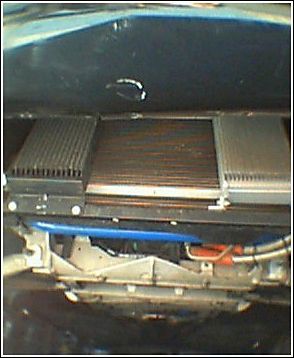
the air damn was removed for matainance