Fixed Orifice PCV "Valve"

Thread Starter
Le Mans Master


Joined: Mar 2002
Posts: 5,955
Likes: 161
From: PNW
 Fixed Orifice PCV "Valve"
I heard that GM has a fixed orifice PCV "valve" unit that will fit into the rubber holder of the original PCV valve for 2003 or older Vettes.
Has anyone used the fixed orifice PCV unit in place of the original valve to see if it makes any difference in the amount of oil in the intake system and/or catch can if you run one?
Anyone know the GM part number for this new PCV “valve” unit?
Has anyone used the fixed orifice PCV unit in place of the original valve to see if it makes any difference in the amount of oil in the intake system and/or catch can if you run one?
Anyone know the GM part number for this new PCV “valve” unit?

Burning Brakes

Joined: Jul 2000
Posts: 1,134
Likes: 1
From: Arlington Texas
I haven't used one, but here is some information on it.
EXCESSIVE OIL CONSUMPTION
GM offers a modified PCV valve to address customer complaints of excessive oil consumption on the following applications equipped with 4.8L, 5.3L or 6.0L engines:
1999–2002 Chevy Silverado, Suburban and Tahoe, 1999–2002 GMC Denali, Sierra, Suburban and Yukon, 2002 Chevy Avalanche, and 2002 Cadillac Escalade and Escalade EXT.
Excessive consumption would involve a vehicle that consumes one quart of oil per 2,000 miles. This is assuming the vehicle is a personal use, non-commercial type vehicle driven under normal conditions. Obviously, vehicles that are used in extreme service, such as heavily loaded trucks, or vehicles driven at high rates of speed would not be included, as their oil consumption rates may vary. Important: A minimum of a 4K mile engine break-in period should be performed, prior to condemning an engine for excessive oil consumption. Some basic checks that should be performed first include:
1) Inspect the top and lower engine components and covers for evidence of leakage.
2) Verify the proper dipstick is being used and that the tube is secured in the engine.
3) After engine shut-down, allow five minutes for oil drain-back, prior to checking the oil level.
4) Make certain the vehicle is sitting in a level position when checking the oil level.
5) Has the vehicle been driven at excessive speeds?
6) Has the vehicle been heavily loaded or pulling a loaded trailer or camper?
7) Is there evidence of engine overheating?
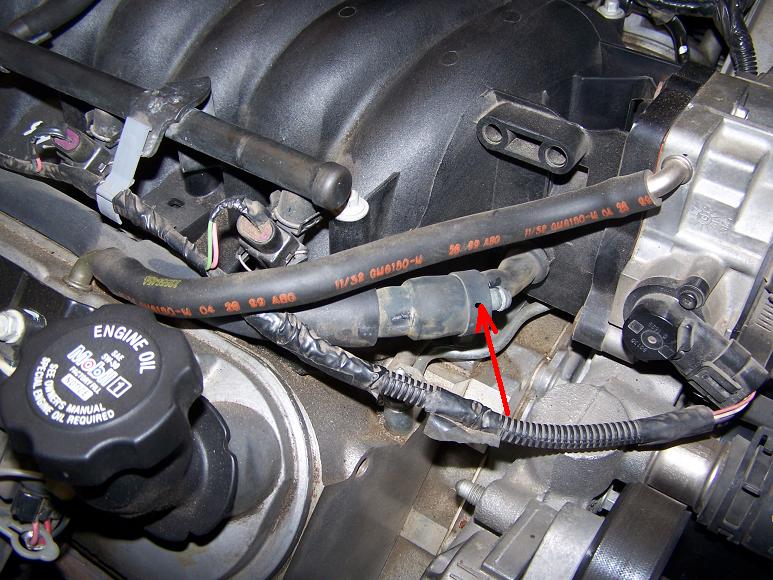
Assuming that the basic checks and considerations have been satisfied, GM recommends installing a revised PCV valve. It has been determined that under certain operating conditions, the original equipment variable type PCV valve flow rate may promote excessive oil consumption. The original equipment valve may promote a siphoning of the oil back into the intake manifold where it would be consumed through the combustion process. Examine the hose that attaches the PCV valve to the intake manifold for evidence of an excessive amount of oil. If excessive oil is present, GM recommends installing a revised PCV valve. The new style valve (GM #12572717, Mighty #3-932) is a fixed orifice valve with no moving parts (see illustration). The valve will not rattle when shaken. It is basically a shell of the OE style valve with an approximate .100 inch hole drilled in the bottom of the valve, providing a fixed flow rate. When servicing, technicians must be aware of the factory modification and be certain not to install the same type variable orifice valve that originally came on the vehicle. Doing so would reintroduce the performance condition that was corrected with the fixed orifice design.

EXCESSIVE OIL CONSUMPTION
GM offers a modified PCV valve to address customer complaints of excessive oil consumption on the following applications equipped with 4.8L, 5.3L or 6.0L engines:
1999–2002 Chevy Silverado, Suburban and Tahoe, 1999–2002 GMC Denali, Sierra, Suburban and Yukon, 2002 Chevy Avalanche, and 2002 Cadillac Escalade and Escalade EXT.
Excessive consumption would involve a vehicle that consumes one quart of oil per 2,000 miles. This is assuming the vehicle is a personal use, non-commercial type vehicle driven under normal conditions. Obviously, vehicles that are used in extreme service, such as heavily loaded trucks, or vehicles driven at high rates of speed would not be included, as their oil consumption rates may vary. Important: A minimum of a 4K mile engine break-in period should be performed, prior to condemning an engine for excessive oil consumption. Some basic checks that should be performed first include:
1) Inspect the top and lower engine components and covers for evidence of leakage.
2) Verify the proper dipstick is being used and that the tube is secured in the engine.
3) After engine shut-down, allow five minutes for oil drain-back, prior to checking the oil level.
4) Make certain the vehicle is sitting in a level position when checking the oil level.
5) Has the vehicle been driven at excessive speeds?
6) Has the vehicle been heavily loaded or pulling a loaded trailer or camper?
7) Is there evidence of engine overheating?
Assuming that the basic checks and considerations have been satisfied, GM recommends installing a revised PCV valve. It has been determined that under certain operating conditions, the original equipment variable type PCV valve flow rate may promote excessive oil consumption. The original equipment valve may promote a siphoning of the oil back into the intake manifold where it would be consumed through the combustion process. Examine the hose that attaches the PCV valve to the intake manifold for evidence of an excessive amount of oil. If excessive oil is present, GM recommends installing a revised PCV valve. The new style valve (GM #12572717, Mighty #3-932) is a fixed orifice valve with no moving parts (see illustration). The valve will not rattle when shaken. It is basically a shell of the OE style valve with an approximate .100 inch hole drilled in the bottom of the valve, providing a fixed flow rate. When servicing, technicians must be aware of the factory modification and be certain not to install the same type variable orifice valve that originally came on the vehicle. Doing so would reintroduce the performance condition that was corrected with the fixed orifice design.
Last edited by thetorch; Dec 28, 2007 at 10:32 PM.
Thread Starter
Le Mans Master
Joined: Mar 2002
Posts: 5,955
Likes: 161
From: PNW
Great info ... thanks! 
I didn't see the Vette engines listed in the application list, but I bet it's the same size as the original PCV valve used on the LSx Vette engines.
It would be nice to hear from anyone who has tried one and what differences they have seen on catch can accumulations and intake manifold oiling ... and especially oil residue in the fresh air line that goes from the valve cover to the throttle body.
I'm wondering if the fixed valve flows enough during WOT ... if not, it could cause more oil vapors to backflow down the fresh air line.
I didn't see the Vette engines listed in the application list, but I bet it's the same size as the original PCV valve used on the LSx Vette engines.
It would be nice to hear from anyone who has tried one and what differences they have seen on catch can accumulations and intake manifold oiling ... and especially oil residue in the fresh air line that goes from the valve cover to the throttle body.
I'm wondering if the fixed valve flows enough during WOT ... if not, it could cause more oil vapors to backflow down the fresh air line.
Last edited by ZeeOSix; Dec 28, 2007 at 10:40 PM.

Tech Contributor


Joined: Dec 1999
Posts: 32,910
Likes: 2,402
From: Anthony TX
CI 6,7,8,9,11 Vet
St. Jude Donor '08
I would be willing to try it to see if it makes a difference. I consume very little oil but in the case of oil in the combustion process. LESS IS BETTER)
BC
BC
Racer


Joined: Jan 2006
Posts: 479
Likes: 2
From: Hollywood Maryland
Have it installed
After reading the above earlier this year, switched to the fixed orifice PCV valve. No change in oil consumption which was minimal with the old type. So I guess it works OK, no issues so far.


Le Mans Master

Joined: Feb 2002
Posts: 6,937
Likes: 21
From: Waldorf MD
Intalled, Oil Analysis, and Other Post with results
I have it installed in my car to prevent an oily intake manifold, even though my car uses no oil.
BTW, the part number is PCV Valve 12572717
People have reported that it decreases the oil in their catch cans.
A lot of LS1 sites recommend using it. It actually simulates the late year Z06 pcv setup.
I have also driven over 6,500 miles with it and have done an oil analysis, no difference in oil from stock pcv valve (this means it works okay and no fumes condense/accumulate in the oil).
See my post:
http://forums.corvetteforum.com/show...ight=pcv+valve
One person had this result: but only 4 ml of oil after 556 miles (0.01 ml/mile) with the fixed orifice vs. about 3 ml in only 100 (0.03 ml/mile)miles on the stock PCV valve. So the fixed orifice reduced oil consumption to 1/3 of the stock in only 1/5 of mileage (this would equate to a 1/15 decrease).
BTW, the part number is PCV Valve 12572717
People have reported that it decreases the oil in their catch cans.
A lot of LS1 sites recommend using it. It actually simulates the late year Z06 pcv setup.
I have also driven over 6,500 miles with it and have done an oil analysis, no difference in oil from stock pcv valve (this means it works okay and no fumes condense/accumulate in the oil).
See my post:
http://forums.corvetteforum.com/show...ight=pcv+valve
One person had this result: but only 4 ml of oil after 556 miles (0.01 ml/mile) with the fixed orifice vs. about 3 ml in only 100 (0.03 ml/mile)miles on the stock PCV valve. So the fixed orifice reduced oil consumption to 1/3 of the stock in only 1/5 of mileage (this would equate to a 1/15 decrease).
Last edited by Oldvetter; Dec 30, 2007 at 12:00 PM.
Corvette Stories
The Best of Corvette for Corvette Enthusiasts

Every 2027 Corvette Engine Explained
Joe Kucinski
Designer Imagines A Corvette That Looks More Like a Corvette Than the Corvette
Verdad Gallardo
10 Ugly Corvettes That We Still Kinda Love
Joe Kucinski
Top 10 Most Expensive Corvettes Ever Sold on Bring A Trailer
Brett Foote
10 Things Every Corvette Owner Needs (2026 Edition)
Michael S. Palmer
8 Most "Only Corvette Owners Understand" Quirks and Problems
Pouria Savadkouei
10 Reasons the C6 Z06 is Still A Performance Benchmark After 20 Years
Joe Kucinski
How Much Horsepower Every Corvette Engine "LOST" in 1972
Joe Kucinski
Top 10 DOs and DON'Ts for Protecting Your Convertible Top!
Michael S. Palmer
Safety Car

Joined: Sep 2003
Posts: 3,558
Likes: 2
From: Cape Coral FL
One very interesting line in the info provided was this one - "The original equipment valve may promote a siphoning of the oil back into the intake manifold where it would be consumed through the combustion process."
I have my catch can after my pcv valve mounted on the frame up in front of the radiator. It does collect oil, but it is slightly lower than the valley cover. That means the oil has gravity working with it coming into the can and against it coming out, but if a siphoning effect is occuring I'm wondering if moving it where it is higher would help more.
---
Also, I'm wondering if I have to use one of these with the LS2 I'm going to be running.
I have my catch can after my pcv valve mounted on the frame up in front of the radiator. It does collect oil, but it is slightly lower than the valley cover. That means the oil has gravity working with it coming into the can and against it coming out, but if a siphoning effect is occuring I'm wondering if moving it where it is higher would help more.
---
Also, I'm wondering if I have to use one of these with the LS2 I'm going to be running.
Thread Starter
Le Mans Master
Joined: Mar 2002
Posts: 5,955
Likes: 161
From: PNW
Oldvetter -- good info, and thanks for that other link ... I check that out too.
I was wondering if the fixed orifice valve would cut flow down too much and cause more contaminates in the oil, but your data on the oil analysis is good info on this issue.
I was wondering if the fixed orifice valve would cut flow down too much and cause more contaminates in the oil, but your data on the oil analysis is good info on this issue.
Race Director

Joined: Dec 2000
Posts: 19,304
Likes: 85
From: San Diego CA
I guess my question is - Why is this NOT specified for the LS1? Could it be that a fixed orifice cannot flow as well under WOT conditions? This may not be too important for an SUV or truck, but a C5? Mmmmmm....

Race Director
Joined: Oct 2002
Posts: 16,477
Likes: 26
From: Gone
CI 6-7-8-9-10 Veteran
St. Jude Donor '03
I would doubt that, since this style PCV first appeared on 2004 LS1/6 engines from the factory.
Thread Starter
Le Mans Master
Joined: Mar 2002
Posts: 5,955
Likes: 161
From: PNW
Yes, I noticed and mentioned the application list did not address Corvettes. I'm wondering why also, since we all know that the 2004+ LSx switched over to the LS6 style valley cover with the 2.5 mm (1/10th inch) fixed orifice PCV system.


Pro

Joined: Nov 2006
Posts: 513
Likes: 1
From: brick nj
i installed this on my 99 in april.i would lose about 1/2 quart in 3,000 miles before with the stock pcv valve.since installing it my oil has been full after 3,000 miles and that includes many wot passes at 11.30.it definitely works.no residue in the intake either
Racer
Joined: Dec 2005
Posts: 431
Likes: 0
From: North Las Vegas Nevada
I too am wondering why the Corvette is not mentioned in that service document. Obviously the smaller hole will cut down on the vacume & will draw less oil through the system. I am a little skeptical though about using it.
Race Director
Joined: Dec 2000
Posts: 19,304
Likes: 85
From: San Diego CA
Actually, when you increase restriction beyond the vacuum source, you increase vacuum pressure. However, as you mentioned, flow will be reduced, possibly resulting in less oil reaching the intake.