






What did I do wrong? Brake Bleeding C5Z
Thread Starter
Pro


Joined: Oct 2007
Posts: 632
Likes: 2
From: Columbus Ohio
 What did I do wrong? Brake Bleeding C5Z
Hey all,
Ok in preparation for a first autox with my 2003 zo6 I tried to bleed the brakes. I emptied the master cylinder reservoir with a syringe and hose, then filled with Ford Motorcraft HD DOT 3, then pumped the pedal up.
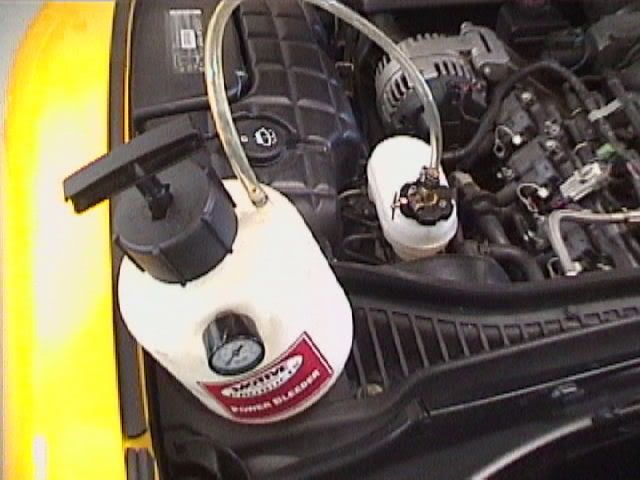
I started with the passenger side rear, I put the mity-vac on and cranked it up, then I cracked open the bleeder and proceeded to flush/bleed from that wheel and it flushed perfectly with a full tube until the fluid looked new.
I then moved to the driver side front and I could not get the fluid to fill the hose no matter how I oriented the length of the mity vac hoses or the amount of suction, or how hard I pushed the hose onto the bleeder. I finally got a decent amout of fluid out but lots of bubbles that would not clear by cracking the bleeder WAY open and then way shut.
I moved to the driver side rear and got the same situation but I could not get as much fluid out of this one no matter what I did. I probably got it to look clear but still lots of bubbles and not acting right.
Then the passenger side front, perfect, nice solid stream, that would fill the mity vac hose.
The driver side seems like it is open somehow- I tried putting the cap on the master cylinder and there was no difference?
Did I somehow get air in the abs module or do I have some sort of blockage in my proportioning valve? The car has 16,000 miles and I assume the fluid to be original and it looked pretty nasty- I got it less than a year ago.
I drove the car around the block and the pedal feels about the same as it did before I started if not a tad bit spongier but power brake cars always have a bit of sponge in the beginning- I engaged abs at a hard 45-0 stop and it seemed to work fine but I want to be sure.
Thanks!
Andrew
Ok in preparation for a first autox with my 2003 zo6 I tried to bleed the brakes. I emptied the master cylinder reservoir with a syringe and hose, then filled with Ford Motorcraft HD DOT 3, then pumped the pedal up.
I started with the passenger side rear, I put the mity-vac on and cranked it up, then I cracked open the bleeder and proceeded to flush/bleed from that wheel and it flushed perfectly with a full tube until the fluid looked new.
I then moved to the driver side front and I could not get the fluid to fill the hose no matter how I oriented the length of the mity vac hoses or the amount of suction, or how hard I pushed the hose onto the bleeder. I finally got a decent amout of fluid out but lots of bubbles that would not clear by cracking the bleeder WAY open and then way shut.
I moved to the driver side rear and got the same situation but I could not get as much fluid out of this one no matter what I did. I probably got it to look clear but still lots of bubbles and not acting right.
Then the passenger side front, perfect, nice solid stream, that would fill the mity vac hose.
The driver side seems like it is open somehow- I tried putting the cap on the master cylinder and there was no difference?
Did I somehow get air in the abs module or do I have some sort of blockage in my proportioning valve? The car has 16,000 miles and I assume the fluid to be original and it looked pretty nasty- I got it less than a year ago.
I drove the car around the block and the pedal feels about the same as it did before I started if not a tad bit spongier but power brake cars always have a bit of sponge in the beginning- I engaged abs at a hard 45-0 stop and it seemed to work fine but I want to be sure.
Thanks!
Andrew
Last edited by hpfiend; Jun 13, 2009 at 06:32 PM.
Instructor

Joined: Jan 2009
Posts: 149
Likes: 1
From: Houston Texas

Team Owner


Joined: Sep 2003
Posts: 43,084
Likes: 33
From: Raleigh / Rolesville NC
I found it makes no difference which order. I do start with the RR.
Do RR, then LR
Pump brake peddle 3-4 times
Refile MC
RF
LF
pump brake peddle 3-4 times
Refil MC
pump brake peddle 3-5 times
take car for short drive
Do RR, then LR
Pump brake peddle 3-4 times
Refile MC
RF
LF
pump brake peddle 3-4 times
Refil MC
pump brake peddle 3-5 times
take car for short drive
Thread Starter
Pro
Joined: Oct 2007
Posts: 632
Likes: 2
From: Columbus Ohio
It sounds as if I need some new technology....
So I need some speed bleeders or the motive pressure bleeder?
Anyone have any idea why the passenger side works perfectly with the mity-vac and the drivers side is difficult? Noone thinks it is a proportioning valve/abs issue?
Thanks!
Andrew
So I need some speed bleeders or the motive pressure bleeder?
Anyone have any idea why the passenger side works perfectly with the mity-vac and the drivers side is difficult? Noone thinks it is a proportioning valve/abs issue?
Thanks!
Andrew
Corvette Stories
The Best of Corvette for Corvette Enthusiasts

Top 10 Most Expensive Corvettes Ever Sold on Bring A Trailer
Brett Foote
10 Things Every Corvette Owner Needs (2026 Edition)
Michael S. Palmer
8 Most "Only Corvette Owners Understand" Quirks and Problems
Pouria Savadkouei
10 Reasons the C6 Z06 is Still A Performance Benchmark After 20 Years
Joe Kucinski
How Much Horsepower Every Corvette Engine "LOST" in 1972
Joe Kucinski
Top 10 DOs and DON'Ts for Protecting Your Convertible Top!
Michael S. Palmer
Top 10 Most Explosive Corvettes Ever Made: Power-to-Weight Ratio Ranked!
Joe Kucinski
150 hp to 1,250 hp: Every Corvette Generation Compared by the Specs That Matter
Joe Kucinski
8 Coolest Corvette Pace Cars (and Replicas) of All Time
Verdad Gallardo

Burning Brakes

Joined: Apr 2009
Posts: 946
Likes: 2
I've always heard you should not pull a vacuum on ABS breaks (since you are only pulling a vac between the caliper and the ABS module anyway, and risk damaging the ABS).
I personally use speed bleeders and bleed all ABS vehicles manually.
I personally use speed bleeders and bleed all ABS vehicles manually.
Thread Starter
Pro
Joined: Oct 2007
Posts: 632
Likes: 2
From: Columbus Ohio
We just had a baby so my wife is not available to press the pedal on command which is why I did not do it manually.
Great :-( how do I tell if I damaged the ABS module?
I am going to order some speed bleeders this week.
Thanks,
Andrew
Great :-( how do I tell if I damaged the ABS module?
I am going to order some speed bleeders this week.
Thanks,
Andrew


Burning Brakes
Joined: Apr 2009
Posts: 946
Likes: 2
 Congrats BTW!
If your ABS is kaput, the computer will let you know. I'm not sure what the actual risk is with that part of the statement, but if your vette isn't screaming for you service the ABS I'd think you are fine.
Le Mans Master


Joined: Jan 2001
Posts: 5,015
Likes: 508
From: Hilton NY
The caliper piston seals are designed to keep the fluid in and air out as in a check valve, if vacuum is used at the master cylinder, air is sucked into the system around the caliper piston seals. All you need is a set of speed bleeders.
Thread Starter
Pro
Joined: Oct 2007
Posts: 632
Likes: 2
From: Columbus Ohio
Thanks all for the advice and congratulations!
I ended up getting a set of stainless speed bleeders SB1010S-SS and they are awesome- brake pedal feels even better and I am again confident with the setup- nice innovation. On a side note I was probably supposed to throw the bag away but it was so neat I emptied it out and kept it for next time.
Thanks,
Andrew
I ended up getting a set of stainless speed bleeders SB1010S-SS and they are awesome- brake pedal feels even better and I am again confident with the setup- nice innovation. On a side note I was probably supposed to throw the bag away but it was so neat I emptied it out and kept it for next time.
Thanks,
Andrew
Race Director


Joined: Dec 2000
Posts: 19,304
Likes: 85
From: San Diego CA
Here's a bit of advice I read in Popular Mechanics and I agree:
When manually bleeding brake fluid using the brake pedal, place a wood block under the pedal to limit travel to approximately the travel the pedal (and master cylinder piston) "sees" during normal use. The reason is that the master cylinder piston sealing surface will eventually have a slight step in it, due to the very consistent travel distance of the piston and seal. Extending the piston past its usual stopping point is a good way to damage its seal.
This happened to a garage's mechanic who was flusing fluid from a van I used to have. When I picked up the van, the pedal was very mushy - not because of air inclusion, but because the master cylinder seal was damaged. When I found out how the mechanic bled the fluid, I told him he was responsible for the MC damage and he admitted that it made sense.
When manually bleeding brake fluid using the brake pedal, place a wood block under the pedal to limit travel to approximately the travel the pedal (and master cylinder piston) "sees" during normal use. The reason is that the master cylinder piston sealing surface will eventually have a slight step in it, due to the very consistent travel distance of the piston and seal. Extending the piston past its usual stopping point is a good way to damage its seal.
This happened to a garage's mechanic who was flusing fluid from a van I used to have. When I picked up the van, the pedal was very mushy - not because of air inclusion, but because the master cylinder seal was damaged. When I found out how the mechanic bled the fluid, I told him he was responsible for the MC damage and he admitted that it made sense.
Instructor
Joined: Jan 2009
Posts: 149
Likes: 1
From: Houston Texas
Here's a bit of advice I read in Popular Mechanics and I agree:
When manually bleeding brake fluid using the brake pedal, place a wood block under the pedal to limit travel to approximately the travel the pedal (and master cylinder piston) "sees" during normal use. The reason is that the master cylinder piston sealing surface will eventually have a slight step in it, due to the very consistent travel distance of the piston and seal. Extending the piston past its usual stopping point is a good way to damage its seal.
This happened to a garage's mechanic who was flusing fluid from a van I used to have. When I picked up the van, the pedal was very mushy - not because of air inclusion, but because the master cylinder seal was damaged. When I found out how the mechanic bled the fluid, I told him he was responsible for the MC damage and he admitted that it made sense.
When manually bleeding brake fluid using the brake pedal, place a wood block under the pedal to limit travel to approximately the travel the pedal (and master cylinder piston) "sees" during normal use. The reason is that the master cylinder piston sealing surface will eventually have a slight step in it, due to the very consistent travel distance of the piston and seal. Extending the piston past its usual stopping point is a good way to damage its seal.
This happened to a garage's mechanic who was flusing fluid from a van I used to have. When I picked up the van, the pedal was very mushy - not because of air inclusion, but because the master cylinder seal was damaged. When I found out how the mechanic bled the fluid, I told him he was responsible for the MC damage and he admitted that it made sense.
Race Director
Joined: Dec 2000
Posts: 19,304
Likes: 85
From: San Diego CA
I agree that pressure bleeders are the way to go. Ever since I had my garage floor painted, however, I've had someone else to the flushing. It runs about $90 and saves my floor from having bare concrete circles under the four corners of any of my cars. One of these days, I'll look into epoxy flooring.......

