



 I try to limit the times IM wrong!



Electrical gremlin from Hell: need advice

Safety Car


Joined: Jun 2004
Posts: 4,986
Likes: 393
From: Stoney Creek Ontario

I'm going to remove my ignition switch and mail it off to Bill to get rebuilt just in case - his thread with pics and instructions is amazing and even though there's nothing currently wrong with mine, I just can't resist sending it off to him! BTW - I haven't seen Bill wrong yet and he gives sound advice

Team Owner

Joined: Mar 2002
Posts: 24,160
Likes: 78
The second time took me maybe 30 minutes.


Thread Starter
Safety Car

Joined: Sep 2002
Posts: 4,030
Likes: 6
From: Maryland
ignition switch--doesn't look like it
I took the liberty of putting my key w/ 10key chain on it and driving car in to work just now.
With the engine hot--parked--I pulled on those keys, shock the hell out of the whole thing, and wagged them back and forth right and left and down towards bottom, pulling all the way.
The cylinder held and gave me no signs it was going to come loose any time soon. It didn't move at all.
Car is a 2002 w/40kmi; mostly highway; I don't think of it as worn.
This really seems torque related--on track, I could pull more g's without the gremlin acting up by not applying much/any throttle coming out of the corner. It was when I gave it throttle (esp. in 3rd gear) out of a corner that the gremlin showed up. And then, never on the 1st laps, into the session a bit after the car was warm/hot.
I'm still going to track all this stuff down that's been mentioned here but I'm less convinced now it is the switch itself. Maybe the wiring leading to the switch after all is more likely.
With the engine hot--parked--I pulled on those keys, shock the hell out of the whole thing, and wagged them back and forth right and left and down towards bottom, pulling all the way.
The cylinder held and gave me no signs it was going to come loose any time soon. It didn't move at all.
Car is a 2002 w/40kmi; mostly highway; I don't think of it as worn.
This really seems torque related--on track, I could pull more g's without the gremlin acting up by not applying much/any throttle coming out of the corner. It was when I gave it throttle (esp. in 3rd gear) out of a corner that the gremlin showed up. And then, never on the 1st laps, into the session a bit after the car was warm/hot.
I'm still going to track all this stuff down that's been mentioned here but I'm less convinced now it is the switch itself. Maybe the wiring leading to the switch after all is more likely.
Team Owner
Joined: Mar 2002
Posts: 24,160
Likes: 78
It doesn't surprise me that you couldn't replicate your problem like that. There's no vibration from the engine, no bumps in the road, etc.
Was the engine running? Did you try my experiment and try to see just how little counterclockwise motion it takes to break that circuit?
Was the engine running? Did you try my experiment and try to see just how little counterclockwise motion it takes to break that circuit?
Thread Starter
Safety Car
Joined: Sep 2002
Posts: 4,030
Likes: 6
From: Maryland
It doesn't surprise me that you couldn't replicate your problem like that. There's no vibration from the engine, no bumps in the road, etc.
Was the engine running? Did you try my experiment and try to see just how little counterclockwise motion it takes to break that circuit?
Was the engine running? Did you try my experiment and try to see just how little counterclockwise motion it takes to break that circuit?
Incidently--the inertia effect of left turns pulls the key right. So that does not tend to rotate it CC. What does is when it's pulled right and then suddenly pulled down (groundward)--vertically down will put a little torque on it. I yanked on it though down, right, left and it would not turn off/cylinder move at all by this action.
Corvette Stories
The Best of Corvette for Corvette Enthusiasts

Top 10 Most Expensive Corvettes Ever Sold on Bring A Trailer
Brett Foote
10 Things Every Corvette Owner Needs (2026 Edition)
Michael S. Palmer
8 Most "Only Corvette Owners Understand" Quirks and Problems
Pouria Savadkouei
10 Reasons the C6 Z06 is Still A Performance Benchmark After 20 Years
Joe Kucinski
How Much Horsepower Every Corvette Engine "LOST" in 1972
Joe Kucinski
Top 10 DOs and DON'Ts for Protecting Your Convertible Top!
Michael S. Palmer
Top 10 Most Explosive Corvettes Ever Made: Power-to-Weight Ratio Ranked!
Joe Kucinski
150 hp to 1,250 hp: Every Corvette Generation Compared by the Specs That Matter
Joe Kucinski
8 Coolest Corvette Pace Cars (and Replicas) of All Time
Verdad Gallardo
Tech Contributor


Joined: Jan 2007
Posts: 19,456
Likes: 1,165
From: Dyer, IN
I'm posting this PM from the OP so we can all stay in the loop, since many are contributing.....
Mike,
Is the serial data line the same as the class-II data purple wire? Mechanic says there's this class-II data purple wire that runs all over the car that will pull the HUD and cluster down.
I think this is what he suspects.
He did not pull the ignition switch itself--he pulled the panel down under the column and looked for something amiss in the connectors/wires there and may have moved them around a bit w/car turned on.
I'll have to look at the specs--I'm interested to see if I can find minifuse 19 and the wire running to the ignition switch itself.
Thank you so much for pointing this stuff out,
Andy
Andy, the mechanic is correct in that the class 2 serial buss connects many systems.....and some of the instruments are included...but not all. What is particularly interesting in your case, is that you lose ALL the instrumentation....like the car is off. This is not consistent with a class 2 problem. A class 2 problem will typically manifest itself one of two ways:
1) loss of control of doors, radio,etc.. and instruments go crazy....usually shorting the serial buss
2) no start, or intermittent stalling, communication....usually bad grounding to the PCM causing no communication.
Since you loose EVERYTHING, that tells me you are losing ignition to the instrument cluster, which suggests you have a bigger issue than just a serial data short, ground, etc.
That's why either the 12 volt battery feed to the ignition switch, or the ignition switch itself is suspect.
The ignition switch must be disassembled and the contacts inspected....period.
On a side note, you should fill out your sig.....might bring some local help. You also might consider taking your car to another mechanic. A competent mechanic ,familiar with C5's, should have come to the conclusions already discussed in this thread........
Mike,
Is the serial data line the same as the class-II data purple wire? Mechanic says there's this class-II data purple wire that runs all over the car that will pull the HUD and cluster down.
I think this is what he suspects.
He did not pull the ignition switch itself--he pulled the panel down under the column and looked for something amiss in the connectors/wires there and may have moved them around a bit w/car turned on.
I'll have to look at the specs--I'm interested to see if I can find minifuse 19 and the wire running to the ignition switch itself.
Thank you so much for pointing this stuff out,
Andy
Andy, the mechanic is correct in that the class 2 serial buss connects many systems.....and some of the instruments are included...but not all. What is particularly interesting in your case, is that you lose ALL the instrumentation....like the car is off. This is not consistent with a class 2 problem. A class 2 problem will typically manifest itself one of two ways:
1) loss of control of doors, radio,etc.. and instruments go crazy....usually shorting the serial buss
2) no start, or intermittent stalling, communication....usually bad grounding to the PCM causing no communication.
Since you loose EVERYTHING, that tells me you are losing ignition to the instrument cluster, which suggests you have a bigger issue than just a serial data short, ground, etc.
That's why either the 12 volt battery feed to the ignition switch, or the ignition switch itself is suspect.
The ignition switch must be disassembled and the contacts inspected....period.
On a side note, you should fill out your sig.....might bring some local help. You also might consider taking your car to another mechanic. A competent mechanic ,familiar with C5's, should have come to the conclusions already discussed in this thread........
Last edited by lucky131969; Apr 2, 2010 at 03:43 PM.
Team Owner
Joined: Mar 2002
Posts: 24,160
Likes: 78
Yes--engine was idling and operating hot--maybe 200F--not road course hot. Yes, I tried cc motions to break the circuit--I couldn't break it. It takes a substantial torque on the cylinder to turn it at all. Touching the key, it takes a decent amount of force to get it to turn off--it's not something you can do by accident.
I'm telling you, I've seen this happen before.
Incidently--the inertia effect of left turns pulls the key right. So that does not tend to rotate it CC. What does is when it's pulled right and then suddenly pulled down (groundward)--vertically down will put a little torque on it. I yanked on it though down, right, left and it would not turn off/cylinder move at all by this action.
 Pulling the bottom of the key to the right will rotate it counterclockwise.
Thread Starter
Safety Car
Joined: Sep 2002
Posts: 4,030
Likes: 6
From: Maryland
Believe me--I'll never run again w/the keys on the chain. But it will be a while before I have a chance to run on course and it's expensive...I want to fix this before I commit.
Thread Starter
Safety Car
Joined: Sep 2002
Posts: 4,030
Likes: 6
From: Maryland
What is particularly interesting in your case, is that you lose ALL the instrumentation....like the car is off. This is not consistent with a class 2 problem. A class 2 problem will typically manifest itself one of two ways:
1) loss of control of doors, radio,etc.. and instruments go crazy....usually shorting the serial buss
2) no start, or intermittent stalling, communication....usually bad grounding to the PCM causing no communication.
Since you loose EVERYTHING, that tells me you are losing ignition to the instrument cluster, which suggests you have a bigger issue than just a serial data short, ground, etc.
That's why either the 12 volt battery feed to the ignition switch, or the ignition switch itself is suspect.
The ignition switch must be disassembled and the contacts inspected....period.
.....
1) loss of control of doors, radio,etc.. and instruments go crazy....usually shorting the serial buss
2) no start, or intermittent stalling, communication....usually bad grounding to the PCM causing no communication.
Since you loose EVERYTHING, that tells me you are losing ignition to the instrument cluster, which suggests you have a bigger issue than just a serial data short, ground, etc.
That's why either the 12 volt battery feed to the ignition switch, or the ignition switch itself is suspect.
The ignition switch must be disassembled and the contacts inspected....period.
.....
I'll look into the manual tonight and see what it takes to get the switch & wiring out on my own. I have looked at the diagrams last winter but at that point I didn't see that the HUD was going down and that the HUD also goes down the same way when you turn the key off.
The puff of smoke is still in play...that was seen by another driver back in the fall and I want to say he thought it was a right front tire...which I also saw smoking at VIR 2 weeks ago as I sat motionsless on the grass...but couldn't get out to inspect.
Another thing I'll try to do is look at your posted diagram and trace down the full path of wiring from the switch to the battery.
With the headers...maybe there's something we just can't see (I've looked with it up on jackstands too--at length!!)
Andy

Instructor


Joined: Feb 2000
Posts: 193
Likes: 4
From: Houston TX
A thought having just looked at this 'switch'. Next to the oil pressure sensor just behind the intake manifold on the driver's side there is a switch that monitors fuel and oil pressure which I believe is essentially a binary (off/on) device. Would an intermittent with this switch or wiring connected to it cause such a problem? I just asked the local Chevy parts dealer what this 'thingie' was for having pulled the intake manifold and I got the above reply. It has three wires coming out of it if I remember correctly. Ken Goodwin
Tech Contributor
Joined: Jan 2007
Posts: 19,456
Likes: 1,165
From: Dyer, IN
A thought having just looked at this 'switch'. Next to the oil pressure sensor just behind the intake manifold on the driver's side there is a switch that monitors fuel and oil pressure which I believe is essentially a binary (off/on) device. Would an intermittent with this switch or wiring connected to it cause such a problem? I just asked the local Chevy parts dealer what this 'thingie' was for having pulled the intake manifold and I got the above reply. It has three wires coming out of it if I remember correctly. Ken Goodwin
Instructor
Joined: Feb 2000
Posts: 193
Likes: 4
From: Houston TX
Right you are, can't rely on everything you're told. But in defense of the dealer's part department, the way I described it, I had the oil pressure sensor reversed with the camshaft position (CMP) sensor which was the initial response. Sorry.

Safety Car


Joined: May 2004
Posts: 4,628
Likes: 397
From: Madison Wi
rebelhart was not very clear. I will expound.
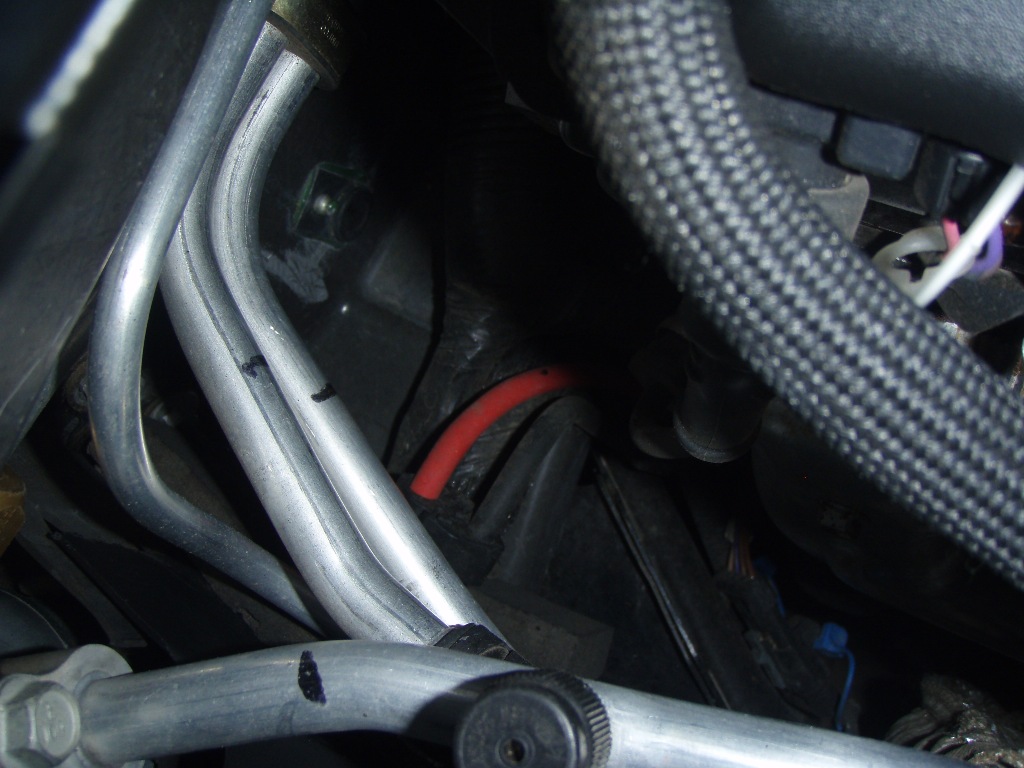
If you look carefully at the + battery cable where it crosses over top of the frame rail you will find a spot where a sharp edge of metal contacts the battery cable and it possible for this sharp edge to cut into the insulation of the battery cable and ground it out.
If your car has this condition, it is very possible that the stress placed on the chassis during racing causes enough flex in the car to make the battery cable with worn insulation dead short resulting in a dead electrical system.
This could also result in a puff of smoke from the right front tire area.
Inspect your +batt cable very carefully! Look at every inch! Especially where it crosses over the frame rail!
Here is a picture of the suspect area in my car. Mine does not rub, but you can see the standing metal seam that it could rub on. I've seen pictures of guys cars that had that seam cut completely through the cable insulation.
Last edited by TraceZ; Apr 2, 2010 at 10:23 PM.

Tech Contributor


Joined: Dec 1999
Posts: 32,910
Likes: 2,402
From: Anthony TX
CI 6,7,8,9,11 Vet
St. Jude Donor '08
Read this post carefully.
rebelhart was not very clear. I will expound.
If you look carefully at the + battery cable where it crosses over top of the frame rail you will find a spot where a sharp edge of metal contacts the battery cable and it possible for this sharp edge to cut into the insulation of the battery cable and ground it out.
If your car has this condition, it is very possible that the stress placed on the chassis causes enough flex in the car to make the battery cable with worn insulation dead short.
This could result in a puff of smoke from the right front tire area.
Inspect your +batt cable very carefully! Look at every inch! Expecially where it crosses over the frame rail!
rebelhart was not very clear. I will expound.
If you look carefully at the + battery cable where it crosses over top of the frame rail you will find a spot where a sharp edge of metal contacts the battery cable and it possible for this sharp edge to cut into the insulation of the battery cable and ground it out.
If your car has this condition, it is very possible that the stress placed on the chassis causes enough flex in the car to make the battery cable with worn insulation dead short.
This could result in a puff of smoke from the right front tire area.
Inspect your +batt cable very carefully! Look at every inch! Expecially where it crosses over the frame rail!
I will have to remember this!
Yep. ALL TRONS to ground will make a C5 unhappy. When you speak 550 amps to ground,,,,,,you should see visions of LOTS OF SMOKE, SPARKS and NOISE! That damage wont be difficult to find.BC

Drifting

Joined: Sep 2004
Posts: 1,727
Likes: 19
From: Carson City, NV
Since this is a crap shoot, I want to enter the contest and propose that your battery cable going to the starter is in close proximity to your hot headers and has the insulation melted off exposing the bare wires. When you're at the track and all the conditions are just right, your headers short out your battery and kills everything for just and instant. No ignition, no spark, no codes, but a puff of smoke is present due to unburned fuel. Sorry, I don't buy the ignition switch trail.
Racer
Joined: Aug 2007
Posts: 497
Likes: 0
From: Monrovia California
I've seen problems before caused by too much weight on the ignition key - stuff like extra keys, bottle openers, charms, etc etc... all these cause problems dangling away and jiggling with the extra weight hanging off the ignition cylinder....once the damage is done, usually removing the extra weight dosen't cure it... the cylinder needs to be rebuilt or replaced ...may or may not be the prob,,,. but you are definately loosing juice 100% as if the key is being turned off, since you're not getting any stored codes...