







Jacking Points
Burning Brakes

Joined: Sep 2009
Posts: 959
Likes: 3
From: Hartford CT


For people that track these cars (C5/C6) regularly and jack them up regularly, they know the Bugman jacking points work fine. Make sure the width of the crosmember is covered by the jack as Bill suggested.
If you have pratical experience working on cars, you know why it works with no issues.
If you are a "stick to the manual" kind of guy, or just to scared to make any decisions on your own without consulting a GM engineer, stick to the EXACT procedure as described in the manual.
I will call you when I fold my car in half and tell you how right you were!
Last edited by Shifter6; Feb 22, 2012 at 02:40 PM.

Safety Car


Joined: Nov 2011
Posts: 3,715
Likes: 343
From: Norman OK
I guess I dotn see the issue. To jack the front of my car up I go to the spot right under the drivers side door on the frame rail and lift the car up, then place a stand under the engine cradle.
then I put the jack under the engine cradle and lift the whole front end up and put the other jack stand under the passenger side of the car and lift it up.
has worked perfectly fine eac time I have done it. To lift the rear I go right in the middle of the exhuast and lift from the rear cradle and lift the entire rear end, then support with stands.
I have not seen one issue so far with these methods.
then I put the jack under the engine cradle and lift the whole front end up and put the other jack stand under the passenger side of the car and lift it up.
has worked perfectly fine eac time I have done it. To lift the rear I go right in the middle of the exhuast and lift from the rear cradle and lift the entire rear end, then support with stands.
I have not seen one issue so far with these methods.
Melting Slicks

Joined: Feb 2011
Posts: 2,840
Likes: 65
From: Tree City
When changing oil, does anyone just use the one jacking puck under the driver's door, jack the car up in that one spot and put a jackstand near the jack and do all of the oil changing work just by using that one jacking puck spot? Or should you jack both sides up using the jacking puck areas and put two jacks under the front of the car? I've never changed oil doing all of that before on my other cars. I always just used one jackstand on the side after I got the car high enough to crawl under. It seems like an awful lot of work to jack both sides up and lower them twice and use two jack stands while changing oil. Is this really necessary?

Team Owner


Joined: Aug 2002
Posts: 35,617
Likes: 167
Tech Contributor
Cruise-In 11 Veteran
NCM Ambassador
St. Jude Donor '05-'06-'07-'10
Notice
When you are jacking or lifting a vehicle at the frame side rails or other prescribed lift points, be certain that the lift pads do not contact the catalytic converter, the brake pipes or the fuel lines. If such contact occurs, vehicle damage or unsatisfactory vehicle performance may result.
Before you begin any lifting procedure, be sure the vehicle is on a clean, hard, level surface. Be sure all the lifting equipment meets weight standards and is in good working order. Be sure all the vehicle loads are equally distributed and secure. If you are only supporting the vehicle at the frame side rails, make sure the lifting equipment does not put too much stress on or weaken the frame side rails.
If you use any other lifting methods than those called out, take special care not to damage the fuel tanks, the exhaust system or the underbody.
Notice
When you are jacking the vehicle at the front locations, be certain that the jack or the jack lift pad does not contact the front fascia, front fascia air dam, or the front fenders. If such contact occurs, vehicle damage may result. When jacking at selected front locations additional clearance may be required for the jacking points.

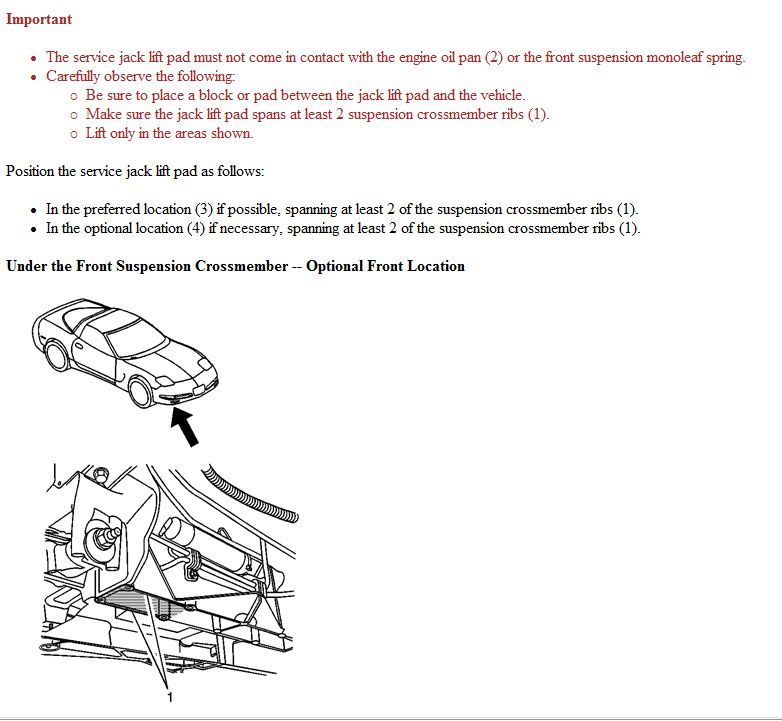
Regarding the owners manual. What it says is as follows:
"If you ever use a jack to lift your vehicle, follow the
instructions that came with the jack, and be sure to
use the correct lifting points to avoid damaging
your vehicle.Notice: Lifting your vehicle improperly can damage
your vehicle and result in costly repairs not covered
by your warranty. To lift your vehicle properly, follow
the advice in this part.
To help prevent vehicle damage:
• Be sure to place a block or pad between the
jack and the vehicle.
• Make sure the jack you’re using spans at least
two crossmember ribs.
• Lift only in the areas shown in the following
pictures.For additional information, see your dealer and the
Chevrolet Corvette service manual.5-77"


Last edited by talon90; Feb 24, 2012 at 10:52 AM.

Le Mans Master


Joined: Jan 2004
Posts: 6,897
Likes: 181
From: Menifee (I.E.) CA
When changing oil, does anyone just use the one jacking puck under the driver's door, jack the car up in that one spot and put a jackstand near the jack and do all of the oil changing work just by using that one jacking puck spot? Or should you jack both sides up using the jacking puck areas and put two jacks under the front of the car? I've never changed oil doing all of that before on my other cars. I always just used one jackstand on the side after I got the car high enough to crawl under. It seems like an awful lot of work to jack both sides up and lower them twice and use two jack stands while changing oil. Is this really necessary?
Melting Slicks
Joined: Feb 2011
Posts: 2,840
Likes: 65
From: Tree City
But my question is: Can't you change oil and only use the one jacking spot under the driver's door ( with the jacking puck) to lift the car up and down? Or do you have to lift the entire front of the car up and support it with TWO jack stands under the front end.
Team Owner
Joined: Aug 2002
Posts: 35,617
Likes: 167
Tech Contributor
Cruise-In 11 Veteran
NCM Ambassador
St. Jude Donor '05-'06-'07-'10
You can safely lift the C6 for an oil change by jacking at the jacking point behind the front wheel. It is always a good idea to use a jack stand for safety when working with a hydrauic jack.
Corvette Stories
The Best of Corvette for Corvette Enthusiasts

Top 10 Most Expensive Corvettes Ever Sold on Bring A Trailer
Brett Foote
10 Things Every Corvette Owner Needs (2026 Edition)
Michael S. Palmer
8 Most "Only Corvette Owners Understand" Quirks and Problems
Pouria Savadkouei
10 Reasons the C6 Z06 is Still A Performance Benchmark After 20 Years
Joe Kucinski
How Much Horsepower Every Corvette Engine "LOST" in 1972
Joe Kucinski
Top 10 DOs and DON'Ts for Protecting Your Convertible Top!
Michael S. Palmer
Top 10 Most Explosive Corvettes Ever Made: Power-to-Weight Ratio Ranked!
Joe Kucinski
150 hp to 1,250 hp: Every Corvette Generation Compared by the Specs That Matter
Joe Kucinski
8 Coolest Corvette Pace Cars (and Replicas) of All Time
Verdad Gallardo
Melting Slicks
Joined: Feb 2011
Posts: 2,840
Likes: 65
From: Tree City
According to my book Bugman has the jacks wrong. He only has the jack under one rib. Look at picture #3 above. He has the weight of the car resting on the jack on only one rib. It says to have the jack under at least TWO ribs. All I have ever done when jacking any of my cars when I change oil is to jack it up by the side rail on only ONE side of the car, slide a jack under it for safety- usually under the frame somewhere, and jack it up and down using only one side of the car. So, jacking it up and down on both side rails with jacking pucks and putting TWO jacks under the front end and doing all of this twice in the process of changing oil- is that really necessary?
Last edited by Jimmy W1; Feb 24, 2012 at 11:07 AM.
Melting Slicks
Joined: Feb 2011
Posts: 2,840
Likes: 65
From: Tree City
That is what I do on my other cars. But I was wondering how to do it with my 05 Corvette.
Last edited by Jimmy W1; Feb 24, 2012 at 11:07 AM.
Team Owner
Joined: Aug 2002
Posts: 35,617
Likes: 167
Tech Contributor
Cruise-In 11 Veteran
NCM Ambassador
St. Jude Donor '05-'06-'07-'10
To make my life easier, I drive up on ramps, then jack from the drivers side and support with jack stands so I can move the jack out of the way. It doesn't take me very long.
The exact procedure I use for changing my oil is listed on my website in a PDF here:
http://www.theredlion.us/C6%20Changi...ette%20Oil.pdf
I only do this because it's the way I do it. The frame jack point is fine and there are plenty who use nothing but the jacking point. As I said, I don't recommend getting under a car with only a hydraulic jack supporting it but if it holds the car is fine. There are still three tires under the car supporting the majority of the weight. You do not need to lift the entire front of the vehicle if you don't want to.
By the way. The owners manual photos and information I posted above is from my 2005 owners manual. Have a look in your manual at pages 5-71, 5-72 and 5-73 for the pictures (including the reference of lifting behind the front tire and the notes stating to use a pad or a block between the jack and the vehicle.
The exact procedure I use for changing my oil is listed on my website in a PDF here:
http://www.theredlion.us/C6%20Changi...ette%20Oil.pdf
I only do this because it's the way I do it. The frame jack point is fine and there are plenty who use nothing but the jacking point. As I said, I don't recommend getting under a car with only a hydraulic jack supporting it but if it holds the car is fine. There are still three tires under the car supporting the majority of the weight. You do not need to lift the entire front of the vehicle if you don't want to.
By the way. The owners manual photos and information I posted above is from my 2005 owners manual. Have a look in your manual at pages 5-71, 5-72 and 5-73 for the pictures (including the reference of lifting behind the front tire and the notes stating to use a pad or a block between the jack and the vehicle.
Last edited by talon90; Feb 24, 2012 at 11:20 AM.
Melting Slicks
Joined: Feb 2011
Posts: 2,840
Likes: 65
From: Tree City
If you drive up on ramps, does all of the oil drain out of your oil pan with only the front end in the air? Once I get the drain plug out of the pan, I always lower the car back down level and let the oil drain out. Then when the pan is empty, I jack it back up to put the filter on and replace the plug. Is the plug on the C6 situated to let all of the oil out of the pan with both sides of the front end elevated?
Team Owner
Joined: Aug 2002
Posts: 35,617
Likes: 167
Tech Contributor
Cruise-In 11 Veteran
NCM Ambassador
St. Jude Donor '05-'06-'07-'10
If you drive up on ramps, does all of the oil drain out of your oil pan with only the front end in the air? Once I get the drain plug out of the pan, I always lower the car back down level and let the oil drain out. Then when the pan is empty, I jack it back up to put the filter on and replace the plug. Is the plug on the C6 situated to let all of the oil out of the pan with both sides of the front end elevated?
Race Director


Joined: Jan 2011
Posts: 11,973
Likes: 463
From: Tonawanda New York

Team Owner
Joined: Sep 1999
Posts: 41,732
Likes: 1,718
From: Springfield MO
Team Owner
Joined: Sep 1999
Posts: 41,732
Likes: 1,718
From: Springfield MO
Actually, this drawing is taken directly from the Corvette service manual. The only thing that has been modified is that the colors were added in place of the various cross hatches in the oriignal drawing to aide in clarity because they are difficult to discern when posted. It also makes allowances for jacks as well as lifts at the primary and secondary locations.
Notice
When you are jacking or lifting a vehicle at the frame side rails or other prescribed lift points, be certain that the lift pads do not contact the catalytic converter, the brake pipes or the fuel lines. If such contact occurs, vehicle damage or unsatisfactory vehicle performance may result.
Before you begin any lifting procedure, be sure the vehicle is on a clean, hard, level surface. Be sure all the lifting equipment meets weight standards and is in good working order. Be sure all the vehicle loads are equally distributed and secure. If you are only supporting the vehicle at the frame side rails, make sure the lifting equipment does not put too much stress on or weaken the frame side rails.
If you use any other lifting methods than those called out, take special care not to damage the fuel tanks, the exhaust system or the underbody.
Notice
When you are jacking the vehicle at the front locations, be certain that the jack or the jack lift pad does not contact the front fascia, front fascia air dam, or the front fenders. If such contact occurs, vehicle damage may result. When jacking at selected front locations additional clearance may be required for the jacking points.
Regarding the owners manual. What it says is as follows:
"If you ever use a jack to lift your vehicle, follow the
instructions that came with the jack, and be sure to
use the correct lifting points to avoid damaging
your vehicle.Notice: Lifting your vehicle improperly can damage
your vehicle and result in costly repairs not covered
by your warranty. To lift your vehicle properly, follow
the advice in this part.
To help prevent vehicle damage:
• Be sure to place a block or pad between the
jack and the vehicle.
• Make sure the jack you’re using spans at least
two crossmember ribs.
• Lift only in the areas shown in the following
pictures.For additional information, see your dealer and the
Chevrolet Corvette service manual.5-77"
Notice
When you are jacking or lifting a vehicle at the frame side rails or other prescribed lift points, be certain that the lift pads do not contact the catalytic converter, the brake pipes or the fuel lines. If such contact occurs, vehicle damage or unsatisfactory vehicle performance may result.
Before you begin any lifting procedure, be sure the vehicle is on a clean, hard, level surface. Be sure all the lifting equipment meets weight standards and is in good working order. Be sure all the vehicle loads are equally distributed and secure. If you are only supporting the vehicle at the frame side rails, make sure the lifting equipment does not put too much stress on or weaken the frame side rails.
If you use any other lifting methods than those called out, take special care not to damage the fuel tanks, the exhaust system or the underbody.
Notice
When you are jacking the vehicle at the front locations, be certain that the jack or the jack lift pad does not contact the front fascia, front fascia air dam, or the front fenders. If such contact occurs, vehicle damage may result. When jacking at selected front locations additional clearance may be required for the jacking points.
Regarding the owners manual. What it says is as follows:
"If you ever use a jack to lift your vehicle, follow the
instructions that came with the jack, and be sure to
use the correct lifting points to avoid damaging
your vehicle.Notice: Lifting your vehicle improperly can damage
your vehicle and result in costly repairs not covered
by your warranty. To lift your vehicle properly, follow
the advice in this part.
To help prevent vehicle damage:
• Be sure to place a block or pad between the
jack and the vehicle.
• Make sure the jack you’re using spans at least
two crossmember ribs.
• Lift only in the areas shown in the following
pictures.For additional information, see your dealer and the
Chevrolet Corvette service manual.5-77"
I could take a GM drawing and modify it to show a 4 X 4 placed across the car under the roof panel and then say the jacking points are at the ends of the 4 X 4. Just because I started out with a approved GM drawing, does not make my modified drawing an approved GM drawing and anyone who follows that drawing and it's instructions are stupid if they beleive they are following a GM approved drawing.
Last edited by JoesC5; Feb 24, 2012 at 01:38 PM.
Team Owner
Joined: Aug 2002
Posts: 35,617
Likes: 167
Tech Contributor
Cruise-In 11 Veteran
NCM Ambassador
St. Jude Donor '05-'06-'07-'10
I will repeat it again for those that do not understand. The drawing that Bugman shows is NOT a GM drawing not approved by GM. The Drawing is a MODIFIED drawing that GM originally drew and approved. ANY drawings and instructions that are been modified by someone other the GM are no longer GM approved drawings.
I could take a GM drawing and modify it to show a 4 X 4 placed across the car under the roof panel and then say the jacking points are at the ends of the 4 X 4. Just because I started out with a approved GM drawing, does not make my modified drawing an approved GM drawing and anyone who follows that drawing and it's instructions are stupid if they beleive they are following a GM approved drawing.
I could take a GM drawing and modify it to show a 4 X 4 placed across the car under the roof panel and then say the jacking points are at the ends of the 4 X 4. Just because I started out with a approved GM drawing, does not make my modified drawing an approved GM drawing and anyone who follows that drawing and it's instructions are stupid if they beleive they are following a GM approved drawing.

Team Owner
Joined: Mar 2001
Posts: 25,013
Likes: 80
From: Manitoba/San Jose del Cabo
Cruise-In III Veteran
St. Jude Donor '11
I will repeat it again for those that do not understand. The drawing that Bugman shows is NOT a GM drawing not approved by GM. The Drawing is a MODIFIED drawing that GM originally drew and approved. ANY drawings and instructions that have been modified by someone other the GM are no longer GM approved drawings.
I could take a GM drawing and modify it to show a 4 X 4 placed across the car under the roof panel and then say the jacking points are at the ends of the 4 X 4. Just because I started out with a approved GM drawing, does not make my modified drawing an approved GM drawing and anyone who follows that drawing and it's instructions are stupid if they beleive they are following a GM approved drawing.
I could take a GM drawing and modify it to show a 4 X 4 placed across the car under the roof panel and then say the jacking points are at the ends of the 4 X 4. Just because I started out with a approved GM drawing, does not make my modified drawing an approved GM drawing and anyone who follows that drawing and it's instructions are stupid if they beleive they are following a GM approved drawing.


Tech Contributor


Joined: Oct 1999
Posts: 41,055
Likes: 9,817
From: Charlotte, NC (formerly Endicott, NY)
Bill