




4:10 gears or higher compression and E85 next?
Tech Contributor


Joined: Mar 2003
Posts: 12,094
Likes: 197
From: Colorado Springs, CO
St. Jude Donor '08-'09-'10-'11

I agree that gears are not hurting 1/4 mile performance and mph and I prefer as much gearing as possible for my vette in 1/4 runs.
I also agree that it is crucial to match the setup with the proper gear on the drag strip.
The one thing I would say to Chris is that if he is not in the 1.3x 60' foot range for whatever reason then he is leaving some et on the table.
My H/C C5 ran similar numbers to subfloor above with 4.10 gears.
I also agree with the fact that there are many 600rwhp vettes running high 11's but IMO they just shouldn't be.
I also agree that it is crucial to match the setup with the proper gear on the drag strip.
The one thing I would say to Chris is that if he is not in the 1.3x 60' foot range for whatever reason then he is leaving some et on the table.
My H/C C5 ran similar numbers to subfloor above with 4.10 gears.
I also agree with the fact that there are many 600rwhp vettes running high 11's but IMO they just shouldn't be.
600rwhp FI on an M6 isnt anywhere near 600rwhp N/A. If it were you would see 139 trap speeds for the FI car at that power. Subfloor is at about 575 to 600. FI cars arent hitting that trap speed.
Your post here is now talking about ET and yes thats driver dependent but the average HP of a M6 S/C car is going to trap 128-130 regardeless of driver. Geared with a good tire that should be a high 10. Dont fear the gear.
Last edited by SpinMonster; Dec 1, 2010 at 04:37 PM.

Le Mans Master


Joined: Jul 2005
Posts: 5,328
Likes: 405


Le Mans Master
Joined: Jul 2005
Posts: 5,328
Likes: 405
and see for yourself.
Maximum top speed is achieved when the car is geared so the engine is at the RPM at which peak HP occurs...no more and no less. I can state beyond a shadow of a doubt that most cars will not hit top speed with 4.10 gears. When it comes to top speed, gears have to be chosen carefully; when it comes to roll racing, the speed range for the race has to be chosen carefully for the gears you have; when it comes to drag racing, gear the crap out of it until you're just about to the rev limiter coming across the line in 4th gear with a manual transmission.
Le Mans Master
Joined: Jul 2005
Posts: 5,328
Likes: 405
Roll racing may be a contest of where to optimize your start and end speed, but gears give me the opportunity to run through peak power more often than a non-geared car. I don't have a sign on my car saying I'll race you, but only if we agree to start at 75 mph and end at 130 mph. 
It may not work in every situation, but over time the ability to go through 4 gears by 130 mph improves the odds in any given race of passing through peak HP more often then going through 4 gears in 160 mph. At least it does for me as I don't find many safe places to go over 140 mph.
It may not work in every situation, but over time the ability to go through 4 gears by 130 mph improves the odds in any given race of passing through peak HP more often then going through 4 gears in 160 mph. At least it does for me as I don't find many safe places to go over 140 mph.
I roll raced when I was young and dumb and while I didn't have a sign for any specific speed range, I knew how to play the game. I always gave the other guy the "break of the wheels" but only after he got the "nod" from me and they were only too eager to receive my "gift" of letting them go first. I also told them the race was over when they saw me hit my brakes and to watch for my front end to dip...gave them the impression they were going to beat me and got their mind off the actual race. What they didn't realize was I was listening to their engine as we slowly accelerated up to the "start" of the race...as soon as I heard them shift to the next gear, I nodded my head and even let them pull me a few feet before I nailed it. I had just put them at the very bottom of their HP curve where they were lucky to be making 200 HP while I was coming up on top of mine making 300+ HP. What do you think happened??? I blew past them like they were sitting still and always hit my brakes before they could catch me...I determined the start and the end of the race making the other guy run "my race". I could beat cars with 100 HP more than me using this simple technique leading many to believe I had 200 HP more than what I actually had. Guys would crawl all over my car looking for secret HP adders but all I had was the stock cam I had custom ground to add lift/duration (but sound stock) and lots of time tuning the carb/ignition. It looked and sounded stock and I would tell them it was all stock. The funniest part was I had single exhaust with a very quiet muffler...just added to the effect.
 Nobody ever figured it out and I won many races just because I was smarter than the other guy.
Most people understand the concept of torque, very few people understand the concept of HP. Most people think in terms of torque accelerating the car. Gears multiply torque giving a linear equation that results in a straight line and then there's the simple linear equation of F=mA or A=F/m which results in another straight line. For as simple as straight lines are, it gets real messy trying to find/combine all the terms and make any sense out of any of it. I think in terms of HP accelerating the car by increasing its kinetic energy. The faster we increase the KE of the car, the quicker it accelerates...the more HP we have, the faster we can increase KE. So if the car sees peak HP in each gear, why doesn't it accelerate the same in each gear??? KE=½mV² which is an exponential equation resulting in a curve. If we look at a 3000 lb car accelerating from 0-10 MPH, we have KE=½*3000*(10)²=150,000 units. (You can convert lbs-mile²/hour² to your favorite units of energy whether it's joules, HP-hour, BTU, ergs, calorie, or even ft-lb if you want, the relative number is the important thing.) If we look at the same car accelerating from 50-60 MPH, we have KE=½*3000*(60²-50²)=1,650,000 units. So it takes 11 times more energy to accelerate from 50-60 MPH than 0-10 MPH even though the increase in speed is the same 10 MPH. You can see one of the units of energy I listed is HP-hour which makes the HP/KE concept very easy to understand. Whoever adds HP to their car the quickest, wins! That's why gears are great for drag racing because they get you up on top of the HP curve quicker where you can increase KE quicker at a point in the run where it has much bigger impact...at the lower speeds. It'll cut your ET significantly but won't have much impact on your MPH because it's such a small part of the overall run where MPH is concerned. Once you're past 1st gear, your rear gear ratio really has no impact.
PS There may be some who notice my list of units of energy above includes "ft-lb". The term ft-lb is in fact a unit of energy not to be confused with the term lb-ft...a unit of torque which is a force. Put simply, torque is a cross product of two vectors resulting in a vector with magnitude and direction while energy is a dot product of two vectors resulting in a scalar that has magnitude but no direction.
Last edited by glass slipper; Dec 1, 2010 at 09:32 PM.
Le Mans Master
Joined: Nov 2003
Posts: 8,308
Likes: 157
From: NJ
Manual transmission FI cars loose boost pressure on shifts. That can be driver error or the car not being setup correctly.
This lowers the average HP to be more like that of a 500rwhp car and 500rwhp cars trap 128-130 or so. That would be an average 500rwhp car. An S/C car off boost has less HP than stock because its driving it by a belt so its losing quite a bit. As most know the MPH reflects the average HP level. If two C6s have the same trap speed, they have the same average HP. 600rwhp FI on the dyno doesnt reflect the boost pressure/power loss because it doesnt shift. If it did, it would have the average power of a 500rwhp N/A car.
If driven poorly,yes.
600rwhp FI on an M6 isnt anywhere near 600rwhp N/A. If it were you would see 139 trap speeds for the FI car at that power. Subfloor is at about 575 to 600. FI cars arent hitting that trap speed.
If I was to drive a 620rwhp s/c vette I would expect to trap 140 in decent air after a few passes.Your post here is now talking about ET and yes thats driver dependent but the average HP of a M6 S/C car is going to trap 128-130 regardeless of driver. Geared with a good tire that should be a high 10. Dont fear the gear.
This lowers the average HP to be more like that of a 500rwhp car and 500rwhp cars trap 128-130 or so. That would be an average 500rwhp car. An S/C car off boost has less HP than stock because its driving it by a belt so its losing quite a bit. As most know the MPH reflects the average HP level. If two C6s have the same trap speed, they have the same average HP. 600rwhp FI on the dyno doesnt reflect the boost pressure/power loss because it doesnt shift. If it did, it would have the average power of a 500rwhp N/A car.
If driven poorly,yes.
600rwhp FI on an M6 isnt anywhere near 600rwhp N/A. If it were you would see 139 trap speeds for the FI car at that power. Subfloor is at about 575 to 600. FI cars arent hitting that trap speed.
If I was to drive a 620rwhp s/c vette I would expect to trap 140 in decent air after a few passes.Your post here is now talking about ET and yes thats driver dependent but the average HP of a M6 S/C car is going to trap 128-130 regardeless of driver. Geared with a good tire that should be a high 10. Dont fear the gear.
I have been, however, commenting for years however on the fact that a 650 rwhp s/c vette that traps 128-130mph is driven improperly, has an issue, or is racing in Denver in the summer.
Drag racing a manual vette take practice to get good performance numbers both et and mph.
You might expect that I would know the differences with how a car performs on the dyno and the drag strip. I probably don't need a lesson in gearing and how it performs on the drag strip either.
Why wouldn't you defer to someone who has alot of experience with racing late model manual vettes on a drag strip? It's like me telling you how to port a fast intake when I haven't ported many.
My goal is often to educate the manual vette owner on how he/she can eek out the most perfomance on the drag strip.
Thoeretical and real world data/ performance can be as different as dyno and drag strip performance.

Melting Slicks


Joined: Nov 2010
Posts: 2,626
Likes: 195
From: On the east coast we drive until we die
You might expect that I would know the differences with how a car performs on the dyno and the drag strip. I probably don't need a lesson in gearing and how it performs on the drag strip either.
Why wouldn't you defer to someone who has alot of experience with racing late model manual vettes on a drag strip? It's like me telling you
how to port a fast intake when I haven't ported many.
Why wouldn't you defer to someone who has alot of experience with racing late model manual vettes on a drag strip? It's like me telling you
how to port a fast intake when I haven't ported many.
600rwhp FI on the dyno doesnt reflect the boost pressure/power loss because it doesnt shift. If it did, it would have the average power of a 500rwhp N/A car.
If driven poorly,yes.
If driven poorly,yes.
I'm not sure how well or for how long our trans will hold out but wouldn't no-lift shifts help this issue?
Le Mans Master
Joined: Nov 2003
Posts: 8,308
Likes: 157
From: NJ

Safety Car

Joined: Nov 2007
Posts: 4,537
Likes: 1,404
From: Bethesda MD
I'm struggling to reconcile your statements:
Both of these point to keeping the highest average HP. If I'm typically not going above 130 MPH, even from a moderate roll I'll still have a chance to pass through peak HP 3 times with my gears (redline the car in 2nd, 3rd, 4th). The 3.42 car can at most do that 2 times (redline the car in 2nd and 3rd). I'm talking random starts, here not anything optimized like you described from your street racing days.
I also understand your point about kinetic energy changes, but it sure feels like HP overcomes the extra energy at the speeds I drive. If the car is in 4th on the highway and I go to pass someone at 50 mph, the rate of acceleration between 55-65 isn't bad. But if I'm at 80 and hammer it in 4th gear, it feels like my 85-95 acceleration is faster. I haven't logged the data, so maybe SOTP error but it sure seems like the opportunity to pass an extra time through peak HP is worth it.
If you were to pick the terms, your best bet is a ¼ mile run from a dead stop where your 4.10 gears multiply the same torque better than 3.42 gears to jump me off the line and get you up on top of your HP curve way before me. Combine that with the fact you get into 4th gear to put more average HP to the ground and you win very easily.
If I were going to optimize roll racing with the 3.42 gears, I'd have a ZR1 gearbox with even closer ratios (1st-4th is 2.29:1-1:1) to keep your engine closer to the HP peak since the HP peak occurs so close to the rev limit.
If I were going to optimize roll racing with the 3.42 gears, I'd have a ZR1 gearbox with even closer ratios (1st-4th is 2.29:1-1:1) to keep your engine closer to the HP peak since the HP peak occurs so close to the rev limit.
I also understand your point about kinetic energy changes, but it sure feels like HP overcomes the extra energy at the speeds I drive. If the car is in 4th on the highway and I go to pass someone at 50 mph, the rate of acceleration between 55-65 isn't bad. But if I'm at 80 and hammer it in 4th gear, it feels like my 85-95 acceleration is faster. I haven't logged the data, so maybe SOTP error but it sure seems like the opportunity to pass an extra time through peak HP is worth it.
Corvette Stories
The Best of Corvette for Corvette Enthusiasts

Top 10 Most Expensive Corvettes Ever Sold on Bring A Trailer
Brett Foote
10 Things Every Corvette Owner Needs (2026 Edition)
Michael S. Palmer
8 Most "Only Corvette Owners Understand" Quirks and Problems
Pouria Savadkouei
10 Reasons the C6 Z06 is Still A Performance Benchmark After 20 Years
Joe Kucinski
How Much Horsepower Every Corvette Engine "LOST" in 1972
Joe Kucinski
Top 10 DOs and DON'Ts for Protecting Your Convertible Top!
Michael S. Palmer
Top 10 Most Explosive Corvettes Ever Made: Power-to-Weight Ratio Ranked!
Joe Kucinski
150 hp to 1,250 hp: Every Corvette Generation Compared by the Specs That Matter
Joe Kucinski
8 Coolest Corvette Pace Cars (and Replicas) of All Time
Verdad Gallardo
Le Mans Master
Joined: Jul 2005
Posts: 5,328
Likes: 405
Just as much as I'm struggling to get what's in my head on paper...obviously I'm not doing a very good job at it.
I'll try again but I'm not sure if I can approach the subject in a different way.
You keep assuming the 3.42 car is going to start in the same gear as the 4.10 car and that just isn't reasonable. That would be like me insisting on you starting in 2nd gear in a race from a dead stop...you'd look at me like I'm crazy.
I'm going to start in 1st gear if you're in 2nd and I'll be in the sweet part of the HP curve while you'll be at the bottom...I'll redline the engine 3 times and quit while I'm ahead. If you're talking random starts/stops, then you're talking random wins by either car. Give me either car and I'll set a specific scenario where I win every time...the rear gear ratio does not have any impact on who wins, it only creates a situation with two identical cars where one can beat the other depending on the scenario of the roll race. One thing that makes it possible is the nearly constant RPM drop for each gear change in the MZ6 transmission:
1st-2nd is (2.97-2.07)/2.97=.30303 or ~30.3%
2nd-3rd is (2.07-1.43)/2.07=.30918 or ~30.9%
3rd-4th is (1.43-1)/1.43=.3007 or ~30.1%
4th-5th is (1-.71)/1=.29 or ~29%
No matter what gear each car starts in, the RPM drop after a shift is almost identical even though they start out in different gears.
I can also create a scenario where the roll race ends in a dead tie.
The single best mod for roll racing (as well as road racing) is a close ratio transmission like the ZR1 MH3 transmission:
1st-2nd is (2.29-1.61)/2.29=.29694 or ~29.7%
2nd-3rd is (1.61-1.21)/1.61=.24844 or ~24.8%
3rd-4th is (1.21-1)/1.21=.17355 or ~17.4%
4th-5th is (1-.81)/1=.19 or ~19%
5th-6th is (.81-.67)/.81=.17284 or ~17.3%
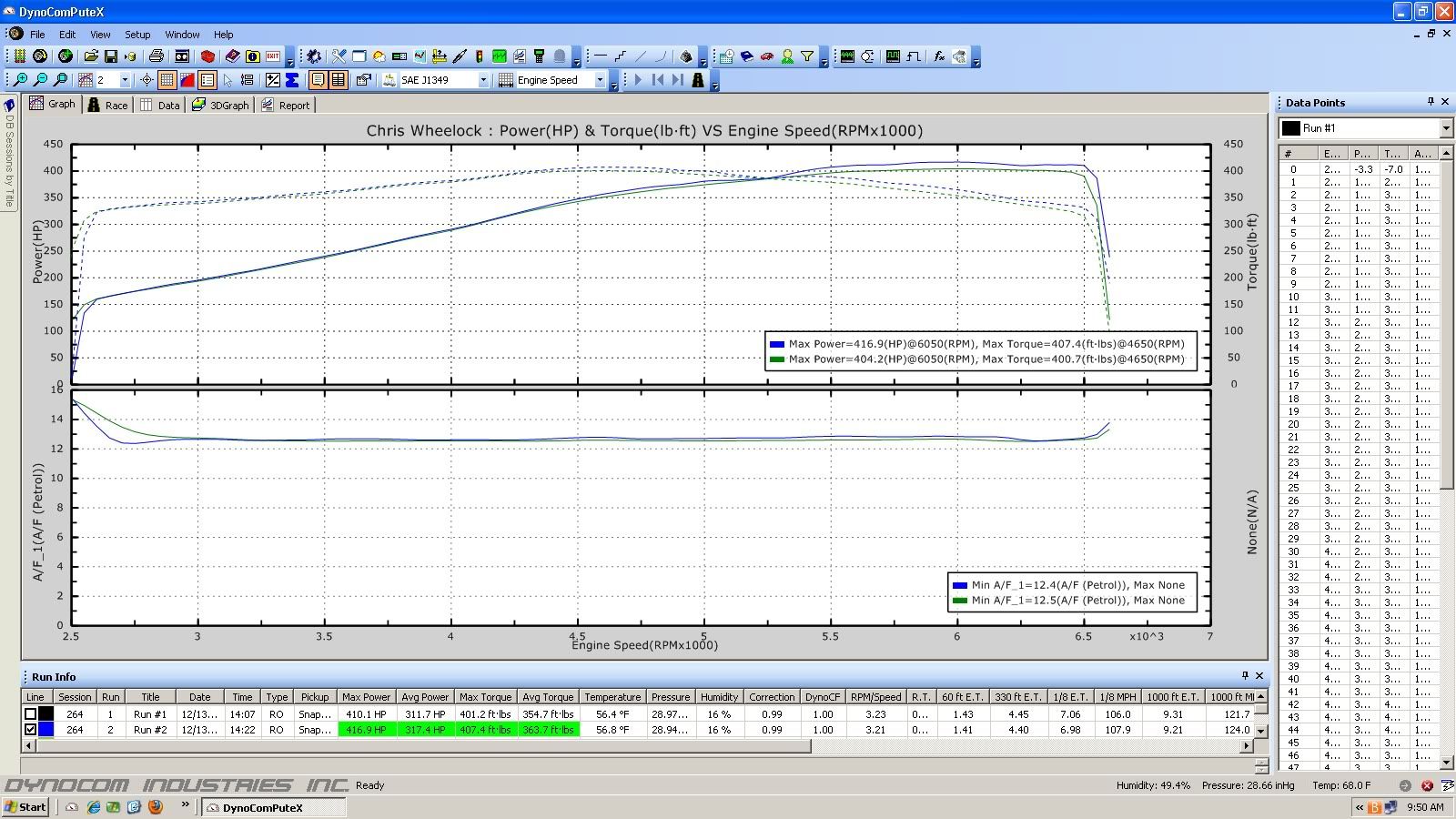
Using the dyno graph from Joe's car:
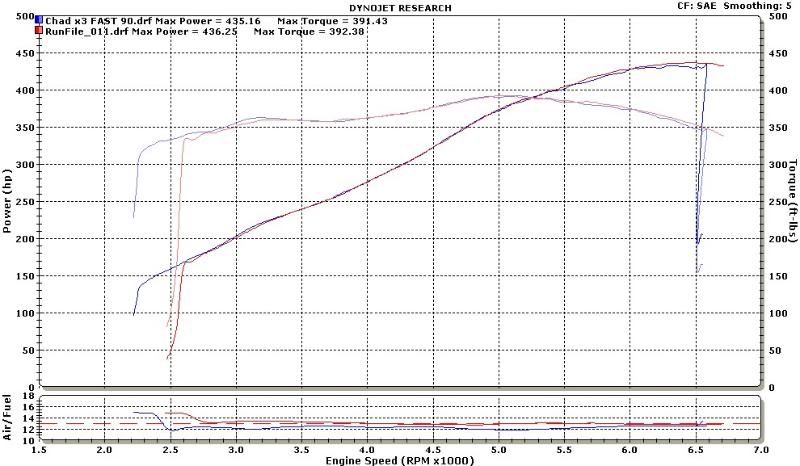
You can see how the MH3 prevents the engine from falling as far off the HP peak as the MZ6...that one mod will guarantee a win every time against the MZ6 no matter what the start/stop speeds are in a roll race (as long as the start is above ~50 MPH). An MH3 car would beat an MZ6 car even if the MZ6 car had 50 HP more. Now let's say Joe changes the bottom end and valvetrain to allow a 7500 RPM redline where the HP there is equal to the HP at 5500 RPM (assuming a symmetrical curve, ~400 HP). The MZ6 will only fall back to ~5230 RPM after each shift giving a HP range of 390-435 HP during a run instead of 340-435 HP with the 6800 RPM. The MH3 will have a 390-435 HP range in 2nd, 400-435 HP in 3rd, and 420-435 HP in 4th, 5th, and 6th. (The shift to 4th, 5th, and 6th would occur before 7500 RPM because the RPM drop is only 17-19%.)
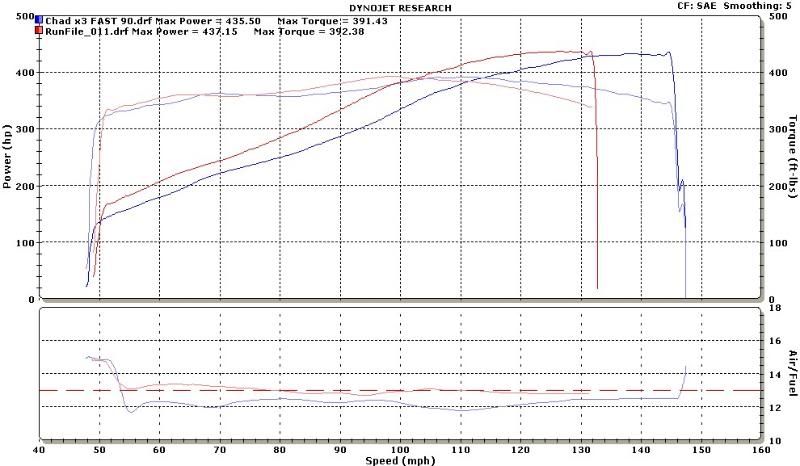
Ok, let's do a few more calculations and use Joe's other dyno graph showing HP vs MPH:
Your 55-65 run results in KE=½*3000*(65²-55²)=1,800,000 units of energy added to the car.
Your 85-95 run results in KE=½*3000*(95²-85²)=2,700,000 units of energy added to the car.
So it takes (2,700,000-1,800,000)/1,800,000=.5 or 50% more KE added to accelerate the car from 85-95 MPH than 55-65 MPH.
Looking at the graph, the car is putting down an average of ~200 HP from 55-65 MPH and ~370 HP from 85-95 MPH.
You have (370-200)/200=.85 or 85% more HP available during the 85-95 MPH run than the 55-65 MPH run while you only need 50% more KE. It makes sense the car accelerates quicker from 85-95 MPH...your butt dyno is correct.
You won't get an extra time to pass through peak HP when roll racing unless you pick the speed range correctly but you were talking random ranges. Stop thinking in terms of rear gear ratios and look at the overall ratios...the overall gear ratio with the MZ6/4.10 1st-5th is 12.18, 8.49, 5.86, 4.10, and 2.91 while the MN6/3.42 1st-5th is 10.16, 7.08, 4.89, 3.42, 2.43. After 1st gear is taken away from the MZ6 car, it just depends on the starting speed and the corresponding overall ratio as to who is going to get the jump and the ending speed will determine if that car is going to get the win or a tie will occur.
I'll try again but I'm not sure if I can approach the subject in a different way.
Both of these point to keeping the highest average HP. If I'm typically not going above 130 MPH, even from a moderate roll I'll still have a chance to pass through peak HP 3 times with my gears (redline the car in 2nd, 3rd, 4th). The 3.42 car can at most do that 2 times (redline the car in 2nd and 3rd). I'm talking random starts, here not anything optimized like you described from your street racing days.
I'm going to start in 1st gear if you're in 2nd and I'll be in the sweet part of the HP curve while you'll be at the bottom...I'll redline the engine 3 times and quit while I'm ahead. If you're talking random starts/stops, then you're talking random wins by either car. Give me either car and I'll set a specific scenario where I win every time...the rear gear ratio does not have any impact on who wins, it only creates a situation with two identical cars where one can beat the other depending on the scenario of the roll race. One thing that makes it possible is the nearly constant RPM drop for each gear change in the MZ6 transmission:
1st-2nd is (2.97-2.07)/2.97=.30303 or ~30.3%
2nd-3rd is (2.07-1.43)/2.07=.30918 or ~30.9%
3rd-4th is (1.43-1)/1.43=.3007 or ~30.1%
4th-5th is (1-.71)/1=.29 or ~29%
No matter what gear each car starts in, the RPM drop after a shift is almost identical even though they start out in different gears.
I can also create a scenario where the roll race ends in a dead tie.
The single best mod for roll racing (as well as road racing) is a close ratio transmission like the ZR1 MH3 transmission:
1st-2nd is (2.29-1.61)/2.29=.29694 or ~29.7%
2nd-3rd is (1.61-1.21)/1.61=.24844 or ~24.8%
3rd-4th is (1.21-1)/1.21=.17355 or ~17.4%
4th-5th is (1-.81)/1=.19 or ~19%
5th-6th is (.81-.67)/.81=.17284 or ~17.3%
Using the dyno graph from Joe's car:
You can see how the MH3 prevents the engine from falling as far off the HP peak as the MZ6...that one mod will guarantee a win every time against the MZ6 no matter what the start/stop speeds are in a roll race (as long as the start is above ~50 MPH). An MH3 car would beat an MZ6 car even if the MZ6 car had 50 HP more. Now let's say Joe changes the bottom end and valvetrain to allow a 7500 RPM redline where the HP there is equal to the HP at 5500 RPM (assuming a symmetrical curve, ~400 HP). The MZ6 will only fall back to ~5230 RPM after each shift giving a HP range of 390-435 HP during a run instead of 340-435 HP with the 6800 RPM. The MH3 will have a 390-435 HP range in 2nd, 400-435 HP in 3rd, and 420-435 HP in 4th, 5th, and 6th. (The shift to 4th, 5th, and 6th would occur before 7500 RPM because the RPM drop is only 17-19%.)
I also understand your point about kinetic energy changes, but it sure feels like HP overcomes the extra energy at the speeds I drive. If the car is in 4th on the highway and I go to pass someone at 50 mph, the rate of acceleration between 55-65 isn't bad. But if I'm at 80 and hammer it in 4th gear, it feels like my 85-95 acceleration is faster. I haven't logged the data, so maybe SOTP error but it sure seems like the opportunity to pass an extra time through peak HP is worth it.
Your 55-65 run results in KE=½*3000*(65²-55²)=1,800,000 units of energy added to the car.
Your 85-95 run results in KE=½*3000*(95²-85²)=2,700,000 units of energy added to the car.
So it takes (2,700,000-1,800,000)/1,800,000=.5 or 50% more KE added to accelerate the car from 85-95 MPH than 55-65 MPH.
Looking at the graph, the car is putting down an average of ~200 HP from 55-65 MPH and ~370 HP from 85-95 MPH.
You have (370-200)/200=.85 or 85% more HP available during the 85-95 MPH run than the 55-65 MPH run while you only need 50% more KE. It makes sense the car accelerates quicker from 85-95 MPH...your butt dyno is correct.
You won't get an extra time to pass through peak HP when roll racing unless you pick the speed range correctly but you were talking random ranges. Stop thinking in terms of rear gear ratios and look at the overall ratios...the overall gear ratio with the MZ6/4.10 1st-5th is 12.18, 8.49, 5.86, 4.10, and 2.91 while the MN6/3.42 1st-5th is 10.16, 7.08, 4.89, 3.42, 2.43. After 1st gear is taken away from the MZ6 car, it just depends on the starting speed and the corresponding overall ratio as to who is going to get the jump and the ending speed will determine if that car is going to get the win or a tie will occur.
Tech Contributor

Joined: Jul 2002
Posts: 14,950
Likes: 264
From: St. Louis, MO
St. Jude Donor '08
Bump to the top.
I had reason to remember this thread today, and upon re-reading it, I realized that we have some new members now and this info is too good to leave buried in the archives.
It's as salient today as it was 5 years ago when it was written. I haven't seen Glass Slipper or Spin in a long time, I know Spin's doing great as a teacher (his calling) and I hope Glass is still keeping us safe by making sure our nuclear submarine fleet is in tip top shape.
I had reason to remember this thread today, and upon re-reading it, I realized that we have some new members now and this info is too good to leave buried in the archives.
It's as salient today as it was 5 years ago when it was written. I haven't seen Glass Slipper or Spin in a long time, I know Spin's doing great as a teacher (his calling) and I hope Glass is still keeping us safe by making sure our nuclear submarine fleet is in tip top shape.

Instructor

Joined: Jan 2015
Posts: 140
Likes: 9
Adding TQ does not replace the benefits of gearing which include a traction aid by slowing down the rate of rotation of the tires. Yes you break loose easier but it rehooks faster because the car catches up to the rate of rotation. Adding TQ with the same gearing just breaks you loose without slowing rate of rotation down and just like doing a 2nd gear burnout, it takes longer to rehook. A geared car can see a 1/2 sec reduction in 1/4 time from reduced 60 foots.
I have stroker, 17psi, and lots of traction with the MT ET street tire. 0-60 is 2.44 secs as confirmed by scans. JoeG sees 2.7secs 0-60's with his 3.90's and 450rwhp.
Gear it.
I have stroker, 17psi, and lots of traction with the MT ET street tire. 0-60 is 2.44 secs as confirmed by scans. JoeG sees 2.7secs 0-60's with his 3.90's and 450rwhp.
Gear it.

Le Mans Master
Joined: Oct 2012
Posts: 8,434
Likes: 411
From: Texas
Great thread.
Ultimately the fastest car is the car that has the highest average hp to the rear wheels during the race, assuming equal drivers.
What I didn't see anyone mention is that lower gears have a very real detrimental effect on hp to the rear wheels due to drivetrain losses. I saw the posts comparing 2 engines that supposedly had identical hp but what was missed is that the geared car had somewhere between 15-35 rwhp loss due to drivetrain losses. So in reality, the geared car was really more powerful.
The other issue is that lower gears assist a driver in keeping his engine at the higher end of the rev range where his hp is on average higher. But the thing is that a nicely tuned LS engine has a nice broad powerband negating some (but not all) of that advantage. For instance, you will find gearing to mean everything on a CR125 (peaky race engine) but to not be nearly as important on a CR150F (casual 4 stroke) that has a very wide powerband relative to it's rpm range.
I can not in any way rap my head around the concept that that somehow lower gears hook up better after breaking loose. Maybe an absolute limit on how fast the rpms can jump has been met allowing the tires to catch up? Maybe the traction software has a max amount of rpm gain over tire slip that can be reached and this allows it to hook up?
I can tell you that I sell Kenworth trucks and I specialize in some very large heavy haul equipment and one aspect of performance we look at is called break away torque. Basically we want the wheels to spin before the engine makes max tq and hooks up and break something, and we get this by running lower rear end gears. Because lower gears break loose easier, a lot easier.
Either way, great thread.
Ultimately the fastest car is the car that has the highest average hp to the rear wheels during the race, assuming equal drivers.
What I didn't see anyone mention is that lower gears have a very real detrimental effect on hp to the rear wheels due to drivetrain losses. I saw the posts comparing 2 engines that supposedly had identical hp but what was missed is that the geared car had somewhere between 15-35 rwhp loss due to drivetrain losses. So in reality, the geared car was really more powerful.
The other issue is that lower gears assist a driver in keeping his engine at the higher end of the rev range where his hp is on average higher. But the thing is that a nicely tuned LS engine has a nice broad powerband negating some (but not all) of that advantage. For instance, you will find gearing to mean everything on a CR125 (peaky race engine) but to not be nearly as important on a CR150F (casual 4 stroke) that has a very wide powerband relative to it's rpm range.
I can not in any way rap my head around the concept that that somehow lower gears hook up better after breaking loose. Maybe an absolute limit on how fast the rpms can jump has been met allowing the tires to catch up? Maybe the traction software has a max amount of rpm gain over tire slip that can be reached and this allows it to hook up?
I can tell you that I sell Kenworth trucks and I specialize in some very large heavy haul equipment and one aspect of performance we look at is called break away torque. Basically we want the wheels to spin before the engine makes max tq and hooks up and break something, and we get this by running lower rear end gears. Because lower gears break loose easier, a lot easier.
Either way, great thread.
Tech Contributor
Joined: Jul 2002
Posts: 14,950
Likes: 264
From: St. Louis, MO
St. Jude Donor '08
Actually, I do know of a back to back test of 4.10 gears to 3.42 gears and no other changes. The 4.10's reduced peak RWHP by 12, a 5% decrease and peak RWTQ by 7, or 2%. This is a car with approx. 400/400 prior to the swap.
As to how a car stops spinning easier when you have lower gears, I can't explain like Glass Slipper but let me try.
Say my 4.10 car's (mz6) top speed in first gear is 30 mph and a 3.42 MM6 car is 62 (which is accurate, Chevy did this to tout the 0-60 time in the Z06, it gets there with no shift).
Assume no brake torquing, and we both rev up and dump the clutch. While we will both be spinning our wheels, we will also both be accelerating forward. My wheels will not be spinning as fast for a given rpm (we're both capped at 6500 rpm for this exercise) and my car will actually accelerate quicker to 30 mph, top speed in gear, before the mm6 car will, as his wheels will be spinning faster. The car's acceleration catches up to the spinning wheels at a lower rpm.
Another example is if you want to just spin your tires and not move without doing a brake torque. You'd start that exercise in 2nd gear, as once you get the tires spinning up to say 90 mph, (redline in 2nd), there's pretty much no way the car can accelerate from that tire spinning that quickly, it'll just sit and spin.
These mph numbers are for example only, but does that explain how it works? I promise you it works - but that's the best way I can explain it.
Pre Z06 did the back to back 3.42 to 4.10 no other changes dyno test, here's the thread and results.
https://www.corvetteforum.com/forums...o-results.html
As to how a car stops spinning easier when you have lower gears, I can't explain like Glass Slipper but let me try.
Say my 4.10 car's (mz6) top speed in first gear is 30 mph and a 3.42 MM6 car is 62 (which is accurate, Chevy did this to tout the 0-60 time in the Z06, it gets there with no shift).
Assume no brake torquing, and we both rev up and dump the clutch. While we will both be spinning our wheels, we will also both be accelerating forward. My wheels will not be spinning as fast for a given rpm (we're both capped at 6500 rpm for this exercise) and my car will actually accelerate quicker to 30 mph, top speed in gear, before the mm6 car will, as his wheels will be spinning faster. The car's acceleration catches up to the spinning wheels at a lower rpm.
Another example is if you want to just spin your tires and not move without doing a brake torque. You'd start that exercise in 2nd gear, as once you get the tires spinning up to say 90 mph, (redline in 2nd), there's pretty much no way the car can accelerate from that tire spinning that quickly, it'll just sit and spin.
These mph numbers are for example only, but does that explain how it works? I promise you it works - but that's the best way I can explain it.
Pre Z06 did the back to back 3.42 to 4.10 no other changes dyno test, here's the thread and results.
https://www.corvetteforum.com/forums...o-results.html
The only change was the addition of Motul fluid (as we are now a vendor) in the diff and tranny, so that could have freed up a few ponies. With the new hybrid tranny (2.97/2.07/1.43/1.00/0.75/0.57) it should go tens next Friday night, weather permitting. Though it'll probably be making less than 400rwhp actually as any chance of negative DA is long gone here in Texas.
Tech Contributor
Joined: Jul 2002
Posts: 14,950
Likes: 264
From: St. Louis, MO
St. Jude Donor '08
Great thread.
I can tell you that I sell Kenworth trucks and I specialize in some very large heavy haul equipment and one aspect of performance we look at is called break away torque. Basically we want the wheels to spin before the engine makes max tq and hooks up and break something, and we get this by running lower rear end gears. Because lower gears break loose easier, a lot easier.
Either way, great thread.
I can tell you that I sell Kenworth trucks and I specialize in some very large heavy haul equipment and one aspect of performance we look at is called break away torque. Basically we want the wheels to spin before the engine makes max tq and hooks up and break something, and we get this by running lower rear end gears. Because lower gears break loose easier, a lot easier.
Either way, great thread.
Tech Contributor
Joined: Jul 2002
Posts: 14,950
Likes: 264
From: St. Louis, MO
St. Jude Donor '08
Since we're enjoying some science in this thread, I thought this was very interesting and thought others would as well. A diff used to be a mystery to me years ago but this explains it pretty well. The should have used the last 2 minutes to explain how posi-traction works instead of showing how moving the pinion lower has advantages, but nonetheless, it really explains differentials very well. My 12 year old understood it! I didn't at 12.
And it has some EXCELLENT trick riding from some early Harley flat head riders.
And it has some EXCELLENT trick riding from some early Harley flat head riders.
