When you click on links to various merchants on this site and make a purchase, this can result in this site earning a commission. Affiliate programs and affiliations include, but are not limited to, the eBay Partner Network.
Tuner said to me today, you have no catch can, good observation on his part. I have read and searched over the years and some like them, some say they are not necessary, can t see any recent posts on them. He tells me the LS3 really needs it, i m not so sure, said he couldn t add any timing in because the knock sensor would take it out due to the oil pooling in intake manifold. Now, i don t know if this is fact or fiction. Looking for some thoughts on weather it is needed, or just another gimmick.
Excessive oil in the cylinders on top of the piston and above causes the Octane rating in the fuel in the cylinders to lower.
Does the LS-3 pass a great deal of oil through the intake through the PVC ports, not really, unless you are playing rev ranger high in the RPM range instead. Both the dirty side out of the engine valley cover, and the clean side out of the valve covers both have baffles to catch most of the oil instead during normal driving.
As for catch can, if you are trying to catch all the oil before it hits the intake manifold, then both the clean side and the dirty side both need catch cans.
As for needing catch cans to push timing safely, kind of far fetched, since if you are pushing the timing that far to the edge for the high octane table, just getting fuel that is slightly less in octane value than it was tuned for is going to cause problems. Hence the first sign of detonation/engine knock the car is going to retard timing and/or kick into the low octane tables instead.
Bluntly, the only way that you can safely push the timing table is to run a Meth kit, or to run E-85. This will keep the octane rating much higher than needed, and you can push the timing to work withing the increased octane ratings.
Don't get me wrong, I believe in catch cans for motors that are going to be pushed. But it not just One catch can on the dirty side only, but one the clean side as well.
As for the difference between the clean side and the dirty side, it's all comes down to throttle position.
When the throttle is less that WOT, the vacuum to draw vapors out of the motor is from the valley cover to behind the throttle plate.
When at WOT, the vacuum pressure in the intake manifold drops to almost nothing, and there is a vacuum create in front of the throttle plate. So the vapor at WOT are drawn out of the valve covers, and to a port in front of the throttle vain instead.
And again, when playing rev ranger, your going to spend a great deal of time at WOT, where a catch can between the valley port and intake manifold port is not doing anything until you come off the throttle.
Single catch can set up, and notice that nothing is catching the oil coming out of the valve cover when you are at WOT.
Dual catch cans, being both the dirty side oil caught at less than wot, and then the clean side oil caught at WOT as well.
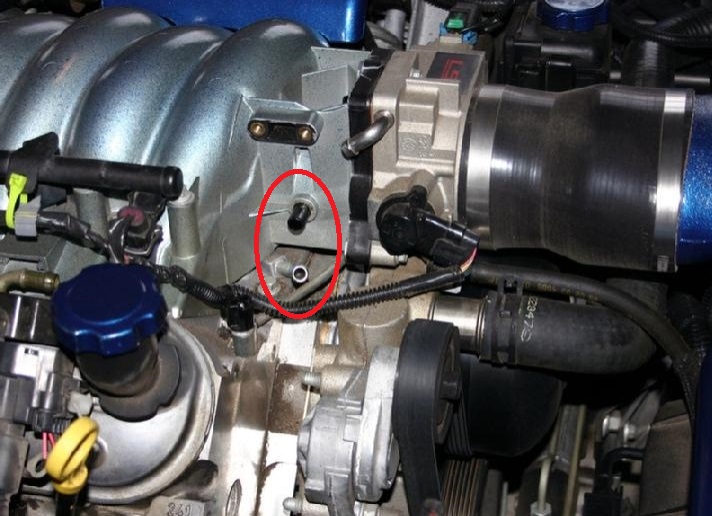
As for the 4 ports, the two circled are the dirty side ports, and the port out of the valve cover is next to the fill cap, to the port on the throttle body is the two clean side ports.
As for anyone trying to second guess the merits of a second catch can on the clean side, very easy to determine. Go buy a cheap see though gas filter and pipe it in line on the clean side line.
Dano523, excellent explanation and photos! Should be a sticky.
Any recommendations on catch can routing on boosted engines with a wet sump? I also noticed some catch cans with additional ports. Is this to eliminate from running dual catch cans?
The C.A.R.B. certified A&A S/C kit for CA re-routes the clean side. The valve cover port is capped. The oil cap gets tapped with an elbow fitting and routes a line to the air filter element. The dirty side receives a check valve, assuming to prevent boost pressure from entering the valley area. This routing passed CA smog emissions inspection.
Catch cans with multiple ports still have only one output to dirty side on NA and clean side on boosted.
The A&A kit is still a compromise but still effective.
Dano523, excellent explanation and photos! Should be a sticky.
Any recommendations on catch can routing on boosted engines with a wet sump? I also noticed some catch cans with additional ports. Is this to eliminate from running dual catch cans?
The C.A.R.B. certified A&A S/C kit for CA re-routes the clean side. The valve cover port is capped. The oil cap gets tapped with an elbow fitting and routes a line to the air filter element. The dirty side receives a check valve, assuming to prevent boost pressure from entering the valley area. This routing passed CA smog emissions inspection.
Standard one way valve to prevent pressure back into the engine off the intake during pressure for a supercharged system on a wet sump motor,
So with a dry sump motor, one catch can on the dirty side, install a one way valve between the catch can and the valley port that is not show in the below photo for the dirty side to prevent pressure back to the motor when when the intake is under pressure. On the clean side, change the oil filler cap on the oil tank to Elite Clean-Air Oil Separator (becomes the catch can on the clean side), then cap the vent out port back to the TP port on the tank and connect that tank vent out line to the clean air separator cap instead.
Note, make sure to get clamps on the hose line between the valley port and the one way check valve so the hose is not blow off these two connections when the manifold/hat goes positive pressure. The rest of the lines are working with a light vacuum instead, so only light hose clamping is needed so you don't end up with an air leak in the lines instead.
This thread went off on a tangent.
Assuming the OP's car is normally aspirated and wet sump i do recommend a catch can.
It eliminates oil being sucked out the engine, pooling in the intake manifold that then gets sucked into the cylinders. This lowers the fuel's octane rating.
Standard one way valve to prevent pressure back into the engine off the intake during pressure for a supercharged system on a wet sump motor,
So with a dry sump motor, one catch can on the dirty side, install a one way valve between the catch can and the valley port that is not show in the below photo for the dirty side to prevent pressure back to the motor when when the intake is under pressure. On the clean side, change the oil filler cap on the oil tank to Elite Clean-Air Oil Separator (becomes the catch can on the clean side), then cap the vent out port back to the TP port on the tank and connect that tank vent out line to the clean air separator cap instead.
Note, make sure to get clamps on the hose line between the valley port and the one way check valve so the hose is not blow off these two connections when the manifold/hat goes positive pressure. The rest of the lines are working with a light vacuum instead, so only light hose clamping is needed so you don't end up with an air leak in the lines instead.
This thread went off on a tangent.
Assuming the OP's car is normally aspirated and wet sump i do recommend a catch can.
It eliminates oil being sucked out the engine, pooling in the intake manifold that then gets sucked into the cylinders. This lowers the fuel's octane rating.
thought it was a simple question, not making 1000 hp
thought it was a simple question, not making 1000 hp
again, where the oil is really sucked out of the engine and past the valley and valve covers baffles is high RPMs, hence at WOT, and the oil being sucked out of the motor on the clean side during WOT, then back to dirty side once you come off the throttle so the intake manifold can generate vacuum again.
So again, if you are trying to catch all the oil out of the motor before it makes it way into the intake manifold, you need to catch the oil from both the dirty side, and the clean side. Hence a single catch can installed on the dirty side only, is like wearing a condom with a hole in it.
Thanks for the very detailed catch can info Dano. I have heads/cam/fast102/stall converter on my 06 base a6 c6 and when heads were swapped, there was an *** ton of carbon buildup on the top end. I bought the car stock w 69000 miles and promptly put a catch can on. Now I think I will be buying a a cc for the other side. Had my TB off the other day and the back was carbon'd up quite a bit.
A catch can is a worthy investment on ANY performance car if it's ever driven hard(wot to redline) regardless of power level. I had one on my ls1 z28 and my srt8 as well. The amount of oil all three cans caught on a regular basis was surprising, and I drive my cars pretty chilly the majority of the time.
Dano,
Great info. One question, would it be better to have two catch cans ( clean and dirty) or one catch can (dirty) and clean air oil separator??? Would this setup accomplish the same?
I mean for an extra 50 dollars one could buy a second catch can, so if the dual catch can is better then it's worth the extra few bucks. If the two setup are the same, then you will same me 50 bucks.
Dano,
Great info. One question, would it be better to have two catch cans ( clean and dirty) or one catch can (dirty) and clean air oil separator??? Would this setup accomplish the same?
I mean for an extra 50 dollars one could buy a second catch can, so if the dual catch can is better then it's worth the extra few bucks. If the two setup are the same, then you will same me 50 bucks.
where do you get a catch can for $50. ? cheapest one i have seen is $140.








 Catch Can on LS3