









Can Anyone help???

Thread Starter
Instructor


Joined: Jun 2021
Posts: 100
Likes: 24
From: Lakeland, FL
 Can Anyone help???
Hello,
I just bought my first corvette yesterday. I bought a 2017 C7 Grand Sport with 9k miles on it. A friend drove me to the dealership located two hours away so I could pick up the new car and drive it home. My friend has a 2013 C6. I found the car online and negotiated with the salesman by phone, got pre approved at my bank for my own financing and all that. Everything was good on my end, so I went to the dealership to check out the car. Also the Carfax was clean. One previous owner. I got to the dealership and everything looked good, so I took it for a test drive. Again, everything looked and felt good, so I did the paperwork and bought it.
Half way home while driving at a steady speed, suddenly It felt like the transmission was slipping for a fraction of a second. It would give this little surge of power, or lack thereof as the RPM gauge would flicker upwards. It would do it every 5 seconds or so. I started thinking if the transmission is slipping for a fraction of a second that would cause the transmission to disengage from the drivetrain and cause the rpm's to move upward like it was doing. So I started thinking that's what was happening. That the transmission was slipping for a fraction of a second. The transmission is an 8 speed automatic. I'm assuming what people here are referring to as an A8.
I also thought it could be a fuel problem. Who knows how long the car was sitting for before I bought it. Maybe there was some moisture in the tank or when the dealership gave me a full tank they topped it off with regular unleaded instead of premium, or maybe some kind of sensor was the cause. Let me also say that I've ruled out the road conditions because it's still doing it today. It's been constant since I was half way home from the dealership yesterday.
The good news is that it's still under warranty. But right now I'm not sure if I should run a couple tanks of good fuel through it, add some additive to remove moisture, and see what happens, or just take it to the dealership??
What does everyone think I should do?? Your feedback will be appreciated.. Thank you.
I just bought my first corvette yesterday. I bought a 2017 C7 Grand Sport with 9k miles on it. A friend drove me to the dealership located two hours away so I could pick up the new car and drive it home. My friend has a 2013 C6. I found the car online and negotiated with the salesman by phone, got pre approved at my bank for my own financing and all that. Everything was good on my end, so I went to the dealership to check out the car. Also the Carfax was clean. One previous owner. I got to the dealership and everything looked good, so I took it for a test drive. Again, everything looked and felt good, so I did the paperwork and bought it.
Half way home while driving at a steady speed, suddenly It felt like the transmission was slipping for a fraction of a second. It would give this little surge of power, or lack thereof as the RPM gauge would flicker upwards. It would do it every 5 seconds or so. I started thinking if the transmission is slipping for a fraction of a second that would cause the transmission to disengage from the drivetrain and cause the rpm's to move upward like it was doing. So I started thinking that's what was happening. That the transmission was slipping for a fraction of a second. The transmission is an 8 speed automatic. I'm assuming what people here are referring to as an A8.
I also thought it could be a fuel problem. Who knows how long the car was sitting for before I bought it. Maybe there was some moisture in the tank or when the dealership gave me a full tank they topped it off with regular unleaded instead of premium, or maybe some kind of sensor was the cause. Let me also say that I've ruled out the road conditions because it's still doing it today. It's been constant since I was half way home from the dealership yesterday.
The good news is that it's still under warranty. But right now I'm not sure if I should run a couple tanks of good fuel through it, add some additive to remove moisture, and see what happens, or just take it to the dealership??
What does everyone think I should do?? Your feedback will be appreciated.. Thank you.
Last edited by Rags6659; Jun 1, 2021 at 03:39 PM.

Drifting


Joined: Apr 2013
Posts: 1,743
Likes: 453
From: Saint Clair Shores Mi
I'm assuming it's an A8? If so drive the car in manual mode using the paddles at steady highway speed and see if it goes away. If so take it to your dealer and tell them it's shuttering at highway speed. They should do a transmission fluid flush under warranty and that will most likely take care of the issue. Many, many threads on the A8 shutter at steady highway speed. So far the new fluid and flush have taken care of all but a few.
Enjoy your car, they are awesome.
tom
Enjoy your car, they are awesome.
tom
Thread Starter
Instructor
Joined: Jun 2021
Posts: 100
Likes: 24
From: Lakeland, FL
Yes it's an A8. I added that to my original thread after realizing I forgot that vital piece of information. Thank you Tom. I will try your recommendation of driving it in manual mode and see what happens.
Now may I ask you an idiotic question. If you're driving at highway speeds in regular drive, can you shift down to manual or would that be a bad idea at like 70 mph? When I was experiencing the problem yesterday I was afraid to try it.. lol.. Being a new corvette owner and never using the manual paddle controls before, I didn't know what to expect..
Now may I ask you an idiotic question. If you're driving at highway speeds in regular drive, can you shift down to manual or would that be a bad idea at like 70 mph? When I was experiencing the problem yesterday I was afraid to try it.. lol.. Being a new corvette owner and never using the manual paddle controls before, I didn't know what to expect..
Drifting
Joined: Apr 2013
Posts: 1,743
Likes: 453
From: Saint Clair Shores Mi
Yes you absolutely can. Put the shifter **** in M and use the paddles. If you try to shift to far down you will get a pop-up *Shift Denied* to protect the trans/engine from over revving. The drivetrain is pretty bullet proof with the A8.
By the way welcome to the forum there are many experts on here that usually will have an answer to your questions
tom
By the way welcome to the forum there are many experts on here that usually will have an answer to your questions
tom

Moderator emeritus


Joined: Jun 2001
Posts: 18,599
Likes: 3,954
From: Jacksonville Florida BWO Dayton, Cincinnati, Bloomsbury NJ, Cincinnati
2015 C7 of the Year Finalist
Yes it's an A8. I added that to my original thread after realizing I forgot that vital piece of information. Thank you Tom. I will try your recommendation of driving it in manual mode and see what happens.
Now may I ask you an idiotic question. If you're driving at highway speeds in regular drive, can you shift down to manual or would that be a bad idea at like 70 mph? When I was experiencing the problem yesterday I was afraid to try it.. lol.. Being a new corvette owner and never using the manual paddle controls before, I didn't know what to expect..
Now may I ask you an idiotic question. If you're driving at highway speeds in regular drive, can you shift down to manual or would that be a bad idea at like 70 mph? When I was experiencing the problem yesterday I was afraid to try it.. lol.. Being a new corvette owner and never using the manual paddle controls before, I didn't know what to expect..
When you are in "D" and driving on the highway, whatever gear the transmission is running will be the same gear if you slip it to "M". No RPM change, no downshift, no anything. If the flush is needed for the transmission, the shift to "M" will stop the shuddering problem as it takes out the ability to shift into V4. Get the triple flush and you should get rid of the problem.
Elmer
Last edited by eboggs_jkvl; Jun 1, 2021 at 04:16 PM.

Drifting
Joined: Jul 2013
Posts: 1,603
Likes: 798
From: Windsor CA
2024 C7 of the Year Finalist - Unmodified
Congrats on your GS from a 2019 GS owner, post pictures when you can and let us know the outcome, when you are in "D" you can also still use the paddle's, maybe you want to bump down a gear, ect. and same with being in "M" mode if it doesn't want to do what you want to do it won't, after 5 seconds or so with no more activity of the paddle it will resume back to "D" mode. Keep an eye on the gear position on your dash and you will see it revert back.
Thread Starter
Instructor
Joined: Jun 2021
Posts: 100
Likes: 24
From: Lakeland, FL
Yes you absolutely can. Put the shifter **** in M and use the paddles. If you try to shift to far down you will get a pop-up *Shift Denied* to protect the trans/engine from over revving. The drivetrain is pretty bullet proof with the A8.
By the way welcome to the forum there are many experts on here that usually will have an answer to your questions
tom
By the way welcome to the forum there are many experts on here that usually will have an answer to your questions
tom
Would you also happen to know if it's normal for a Grand Sport to idle rough? When I'm at a red light with my foot on the brake it seems to run rough. I don't know if that's normal for a grand sport or any corvette for that matter. I changed the exhaust levels between the different modes and it still seemed to run rough in each exhaust mode. I actually love an aggressive sounding engine, I just want to make sure it's normal to seem to idle rough all the time like it does. .lol
Thanks for your welcome to the forum. I'm happy to be here and I have lots to learn.. You're making it a great experience. Thanks for your help.
Corvette Stories
The Best of Corvette for Corvette Enthusiasts

Top 10 Most Expensive Corvettes Ever Sold on Bring A Trailer
Brett Foote
10 Things Every Corvette Owner Needs (2026 Edition)
Michael S. Palmer
8 Most "Only Corvette Owners Understand" Quirks and Problems
Pouria Savadkouei
10 Reasons the C6 Z06 is Still A Performance Benchmark After 20 Years
Joe Kucinski
How Much Horsepower Every Corvette Engine "LOST" in 1972
Joe Kucinski
Top 10 DOs and DON'Ts for Protecting Your Convertible Top!
Michael S. Palmer
Top 10 Most Explosive Corvettes Ever Made: Power-to-Weight Ratio Ranked!
Joe Kucinski
150 hp to 1,250 hp: Every Corvette Generation Compared by the Specs That Matter
Joe Kucinski
8 Coolest Corvette Pace Cars (and Replicas) of All Time
Verdad Gallardo


Thread Starter
Instructor
Joined: Jun 2021
Posts: 100
Likes: 24
From: Lakeland, FL
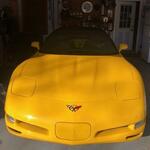
Thanks for your welcome. My car looks exactly like yours, same color and everything.. Would you happen to have a picture I can borrow to do that. lol. Joking of course. I already have many pictures of every angle, except of the undercarriage. That will come soon. lol
Thread Starter
Instructor
Joined: Jun 2021
Posts: 100
Likes: 24
From: Lakeland, FL
When you are in "D" and driving on the highway, whatever gear the transmission is running will be the same gear if you slip it to "M". No RPM change, no downshift, no anything. If the flush is needed for the transmission, the shift to "M" will stop the shuddering problem as it takes out the ability to shift into V4. Get the triple flush and you should get rid of the problem.
Elmer
Elmer
Can you also explain the V4 part? I don't really understand the V4 part of what's going on in there. lol. Is the transmission going into V4 to save fuel or something else?


Thread Starter
Instructor
Joined: Jun 2021
Posts: 100
Likes: 24
From: Lakeland, FL
Congrats on your GS from a 2019 GS owner, post pictures when you can and let us know the outcome, when you are in "D" you can also still use the paddle's, maybe you want to bump down a gear, ect. and same with being in "M" mode if it doesn't want to do what you want to do it won't, after 5 seconds or so with no more activity of the paddle it will resume back to "D" mode. Keep an eye on the gear position on your dash and you will see it revert back.
Did you read my reply to another member about my concern over the GS running rough?

Melting Slicks


Joined: Jan 2019
Posts: 2,769
Likes: 1,116
From: Howell N.J
Rag Man < sorry.
Welcome to the best Forum going. Congrats on you purchase. Once you get the flush get a" Range" unit to plug in under the dash on the drivers side to keep her from going into V4 mode. Lots of info on this will be added after this !!
Great luck,
Rich, Stella for me !! <
sorry.Welcome to the best Forum going. Congrats on you purchase. Once you get the flush get a" Range" unit to plug in under the dash on the drivers side to keep her from going into V4 mode. Lots of info on this will be added after this !!
Great luck,
Rich, Stella for me !! <
Last edited by Vette Ski; Jun 1, 2021 at 05:11 PM.
Thread Starter
Instructor
Joined: Jun 2021
Posts: 100
Likes: 24
From: Lakeland, FL
Thread Starter
Instructor
Joined: Jun 2021
Posts: 100
Likes: 24
From: Lakeland, FL
Moderator emeritus
Joined: Jun 2001
Posts: 18,599
Likes: 3,954
From: Jacksonville Florida BWO Dayton, Cincinnati, Bloomsbury NJ, Cincinnati
2015 C7 of the Year Finalist
Thanks Elmer. That was explained very well as I was also wondering how the gearing would integrate when shifting to "M" at highway speeds. That is good to hear that it's seamless like that.
Can you also explain the V4 part? I don't really understand the V4 part of what's going on in there. lol. Is the transmission going into V4 to save fuel or something else?
Can you also explain the V4 part? I don't really understand the V4 part of what's going on in there. lol. Is the transmission going into V4 to save fuel or something else?
To allow V4 mode:
Engine speed is between 700 and 2800rpm
Engine oil pressure is between 187–455kPa (27–66psi)
Engine coolant temperature is between 40–129°C (100–264°F)
Engine oil temperature is between 16–128°C (61–263°F)
Throttle angle is 6% or less
Transmission is not in first, second, or reverse gear
Vehicle speed is greater than 25kph (15.5mph)
Vehicle is not in fuel shut off mode
Vehicle is not in heater performance mode
Vehicle is not in tip in bump acceleration mode
Vehicle is not in oil aeration mode
To help prevent spark plug fouling, the ignition system secondary voltage or spark is still present across the spark plug electrodes on the deactivated cylinders. If all enabling conditions are met and maintained for cylinder deactivation operation, the ECM calibrations will limit cylinder deactivation to a cycle time of 10 minutes in V4 mode, then return to V8 mode for 1 minute.
Part B:
Active Fuel Management (AFM), which shuts down the LT1’s firing cylinders from V eight to V four by disabling the valves to the cylinders. When AFM initiates, the engine turns the 6.2L V8 into a 3.1L V4, shutting down cylinders 1, 4, 6 and 7, and firing only cylinders 8, 2, 5 and 3 in that order.
Otherwise, the complete firing order is 1, 8, 7, 2, 6, 5, 4, 3.
2, 4, 6, 8, Passenger side from front to rear.
1, 3, 5, 7, Driver's side from front to rear
There's the V4 explanation.
Elmer
Last edited by eboggs_jkvl; Jun 1, 2021 at 05:18 PM.
Thread Starter
Instructor
Joined: Jun 2021
Posts: 100
Likes: 24
From: Lakeland, FL
Rag Man < sorry.
Welcome to the best Forum going. Congrats on you purchase. Once you get the flush get a" Range" unit to plug in under the dash on the drivers side to keep her from going into V4 mode. Lots of info on this will be added after this !!
Great luck,
Rich, Stella for me !! <
sorry.Welcome to the best Forum going. Congrats on you purchase. Once you get the flush get a" Range" unit to plug in under the dash on the drivers side to keep her from going into V4 mode. Lots of info on this will be added after this !!
Great luck,
Rich, Stella for me !! <
Thread Starter
Instructor
Joined: Jun 2021
Posts: 100
Likes: 24
From: Lakeland, FL
Part A:
To allow V4 mode:
Engine speed is between 700 and 2800rpm
Engine oil pressure is between 187–455kPa (27–66psi)
Engine coolant temperature is between 40–129°C (100–264°F)
Engine oil temperature is between 16–128°C (61–263°F)
Throttle angle is 6% or less
Transmission is not in first, second, or reverse gear
Vehicle speed is greater than 25kph (15.5mph)
Vehicle is not in fuel shut off mode
Vehicle is not in heater performance mode
Vehicle is not in tip in bump acceleration mode
Vehicle is not in oil aeration mode
To help prevent spark plug fouling, the ignition system secondary voltage or spark is still present across the spark plug electrodes on the deactivated cylinders. If all enabling conditions are met and maintained for cylinder deactivation operation, the ECM calibrations will limit cylinder deactivation to a cycle time of 10 minutes in V4 mode, then return to V8 mode for 1 minute.
Part B:
Active Fuel Management (AFM), which shuts down the LT1’s firing cylinders from V eight to V four by disabling the valves to the cylinders. When AFM initiates, the engine turns the 6.2L V8 into a 3.1L V4, shutting down cylinders 1, 4, 6 and 7, and firing only cylinders 8, 2, 5 and 3 in that order.
Otherwise, the complete firing order is 1, 8, 7, 2, 6, 5, 4, 3.
2, 4, 6, 8, Passenger side from front to rear.
1, 3, 5, 7, Driver's side from front to rear
There's the V4 explanation.
Elmer
To allow V4 mode:
Engine speed is between 700 and 2800rpm
Engine oil pressure is between 187–455kPa (27–66psi)
Engine coolant temperature is between 40–129°C (100–264°F)
Engine oil temperature is between 16–128°C (61–263°F)
Throttle angle is 6% or less
Transmission is not in first, second, or reverse gear
Vehicle speed is greater than 25kph (15.5mph)
Vehicle is not in fuel shut off mode
Vehicle is not in heater performance mode
Vehicle is not in tip in bump acceleration mode
Vehicle is not in oil aeration mode
To help prevent spark plug fouling, the ignition system secondary voltage or spark is still present across the spark plug electrodes on the deactivated cylinders. If all enabling conditions are met and maintained for cylinder deactivation operation, the ECM calibrations will limit cylinder deactivation to a cycle time of 10 minutes in V4 mode, then return to V8 mode for 1 minute.
Part B:
Active Fuel Management (AFM), which shuts down the LT1’s firing cylinders from V eight to V four by disabling the valves to the cylinders. When AFM initiates, the engine turns the 6.2L V8 into a 3.1L V4, shutting down cylinders 1, 4, 6 and 7, and firing only cylinders 8, 2, 5 and 3 in that order.
Otherwise, the complete firing order is 1, 8, 7, 2, 6, 5, 4, 3.
2, 4, 6, 8, Passenger side from front to rear.
1, 3, 5, 7, Driver's side from front to rear
There's the V4 explanation.
Elmer
Drifting
Joined: Jul 2013
Posts: 1,603
Likes: 798
From: Windsor CA
2024 C7 of the Year Finalist - Unmodified
I have had a Range device in my GS since it was at about 200 miles, only time it was out was when it was in the dealer for my two free oil changes highly recommend as I didn't buy it to run on 4 cylinders. Something else you might want to consider is having the throttle body ported by Solar Performance as occasionally when you nail it it will sometimes have a flat spot, stumble, ect. With the re-worked throttle body it just runs better and no hesitation (flat spot), also made huge improvement to my wife's 2015 Z51 M7 car.