When you click on links to various merchants on this site and make a purchase, this can result in this site earning a commission. Affiliate programs and affiliations include, but are not limited to, the eBay Partner Network.
A dozen posters have opined about the roomy McClaren. Hmm? Other than an online article, I've never seen one. Nor in my metro area of 3/4s of a million people do I ever expect to. While a McLaren odometer might go to 100,000 miles, I'd wager none ever have. Most won't see the far side of 10,000. And then only by the 3rd or 4th owner. So give me a break! All of the well how about the Hellcat or the Mustang posts are dumb and dumber. You don't buy a C8 to be the fastest or the roomiest. You buy it because it is a super exotic looking car that you can afford. And maybe you can't. But you can park at Wal Mart without an armed guard posted nearby. Corvette has been and always will be the paragon of affordable American made automotive chic.
The center channel is huge... This video of a cutaway c8 discusses that right away.... About 15 seconds in.
Whether it's hollow to possibly hold batteries or not, I do not know.
Hmm read the article published in November 2019 on this Forum Thread: https://www.corvetteforum.com/forums...-drive-c8.html
t clearly states what it holds the hybrid battery and the battery chiller as does the leaked pic included I posted above!
Further proof that it's a structural member as well is the 5 mm aluminum plate covering the bottom section as Tadge noted in the 1 hour Autoline interview that is attached with the shinny bolt heads you can see on the bottom!
Fourth, the cover for the mode selector not necessary and is irritating. On the C7, it didn’t have a cover and was much easier to use. Now, you have to reach around the cover. I don’t see why they did that.
I had the same reaction when I saw that. Couldn't figure out its purpose. Does it prevent accidentally changing modes when reaching for the front lift or camera buttons?
I've seen your design attempts. I'm not the crazy one.
If that is about the batteries, there's no question they have (or had) plans for a hybrid version with electric front drive in addition to the ICE rear drive.
saw the C8 up close in person and looks great. i know every one has issues with the rear end which is understandable. However my problem is with the interior design ( not the quality which is great). previous generation vettes felt claustrophobic due to the torque tube running in the middle of the car. given the ME architecture of c8 there should not be any mechanical constraints preventing the center console to go all the way to the floor. Maclarens feel much roomier on the inside because of that. does anyone know what resides below the center console that requires it to be at this specific height?
They specifically kept the center tunnel large to be the backbone of the car. This allows a reduced door sill height and more traditional step-over height for entry/exit. Many ME cars (McLarens are especially pronounced) have very high sill height which makes it harder for the traditional Corvette demographic to use and enjoy the car. Team Corvette was very proud with the level of usability/functionality the engineered into a mid-engine sports car. Currently there are coolant pipes that transmit the coolant from the engine to the front radiators and AC lines that go from the compressor to the condensers. Rumor is that the space will be used for a battery pack for the eventual hybrid AWD model which will have dedicated electric front drive.
McLarens relatively "normal" 570S (not one of their hypercar models)
vs. C8 .
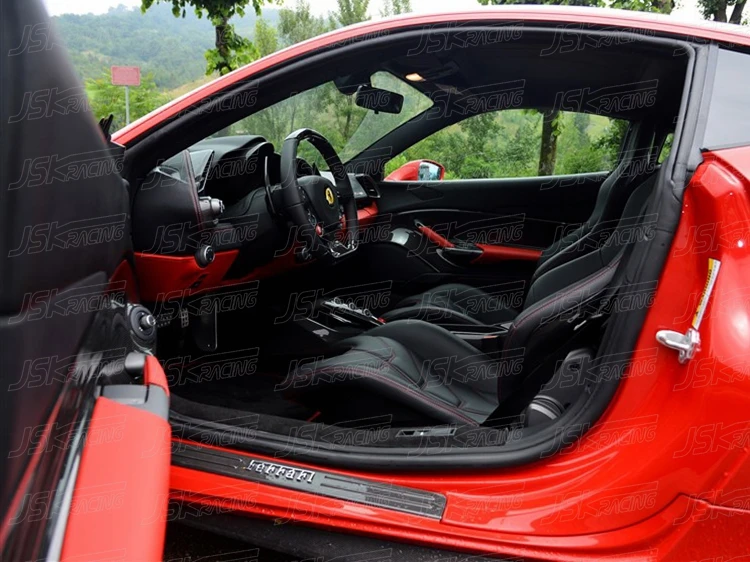
vs. Ferrari 488
Notice the C8 has no height to the sill. Yes, it's a little wider than the C5/6/7, but doesn't have the height of the McLaren or Ferrari road cars.
The reason I asked the OP if he was able to get in and drive one is the console flairs out from the tunnel. Look into the car from the outside the tunnel looks bigger than it is and the interior looks crowded compared to other sports cars but does not feel that way once you get seated.
Actually I thought I saw info from Tadge that said the center tunnel was there for structural rigidity. It was mentioned as part of the reason they didn't want to put a manual in. They didn't want to compromise the tunnel stiffness.
Additionally there is a large strong panel on the bottom of the tunnel that uses many bolts to keep the bottom edges locked into a solid position.
I don't think you are wrong about the hybrid part either tho, I think it was a smart design serving a dual purpose.
"Someone who uses a tool for its intended purpose is a good mechanic, Someone who can use a tool for two purposes is a great mechanic, Someone who can use a tool for 3 purposes is the person I want to hire."
half truth and half lie. They don't want to give away the real reason its there yet. No way it needs to be that huge for structural reasons as he says.
ive never driven one. however 911s a very low center console as well based on engine transmission location. and very easy to get in and out. seems like the logical explanation is the battery pack.
They specifically kept the center tunnel large to be the backbone of the car. This allows a reduced door sill height and more traditional step-over height for entry/exit. Many ME cars (McLarens are especially pronounced) have very high sill height which makes it harder for the traditional Corvette demographic to use and enjoy the car. Team Corvette was very proud with the level of usability/functionality the engineered into a mid-engine sports car. Currently there are coolant pipes that transmit the coolant from the engine to the front radiators and AC lines that go from the compressor to the condensers. Rumor is that the space will be used for a battery pack for the eventual hybrid AWD model which will have dedicated electric front drive.
McLarens relatively "normal" 570S (not one of their hypercar models)
vs. C8 .
vs. Ferrari 488
Notice the C8 has no height to the sill. Yes, it's a little wider than the C5/6/7, but doesn't have the height of the McLaren or Ferrari road cars.
.
I dont see much difference between the sill heights. but the Ferrari interior is much roomier due to the lack of the rather large center console.
I've seen your design attempts. I'm not the crazy one.
If that is about the batteries, there's no question they have (or had) plans for a hybrid version with electric front drive in addition to the ICE rear drive.
Oh, so how many chassis design attempts have made that meet DOT requirements for production (And EPA) certification which include crash tests? I've done a FE and a ME car and many non production chassis. I'm on my 3rd design but the China Syndrome has curtailed the activities. Like the C8, these structures are not as efficient as they could be as a result of compliance. The center tunnel, for your information, is a major structural component. The fact that it can house batteries is incidental.
2500 lbs with 620 HP LS7 and air.
1850 lbs and 410 HP LS1. No doors saves 500lbs.
620 HP LS7 with air and no space for golf clubs.
Once the sheet metal is welded in place, just it's shape can exceed the properties of the tubes it replaces at a weight saving.
This structure allows a long wheel base and no roof. Building a bridge is no different. I employed the same section modulas as Corvette has done but my engine is 12" behind the front axle
and the C8 had to design their own DCT to place the engine as close to the axle as possible to reduce the bending moment. It is far from satisfactory. Aluminum is poor in bending but good in torsion.
The C8 structure takes much into account. Depending on the engine placement between the wheels of a long wheel base chassis dictates the design. You need a lot of aluminum to attempt to do what Chevy has tried to do at minimum cost to meet all objectives. I can't even begin to tell you what is going on here, I have covered it elsewhere to some extent.
half truth and half lie. They don't want to give away the real reason its there yet. No way it needs to be that huge for structural reasons as he says.
As per the usual, you have no idea what you're talking about. Watch the videos here
.
I dont see much difference between the sill heights. but the Ferrari interior is much roomier due to the lack of the rather large center console.
Ferrari 488 sill is about 2X as high vs. the floorboard. They use the perimeter of the chassis for rigidity vs. the center tunnel backbone that the Corvette uses.
From: Philadelphia PA (Birthplace of the USA, UNESCO World Heritage City)
Originally Posted by Supermassive
The C8 center tunnel is what you get for easier entry and exit. Instead of putting the chassis structure in the sills, GM decided on the tunnel bearing the burden. This is what makes the C8 a far more livable car than most exotics. I've driven the 650S and the 570S and while the transition from the monocell in the 650S to the monocell 2 in the 570S was very noticeable, you still have to do the exotic car dance to get into and out of the thing.
This is the correct answer. That being said, no reason why GM couldn't put the HVAC controls flush on top of the center tunnel instead of adding a ski slope. And putting the touchscreen flush and flat against the dashboard instead of sticking out and angled.
This is the correct answer. That being said, no reason why GM couldn't put the HVAC controls flush on top of the center tunnel instead of adding a ski slope. And putting the touchscreen flush and flat against the dashboard instead of sticking out and angled.
There's a video where the head interior designer specifically addresses this. Adding the HVAC controls in the "traditional spot" moves everything up (I can't recall the exact height). That defeated the entire objective with the interior of having a super low dash for maximum sight lines with the new ME layout. They went outside the box and came up with the button slope.
The trick for torsional stiffness is that you’ve got to get the load through the tunnel and back to the shock towers and it is hard with the engine there,” Moss said. The car’s central spine, or tunnel, carries load from the front suspension back to the rear of the car, where the engine cradle castings transmit loads to the rear suspension mount castings. That makes the tunnel a crucial link. It is a three-sided aluminum square tube, with an open bottom. For the C8 Corvette, Chevrolet applies a carbon fiber panel to the bottom to close that tunnel off, boosting its strength by 10 percent.
There's a video somewhere to Tadge specifically addressing the step-over height objective and execution.
Another thing Juechter mentioned was the center tunnel, which acts as the car’s backbone. Chevy has been using such a design on the Corvette since 1997, Juechter said, and its main job is to keep the car nice and stiff to allow for better ride and handling (since a stiff structure means the precisely-tuned suspension, and not the body, can do all the flexing). The backbone, the chief engineer said, has been completely redesigned on the C8, and the setup allows the vehicle to have low rocker panels.Chevrolet expounds on this last bit in its press release, saying the low rockers allow for easy ingress and egress. “Unlike some competitors,” Chevy says, “there’s no need for oversized rocker panels to bear structural and load weights, making it easier to enter and exit the vehicle.”
Last edited by RapidC84B; May 15, 2020 at 03:34 PM.
“The whole point of [getting] that engine behind you is it allows you to have a much lower cowl…you no longer have to sit above the engine, and you can get these really great sightlines,” Murphy said. “And that’s what a mid-engine car does. The last thing we want to do was have this amazing downvision, then have this typical tall instrument panel. It was about, how do we change the game and how do we reconstruct a dashboard here to be as low and as thin as possible? That was the mission statement of the whole car.”
Quote: The trick for torsional stiffness is that you’ve got to get the load through the tunnel and back to the shock towers and it is hard with the engine there,” Moss said. The car’s central spine, or tunnel, carries load from the front suspension back to the rear of the car, where the engine cradle castings transmit loads to the rear suspension mount castings. That makes the tunnel a crucial link. It is a three-sided aluminum square tube, with an open bottom. For the C8 Corvette, Chevrolet applies a carbon fiber panel to the bottom to close that tunnel off, boosting its strength by 10 percent.
I don't know who wrote this but it's wrong. The load paths should be as close to the triangle as possible. All forces act thru the Cg.
A fixed roof should be on the HP cars.
The C8 chassis could have been much lighter and stiffer. That long chassis can't be made strong will aluminum.
The load paths are very inefficient here. The yellow is frontal impact. Note the Cg is raised because of the placement of the hard points for the very tall cast coil/over towers
C8R engine further forward than the C8
Stock C8 structure vs how it should be for efficient load transfers..
The bending load is most important carried by the side panels on this backbone. How does the the bolted on bottom panel boost strength? Strength of what? All we are interested in is torsion and bending. All sides of the box must be secured in order for it to function. The design calls for multiple load paths for each load but why wouldn't you carry the loads like the C8R has done or how I would have done it? Mine needs a roof and the race car has the roll cage. My biggest beef with the C8.
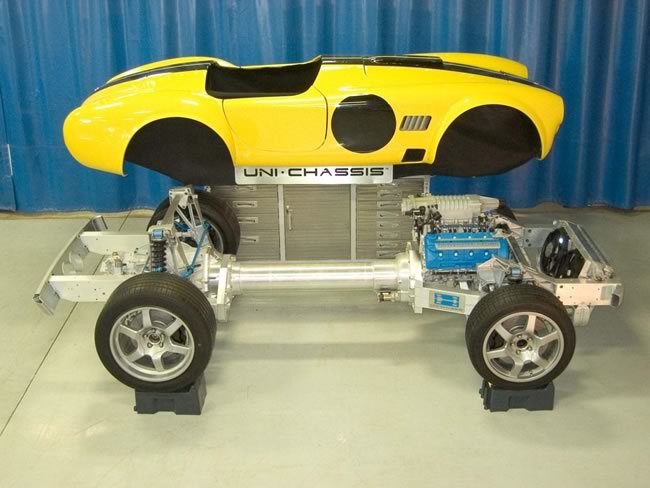
That's a Uni Chassis "The combination of a rigid backbone structure connecting front and rear structures; in combination with the front and rear suspensions affixed to the to the front and rear structures; to create a complete, self-supporting chassis, without the need for a separate frame…."
“The combination of a rigid backbone structure connecting front and rear structures; in combination with the front and rear suspensions affixed to the to the front and rear structures; to create a complete, self-supporting chassis, without the need for a separate frame…."
¤ Weight, cost and investment savings
¤ Battery Box on Plug-in Hybrid and BEVs doubles as the backbone
¤ Adapt different bodies to the same Uni-Chassis™
¤ Uni-Chassis™ is scaleable to different size vehicles by varying backbone length
¤ Uni-Chassis™ is modular, allowing different powertrains within the same architecture
¤ Creates a “rolling chassis” before installation of the body
¤ De-couple chassis loads from body loads
¤ Decouples chassis and body crashworthiness requirements
Project > Uni-Chassis > Design/Engineering Uni-Chassis Design and Engineering
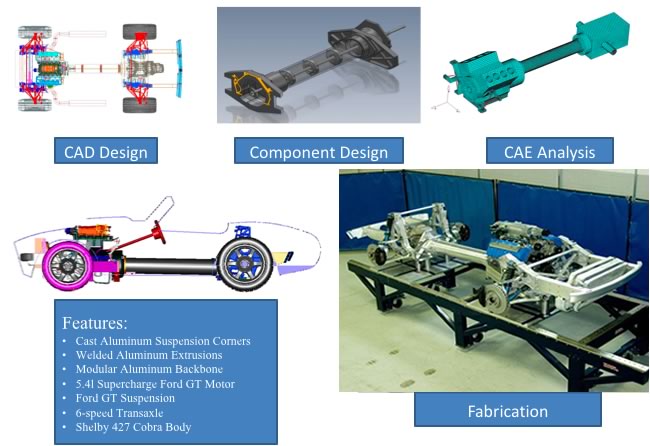
Uni-Chassis Proof – of - Concept
Chris Theodore whose patenting this approach came from a lot of places but it was shortly after leaving Ford that be realized that a 8" tube of extruded al would do the trick. I'm not remembering the wall thickness. Check his book, The Last Shelby Cobra.
The "Father of the Ford GT (2005-2007)," the "engineer´s engineer," a 40 year industry veteran.
That's a Uni Chassis "The combination of a rigid backbone structure connecting front and rear structures; in combination with the front and rear suspensions affixed to the to the front and rear structures; to create a complete, self-supporting chassis, without the need for a separate frame…."
“The combination of a rigid backbone structure connecting front and rear structures; in combination with the front and rear suspensions affixed to the to the front and rear structures; to create a complete, self-supporting chassis, without the need for a separate frame…."
¤ Weight, cost and investment savings
¤ Battery Box on Plug-in Hybrid and BEVs doubles as the backbone
¤ Adapt different bodies to the same Uni-Chassis™
¤ Uni-Chassis™ is scaleable to different size vehicles by varying backbone length
¤ Uni-Chassis™ is modular, allowing different powertrains within the same architecture
¤ Creates a “rolling chassis” before installation of the body
¤ De-couple chassis loads from body loads
¤ Decouples chassis and body crashworthiness requirements
Project > Uni-Chassis > Design/Engineering Uni-Chassis Design and Engineering
Uni-Chassis Proof – of - Concept
Chris Theodore whose patenting this approach came from a lot of places but it was shortly after leaving Ford that be realized that a 8" tube of extruded al would do the trick. I'm not remembering the wall thickness. Check his book, The Last Shelby Cobra.
The "Father of the Ford GT (2005-2007)," the "engineer´s engineer," a 40 year industry veteran.
Oh no you didn't!
Expect Shaka to rip this to shreds! It is obviously amateurish and wrong, and we'll be given MS paint images with triangles and circles with little actual explanation as to what the hell we are looking at...and then we'll see pictures of a real race car.
Sorry Shaka I couldn't help it...sometimes you are an amazing source of information and I truly like to read it, other times...well triangles and circles man...
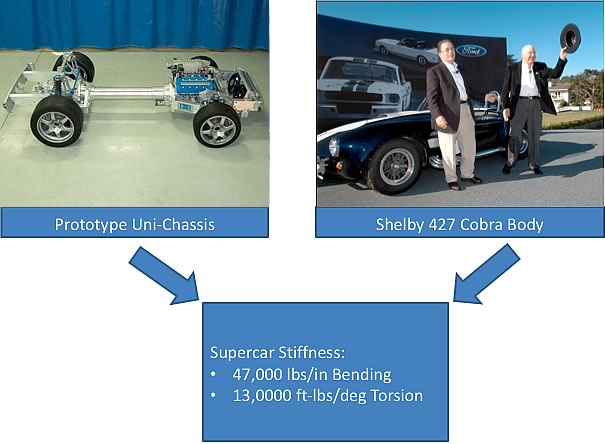
"FORMER FORD AND CHRYSLER CHIEF ENGINEER UNVEILS NEW WAY TO DESIGN VEHICLES AT SAE WORLD CONGRESS Plug-in Hybrids and Electric Vehicles are Early Uni-Chassis™ Targets April 12, 2011 Detroit, MI – The lead engineer behind the creation of the original Chrysler PT Cruiser, 2005 Ford GT, second generation Chrysler minivan and the DeLorean twin-turbo featured in the “Back to the Future” movies has introduced a new way of making cars that is particularly well suited to Plug-in Hybrid and Battery Electric Vehicles. Theodore and Associates President Chris P. Theodore today unveiled the UniChassis, a frameless body-on-chassis design that is lighter in weight, lower investment and lower cost compared to traditional body-on-frame and unibody designs. Uni-Chassis is a simple and efficient design made up of three basic elements: A front structure that utilizes a stressed engine to take suspension loads; a rear structure that utilizes the transaxle as a structural component; and, most importantly, the connection of front and rear structures by a structural tubular backbone that doubles as the torque tube. Theodore sees three target markets that could benefit from the Uni-Chassis design – low volume speciality cars, coachbuilding, and plug-in hybrid and electric vehicles - with the latter having the largest commercial application. “Why go to the complexity and expense of creating a battery box strong enough to support 400 to 800 pounds of batteries, then reinforce the body to support the battery box, when you can more efficiently use the battery box to double as the structural backbone of the Uni-Chassis?” said Theodore in a display at the 2011 Society of Automotive Engineers’ World Congress in Detroit. Adding to the Uni-Chassis’ advantages of simplicity, efficiently and lower cost, are its flexibility and modularity. To increase wheelbase from one vehicle model to the next, the THEODORE & Associates LLC tubular backbone can be lengthened by as much as 20 percent, covering two and perhaps three classes of vehicles. The design is modular since front and rear structures can easily be substituted, enabling a true mix-and-match architecture. The Uni-Chassis design also is world-class in both torsional and bending stiffness. “Using Finite Element Analysis, we optimized the backbone design to achieve more than 13,000 ft. lbs./degree torsional stiffness and 47,000 lb./inch bending stiffness,” said Theodore. “That’s better than most supercars.” The Uni-Chassis is made up of four aluminum suspension corner castings and aluminum extrusions, helping keep the weight and manufacturing expenses low. The aluminum tubular backbone also can be made from carbon fiber to further increase stiffness and reduce weight. “Of course, carbon fiber is expensive, but tubular carbon fiber products are the least costly to manufacture using filament winding techniques,” said Theodore. “Just think of golf clubs.” Theodore expects to have a complete, running Uni-Chassis vehicle, built around Ford GT parts and housed in a modified Shelby Cobra 427 body, for evaluation this fall."
Tis what it tis. Note the date 2011!
Last edited by Kodiak Bear; May 16, 2020 at 08:36 PM.







 Really?







 .
. 


















 Uni-Chassis Proof – of - Concept