


Bracket racing strategy...
Instructor

Joined: Feb 2009
Posts: 110
Likes: 0
From: Yuba City CA

Peter is also one of the best in history. A great guy too. I have had the pleasure of racing Peter once, I know Peter personally and the guy is not 100% human. He is a machine. On that day I happened to be .004 on the tree, chopped him up at the stripe and sent that machine packing back to New Jersey.
I personally know that he was dumping me pretty hard, and that guy has more strategy than anyone. I would say that his claim of not braking is a disclaimer to keep others from relying on the brake pedal. There is a fine line between braking and excessive braking. You gotta be very careful on th brakes, not so much in a late model Vette with all the ABS equipment, but skidding the tires in an old muscle car or race car is on the edge of putting it into the wall. If you can do all the work by lifting you are on the right track, but some situations will make you keep your left foot cocked and ready.
I personally know that he was dumping me pretty hard, and that guy has more strategy than anyone. I would say that his claim of not braking is a disclaimer to keep others from relying on the brake pedal. There is a fine line between braking and excessive braking. You gotta be very careful on th brakes, not so much in a late model Vette with all the ABS equipment, but skidding the tires in an old muscle car or race car is on the edge of putting it into the wall. If you can do all the work by lifting you are on the right track, but some situations will make you keep your left foot cocked and ready.
Instructor
Joined: Feb 2009
Posts: 110
Likes: 0
From: Yuba City CA
My name is Jesse Adams, I am 27 years old from Northern California. My dad is Chuck adams, he was NHRA Winston S/ST World Champion in 1985, back then he drove an orange 64 Nova that said AWESOME in huge gold leaf. I have a 69 Camaro Stock Eliminator/bracket car, a 67 Chevelle Stock Eliminator/bracket car, I run S/C, S/ST, drive other peoples stuff alot, as well as do chassis work at home and help local guys with their stuff. I will be driving a low 7 second, 190 mph Top Sportsman Mustang for its owner this year. Again I apologize for the first post on here, I only jumped on this site to check up on someone, ran across the post, and vented about the guys I see at my local tracks who think they are too cool to swallow their credit card horsepower pride and learn to race. Is that understandable? Hopefully what I posted afterwards is somewhat useful.

Race Director


Joined: Oct 1999
Posts: 13,298
Likes: 14
From: Somers NY
My name is Jesse Adams, I am 27 years old from Northern California. My dad is Chuck adams, he was NHRA Winston S/ST World Champion in 1985,
and vented about the guys I see at my local tracks who think they are too cool to swallow their credit card horsepower pride and learn to race. Is that understandable?
Hopefully what I posted afterwords is somewhat useful.

I think you come across as a legit racer who knows what he is talking about

As for Jeanne she also races K/SA in NHRA.. if you ever come out East to race a divisional or National event it would be interesting ..
 She runs them all here in the NorthEast...
Last edited by jpee; Feb 18, 2009 at 05:16 PM.

AMP Racing


Joined: Aug 2006
Posts: 10,755
Likes: 589
From: Washington TWP NJ
2023 C5 of the Year Finalist - Modified
2017 C5 of Year Finalist
St. Jude Donor '09-'10-'11-'12
Welcome to CF, Jesse.
Your tips here, along with others here are very helpful to a guy like me.
I have a total of 12 1/4 mile runs under my belt.
Next year I'd like to participate in a bracket series like the CC
This year, I'm just trying to figure out how to do this stuff.
I have a notebook and write stuff down for every run. I hope to get at least 100 runs in this year. Shouldnt be too hard.
I find this funny, cause I could throw my CC at my car and get it to run real fast as I see others do at the T&T nights, but I am resisting the urge (and it isnt easy). I want to improve ME before improving my car.
I can already beat my buddy's slightly modded C5
Pete
Your tips here, along with others here are very helpful to a guy like me.
I have a total of 12 1/4 mile runs under my belt.
Next year I'd like to participate in a bracket series like the CC
This year, I'm just trying to figure out how to do this stuff.
I have a notebook and write stuff down for every run. I hope to get at least 100 runs in this year. Shouldnt be too hard.
...vented about the guys I see at my local tracks who think they are too cool to swallow their credit card horsepower pride and learn to race.
I can already beat my buddy's slightly modded C5
Pete
Race Director
Joined: Oct 1999
Posts: 13,298
Likes: 14
From: Somers NY
Re: Jesse Adams RT
Jesse sent me the following E mail... >>>
Hi.
It is always easier to cut consistant lights on a pro tree because the chance of anticipating is not there. You either anticipate the possibility of the light, or you hit it the way you want, or you are late. That is pretty simple.
But on the full tree you have to teach yourself how to put a mental block on the other bulbs. Typically, I watch the third amber, I focus on the whole bulb, not just the center, or bottom half. I do not block out the top two ambers with a "blinder", which is a piece of cardboard or anything positioned in the field of vision to cover up the top two bulbs. Many good racers do use a blinder, but in my opinion it is too distracting to try and adjust my head into the perfect posistion after staging to cover those top two ambers. and when night racing you get glare off your hood, or light glare/pollution off the top two as they count down and that is distracting too. Most blinder racers hate racing at night. My eyes see the top bulbs counting down, but that is not where my focus is. They are just there, I make sure that my focal point stays on the bottom bulb alone. When I see that light come on at all, is when I leave. Treat the bottom bulb as the only bulb on a pro tree. Perephreal vision will not let you not notice the top two ambers, so just think of them as indicators that YOUR bulb is gonna light. The reason your lights vary so much is because the first shot you anticipate and go red, the next one you try to soften up and are late. The next one you cut a .014, then try to back that up or beat it and OOPS, you tried so hard to beat it you anticipated again and go Red.
Staging can help you adjust once you establish your comfort zone. Go to a test and tune, make 4 runs by barely turning on the bottom bulb, you want to be the same staging depth on all 4 runs, if you can manage to go .060 .065 .056 .074, that is a pretty nice group. So now you go up and stage, barely turn tht bottom bulb on, then pump the brake one....two......three times, taking about 2 inches at a time. Every 2 inches you bump in corresponds to about .010 of reaction time. So bumping in 6 inches should move your group down to .030, .035, .026, .044 If you can race in this ballpark each day you are going to do pretty well. If you want to get it in even deeper, and just barely let the top stage bulb turn off, you will be even quicker off the line, but deepstaging is a risky situation, you leave no room for error. If you accidently bump your launch RPM a little too high and cause the car to creep forward you have no safe zone.
There is a huge distance between staging shallow and TRUE deep staging, where the pre stage bulb turns off. It takes about 10-12 inches of forward motion to deep stage, Less if you have a small diameter tire, more for a larger one. Point being.....take a few test and tune runs to bump in 2 inches at a time, from shallow to DEEP, count the bumps. Now you know exactly how much room you have to help adjust your reaction time. Do it in both lanes, it may suprise you but they can be different from left to right, track to track. I doubt on your Vette it makes a difference at all because of your small sidewall tires, but on a car like mine with 15" rims and 26" tires, tire PSI will have an effect on R.T. More air makes the tire more round at the bottom, and does not have a wide, squished footprint like it would if there were less PSI. More PSI = quicker R.T. Less PSI = slower R.T.
Get yourself a practice tree. Even a hand held will work. Put it on the full tree mode and adjust the rollout to like 26. Then hit it over and over and over. DO NOT ATTEMPT TO CUT PERFECT .000 LIGHTS ALL THE TIME That is pointless because your car will not react like the practice tree. Just try to keep the most consistent group possible, try to hit 30 runs in a row within + - .020 The exersize is to learn how to see all 3 ambers, while only watching and reacting to the third one.
Let me know what you think. Is this what you were looking for? I don't know how to explain in short terms because bracket racing is not black and white. Every time I begin to explain one thing, 50 other scenerios need explaining. I do not mind at all, I hope it helps you be a better racer. Satisfaction is self improvement, you don't have to go win a bunch af races to enjoy yourself, as long as you understand why you won or lost, and can use that knowledge to do it again, or do it better the next time.
I don't care if you attach this to the forum or not, but let the guys on the forum know that I sent this to you and if it was helpful or not. I am still trying to fix my image after that first post.
Thanks, Jesse
Hi.
It is always easier to cut consistant lights on a pro tree because the chance of anticipating is not there. You either anticipate the possibility of the light, or you hit it the way you want, or you are late. That is pretty simple.
But on the full tree you have to teach yourself how to put a mental block on the other bulbs. Typically, I watch the third amber, I focus on the whole bulb, not just the center, or bottom half. I do not block out the top two ambers with a "blinder", which is a piece of cardboard or anything positioned in the field of vision to cover up the top two bulbs. Many good racers do use a blinder, but in my opinion it is too distracting to try and adjust my head into the perfect posistion after staging to cover those top two ambers. and when night racing you get glare off your hood, or light glare/pollution off the top two as they count down and that is distracting too. Most blinder racers hate racing at night. My eyes see the top bulbs counting down, but that is not where my focus is. They are just there, I make sure that my focal point stays on the bottom bulb alone. When I see that light come on at all, is when I leave. Treat the bottom bulb as the only bulb on a pro tree. Perephreal vision will not let you not notice the top two ambers, so just think of them as indicators that YOUR bulb is gonna light. The reason your lights vary so much is because the first shot you anticipate and go red, the next one you try to soften up and are late. The next one you cut a .014, then try to back that up or beat it and OOPS, you tried so hard to beat it you anticipated again and go Red.
Staging can help you adjust once you establish your comfort zone. Go to a test and tune, make 4 runs by barely turning on the bottom bulb, you want to be the same staging depth on all 4 runs, if you can manage to go .060 .065 .056 .074, that is a pretty nice group. So now you go up and stage, barely turn tht bottom bulb on, then pump the brake one....two......three times, taking about 2 inches at a time. Every 2 inches you bump in corresponds to about .010 of reaction time. So bumping in 6 inches should move your group down to .030, .035, .026, .044 If you can race in this ballpark each day you are going to do pretty well. If you want to get it in even deeper, and just barely let the top stage bulb turn off, you will be even quicker off the line, but deepstaging is a risky situation, you leave no room for error. If you accidently bump your launch RPM a little too high and cause the car to creep forward you have no safe zone.
There is a huge distance between staging shallow and TRUE deep staging, where the pre stage bulb turns off. It takes about 10-12 inches of forward motion to deep stage, Less if you have a small diameter tire, more for a larger one. Point being.....take a few test and tune runs to bump in 2 inches at a time, from shallow to DEEP, count the bumps. Now you know exactly how much room you have to help adjust your reaction time. Do it in both lanes, it may suprise you but they can be different from left to right, track to track. I doubt on your Vette it makes a difference at all because of your small sidewall tires, but on a car like mine with 15" rims and 26" tires, tire PSI will have an effect on R.T. More air makes the tire more round at the bottom, and does not have a wide, squished footprint like it would if there were less PSI. More PSI = quicker R.T. Less PSI = slower R.T.
Get yourself a practice tree. Even a hand held will work. Put it on the full tree mode and adjust the rollout to like 26. Then hit it over and over and over. DO NOT ATTEMPT TO CUT PERFECT .000 LIGHTS ALL THE TIME That is pointless because your car will not react like the practice tree. Just try to keep the most consistent group possible, try to hit 30 runs in a row within + - .020 The exersize is to learn how to see all 3 ambers, while only watching and reacting to the third one.
Let me know what you think. Is this what you were looking for? I don't know how to explain in short terms because bracket racing is not black and white. Every time I begin to explain one thing, 50 other scenerios need explaining. I do not mind at all, I hope it helps you be a better racer. Satisfaction is self improvement, you don't have to go win a bunch af races to enjoy yourself, as long as you understand why you won or lost, and can use that knowledge to do it again, or do it better the next time.
I don't care if you attach this to the forum or not, but let the guys on the forum know that I sent this to you and if it was helpful or not. I am still trying to fix my image after that first post.
Thanks, Jesse

Drifting


Joined: Jan 2006
Posts: 1,457
Likes: 22
Jesse sent me the following E mail... >>>
Hi.
It is always easier to cut consistant lights on a pro tree because the chance of anticipating is not there. You either anticipate the possibility of the light, or you hit it the way you want, or you are late. That is pretty simple.
But on the full tree you have to teach yourself how to put a mental block on the other bulbs. Typically, I watch the third amber, I focus on the whole bulb, not just the center, or bottom half. I do not block out the top two ambers with a "blinder", which is a piece of cardboard or anything positioned in the field of vision to cover up the top two bulbs. Many good racers do use a blinder, but in my opinion it is too distracting to try and adjust my head into the perfect posistion after staging to cover those top two ambers. and when night racing you get glare off your hood, or light glare/pollution off the top two as they count down and that is distracting too. Most blinder racers hate racing at night. My eyes see the top bulbs counting down, but that is not where my focus is. They are just there, I make sure that my focal point stays on the bottom bulb alone. When I see that light come on at all, is when I leave. Treat the bottom bulb as the only bulb on a pro tree. Perephreal vision will not let you not notice the top two ambers, so just think of them as indicators that YOUR bulb is gonna light. The reason your lights vary so much is because the first shot you anticipate and go red, the next one you try to soften up and are late. The next one you cut a .014, then try to back that up or beat it and OOPS, you tried so hard to beat it you anticipated again and go Red.
Staging can help you adjust once you establish your comfort zone. Go to a test and tune, make 4 runs by barely turning on the bottom bulb, you want to be the same staging depth on all 4 runs, if you can manage to go .060 .065 .056 .074, that is a pretty nice group. So now you go up and stage, barely turn tht bottom bulb on, then pump the brake one....two......three times, taking about 2 inches at a time. Every 2 inches you bump in corresponds to about .010 of reaction time. So bumping in 6 inches should move your group down to .030, .035, .026, .044 If you can race in this ballpark each day you are going to do pretty well. If you want to get it in even deeper, and just barely let the top stage bulb turn off, you will be even quicker off the line, but deepstaging is a risky situation, you leave no room for error. If you accidently bump your launch RPM a little too high and cause the car to creep forward you have no safe zone.
There is a huge distance between staging shallow and TRUE deep staging, where the pre stage bulb turns off. It takes about 10-12 inches of forward motion to deep stage, Less if you have a small diameter tire, more for a larger one. Point being.....take a few test and tune runs to bump in 2 inches at a time, from shallow to DEEP, count the bumps. Now you know exactly how much room you have to help adjust your reaction time. Do it in both lanes, it may suprise you but they can be different from left to right, track to track. I doubt on your Vette it makes a difference at all because of your small sidewall tires, but on a car like mine with 15" rims and 26" tires, tire PSI will have an effect on R.T. More air makes the tire more round at the bottom, and does not have a wide, squished footprint like it would if there were less PSI. More PSI = quicker R.T. Less PSI = slower R.T.
Get yourself a practice tree. Even a hand held will work. Put it on the full tree mode and adjust the rollout to like 26. Then hit it over and over and over. DO NOT ATTEMPT TO CUT PERFECT .000 LIGHTS ALL THE TIME That is pointless because your car will not react like the practice tree. Just try to keep the most consistent group possible, try to hit 30 runs in a row within + - .020 The exersize is to learn how to see all 3 ambers, while only watching and reacting to the third one.
Let me know what you think. Is this what you were looking for? I don't know how to explain in short terms because bracket racing is not black and white. Every time I begin to explain one thing, 50 other scenerios need explaining. I do not mind at all, I hope it helps you be a better racer. Satisfaction is self improvement, you don't have to go win a bunch af races to enjoy yourself, as long as you understand why you won or lost, and can use that knowledge to do it again, or do it better the next time.
I don't care if you attach this to the forum or not, but let the guys on the forum know that I sent this to you and if it was helpful or not. I am still trying to fix my image after that first post.
Thanks, Jesse
Hi.
It is always easier to cut consistant lights on a pro tree because the chance of anticipating is not there. You either anticipate the possibility of the light, or you hit it the way you want, or you are late. That is pretty simple.
But on the full tree you have to teach yourself how to put a mental block on the other bulbs. Typically, I watch the third amber, I focus on the whole bulb, not just the center, or bottom half. I do not block out the top two ambers with a "blinder", which is a piece of cardboard or anything positioned in the field of vision to cover up the top two bulbs. Many good racers do use a blinder, but in my opinion it is too distracting to try and adjust my head into the perfect posistion after staging to cover those top two ambers. and when night racing you get glare off your hood, or light glare/pollution off the top two as they count down and that is distracting too. Most blinder racers hate racing at night. My eyes see the top bulbs counting down, but that is not where my focus is. They are just there, I make sure that my focal point stays on the bottom bulb alone. When I see that light come on at all, is when I leave. Treat the bottom bulb as the only bulb on a pro tree. Perephreal vision will not let you not notice the top two ambers, so just think of them as indicators that YOUR bulb is gonna light. The reason your lights vary so much is because the first shot you anticipate and go red, the next one you try to soften up and are late. The next one you cut a .014, then try to back that up or beat it and OOPS, you tried so hard to beat it you anticipated again and go Red.
Staging can help you adjust once you establish your comfort zone. Go to a test and tune, make 4 runs by barely turning on the bottom bulb, you want to be the same staging depth on all 4 runs, if you can manage to go .060 .065 .056 .074, that is a pretty nice group. So now you go up and stage, barely turn tht bottom bulb on, then pump the brake one....two......three times, taking about 2 inches at a time. Every 2 inches you bump in corresponds to about .010 of reaction time. So bumping in 6 inches should move your group down to .030, .035, .026, .044 If you can race in this ballpark each day you are going to do pretty well. If you want to get it in even deeper, and just barely let the top stage bulb turn off, you will be even quicker off the line, but deepstaging is a risky situation, you leave no room for error. If you accidently bump your launch RPM a little too high and cause the car to creep forward you have no safe zone.
There is a huge distance between staging shallow and TRUE deep staging, where the pre stage bulb turns off. It takes about 10-12 inches of forward motion to deep stage, Less if you have a small diameter tire, more for a larger one. Point being.....take a few test and tune runs to bump in 2 inches at a time, from shallow to DEEP, count the bumps. Now you know exactly how much room you have to help adjust your reaction time. Do it in both lanes, it may suprise you but they can be different from left to right, track to track. I doubt on your Vette it makes a difference at all because of your small sidewall tires, but on a car like mine with 15" rims and 26" tires, tire PSI will have an effect on R.T. More air makes the tire more round at the bottom, and does not have a wide, squished footprint like it would if there were less PSI. More PSI = quicker R.T. Less PSI = slower R.T.
Get yourself a practice tree. Even a hand held will work. Put it on the full tree mode and adjust the rollout to like 26. Then hit it over and over and over. DO NOT ATTEMPT TO CUT PERFECT .000 LIGHTS ALL THE TIME That is pointless because your car will not react like the practice tree. Just try to keep the most consistent group possible, try to hit 30 runs in a row within + - .020 The exersize is to learn how to see all 3 ambers, while only watching and reacting to the third one.
Let me know what you think. Is this what you were looking for? I don't know how to explain in short terms because bracket racing is not black and white. Every time I begin to explain one thing, 50 other scenerios need explaining. I do not mind at all, I hope it helps you be a better racer. Satisfaction is self improvement, you don't have to go win a bunch af races to enjoy yourself, as long as you understand why you won or lost, and can use that knowledge to do it again, or do it better the next time.
I don't care if you attach this to the forum or not, but let the guys on the forum know that I sent this to you and if it was helpful or not. I am still trying to fix my image after that first post.
Thanks, Jesse
This looks like a page from the bracket racing class I attended a few years back.

Corvette Stories
The Best of Corvette for Corvette Enthusiasts

How Much Horsepower Every Corvette Engine "LOST" in 1972
Joe Kucinski
Top 10 DOs and DON'Ts for Protecting Your Convertible Top!
Michael S. Palmer
Top 10 Most Explosive Corvettes Ever Made: Power-to-Weight Ratio Ranked!
Joe Kucinski
150 hp to 1,250 hp: Every Corvette Generation Compared by the Specs That Matter
Joe Kucinski
8 Coolest Corvette Pace Cars (and Replicas) of All Time
Verdad Gallardo
Top 10 Corvette Engines RANKED by Peak Torque (70+ Years of Muscle!)
Joe Kucinski
Corvette ZR1X Will Be Pacing the Indy 500, And Could Probably Race, Too!
Verdad Gallardo
Top 10 Corvettes Coming to Mecum Indy 2026!
Brett Foote
Top 10 C9 Corvette MUST-HAVES to Fix These C8 Generation Flaws!
Michael S. Palmer
Team Owner

Joined: Feb 2000
Posts: 32,545
Likes: 2
From: Lithia FL
Cruise-In II & IV Veteran
CI VI Drag Champ!
Team Owner
Joined: Feb 2000
Posts: 32,545
Likes: 2
From: Lithia FL
Cruise-In II & IV Veteran
CI VI Drag Champ!
Race Director
Joined: Oct 1999
Posts: 13,298
Likes: 14
From: Somers NY
Posted by RedgarNope, just move the keyboard off the desk.
Laydown on the desk with your feet to the left facing the monitor and use you reading glasses.
Laydown on the desk with your feet to the left facing the monitor and use you reading glasses.
Instructor
Joined: Aug 2008
Posts: 235
Likes: 0
From: Orlando Florida
Hi all, this has been some great reading...just finished the entire thread when I realized this thread is over three years old and evolving...great reading...I have about 30 quarter mile runs under my belt using two different vettes. The one I have a lot of runs on is the 78 in my avatar...the problem is it is a 5 spd Tremec and the gates are just too tight to consistently hit third w/o missing it and then there goes a second off my E.T...not to ramble on, but my R/T's have always been about a .500 with the 78 but I am now bracket racing with a 92 coupe with an automatic and wow, what a difference...I can cut consistent .070 lights and stage shallow every time- never deep. I have read all of Jesse's advice and esp. the looking back at the 1000 ft mark references and I fully understand...but our track here in Orlando just went to eighth mile and I'm having to re evaluate things here...can you explain my reference points with eighth mile...there's not much time to react in such a short distance...my 92 runs in the 14's in the quarter as it is stock LT1 so I know I will be racing faster cars usually...any advice here would be great...thanks Jesse also for the input here...I know not many good racers like to share their experiences too much as it is part of the game, but any input here would be great...what should my strategy be in this situation?...DDBS
Last edited by Daddybugs; Feb 21, 2009 at 01:57 AM.
Race Director

Joined: Oct 2001
Posts: 19,653
Likes: 428
From: Melbourne Florida
Cruise-In IV Veteran
I race at Orlando as well...1/8 mile racing is a lot tougher than 1/4 mile...first off you must cut decent lights to be successful at 1/8 mile....second, you need a reasonably consistent car...
Since you will be leaving first most times, focus on leaving well and then take your first look over at about 330'....if your opponent is not going to catch you be ready to hit the brakes...I always leave my foot to the floor on the gas pedal while applying the brakes full blast as well...this way you regain some momentum if you need to take the stripe back...if he still is not going to catch you at the traps, lift off the gas and stay on the binders...the only way you can lose at that point is if you break out...
I raced a 93 vette for many years...I left first most of the time...one of the things I did was check out my opponents dial...if he was a much faster car I would dial hard since I knew he would be coming at me real hard at the traps...it is very difficult to judge the stripe with a car coming at you at 110+ mph if you are doing 75 mph...
If you run into an opponent who is dialing the same or slower than you then dial soft...in other words hold a couple of hundredths in the bank...when doing this be ready to hit the brake at the stripe...
As an example, if your car normally runs 9.00 in the 1/8th, dialing soft would be 9.02 to 9.04 and hard would be 8.98 to 9.00...1/8 mile racing happens fast and driving skills are much more apparent and necessary versus 1/4 mile racing...hope this helped a little...
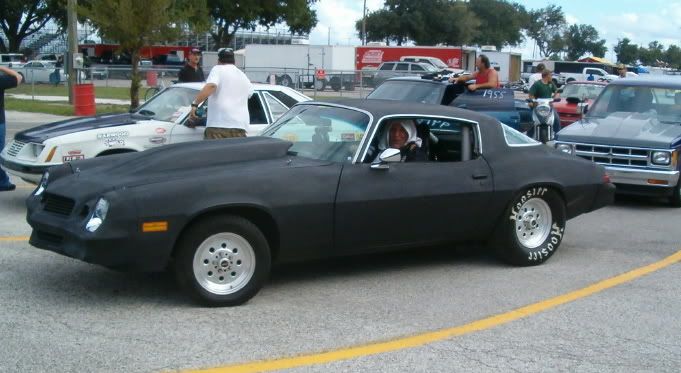
BTW, I am the guy with the black primer Camaro that hangs out with Mike with the red 79 vette..we will be there tomorrow night for the points and down in palm beach for the super chevy on march 6th...
Since you will be leaving first most times, focus on leaving well and then take your first look over at about 330'....if your opponent is not going to catch you be ready to hit the brakes...I always leave my foot to the floor on the gas pedal while applying the brakes full blast as well...this way you regain some momentum if you need to take the stripe back...if he still is not going to catch you at the traps, lift off the gas and stay on the binders...the only way you can lose at that point is if you break out...
I raced a 93 vette for many years...I left first most of the time...one of the things I did was check out my opponents dial...if he was a much faster car I would dial hard since I knew he would be coming at me real hard at the traps...it is very difficult to judge the stripe with a car coming at you at 110+ mph if you are doing 75 mph...
If you run into an opponent who is dialing the same or slower than you then dial soft...in other words hold a couple of hundredths in the bank...when doing this be ready to hit the brake at the stripe...
As an example, if your car normally runs 9.00 in the 1/8th, dialing soft would be 9.02 to 9.04 and hard would be 8.98 to 9.00...1/8 mile racing happens fast and driving skills are much more apparent and necessary versus 1/4 mile racing...hope this helped a little...
BTW, I am the guy with the black primer Camaro that hangs out with Mike with the red 79 vette..we will be there tomorrow night for the points and down in palm beach for the super chevy on march 6th...
Instructor
Joined: Feb 2009
Posts: 110
Likes: 0
From: Yuba City CA
Dice made some good points, 1/8 mile racing is a lot tighter racing. You are forced to rely on better lights, because there is less margin of error in 1/8 mile. Half the track means half the variables to change the performance of your car. His dialing strategy is close to what I would suggest also, however I rarely dial .020 on the HARD side. The only track variable that would make me dial hard by .020 would be an unpredictable tail wind that you have not expierienced before. Sometimes, like at Nationals and Divisionals, or any multi day event, you make all your time runs on one day, and have 1, 2, or 3 rounds the next, and the rest on Sunday. So you might encounter a huge tail wind that you have never seen before, and are forced to judge it and correspond that to your dial in. But in 1/8 mile racing dialing hard by
.020 during typical/familiar conditions is like giving up .020 on the tree. If you are doing all you can to get the advantage on the tree you should not be so generous to give up all that hard work. Make 'em earn it. 1/8 mile is all about tight packages. You need to rely on a good light, and be ready to dial dead on honest, or hard by .010..... Then I am never just ready for the brake pedal. I can tell by the 330 mark if I am gonna catch the other car, or if he's gonna catch me by a significant margin or not, then I start whackin the throttle accordingly. Like I explained in a previous "chapter, LOL" you have an Idea how much E.T. is being killed by working the throttle, not by hammering the brakes. The brake pedal is there if you screwed up and realize you did not scrub enough E.T. and want to tighten it up at the stripe because there is no other option, or to DUMP your opponent as they are going to get the stripe and you are not. If I think it is gonna be really close I will wing it when I get to the stripe, I can't really explain that because it is 100% natural instinct to do what needs to be done. I would be willing to bet that for every 50 rounds of eliminations, I may only run it all out 4 or 5 times. I can honestly tell you that I can not remember the last time I was in the throttle for the entire duration of the run (during eliminations). Like in the Biondo article, he explains the rate of closure....I have always refered to it as the rate of gain. But after you leave the starting line, you transfer all of the focus to that. Making the finish line a guessing game will not win many rounds. I run PRO and SUPER PRO at Sacramento Raceway (I claim points there, as it's my home track) I am driving my 69 Camaro this year, 11.50s 1/4mile 7.40s 1/8 383 SBC & Powerglide. At Sac they allow 2 categories in 1 car. I do not use a delay box in the Camaro, I bottom bulb in both categories. In all cars last year I probabaly made around 500 passes. check out our points stats...scan the event results and E.T. series stuff www.sacramentoraceway.com (Not trying to brag, just sharing because I'm proud) Also, I know a lot of the Vettes you guys are running are not as consistant as a "bare essentials" race car, but that can help you learn to drive the stripe. Have any of you tried the freeway practice yet? You can learn how to put 6" on cars all day long, too bad they won't know what the hell you are doing. And since you are all in Vettes, not many guys can get fed up with your games and leave you in the dust.
.020 during typical/familiar conditions is like giving up .020 on the tree. If you are doing all you can to get the advantage on the tree you should not be so generous to give up all that hard work. Make 'em earn it.
1/8 mile is all about tight packages. You need to rely on a good light, and be ready to dial dead on honest, or hard by .010..... Then I am never just ready for the brake pedal. I can tell by the 330 mark if I am gonna catch the other car, or if he's gonna catch me by a significant margin or not, then I start whackin the throttle accordingly. Like I explained in a previous "chapter, LOL" you have an Idea how much E.T. is being killed by working the throttle, not by hammering the brakes. The brake pedal is there if you screwed up and realize you did not scrub enough E.T. and want to tighten it up at the stripe because there is no other option, or to DUMP your opponent as they are going to get the stripe and you are not. If I think it is gonna be really close I will wing it when I get to the stripe, I can't really explain that because it is 100% natural instinct to do what needs to be done. I would be willing to bet that for every 50 rounds of eliminations, I may only run it all out 4 or 5 times. I can honestly tell you that I can not remember the last time I was in the throttle for the entire duration of the run (during eliminations). Like in the Biondo article, he explains the rate of closure....I have always refered to it as the rate of gain. But after you leave the starting line, you transfer all of the focus to that. Making the finish line a guessing game will not win many rounds. I run PRO and SUPER PRO at Sacramento Raceway (I claim points there, as it's my home track) I am driving my 69 Camaro this year, 11.50s 1/4mile 7.40s 1/8 383 SBC & Powerglide. At Sac they allow 2 categories in 1 car. I do not use a delay box in the Camaro, I bottom bulb in both categories. In all cars last year I probabaly made around 500 passes. check out our points stats...scan the event results and E.T. series stuff www.sacramentoraceway.com (Not trying to brag, just sharing because I'm proud) Also, I know a lot of the Vettes you guys are running are not as consistant as a "bare essentials" race car, but that can help you learn to drive the stripe. Have any of you tried the freeway practice yet? You can learn how to put 6" on cars all day long, too bad they won't know what the hell you are doing. And since you are all in Vettes, not many guys can get fed up with your games and leave you in the dust.
Last edited by jadams67; Feb 21, 2009 at 04:58 AM.
Instructor
Joined: Aug 2008
Posts: 235
Likes: 0
From: Orlando Florida
I race at Orlando as well...1/8 mile racing is a lot tougher than 1/4 mile...first off you must cut decent lights to be successful at 1/8 mile....second, you need a reasonably consistent car...
Since you will be leaving first most times, focus on leaving well and then take your first look over at about 330'....if your opponent is not going to catch you be ready to hit the brakes...I always leave my foot to the floor on the gas pedal while applying the brakes full blast as well...this way you regain some momentum if you need to take the stripe back...if he still is not going to catch you at the traps, lift off the gas and stay on the binders...the only way you can lose at that point is if you break out...
I raced a 93 vette for many years...I left first most of the time...one of the things I did was check out my opponents dial...if he was a much faster car I would dial hard since I knew he would be coming at me real hard at the traps...it is very difficult to judge the stripe with a car coming at you at 110+ mph if you are doing 75 mph...
If you run into an opponent who is dialing the same or slower than you then dial soft...in other words hold a couple of hundredths in the bank...when doing this be ready to hit the brake at the stripe...
As an example, if your car normally runs 9.00 in the 1/8th, dialing soft would be 9.02 to 9.04 and hard would be 8.98 to 9.00...1/8 mile racing happens fast and driving skills are much more apparent and necessary versus 1/4 mile racing...hope this helped a little...
BTW, I am the guy with the black primer Camaro that hangs out with Mike with the red 79 vette..we will be there tomorrow night for the points and down in palm beach for the super chevy on march 6th...
Since you will be leaving first most times, focus on leaving well and then take your first look over at about 330'....if your opponent is not going to catch you be ready to hit the brakes...I always leave my foot to the floor on the gas pedal while applying the brakes full blast as well...this way you regain some momentum if you need to take the stripe back...if he still is not going to catch you at the traps, lift off the gas and stay on the binders...the only way you can lose at that point is if you break out...
I raced a 93 vette for many years...I left first most of the time...one of the things I did was check out my opponents dial...if he was a much faster car I would dial hard since I knew he would be coming at me real hard at the traps...it is very difficult to judge the stripe with a car coming at you at 110+ mph if you are doing 75 mph...
If you run into an opponent who is dialing the same or slower than you then dial soft...in other words hold a couple of hundredths in the bank...when doing this be ready to hit the brake at the stripe...
As an example, if your car normally runs 9.00 in the 1/8th, dialing soft would be 9.02 to 9.04 and hard would be 8.98 to 9.00...1/8 mile racing happens fast and driving skills are much more apparent and necessary versus 1/4 mile racing...hope this helped a little...
BTW, I am the guy with the black primer Camaro that hangs out with Mike with the red 79 vette..we will be there tomorrow night for the points and down in palm beach for the super chevy on march 6th...
 thanks for the input...DDBS (Todd)


Instructor
Joined: Aug 2008
Posts: 235
Likes: 0
From: Orlando Florida
Thanks Jesse, lots of good advice there. I am running my local points eighth mile et's tonight and I will share how I did...hopefully I won't embarrass myself in the process...tonight I will focus on your advice and see how I do...I will probably need to practice it more a T&T nights also. Awesome job at Sac BTW...I truly thing you know what you are talking about...

