


Bracket racing strategy...
Instructor

Joined: Feb 2009
Posts: 110
Likes: 0
From: Yuba City CA

Ok, maybe my statement was in bad taste, but it's all I could muster up as I could not believe what I was reading. I will not get into the way I race, I could sit here for hours and not really accomplish anything. Mainly because it takes more than reading an article or talking to someone else who knows how to race WELL, to learn the true art of bracket racing. It takes real dedication. There is no black and white way to strategise. If some of you want to really learn how to bracket race effectively, you need to prepare long before you start your engine. The best post I read on this whole thread was from RED 69. The guy bought a practice tree. I myself have been racing with my father forever, he was a real hitter in his time, NHRA World Champion. I took what he has taught me and made it my own. When he started, he would ask guys how to win, and between sifting through the BS and watching the starting line, finish line, the staging lanes, the pits, the whole 9 yards, he managed to become a winner. I myself have won multiple track championships at multiple tracks, NHRA divisional races, and countless bracket races. I understand not everyone has the teachers I had available to me, but what I origionally meant was...Bouncing ideas off a handfull of racers and a boatload of idiots won't help much. You want some real advise on how to learn to be a serious racer? Find a series of videos made by Edmond and Scotty Richardson. They are two the best bracket racers in history. Their videos may seem lame, possibly because they are a couple of southern good ole boys that fit the bill of dumb red necks. However they have won more money bracket racing than anyone. 

Team Owner


Joined: Feb 2000
Posts: 32,545
Likes: 2
From: Lithia FL
Cruise-In II & IV Veteran
CI VI Drag Champ!

Team Owner
Joined: Nov 1999
Posts: 32,782
Likes: 11
From: Former NCM Drag Racing coordinator, National director Corvette Challenge Spring Hill, Tennessee: Whiting, New Jersey
Cruise-In VI Veteran
Cruise-In VII Veteran
Ya, I'd say so. Give these guys a break, most are not serious bracket racers but do it as a hobby, for their own personal enjoyment. They will never be big time bracket racers. We do have a few here that are very competitive and know what they are doing and some are still learning so don't hold that against them.
I would like to know who your dad is, I may know him. I've been around a long time.
Instructor
Joined: Feb 2009
Posts: 110
Likes: 0
From: Yuba City CA
Yep, those are the videos. And I know a lot of the guys do it for their own enjoyment. But I hate the fact that I see so many guys waste their hard earned time and money, and not showing any type of improvement. So as I admitted, I did not come across very polite, and I apologise, however my goal was to get my point across by possibly helping guys get the big picture. The ultimate goal should be to do what you enjoy doing, and not suck at it. It is ok to suck in the beginning, but progress is the payout. So rather than learn by comparing bad ideas, I hope I brought some valid points and info in the second one. I kinda jumped the gun with the critisizm, but I first called it how I saw it. Now I see it a little different.
Team Owner
Joined: Nov 1999
Posts: 32,782
Likes: 11
From: Former NCM Drag Racing coordinator, National director Corvette Challenge Spring Hill, Tennessee: Whiting, New Jersey
Cruise-In VI Veteran
Cruise-In VII Veteran
Yep, those are the videos. And I know a lot of the guys do it for their own enjoyment. But I hate the fact that I see so many guys waste their hard earned time and money, and not showing any type of improvement. So as I admitted, I did not come across very polite, and I apologise, however my goal was to get my point across by possibly helping guys get the big picture. The ultimate goal should be to do what you enjoy doing, and not suck at it. It is ok to suck in the beginning, but progress is the payout. So rather than learn by comparing bad ideas, I hope I brought some valid points and info in the second one. I kinda jumped the gun with the critisizm, but I first called it how I saw it. Now I see it a little different.
I'd still like to know who your dad is.

Safety Car

Joined: Nov 2004
Posts: 4,991
Likes: 5
From: The Pines South Jersey
Very rare to have a gimme round in our series.
Aside from the video recommendation, can you share anything that might help one of us?

Race Director


Joined: Oct 1999
Posts: 13,298
Likes: 14
From: Somers NY
I remember when Mackey, Bob Trishman, & myself had to teach Redgar how to stage his 1995 Green 6 speed Vette...He was happy when it ran in the low 13s..
He has come a very long way... As for myself I'm to OLD to learn & improve anymore, so I'll just do my best in the "Senior Citizen" races Englishtown puts on...
Here is our last yrs Champ.. we had over 100 (some very experienced racers) in the Challenge!
I still say "SOME" people are naturals, and learn to bracket quickly, then there are some who have been going to the track for 20+ yrs and still cant win more then 2 rounds in a race..
But for the most part anyone who is "SERIOUS" can learn to be competitive!
Here is a "Kid" 22 yrs old" who beat all the heavy Hitters in 2008
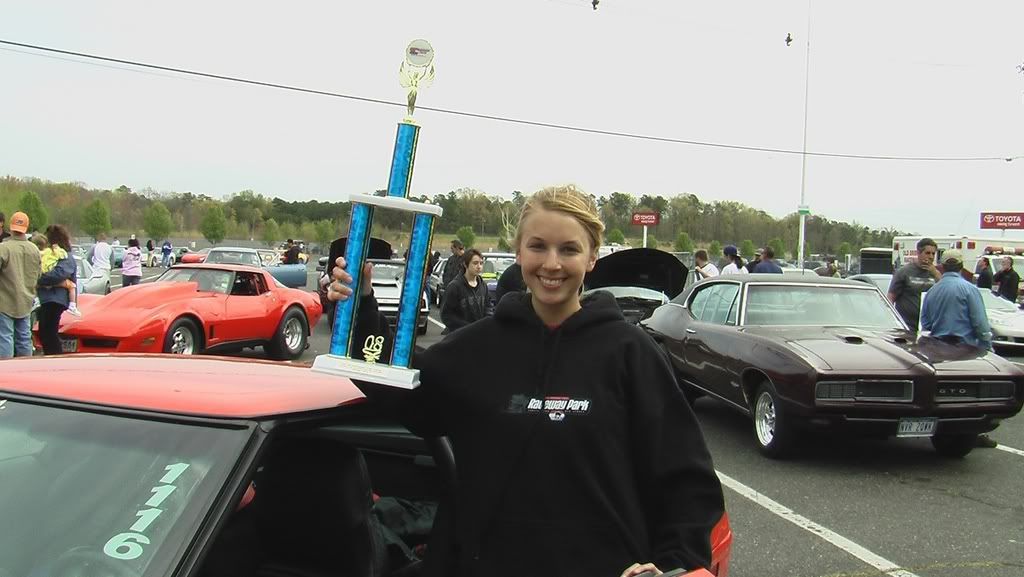
He has come a very long way... As for myself I'm to OLD to learn & improve anymore, so I'll just do my best in the "Senior Citizen" races Englishtown puts on...
Here is our last yrs Champ.. we had over 100 (some very experienced racers) in the Challenge!
I still say "SOME" people are naturals, and learn to bracket quickly, then there are some who have been going to the track for 20+ yrs and still cant win more then 2 rounds in a race..
But for the most part anyone who is "SERIOUS" can learn to be competitive!
Here is a "Kid" 22 yrs old" who beat all the heavy Hitters in 2008

Drifting


Joined: Jan 2006
Posts: 1,457
Likes: 22
The worst bracket racers I have ever seen at the track happen to be late model Mustang and Corvette owners. If some of you would take a day or two to show up at the track at talk to some expierienced racers, and sit at the finish line watching how it's really done, you could learn a lot more that taking stripe driving advise from guys lying about how good they are on the tree, and always seem to go home wondering what the hell happened. Some of these posts are pure comedy.
Last edited by kazman; Feb 16, 2009 at 12:56 PM.
Corvette Stories
The Best of Corvette for Corvette Enthusiasts

5 Best & 5 Worst Corvette Daily Drivers
Joe Kucinski
The Headlights of Every Corvette Generation Explained
Joe Kucinski
5 Best & 5 Most Overrated Corvette Track Packages of All Time!
Joe Kucinski
Every 2027 Corvette Engine Explained
Joe Kucinski
Designer Imagines A Corvette That Looks More Like a Corvette Than the Corvette
Verdad Gallardo
10 Ugly Corvettes That We Still Kinda Love
Joe Kucinski
Top 10 Most Expensive Corvettes Ever Sold on Bring A Trailer
Brett Foote
10 Things Every Corvette Owner Needs (2026 Edition)
Michael S. Palmer
8 Most "Only Corvette Owners Understand" Quirks and Problems
Pouria Savadkouei
Instructor
Joined: Feb 2009
Posts: 110
Likes: 0
From: Yuba City CA
Your 09 plan is solid. What guys need to learn is driving the finish line. I am going to try to break this down in a few parts, I tend to ramble and mix thoughts when explaining this stuff but you should be able to make sense of it, so bear with me. I am not targeting any individual posts, just starting with basic "bad driving" observations I make every week.
When a guy's plan is to dial their car a number that it can't run by .010 -.030 and hope to make that difference up on the tree...so they can run it full throttle all the way through and not break out, that is bad. For one, if you think this way, most likely you are not serious enough to learn why finish line driving is important, and are not that good on the tree anyway. Some people think sand bagging is wrong. Why is it wrong? It does not give any advantage or disadvantage, it is just part of the game. In my opinion, unless you are the slower car, and you are facing a MPH split of 25 MPH or more, there is no reason in the world that you should not dial in at least .010 slower than what you can run. (ex. you think you can go 12.45, so dial 12.46 or 12.47) That .010-.020 is your cushion in case of a change. Gust of wind, tire spin, track change, lane swap, etc. If you have a good light.... .015 against a... .045, you are ahead by .030 already. If your car is doing what it's supposed to, you should know by 1000' if the other guy is gonna catch you or not. ( As soon as you are done shifting you should be watching the other car 80% of the time, and taking glances at the finish line stripe 20%. You gotta get a fix on whether or not the opponent is going to catch you before the stripe or not. A good way to practice this off the track is on the freeway, legally. As you are cruising on the freeway watch for people going faster than you, guage their closing rate on you, and pick a fixed point on the road ahead that you thin they will catch you by. It sounds lame, but learning how to judge distace closing rates is the most important part of driving the finish line.) Back to situation: So you are watching this guy try to run you down. When you know he can't catch you by 8 feet, you gotta close that gap. You lift once with a rapid OFF/ON of the gas. Still not gonna catch you? OFF/ON again Now you are at the MPH stripe and he is at your door handle? One more OFF/ON. That's 3 whacks, I know what my car will do over the course of the day. If we get 3 time runs before eliminations, I will use 2 for wide open #s, and on the third I will whack the throttle 4 times starting at about 1200'. Now I know how much E.T. 3 whacks is worth. (My car 4 whacks is worth about .030) So, I am confident my car will run 12.45; I dialed 12.47 I took a .030 advantage on the tree. (For the situation we are assuming opponent's car is running dead on his dial in) At the stripe I give the throttle 3 whacks, if 4whacks=.030, then 3 whacks should =.022 So I run a 12.472, on my 12.47 dial, and took a .008 stripe. Because I used .022 of a .030 advanatge. Where this gets tricky is: I am counting whacks as I do them, but my intention is to judge and drive using the visual reference of opponents front tire to my front tire. I know I am gonna need to lift to not break out. Correct? Correct. So what if at 1200' on the track I can see that we are gonna be dead even at the finish line, and I have not killed any E.T. by whacking the throttle? Assuming I still have the .030 starting line advantage for the situation, this would mean that if I am gonna break out by .020 (because thats how much I was dialed soft) The other guy is breaking out by .050 For him to overcome a .030 starting line disadvantage, and catch up to me who is already bagging .020, means that he too is bagging as much as me + the starting line difference. *******This is my ramble, but it is what it is, and it is all valid.************* If at 1200' I can already see that he is gonna catch and pass me, I know that he will probabally start whacking his throttle to put a wheel on me. My new goal is to force him as far as I can until he can not react to me dumping the brakes and slowing my E.T., while he breaks out and loses. Obviously the situation would be different if the reaction times were different, and you don't know what the opponent's strategy really is, but if they are dialed soft, it gives them just as much chance to break out as you. If they are dailed hard, it makes it easier for you to make the stripe tight and kill the E.T. you need to kill to not break out. I know some people will read this and think..."What the hell was that?" But the absolute objective for typical, no BS bracket racing is to: Be the quickest off the starting line, and get to the finish line FIRST by the absolute smallest margin possible. When you read a time slip, below the run data it will tell which lane got to the finish line first, and the MOV. (margin of victory) that number needs to be small, the smaller the better. If you can be consistantly decent on the tree .000 - .025, and make that MOV say .005 - .020, you are gonna win a lot of rounds.
This is literally the tip of the iceburg. The better a racer is, the more he/she can do this kind of stuff without thinking. An expierienced racer will read this, and think "Oh come on, who doesn't know that and laugh (as I first did). But someone who knows little may find it very informative. Change strategy from round to round. They will know who the good racers are and who the less expierienced are, that is important to know to help decide how you approach a round. Use a practice tree. But don't dwell on catching a perfect light on your practice tree. Turn it on, and attempt to gain consistancy, it's gonna be different on the track. If you can put 30 hits on a practice tree within a .030 group you are doing great. Get on the track and adjust the car or staging depth to put that .030 group where it needs to be: .005 - .035 Stage carefully. DO NOT PRE STAGE UNTIL YOU HAVE CHECKED YOUR DIAL IN ON THE BOARD. This is your responsibility, not the tracks. If the dial in is wrong, it is your RIGHT to have them correct it. Put the Pre-Stage light on and STOP, don't just roll until the Stage light comes on too. STOP, take a few breaths and creep forward 2 inches at a time. Don't just jam it in there like a 16 year old gets his first piece of trim. Ease it in so you can do it the same every run. The way you stage directly affects E.T. The shallower you stage the quicker E.T. you will have, because you will get a slight "rolling start" before breaking the beam and starting the E.T. timers. The opposite if you deep stage, the deeper you are in, the slower the E.T. If you are super shallow and can't cut a light, bump it in deeper, it will help your light, but be ready for the concequences, and compensate your dial in for your staging style. And it's amazing how many people do not know this: The E.T. timers do NOT start until the STAGE lights turn off by your tire rolling out of the infrared beam. A quicker reaction time will not make your E.T. quicker. You can have a .000 RT, and run 11.90, or have a 4.546 RT and still run the same 11.90
I am rambling again, give me some feedback. Does this help, should I leave this site and never come back?
And that 22 year old chick who won your series is hot, post more pictures of her. The fact that she wad holding the trophy made it even better.
When a guy's plan is to dial their car a number that it can't run by .010 -.030 and hope to make that difference up on the tree...so they can run it full throttle all the way through and not break out, that is bad. For one, if you think this way, most likely you are not serious enough to learn why finish line driving is important, and are not that good on the tree anyway. Some people think sand bagging is wrong. Why is it wrong? It does not give any advantage or disadvantage, it is just part of the game. In my opinion, unless you are the slower car, and you are facing a MPH split of 25 MPH or more, there is no reason in the world that you should not dial in at least .010 slower than what you can run. (ex. you think you can go 12.45, so dial 12.46 or 12.47) That .010-.020 is your cushion in case of a change. Gust of wind, tire spin, track change, lane swap, etc. If you have a good light.... .015 against a... .045, you are ahead by .030 already. If your car is doing what it's supposed to, you should know by 1000' if the other guy is gonna catch you or not. ( As soon as you are done shifting you should be watching the other car 80% of the time, and taking glances at the finish line stripe 20%. You gotta get a fix on whether or not the opponent is going to catch you before the stripe or not. A good way to practice this off the track is on the freeway, legally. As you are cruising on the freeway watch for people going faster than you, guage their closing rate on you, and pick a fixed point on the road ahead that you thin they will catch you by. It sounds lame, but learning how to judge distace closing rates is the most important part of driving the finish line.) Back to situation: So you are watching this guy try to run you down. When you know he can't catch you by 8 feet, you gotta close that gap. You lift once with a rapid OFF/ON of the gas. Still not gonna catch you? OFF/ON again Now you are at the MPH stripe and he is at your door handle? One more OFF/ON. That's 3 whacks, I know what my car will do over the course of the day. If we get 3 time runs before eliminations, I will use 2 for wide open #s, and on the third I will whack the throttle 4 times starting at about 1200'. Now I know how much E.T. 3 whacks is worth. (My car 4 whacks is worth about .030) So, I am confident my car will run 12.45; I dialed 12.47 I took a .030 advantage on the tree. (For the situation we are assuming opponent's car is running dead on his dial in) At the stripe I give the throttle 3 whacks, if 4whacks=.030, then 3 whacks should =.022 So I run a 12.472, on my 12.47 dial, and took a .008 stripe. Because I used .022 of a .030 advanatge. Where this gets tricky is: I am counting whacks as I do them, but my intention is to judge and drive using the visual reference of opponents front tire to my front tire. I know I am gonna need to lift to not break out. Correct? Correct. So what if at 1200' on the track I can see that we are gonna be dead even at the finish line, and I have not killed any E.T. by whacking the throttle? Assuming I still have the .030 starting line advantage for the situation, this would mean that if I am gonna break out by .020 (because thats how much I was dialed soft) The other guy is breaking out by .050 For him to overcome a .030 starting line disadvantage, and catch up to me who is already bagging .020, means that he too is bagging as much as me + the starting line difference. *******This is my ramble, but it is what it is, and it is all valid.************* If at 1200' I can already see that he is gonna catch and pass me, I know that he will probabally start whacking his throttle to put a wheel on me. My new goal is to force him as far as I can until he can not react to me dumping the brakes and slowing my E.T., while he breaks out and loses. Obviously the situation would be different if the reaction times were different, and you don't know what the opponent's strategy really is, but if they are dialed soft, it gives them just as much chance to break out as you. If they are dailed hard, it makes it easier for you to make the stripe tight and kill the E.T. you need to kill to not break out. I know some people will read this and think..."What the hell was that?" But the absolute objective for typical, no BS bracket racing is to: Be the quickest off the starting line, and get to the finish line FIRST by the absolute smallest margin possible. When you read a time slip, below the run data it will tell which lane got to the finish line first, and the MOV. (margin of victory) that number needs to be small, the smaller the better. If you can be consistantly decent on the tree .000 - .025, and make that MOV say .005 - .020, you are gonna win a lot of rounds.
This is literally the tip of the iceburg. The better a racer is, the more he/she can do this kind of stuff without thinking. An expierienced racer will read this, and think "Oh come on, who doesn't know that and laugh (as I first did). But someone who knows little may find it very informative. Change strategy from round to round. They will know who the good racers are and who the less expierienced are, that is important to know to help decide how you approach a round. Use a practice tree. But don't dwell on catching a perfect light on your practice tree. Turn it on, and attempt to gain consistancy, it's gonna be different on the track. If you can put 30 hits on a practice tree within a .030 group you are doing great. Get on the track and adjust the car or staging depth to put that .030 group where it needs to be: .005 - .035 Stage carefully. DO NOT PRE STAGE UNTIL YOU HAVE CHECKED YOUR DIAL IN ON THE BOARD. This is your responsibility, not the tracks. If the dial in is wrong, it is your RIGHT to have them correct it. Put the Pre-Stage light on and STOP, don't just roll until the Stage light comes on too. STOP, take a few breaths and creep forward 2 inches at a time. Don't just jam it in there like a 16 year old gets his first piece of trim. Ease it in so you can do it the same every run. The way you stage directly affects E.T. The shallower you stage the quicker E.T. you will have, because you will get a slight "rolling start" before breaking the beam and starting the E.T. timers. The opposite if you deep stage, the deeper you are in, the slower the E.T. If you are super shallow and can't cut a light, bump it in deeper, it will help your light, but be ready for the concequences, and compensate your dial in for your staging style. And it's amazing how many people do not know this: The E.T. timers do NOT start until the STAGE lights turn off by your tire rolling out of the infrared beam. A quicker reaction time will not make your E.T. quicker. You can have a .000 RT, and run 11.90, or have a 4.546 RT and still run the same 11.90
I am rambling again, give me some feedback. Does this help, should I leave this site and never come back?
And that 22 year old chick who won your series is hot, post more pictures of her. The fact that she wad holding the trophy made it even better.
Race Director
Joined: Oct 1999
Posts: 13,298
Likes: 14
From: Somers NY
Your 09 plan is solid. What guys need to learn is driving the finish line. I am going to try to break this down in a few parts, I tend to ramble and mix thoughts when explaining this stuff but you should be able to make sense of it, so bear with me. I am not targeting any individual posts, just starting with basic "bad driving" observations I make every week.
When a guy's plan is to dial their car a number that it can't run by .010 -.030 and hope to make that difference up on the tree...so they can run it full throttle all the way through and not break out, that is bad. For one, if you think this way, most likely you are not serious enough to learn why finish line driving is important, and are not that good on the tree anyway. Some people think sand bagging is wrong. Why is it wrong? It does not give any advantage or disadvantage, it is just part of the game. In my opinion, unless you are the slower car, and you are facing a MPH split of 25 MPH or more, there is no reason in the world that you should not dial in at least .010 slower than what you can run. (ex. you think you can go 12.45, so dial 12.46 or 12.47) That .010-.020 is your cushion in case of a change. Gust of wind, tire spin, track change, lane swap, etc. If you have a good light.... .015 against a... .045, you are ahead by .030 already. If your car is doing what it's supposed to, you should know by 1000' if the other guy is gonna catch you or not. ( As soon as you are done shifting you should be watching the other car 80% of the time, and taking glances at the finish line stripe 20%. You gotta get a fix on whether or not the opponent is going to catch you before the stripe or not. A good way to practice this off the track is on the freeway, legally. As you are cruising on the freeway watch for people going faster than you, guage their closing rate on you, and pick a fixed point on the road ahead that you thin they will catch you by. It sounds lame, but learning how to judge distace closing rates is the most important part of driving the finish line.) Back to situation: So you are watching this guy try to run you down. When you know he can't catch you by 8 feet, you gotta close that gap. You lift once with a rapid OFF/ON of the gas. Still not gonna catch you? OFF/ON again Now you are at the MPH stripe and he is at your door handle? One more OFF/ON. That's 3 whacks, I know what my car will do over the course of the day. If we get 3 time runs before eliminations, I will use 2 for wide open #s, and on the third I will whack the throttle 4 times starting at about 1200'. Now I know how much E.T. 3 whacks is worth. (My car 4 whacks is worth about .030) So, I am confident my car will run 12.45; I dialed 12.47 I took a .030 advantage on the tree. (For the situation we are assuming opponent's car is running dead on his dial in) At the stripe I give the throttle 3 whacks, if 4whacks=.030, then 3 whacks should =.022 So I run a 12.472, on my 12.47 dial, and took a .008 stripe. Because I used .022 of a .030 advantage. Where this gets tricky is: I am counting whacks as I do them, but my intention is to judge and drive using the visual reference of opponents front tire to my front tire. I know I am gonna need to lift to not break out. Correct? Correct. So what if at 1200' on the track I can see that we are gonna be dead even at the finish line, and I have not killed any E.T. by whacking the throttle? Assuming I still have the .030 starting line advantage for the situation, this would mean that if I am gonna break out by .020 (because thats how much I was dialed soft) The other guy is breaking out by .050 For him to overcome a .030 starting line disadvantage, and catch up to me who is already bagging .020, means that he too is bagging as much as me + the starting line difference. *******This is my ramble, but it is what it is, and it is all valid.************* If at 1200' I can already see that he is gonna catch and pass me, I know that he will probably start whacking his throttle to put a wheel on me. My new goal is to force him as far as I can until he can not react to me dumping the brakes and slowing my E.T., while he breaks out and loses. Obviously the situation would be different if the reaction times were different, and you don't know what the opponent's strategy really is, but if they are dialed soft, it gives them just as much chance to break out as you. If they are dialed hard, it makes it easier for you to make the stripe tight and kill the E.T. you need to kill to not break out. I know some people will read this and think..."What the hell was that?" But the absolute objective for typical, no BS bracket racing is to: Be the quickest off the starting line, and get to the finish line FIRST by the absolute smallest margin possible. When you read a time slip, below the run data it will tell which lane got to the finish line first, and the MOV. (margin of victory) that number needs to be small, the smaller the better. If you can be consistently decent on the tree .000 - .025, and make that MOV say .005 - .020, you are gonna win a lot of rounds.
This is literally the tip of the iceberg. The better a racer is, the more he/she can do this kind of stuff without thinking. An experienced racer will read this, and think "Oh come on, who doesn't know that and laugh (as I first did). But someone who knows little may find it very informative. Change strategy from round to round. They will know who the good racers are and who the less experienced are, that is important to know to help decide how you approach a round. Use a practice tree. But don't dwell on catching a perfect light on your practice tree. Turn it on, and attempt to gain consistency, it's gonna be different on the track. If you can put 30 hits on a practice tree within a .030 group you are doing great. Get on the track and adjust the car or staging depth to put that .030 group where it needs to be: .005 - .035 Stage carefully. DO NOT PRE STAGE UNTIL YOU HAVE CHECKED YOUR DIAL IN ON THE BOARD. This is your responsibility, not the tracks. If the dial in is wrong, it is your RIGHT to have them correct it. Put the Pre-Stage light on and STOP, don't just roll until the Stage light comes on too. STOP, take a few breaths and creep forward 2 inches at a time. Don't just jam it in there like a 16 year old gets his first piece of trim. Ease it in so you can do it the same every run. The way you stage directly affects E.T. The shallower you stage the quicker E.T. you will have, because you will get a slight "rolling start" before breaking the beam and starting the E.T. timers. The opposite if you deep stage, the deeper you are in, the slower the E.T. If you are super shallow and can't cut a light, bump it in deeper, it will help your light, but be ready for the consequences, and compensate your dial in for your staging style. And it's amazing how many people do not know this: The E.T. timers do NOT start until the STAGE lights turn off by your tire rolling out of the infrared beam. A quicker reaction time will not make your E.T. quicker. You can have a .000 RT, and run 11.90, or have a 4.546 RT and still run the same 11.90
I am rambling again, give me some feedback. Does this help, should I leave this site and never come back?
And that 22 year old chick who won your series is hot, post more pictures of her. The fact that she wad holding the trophy made it even better.
When a guy's plan is to dial their car a number that it can't run by .010 -.030 and hope to make that difference up on the tree...so they can run it full throttle all the way through and not break out, that is bad. For one, if you think this way, most likely you are not serious enough to learn why finish line driving is important, and are not that good on the tree anyway. Some people think sand bagging is wrong. Why is it wrong? It does not give any advantage or disadvantage, it is just part of the game. In my opinion, unless you are the slower car, and you are facing a MPH split of 25 MPH or more, there is no reason in the world that you should not dial in at least .010 slower than what you can run. (ex. you think you can go 12.45, so dial 12.46 or 12.47) That .010-.020 is your cushion in case of a change. Gust of wind, tire spin, track change, lane swap, etc. If you have a good light.... .015 against a... .045, you are ahead by .030 already. If your car is doing what it's supposed to, you should know by 1000' if the other guy is gonna catch you or not. ( As soon as you are done shifting you should be watching the other car 80% of the time, and taking glances at the finish line stripe 20%. You gotta get a fix on whether or not the opponent is going to catch you before the stripe or not. A good way to practice this off the track is on the freeway, legally. As you are cruising on the freeway watch for people going faster than you, guage their closing rate on you, and pick a fixed point on the road ahead that you thin they will catch you by. It sounds lame, but learning how to judge distace closing rates is the most important part of driving the finish line.) Back to situation: So you are watching this guy try to run you down. When you know he can't catch you by 8 feet, you gotta close that gap. You lift once with a rapid OFF/ON of the gas. Still not gonna catch you? OFF/ON again Now you are at the MPH stripe and he is at your door handle? One more OFF/ON. That's 3 whacks, I know what my car will do over the course of the day. If we get 3 time runs before eliminations, I will use 2 for wide open #s, and on the third I will whack the throttle 4 times starting at about 1200'. Now I know how much E.T. 3 whacks is worth. (My car 4 whacks is worth about .030) So, I am confident my car will run 12.45; I dialed 12.47 I took a .030 advantage on the tree. (For the situation we are assuming opponent's car is running dead on his dial in) At the stripe I give the throttle 3 whacks, if 4whacks=.030, then 3 whacks should =.022 So I run a 12.472, on my 12.47 dial, and took a .008 stripe. Because I used .022 of a .030 advantage. Where this gets tricky is: I am counting whacks as I do them, but my intention is to judge and drive using the visual reference of opponents front tire to my front tire. I know I am gonna need to lift to not break out. Correct? Correct. So what if at 1200' on the track I can see that we are gonna be dead even at the finish line, and I have not killed any E.T. by whacking the throttle? Assuming I still have the .030 starting line advantage for the situation, this would mean that if I am gonna break out by .020 (because thats how much I was dialed soft) The other guy is breaking out by .050 For him to overcome a .030 starting line disadvantage, and catch up to me who is already bagging .020, means that he too is bagging as much as me + the starting line difference. *******This is my ramble, but it is what it is, and it is all valid.************* If at 1200' I can already see that he is gonna catch and pass me, I know that he will probably start whacking his throttle to put a wheel on me. My new goal is to force him as far as I can until he can not react to me dumping the brakes and slowing my E.T., while he breaks out and loses. Obviously the situation would be different if the reaction times were different, and you don't know what the opponent's strategy really is, but if they are dialed soft, it gives them just as much chance to break out as you. If they are dialed hard, it makes it easier for you to make the stripe tight and kill the E.T. you need to kill to not break out. I know some people will read this and think..."What the hell was that?" But the absolute objective for typical, no BS bracket racing is to: Be the quickest off the starting line, and get to the finish line FIRST by the absolute smallest margin possible. When you read a time slip, below the run data it will tell which lane got to the finish line first, and the MOV. (margin of victory) that number needs to be small, the smaller the better. If you can be consistently decent on the tree .000 - .025, and make that MOV say .005 - .020, you are gonna win a lot of rounds.
This is literally the tip of the iceberg. The better a racer is, the more he/she can do this kind of stuff without thinking. An experienced racer will read this, and think "Oh come on, who doesn't know that and laugh (as I first did). But someone who knows little may find it very informative. Change strategy from round to round. They will know who the good racers are and who the less experienced are, that is important to know to help decide how you approach a round. Use a practice tree. But don't dwell on catching a perfect light on your practice tree. Turn it on, and attempt to gain consistency, it's gonna be different on the track. If you can put 30 hits on a practice tree within a .030 group you are doing great. Get on the track and adjust the car or staging depth to put that .030 group where it needs to be: .005 - .035 Stage carefully. DO NOT PRE STAGE UNTIL YOU HAVE CHECKED YOUR DIAL IN ON THE BOARD. This is your responsibility, not the tracks. If the dial in is wrong, it is your RIGHT to have them correct it. Put the Pre-Stage light on and STOP, don't just roll until the Stage light comes on too. STOP, take a few breaths and creep forward 2 inches at a time. Don't just jam it in there like a 16 year old gets his first piece of trim. Ease it in so you can do it the same every run. The way you stage directly affects E.T. The shallower you stage the quicker E.T. you will have, because you will get a slight "rolling start" before breaking the beam and starting the E.T. timers. The opposite if you deep stage, the deeper you are in, the slower the E.T. If you are super shallow and can't cut a light, bump it in deeper, it will help your light, but be ready for the consequences, and compensate your dial in for your staging style. And it's amazing how many people do not know this: The E.T. timers do NOT start until the STAGE lights turn off by your tire rolling out of the infrared beam. A quicker reaction time will not make your E.T. quicker. You can have a .000 RT, and run 11.90, or have a 4.546 RT and still run the same 11.90
I am rambling again, give me some feedback. Does this help, should I leave this site and never come back?
And that 22 year old chick who won your series is hot, post more pictures of her. The fact that she wad holding the trophy made it even better.
This should be labeled post of the year.. to "ME" it is one if the "BEST" posts I've read on bracket racing.... I do exactly as you describe.. as I get close to the 1000' I'm looking over my shoulder most of the time (If he is faster) and trying to judge how fast he is closing..
About the only time i "DON'T do this is if I am racing a 8-9 sec car (150 mph+) then I dial exactly what I think I'll run, & "HOPE" I hit the tree better....and just tap the break in the last 30' if he looks to be far back.. @ 150 he is closing Damn FAST.. not much time to make decesions...
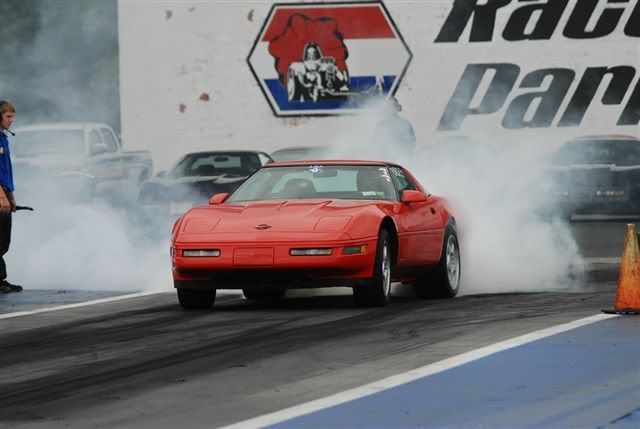
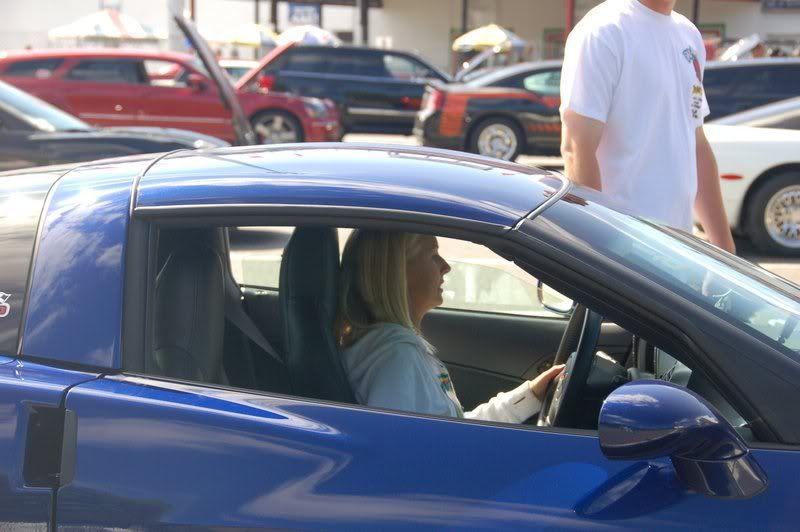
As for the photos... Jeanne won out 2008 Championship, & Rookie of the Yr. Although she is NOT a Rookie Driver... She is Deadly consistent on the tree, & knows how to drive the TOP END .. (I did the dialing) as I knew the car, but she also has a lot of input based on how it felt on the launch (good or bad track) engine temp (if it was later rounds, the motor was hotter, & the car would run a little slower.. .. Knowing this helps a lot...expecially in the last 2 rounds as they are almost Hot Lapping you!...
Here are a few photo's of what I consider an excellent racer!!

Drifting
Joined: Jan 2006
Posts: 1,457
Likes: 22
730GT500: Thank you for your "ramblings".
In my cars wacking the gas scrubs MPH but not much ET. I keep it to the floor and stab the breaks. 1 stab = .02 ET. It's important to know how much ET you are scrubbing. 5 stabs between the 1000' marker and finish scrubs a full .10 from my ET. Yes, I am confortable holding a full .10. I can hold more but have to scrub before the 1000' marker which isn't a good idea (in most cases). I use the 1000' to finish split time from a full run to calculate what my ET would of been on "scubed" elimination rounds.
I deep stage at a track that doesn't reconize deep and uses a 10 second autostart. I usually stage last and go out first. I stop just before the prestage beam, relax, bring it up to launch rpm, then heal toe the break pedel and slowly slide the car in from nothing lit to fully deep and ready to go. To some it seems that I take a long time to stage while others think I jump right in. I can hit my spot on the line 90% of the time. I will be working on my staging at every stoplight. Last night a poor little guy in a honda thought I wanted to race and bugged out as the light turned green. Practicing reaction time at traffic lightes is just plain bad. Ok to practice sliding in or bumping.
I don't like the idea of bumping to adjust RT. I would advise for shallow stagers to just turn on the stage light on. Deep stagers just turn the prestage light out. 2 good reference points. Then adjust the car to "cut" the light. Higher launch rpm or increasing the rear tire pressure will make the car cut a quicker light. Other things effect this as well such as converters, gears, supension adjustments, etc. Adjust the car not the driver. Let the car cut the light for you. On my Mustang launching at 1500rmp gives me a .020 light. My current window is +-.020. So if I hit my spot I should have a .000 to a .039 light without any redlight worries. If I need to cut a killer light I can launch at 1700 but may go red. If I want to cut a very consertive light I will lower the launch to 1200rmp. Less likely to go red but may cut a .070 light. It is very rare for me to put the car on full kill. Please note that I am human and do at times completly fubar the tree.
Here's something everyone can do in their next elimination round. Pick up your time slip but before you read it write down what you thought your and your opponents RT, who was going to win and by how much at the 1000' mark, the MOV amount (win or loose), and your ET. These are things you need to know as you go down the track.
730GT500 again thanks for you input. I know some here will get it and others just won't.
In my cars wacking the gas scrubs MPH but not much ET. I keep it to the floor and stab the breaks. 1 stab = .02 ET. It's important to know how much ET you are scrubbing. 5 stabs between the 1000' marker and finish scrubs a full .10 from my ET. Yes, I am confortable holding a full .10. I can hold more but have to scrub before the 1000' marker which isn't a good idea (in most cases). I use the 1000' to finish split time from a full run to calculate what my ET would of been on "scubed" elimination rounds.
I deep stage at a track that doesn't reconize deep and uses a 10 second autostart. I usually stage last and go out first. I stop just before the prestage beam, relax, bring it up to launch rpm, then heal toe the break pedel and slowly slide the car in from nothing lit to fully deep and ready to go. To some it seems that I take a long time to stage while others think I jump right in. I can hit my spot on the line 90% of the time. I will be working on my staging at every stoplight. Last night a poor little guy in a honda thought I wanted to race and bugged out as the light turned green. Practicing reaction time at traffic lightes is just plain bad. Ok to practice sliding in or bumping.
I don't like the idea of bumping to adjust RT. I would advise for shallow stagers to just turn on the stage light on. Deep stagers just turn the prestage light out. 2 good reference points. Then adjust the car to "cut" the light. Higher launch rpm or increasing the rear tire pressure will make the car cut a quicker light. Other things effect this as well such as converters, gears, supension adjustments, etc. Adjust the car not the driver. Let the car cut the light for you. On my Mustang launching at 1500rmp gives me a .020 light. My current window is +-.020. So if I hit my spot I should have a .000 to a .039 light without any redlight worries. If I need to cut a killer light I can launch at 1700 but may go red. If I want to cut a very consertive light I will lower the launch to 1200rmp. Less likely to go red but may cut a .070 light. It is very rare for me to put the car on full kill. Please note that I am human and do at times completly fubar the tree.
Here's something everyone can do in their next elimination round. Pick up your time slip but before you read it write down what you thought your and your opponents RT, who was going to win and by how much at the 1000' mark, the MOV amount (win or loose), and your ET. These are things you need to know as you go down the track.
730GT500 again thanks for you input. I know some here will get it and others just won't.



Drifting
Joined: Jan 2006
Posts: 1,457
Likes: 22
I use the middle of my opponents windshield pillar as the reference point. I look straight across 90 degrees. At the finish line, if I'm dead center to the middle point of the windshild piller then I'm taking stripe by .010-.019. In front of the reference point I'm breaking out, behind I ain't getting to the stripe first. Anything less than a .010 MOV is a great looking guess. MOV's more than .020 are too large and too much stripe was taken. In races when there is a huge advantage then the amount of MOV doesn't matter. Example is when the other car was nowhere to be found, you were holding .02 and scurbbed .06 and took the win with .200 MOV. When dumping you want to get the largest MOV possible by putting as much space between you and the opponent. Dumping should be done as late as possible (don't lock your breaks up) so your opponent doesn't have time to react. I dump opponents in the mph box ("push them into a breakout"). You do need to watch for the jokers who put a little piece of metal under their front bumpers (a flag). The flag will break the beam not their front tires. Need to mentally adjust for this trick. Also on a C5 hitting the breaks will cause the front spoiler to break the beam. Reason why I "scrubed" .02 and went .04 faster. 
Instructor
Joined: Feb 2009
Posts: 110
Likes: 0
From: Yuba City CA
There are two ways you can tell what your car would have run if you had not lifted, or braked before crossing the finish line. Unless the other car breaks, like broken, blown up, kaput, etc... I will usually never lift BEFORE the 1000' mark. This gives me a solid reference to calculate what I would have ran. One way to figure out how much E.T. you scrubbed is to hold the two slips side by side, (or post them in a log book) And compare 60', 330', 660', 1000'.......One slip is a time run where you ran it all out ex: 12.09, the other is the one that you lifted ex: 12.15....... If you were quicker @ 60' on the run you lifted by .010, quicker at 330' by .020, 660' by .030, 1000' by .040, you safely assume that you would have been .050 quicker by 1320' (finish line) =12.04= Same works for being slower bla bla bla. you can see the pattern of how much you are quicker/slower as the datareveals for each E.T. timer.
But the second way is much better if you are working with a consistant car. Take all of your time slips assuming that they are legitimate wide open runs with consistant data. divide the 1/4 mile E.T. into the 1000' E.T. example 1000' = 9.905 1320' = 11.553
11.553/9.905 = 1.166 I call this number my E.T. factor
Now take your time slip where you lifted: 1000' = 9.932 1320' = 11.674 (you took the tree by a mile and lifted a lot, but you notice your 1000' was a little slow ) Multiply your 1000' time by your E.T. factor
9.932 X 1.166 = 11.580 You would have run a 11.580 all out.
If your car is not very consistant it is hard to use the E.T. factor, because it will vary as much as the car does. But it will still work because you are not using an elapsed time(E.T.) to do the calculation, you are using an incremental time.
But grab a handfull of old, wide open throttle time slips, and check this out. If you have never done it before you may be suprised how well it works.
I check the E.T. factor for each time run, and see how well they correspond with each other. My car is typically so consistant I can use numbers from 330' or 660' the get my Factor too, but 1000' is best. But you can back up the theory by using a 660' Factor as well, just do it the same way, and your multiplier # will just be larger. I also don't use slips from a previous day at the track to get my factor, I use my old #s out of my log book as a reference if I need to. But I determine my new E.T. Factor using the time runs of that day.
But the second way is much better if you are working with a consistant car. Take all of your time slips assuming that they are legitimate wide open runs with consistant data. divide the 1/4 mile E.T. into the 1000' E.T. example 1000' = 9.905 1320' = 11.553
11.553/9.905 = 1.166 I call this number my E.T. factor
Now take your time slip where you lifted: 1000' = 9.932 1320' = 11.674 (you took the tree by a mile and lifted a lot, but you notice your 1000' was a little slow ) Multiply your 1000' time by your E.T. factor
9.932 X 1.166 = 11.580 You would have run a 11.580 all out.
If your car is not very consistant it is hard to use the E.T. factor, because it will vary as much as the car does. But it will still work because you are not using an elapsed time(E.T.) to do the calculation, you are using an incremental time.
But grab a handfull of old, wide open throttle time slips, and check this out. If you have never done it before you may be suprised how well it works.
I check the E.T. factor for each time run, and see how well they correspond with each other. My car is typically so consistant I can use numbers from 330' or 660' the get my Factor too, but 1000' is best. But you can back up the theory by using a 660' Factor as well, just do it the same way, and your multiplier # will just be larger. I also don't use slips from a previous day at the track to get my factor, I use my old #s out of my log book as a reference if I need to. But I determine my new E.T. Factor using the time runs of that day.
Instructor
Joined: Feb 2009
Posts: 110
Likes: 0
From: Yuba City CA
dead on kazman, the reason for guys using the stripe taker, or flag on the nose of their car is typically not to fool the other driver, but so IT will take the stripe every time, regardless of how hard they hit the brakes. Like in the C5, you may hit the brakes to kill E.T., dip the nose and gain E.T., and CAUSE yourself to breakout while you were attempting the opposite. If I had a C5, I would put a fin on it. it needs to be 3" off the ground and no higher. Staging beam elevation rule of thum bs 2" elevation. The incremental clocks are set at 5" elevation. But horsepower will have the nose hiked up down track, so get the fin high enough to not activate staging beams, but low enough to trip the incrementals.
 And Jeanne is smokin' hot. As well as a good driver.
Drifting

Joined: Feb 2000
Posts: 1,413
Likes: 10
From: Skillman NJ
I have a very good article my Peter Biondo on finish-line driving. His style is a bit different. He tends not to use the brake and lifts early in the race when he can. The article is a pdf file. If someone is willing to host it I will send it to them.
 Jim
Jim