



Possibly the dumbest engine question

Thread Starter
Advanced

Joined: Aug 2009
Posts: 53
Likes: 0
 Possibly the dumbest engine question
Well, the disclaimer is in the title, so here it goes. What determines if a certain engine is a big block or a small block.
It seems like it should be obvious, but I can't figure it out. Wikipedia was kinda blurry on it. I always used to think a big block was an engine of at least 5.7L (or so) with a stroke bigger than it's bore. What started me thinking about this was my considering a 383 stroker kit for my 350 in my vette. That would make it a big stroker motor, but still a small block.
Confusing me more is the fact that chevy makes only small blocks now, and they range up to 427. I always think of anything over the 400 range as big block territory. I think they called the 8.1 a big block though? So maybe the terminoligy use to hold merit in the 60's, but it is only a marketing scheme now. Call the big truck motor a big block to imply stump pulling raw torque, and call the car motor a small block to imply fast rapping drag racing.
I don't know if this the right place for this thread. and sorry if it is a stupid question, but you couldn't have been expecting too much if you clicked on this thread.
It seems like it should be obvious, but I can't figure it out. Wikipedia was kinda blurry on it. I always used to think a big block was an engine of at least 5.7L (or so) with a stroke bigger than it's bore. What started me thinking about this was my considering a 383 stroker kit for my 350 in my vette. That would make it a big stroker motor, but still a small block.
Confusing me more is the fact that chevy makes only small blocks now, and they range up to 427. I always think of anything over the 400 range as big block territory. I think they called the 8.1 a big block though? So maybe the terminoligy use to hold merit in the 60's, but it is only a marketing scheme now. Call the big truck motor a big block to imply stump pulling raw torque, and call the car motor a small block to imply fast rapping drag racing.
I don't know if this the right place for this thread. and sorry if it is a stupid question, but you couldn't have been expecting too much if you clicked on this thread.
Burning Brakes

Joined: Jan 2007
Posts: 1,164
Likes: 1
From: Port Clinton Ohio
St. Jude Donor '08-'09-'10-'11-'12-'13
A big block is a 396, 427, 454, or 502. I think there might be a 572 now too. The small block is a 262?, 283?, 302, 305, 307, 327, 350, 383, 400. I probably missed a couple but that's the general idea.
They are easy to tell apart by the size of the valve covers. Big blocks are big and small blocks are small.
They are easy to tell apart by the size of the valve covers. Big blocks are big and small blocks are small.

Race Director


Joined: Apr 1999
Posts: 15,156
Likes: 477
From: NM
Don't think of displacement. Think physical size of block. The chevy big block is much larger than the small block.
Some other makes used only one block for both small displacement and large displacement. So those are hard to define.
But for Chevy it is the physical size of the block.
tom...
Some other makes used only one block for both small displacement and large displacement. So those are hard to define.
But for Chevy it is the physical size of the block.
tom...

Drifting


Joined: Apr 2008
Posts: 1,992
Likes: 56
From: Antioch IL
A big block is a 396, 427, 454, or 502. I think there might be a 572 now too. The small block is a 262?, 283?, 302, 305, 307, 327, 350, 383, 400. I probably missed a couple but that's the general idea.
They are easy to tell apart by the size of the valve covers. Big blocks are big and small blocks are small.
They are easy to tell apart by the size of the valve covers. Big blocks are big and small blocks are small.


Safety Car


Joined: Mar 2009
Posts: 3,558
Likes: 4
From: Oakland California
A big block is a 396, 427, 454, or 502. I think there might be a 572 now too. The small block is a 262?, 283?, 302, 305, 307, 327, 350, 383, 400. I probably missed a couple but that's the general idea.
They are easy to tell apart by the size of the valve covers. Big blocks are big and small blocks are small.
They are easy to tell apart by the size of the valve covers. Big blocks are big and small blocks are small.
Racer

Joined: Jan 2010
Posts: 351
Likes: 48
From: Penn Yan NY
Corvette Stories
The Best of Corvette for Corvette Enthusiasts

5 Best & 5 Worst Corvette Daily Drivers
Joe Kucinski
The Headlights of Every Corvette Generation Explained
Joe Kucinski
5 Best & 5 Most Overrated Corvette Track Packages of All Time!
Joe Kucinski
Every 2027 Corvette Engine Explained
Joe Kucinski
Designer Imagines A Corvette That Looks More Like a Corvette Than the Corvette
Verdad Gallardo
10 Ugly Corvettes That We Still Kinda Love
Joe Kucinski
Top 10 Most Expensive Corvettes Ever Sold on Bring A Trailer
Brett Foote
10 Things Every Corvette Owner Needs (2026 Edition)
Michael S. Palmer
8 Most "Only Corvette Owners Understand" Quirks and Problems
Pouria Savadkouei
Race Director
Joined: Apr 1999
Posts: 11,520
Likes: 13
From: CORVETTE 77 385 C.I. TEXAS
The history of the SBC has been one of ever increasing displacement.
....I always used to think a big block was an engine of at least 5.7L (or so) with a stroke bigger than it's bore. What started me thinking about this was my considering a 383 stroker kit for my 350 in my vette. That would make it a big stroker motor, but still a small block.
When the BBC was designed it was 427CI & the SBC was 327 C.I., then the SBC went to 350 or 5.7L.
Then a 400 SBC was done & the typical BB was around 400(+) C.I. displacement.

Team Owner


Joined: Jan 2006
Posts: 37,637
Likes: 3,118
From: Crossville TN
The small block and big block castings are completely different. Small blocks began with the original 265 cu in V8 in the mid-50's and were used through the 350 cu in (like in our C3 cars) and 400 cu in series into the 80s. Modern Corvette blocks are different casting designs, even though they may be of similar displacement. The "big blocks" began in the mid 60's with the 396, 427 and 454. Prior to that there were some "W" block designs [originally for truck engine use] comprised of the 348, 409 and 427 (early). They were good for cubic inches, but not for durability and were dropped from car lines when the 396/427 BB engine was developed. Hope that helps.
Racer
Joined: Dec 2005
Posts: 344
Likes: 0
From: Washington DC
The easiest way to tell them apart by glancing at the engine is to look at the exhaust ports. On a Chevy big block, the exhaust ports are evenly spaced. On a small block, the two middle ports are right next to each other.

Le Mans Master


Joined: Oct 2000
Posts: 8,897
Likes: 1,357
From: Santa Ana CA
As I noted, it is the spacing of the cylinder bores that determies a BB from a SB.
Small blocks are spaced at 4.40 inches which typically limits the bore to ~4.155" and big blocks are at 4.84" which effectively limits the bore to ~4.65".
Heads, valve configurations, and the like have nothing to do with this designation.
Small blocks are spaced at 4.40 inches which typically limits the bore to ~4.155" and big blocks are at 4.84" which effectively limits the bore to ~4.65".
Heads, valve configurations, and the like have nothing to do with this designation.

Burning Brakes
Joined: May 2008
Posts: 1,116
Likes: 5
From: Middleburg Florida
The heads are completely different, which causes the valve covers to be vastly different as well. This is probably the easiest way to tell the difference between bb and sb without taking anything apart or measuring anything. BB valve covers have seven bolts. Small blocks typically 4 unless your talking about the newer generation LS small blocks, then the bolts go through the tops of the valve covers. The BB valve covers are much wider becuase the valves in the head are stagered, unlike the small block which are all in a straight line. All the other things stated about the blocks are certainly true, but you can't see that from the outside. 

Melting Slicks


Joined: Nov 2002
Posts: 2,231
Likes: 7
From: Fort Pierce Florida
The valve covers are the easiest way to identify a big block. They are just bigger and so is the block. After awhile you'll be able to spot the big blocks immediately. Modern LSX small blocks can get up to 502 cubic inches, so it has nothing to do with displacement anymore. They also have even exhaust port spacing.See, there were some people here who didn't know either so it wasn't a stupid question.


Melting Slicks

Joined: May 2005
Posts: 2,486
Likes: 71
From: Elkhart Lake, Wisconsin
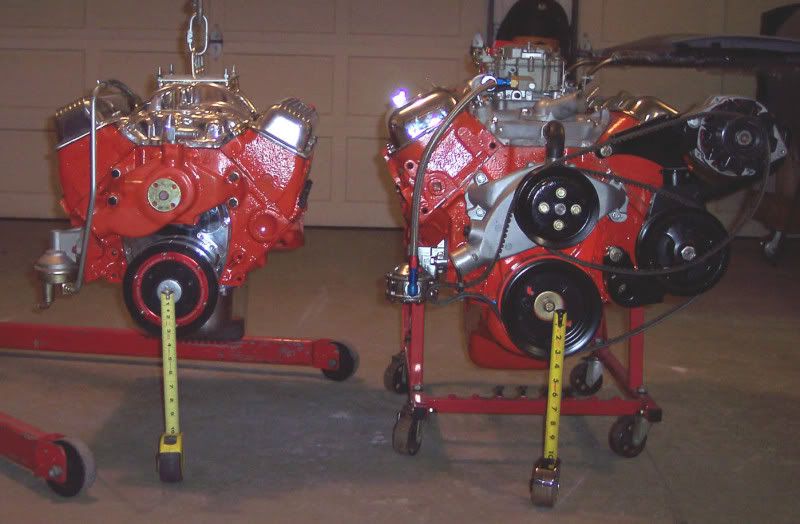
I took the picture as someone said there wasn't much difference in size. So I posted a picture like that one and then they said that it was because they were at different heights the BBC looked bigger, which they weren't so I put the tape measures on the crank center-line and matched the fronts of the motors up. You sure can tell the difference in the head weights and the block when working on them!

Instructor
Joined: Sep 2009
Posts: 115
Likes: 1
From: New Hartford Iowa
Not exactly. That would be true of small blocks 1955 through the mid "90s (LT1 & LT4 etc. but LS series small blocks are staggered ports like the big blocks.
