




Interior Heat
Instructor


Joined: Jun 2010
Posts: 170
Likes: 8
From: Bastrop Texas

U17, which Hooker headers did you install, and did you have any clearance problems? I've been told that due to the "D" shape of the exhaust ports on my ZZ4 crate engine, no headers will fit properly.
Le Mans Master


Joined: May 2003
Posts: 8,877
Likes: 3,556
From: Fernandina Beach FL
2023 Restomod of the Year finalist
2020 C3 of the Year Winner - Modified
While I understand your theory, the heat shield on the space shuttle is not sticky backed aluminum foil. How long do you think that heat shield stuff will last on the outside? It seems that stuff is a bit fragile to be in the elements. I think that is why you see that stuff put on the inside and not the outside. Just my 2 cents.
This material came off a BMW 7 series ($100K sticker when new) and has about 150k miles on it..It's actually a thin aluminum foil over an insulator fiberglass material mounted on a thicker piece of aluminum...Has held up well...
I am ALSO spraying the INTERIOR w/ Lizard skin...
And like my mom use to say- "Just because everybody else is doing it...Doesn't make it right."
Richard


Melting Slicks


Joined: Dec 2008
Posts: 2,070
Likes: 5
From: N.Richland Hills Texas

Drifting


Joined: Jun 2013
Posts: 1,269
Likes: 226
From: Cocoa FL
Richard 454 - I just reread my post, sorry if it sounded a little prickish' 
That BMW stuff looks like some good stuff. Is that something that is available for us average Joe's - aftermarket maybe? That would certainly do the trick. I was thinking of Dynamat, I don't think it would handle being outside.
That BMW stuff looks like some good stuff. Is that something that is available for us average Joe's - aftermarket maybe? That would certainly do the trick. I was thinking of Dynamat, I don't think it would handle being outside.

Le Mans Master

Joined: Oct 2006
Posts: 6,842
Likes: 285
From: Palmdale CA
There are specific headers for just that application, by Hedmann Headers. I have a set waiting to be installed at the shop. I used these thick crushable gaskets, made out of graphite to stop the leaks. I have rework the brand new exhaust system, I have, before I can install them.
Le Mans Master
Joined: Oct 2006
Posts: 6,842
Likes: 285
From: Palmdale CA
Regarding the heat problem. I have hundreds of yards of aluminized Dupont Kapton film, that I had purchased at my company Salvage Sales.
It is on thin mylar film and can withstand temps of up to 700 degrees and -200 degrees F. It sells for $30 - $35 a yard.
Recently, as an experiment at the shop, on a running C3, I took a loose 6x12 piece of film and laid it lengthwise between the header and the fender on the passenger side. I then compared it to the drivers side, putting the back of my hand within a few inches of the header. You could easily feel the heat coming off've it, but on the passenger side, you could get within an inch of the header using the loose Kapton film as a barrier and you couldn't feel any heat at all! I called my shop partner over and he was surprised. He was so confident, that he actually got too close and let the sheet contact the front pipe and he got a slight burn, when the sheet actually touched the pipe! The sheet was't damaged either. I work in aerospace and this is the real deal, material used on aircraft and space vehicles. I've got both Dupont and Dunsmore film, that's 24" wide.
While under the C3 last week, I pondered how to apply it and looked at the 39 year old undercoating, with it's built-in oil, grease and whatever and unless you have at least the trans out to remove it, there's no way to mount it directly to the underside, but looking carefully at the structure underneath, I believe there is a way to mount a piece of sheetmetal, with the Kapton film as a coating, between the exhaust pipes and the floor and then have a curved piece either as part of the overall assembly or as a seperate piece to go up and into the trans tunnel.
It is on thin mylar film and can withstand temps of up to 700 degrees and -200 degrees F. It sells for $30 - $35 a yard.
Recently, as an experiment at the shop, on a running C3, I took a loose 6x12 piece of film and laid it lengthwise between the header and the fender on the passenger side. I then compared it to the drivers side, putting the back of my hand within a few inches of the header. You could easily feel the heat coming off've it, but on the passenger side, you could get within an inch of the header using the loose Kapton film as a barrier and you couldn't feel any heat at all! I called my shop partner over and he was surprised. He was so confident, that he actually got too close and let the sheet contact the front pipe and he got a slight burn, when the sheet actually touched the pipe! The sheet was't damaged either. I work in aerospace and this is the real deal, material used on aircraft and space vehicles. I've got both Dupont and Dunsmore film, that's 24" wide.
While under the C3 last week, I pondered how to apply it and looked at the 39 year old undercoating, with it's built-in oil, grease and whatever and unless you have at least the trans out to remove it, there's no way to mount it directly to the underside, but looking carefully at the structure underneath, I believe there is a way to mount a piece of sheetmetal, with the Kapton film as a coating, between the exhaust pipes and the floor and then have a curved piece either as part of the overall assembly or as a seperate piece to go up and into the trans tunnel.
Last edited by F22; Aug 31, 2013 at 12:06 PM.

Pro

Joined: Apr 2012
Posts: 543
Likes: 10
From: B.F.E....Bowling Green Kentucky
I'm battling the same issue. Most of my heat is header heat. Drive it about 30 minutes and the floorboards/ footwell areas are scorching! I even painted it with a homemade version of lizzard skin, worked great on the pie pan test I did, but the heat is still almost unbearable. I've got the foil covered bubble wrap stuff I'm going to put down and of course the carpet.
Great car for winter!
For what it's worth, I shot a video on my lizzard skin test. I guess it just slows the heat down, not stops it.
Great car for winter!
For what it's worth, I shot a video on my lizzard skin test. I guess it just slows the heat down, not stops it.
Corvette Stories
The Best of Corvette for Corvette Enthusiasts

Top 10 Most Expensive Corvettes Ever Sold on Bring A Trailer
Brett Foote
10 Things Every Corvette Owner Needs (2026 Edition)
Michael S. Palmer
8 Most "Only Corvette Owners Understand" Quirks and Problems
Pouria Savadkouei
10 Reasons the C6 Z06 is Still A Performance Benchmark After 20 Years
Joe Kucinski
How Much Horsepower Every Corvette Engine "LOST" in 1972
Joe Kucinski
Top 10 DOs and DON'Ts for Protecting Your Convertible Top!
Michael S. Palmer
Top 10 Most Explosive Corvettes Ever Made: Power-to-Weight Ratio Ranked!
Joe Kucinski
150 hp to 1,250 hp: Every Corvette Generation Compared by the Specs That Matter
Joe Kucinski
8 Coolest Corvette Pace Cars (and Replicas) of All Time
Verdad Gallardo
Le Mans Master
Joined: Oct 2006
Posts: 6,842
Likes: 285
From: Palmdale CA
I had amazing results today! I just had to experiment today with the Kapton aluminized film. I had a 6x6 square piece of 16 gauge sheet metal and using 3M Super 77 adhesive, I glued a piece of the Kapton film that I measured and cut.
With the 74' running and the hood up, I wedged the metal piece between the fuel lines on the frame, so that it was upright and only one inch of space between the face of the plate and the header!
I got in the car and held it at 3k for at least two minutes to get it hot. My partner already had the laser thermometer out and we started to take readings.
Pointing it right at the curve of the #2 exhaust header as it exited the head, it was 315 degrees. Moving the thermometer to the back of the plate an inch away, it was only 110 degrees!!!
It cut down the temp by a third! I took pics as well. There is room for a thin metal plate, that would have this coating and from the results of today's experiment, I think ir would work well to eliminate much of the heat in the cockpit.
Next: Designing and fabbing the full size version, doing before and after experiments and seeing how it works...
With the 74' running and the hood up, I wedged the metal piece between the fuel lines on the frame, so that it was upright and only one inch of space between the face of the plate and the header!
I got in the car and held it at 3k for at least two minutes to get it hot. My partner already had the laser thermometer out and we started to take readings.
Pointing it right at the curve of the #2 exhaust header as it exited the head, it was 315 degrees. Moving the thermometer to the back of the plate an inch away, it was only 110 degrees!!!
It cut down the temp by a third! I took pics as well. There is room for a thin metal plate, that would have this coating and from the results of today's experiment, I think ir would work well to eliminate much of the heat in the cockpit.
Next: Designing and fabbing the full size version, doing before and after experiments and seeing how it works...
Last edited by F22; Aug 31, 2013 at 07:29 PM.

Le Mans Master
Joined: Oct 2006
Posts: 6,842
Likes: 285
From: Palmdale CA
Today, I measured the floor board temps after a two hour drive in 90~95 degree heat. This is a 74' SBC car with a manual and headers. New carpet and insulation, with Eastwood brand aluminum backed, rubber insulation, throughout.
The laser thermometer measured a constant 125 to 130 degrees at the gas pedal, with the engine running! The passenger side was slightly "cooler" at 115 or so. If we can reduce the temps by a third, that would be double the 20 degrees that generated excitement in the last post!
Remember, our simple experiment with the 6x6 16 ga steel plate, that had a thin, but very tough Dupont Kapton film that when placed within an inch of the header reduced the temp by 2/3! From over 300 degrees to just over a 100. Took pics of the readings and will post them tommorow. We're going to fab us up some heatshields in the shop this week!
The laser thermometer measured a constant 125 to 130 degrees at the gas pedal, with the engine running! The passenger side was slightly "cooler" at 115 or so. If we can reduce the temps by a third, that would be double the 20 degrees that generated excitement in the last post!
Remember, our simple experiment with the 6x6 16 ga steel plate, that had a thin, but very tough Dupont Kapton film that when placed within an inch of the header reduced the temp by 2/3! From over 300 degrees to just over a 100. Took pics of the readings and will post them tommorow. We're going to fab us up some heatshields in the shop this week!

Le Mans Master
Joined: Apr 2011
Posts: 6,284
Likes: 1,171
From: Hermosa
I have a 77 L-48 with hopped up 350. It makes lots of heat. On a 100degree day with a/c on my wife complains it's cold in the cabin. This is a black vette so no break there either.
What I did to bring the heat down are the following;
Put on hooker headers with side pipes ceramic coated in and out by jet hot.
Put down fat mat super mat for sound but it may have helped with heat a little.
Used reflexit insulation on top of that then stock carpet back on top of that with it's backing. Used 3m spray adhesive to stick down the reflexit.
Installed ball valves to close off water to heater core.
That cooled things off pretty good.
Then I added electric fans and aluminum radiator. Electric fans substantially increased a/c's efficiency at low speeds.
Extended air dam on front of car, noticeably cooler running at speed and cooler a/c temps.
Did c4 circulation fan mod. Huge improvement!
It's now a meat locker if I want it to be.
What I did to bring the heat down are the following;
Put on hooker headers with side pipes ceramic coated in and out by jet hot.
Put down fat mat super mat for sound but it may have helped with heat a little.
Used reflexit insulation on top of that then stock carpet back on top of that with it's backing. Used 3m spray adhesive to stick down the reflexit.
Installed ball valves to close off water to heater core.
That cooled things off pretty good.
Then I added electric fans and aluminum radiator. Electric fans substantially increased a/c's efficiency at low speeds.
Extended air dam on front of car, noticeably cooler running at speed and cooler a/c temps.
Did c4 circulation fan mod. Huge improvement!
It's now a meat locker if I want it to be.
Last edited by REELAV8R; Sep 2, 2013 at 10:27 PM.

Le Mans Master
Joined: Oct 2006
Posts: 6,842
Likes: 285
From: Palmdale CA
Very good work! Alas, no AC, in the 74, but have an aluminum radiator and single heater hose shut off valve. The extended air dam, electric fans, and the fat mat help as well, but for us guys who don't want sidepipes (snd have non ac C3's), I think that if you could stop the heat, before it ever even toasts.the floorboards and the firewall, you'd win half the battle!
It'd sure make the ride feel a lot less than a toaster oven for your tootsies!
It'd sure make the ride feel a lot less than a toaster oven for your tootsies!
Racer
Joined: Jul 2013
Posts: 385
Likes: 3
From: Leesburg VA
I've got sidepipes from the stock manifold and my car gets at least as hot as F22 stated after a 30 - 40 minute drive. I am hopeful your solution will work F22, because I'd be buying if the price is reasonable. The heat is the one thing that really takes away from the joy of driving the vette for any length of time.
John
John
Le Mans Master
Joined: Oct 2006
Posts: 6,842
Likes: 285
From: Palmdale CA
I've got sidepipes from the stock manifold and my car gets at least as hot as F22 stated after a 30 - 40 minute drive. I am hopeful your solution will work F22, because I'd be buying if the price is reasonable. The heat is the one thing that really takes away from the joy of driving the vette for any length of time.
John
John


Racer
Joined: May 2010
Posts: 448
Likes: 3
From: Olathe KS
Today, I measured the floor board temps after a two hour drive in 90~95 degree heat. This is a 74' SBC car with a manual and headers. New carpet and insulation, with Eastwood brand aluminum backed, rubber insulation, throughout.
The laser thermometer measured a constant 125 to 130 degrees at the gas pedal, with the engine running! The passenger side was slightly "cooler" at 115 or so. If we can reduce the temps by a third, that would be double the 20 degrees that generated excitement in the last post!
Remember, our simple experiment with the 6x6 16 ga steel plate, that had a thin, but very tough Dupont Kapton film that when placed within an inch of the header reduced the temp by 2/3! From over 300 degrees to just over a 100. Took pics of the readings and will post them tommorow. We're going to fab us up some heatshields in the shop this week!
The laser thermometer measured a constant 125 to 130 degrees at the gas pedal, with the engine running! The passenger side was slightly "cooler" at 115 or so. If we can reduce the temps by a third, that would be double the 20 degrees that generated excitement in the last post!
Remember, our simple experiment with the 6x6 16 ga steel plate, that had a thin, but very tough Dupont Kapton film that when placed within an inch of the header reduced the temp by 2/3! From over 300 degrees to just over a 100. Took pics of the readings and will post them tommorow. We're going to fab us up some heatshields in the shop this week!
I'm excited to see these results - and inquire about having a set made for me!
Le Mans Master
Joined: Oct 2006
Posts: 6,842
Likes: 285
From: Palmdale CA
OK, here are the shots I took;
Driver's side floorboard, aiming right at the gas pedal.

Aluminized Dupton Kapton Film and 6" x 6" 16 ga. Sheet Metal plate with Kapton Film on one side (copper side to back) and adhered to with 3M 77 Super Adhesive.

Overhead view of plate, wedged between fuel lines on the frame. We put it as close as possible to the hottest part of the header! Only one inch, separates the plate from that initial bend out of the head! If you look at the top right edge, you can see a tiny sliver of copper sticking out, from the back side of the film.
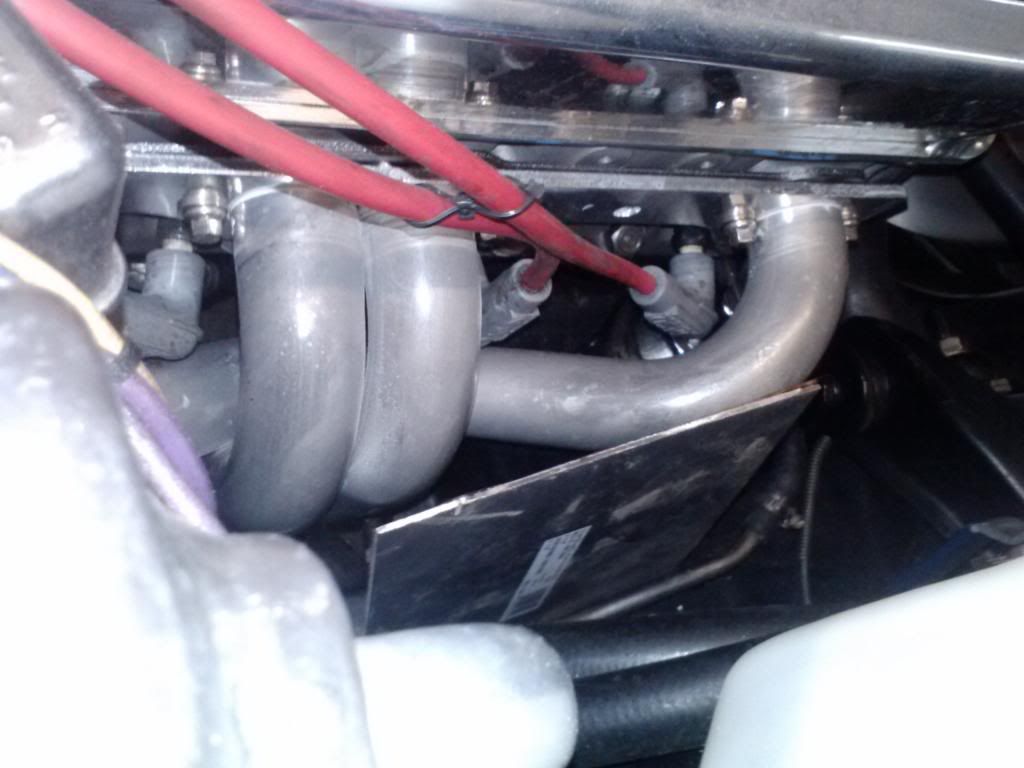
After five minutes of running and two minutes of holding 3K RPM for over two minutes. You can see the laser dot on the header. Temp: 315 degrees.

Moving the thermometer only an inch, to measure the back of the Kapton coated steel plate. Did this three or four times, from different angles with the same result. You can see the laser dot on the back of the plate as well. Result: 115 degrees or the temp cut by nearly cut by two thirds!

This is what's motivating me to make the heat shields and we're starting tonight!

Driver's side floorboard, aiming right at the gas pedal.
Aluminized Dupton Kapton Film and 6" x 6" 16 ga. Sheet Metal plate with Kapton Film on one side (copper side to back) and adhered to with 3M 77 Super Adhesive.
Overhead view of plate, wedged between fuel lines on the frame. We put it as close as possible to the hottest part of the header! Only one inch, separates the plate from that initial bend out of the head! If you look at the top right edge, you can see a tiny sliver of copper sticking out, from the back side of the film.
After five minutes of running and two minutes of holding 3K RPM for over two minutes. You can see the laser dot on the header. Temp: 315 degrees.
Moving the thermometer only an inch, to measure the back of the Kapton coated steel plate. Did this three or four times, from different angles with the same result. You can see the laser dot on the back of the plate as well. Result: 115 degrees or the temp cut by nearly cut by two thirds!
This is what's motivating me to make the heat shields and we're starting tonight!

