



Interior Heat

2026 Loser of the Year


Joined: Sep 2013
Posts: 36,628
Likes: 7,081
From: New Or-leens Loo-z-anna

I flipped thru this thread---the subject has already been covered---but, like another member stated..."has technology out-witted itself"? I like the electric fans....but the subject has been brought up that there is a lack of air circulation when the mechanical fan is removed.
How about a compromise from a rookie using ideas from this thread: Leave the electric fans in place and re-install the mechanical fan after modifying it to fit.
Trim down the mechanical fan blades to a smaller-easier-to-use diameter(12"?)/add more pitch to each blade by using an angle gage/construct a modified fan "shroud".
The front of the shroud should be enclosed on an angle to deflect 195*F radiator air downward before it reaches the engine. The front of the shroud will have two 4" diameter flanges located horizontally 180* apart.
4" flexible duct would be connected to each 4" flange and run to the respective front grills.
This way, whether the car is stationary or moving, fresh ambient air will be pulled thru the ducts and delivered over the engine/exhaust manifolds/firewall/transmission---this air will be much cooler than the air pulled thru the 195*F radiator/A.C. (which will still be cooled by the electric fans).
I would be more than willing to give up 3-4 h.p. that the mechanical fan will use to reduce the engine bay temps ........example: 280*F near headers mixed with 195*F radiator air opposed to 280*F air mixed with 90*F ambient air at 1200CFM from the modified mechanical fan.
(In-line axial fans could be used in the ducts which would be directed at the headers/there would be no need for a mechanical fan/shroud set-up....BUT...axial fans would only supply a 20% airflow compared to the mechanical fan set-up)
How about a compromise from a rookie using ideas from this thread: Leave the electric fans in place and re-install the mechanical fan after modifying it to fit.
Trim down the mechanical fan blades to a smaller-easier-to-use diameter(12"?)/add more pitch to each blade by using an angle gage/construct a modified fan "shroud".
The front of the shroud should be enclosed on an angle to deflect 195*F radiator air downward before it reaches the engine. The front of the shroud will have two 4" diameter flanges located horizontally 180* apart.
4" flexible duct would be connected to each 4" flange and run to the respective front grills.
This way, whether the car is stationary or moving, fresh ambient air will be pulled thru the ducts and delivered over the engine/exhaust manifolds/firewall/transmission---this air will be much cooler than the air pulled thru the 195*F radiator/A.C. (which will still be cooled by the electric fans).
I would be more than willing to give up 3-4 h.p. that the mechanical fan will use to reduce the engine bay temps ........example: 280*F near headers mixed with 195*F radiator air opposed to 280*F air mixed with 90*F ambient air at 1200CFM from the modified mechanical fan.
(In-line axial fans could be used in the ducts which would be directed at the headers/there would be no need for a mechanical fan/shroud set-up....BUT...axial fans would only supply a 20% airflow compared to the mechanical fan set-up)
Last edited by doorgunner; Oct 22, 2013 at 02:43 AM.

Melting Slicks


Joined: Oct 2012
Posts: 2,156
Likes: 273
From: Dunedin NZ.
Update: We're going to set up the Ram Air this week. I came up with a very simple design for a scoop. Thought I'd have to fab a scoop, but I came up with this instead!
A Shop Vac 8" Utility Nozzle, that feeds a 2.5" hose!!! Put this behind the grill and run that hose into the engine compartment, through the forward fender liner and you've got cool air at velocity, pumping into the engine compartment.

A Shop Vac 8" Utility Nozzle, that feeds a 2.5" hose!!! Put this behind the grill and run that hose into the engine compartment, through the forward fender liner and you've got cool air at velocity, pumping into the engine compartment.


Melting Slicks
Joined: Aug 2012
Posts: 3,487
Likes: 83
From: Titusville Florida
It is a mild 350 that on a dyno was 335 hp at the wheels, but that was with iron heads. I am in the process of a frame off rebuild and I now have aluminum heads but it will be 6+ months before I think she will be running. Last July 2012 I drove it from TX to UT and the floor next to the accelerator pedal got so hot that it burned my leg and looked like a bad sunburn for a week. I am working on figuring out ways to keep the car cool so this has been a thread that I have been following closely. Here is a link to my car and you can see the insulation that I installed under the car and I have some info on a test I performed to test it with a heat gun. http://forums.corvetteforum.com/c3-g...ld-thread.html
F22, Keep up the good work that you are doing!
F22, Keep up the good work that you are doing!

Melting Slicks
Joined: Aug 2012
Posts: 3,487
Likes: 83
From: Titusville Florida
I flipped thru this thread---the subject has already been covered---but, like another member stated..."has technology out-witted itself"? I like the electric fans....but the subject has been brought up that there is a lack of air circulation when the mechanical fan is removed.
How about a compromise from a rookie using ideas from this thread: Leave the electric fans in place and re-install the mechanical fan after modifying it to fit.
Trim down the mechanical fan blades to a smaller-easier-to-use diameter(12"?)/add more pitch to each blade by using an angle gage/construct a modified fan "shroud".
The front of the shroud should be enclosed on an angle to deflect 195*F radiator air downward before it reaches the engine. The front of the shroud will have two 4" diameter flanges located horizontally 180* apart.
4" flexible duct would be connected to each 4" flange and run to the respective front grills.
This way, whether the car is stationary or moving, fresh ambient air will be pulled thru the ducts and delivered over the engine/exhaust manifolds/firewall/transmission---this air will be much cooler than the air pulled thru the 195*F radiator/A.C. (which will still be cooled by the electric fans).
I would be more than willing to give up 3-4 h.p. that the mechanical fan will use to reduce the engine bay temps ........example: 280*F near headers mixed with 195*F radiator air opposed to 280*F air mixed with 90*F ambient air at 1200CFM from the modified mechanical fan.
(In-line axial fans could be used in the ducts which would be directed at the headers/there would be no need for a mechanical fan/shroud set-up....BUT...axial fans would only supply a 20% airflow compared to the mechanical fan set-up)
How about a compromise from a rookie using ideas from this thread: Leave the electric fans in place and re-install the mechanical fan after modifying it to fit.
Trim down the mechanical fan blades to a smaller-easier-to-use diameter(12"?)/add more pitch to each blade by using an angle gage/construct a modified fan "shroud".
The front of the shroud should be enclosed on an angle to deflect 195*F radiator air downward before it reaches the engine. The front of the shroud will have two 4" diameter flanges located horizontally 180* apart.
4" flexible duct would be connected to each 4" flange and run to the respective front grills.
This way, whether the car is stationary or moving, fresh ambient air will be pulled thru the ducts and delivered over the engine/exhaust manifolds/firewall/transmission---this air will be much cooler than the air pulled thru the 195*F radiator/A.C. (which will still be cooled by the electric fans).
I would be more than willing to give up 3-4 h.p. that the mechanical fan will use to reduce the engine bay temps ........example: 280*F near headers mixed with 195*F radiator air opposed to 280*F air mixed with 90*F ambient air at 1200CFM from the modified mechanical fan.
(In-line axial fans could be used in the ducts which would be directed at the headers/there would be no need for a mechanical fan/shroud set-up....BUT...axial fans would only supply a 20% airflow compared to the mechanical fan set-up)
I actually do have a flex fan and two e-fans, the e-fans just weren't keeping the engine cool enough (a Dewitts is in the future but that's another subject)... That flex fan moves a heck of a lot of air around the engine bay too.

Racer

Joined: Jul 2013
Posts: 385
Likes: 3
From: Leesburg VA
 Mine sounds a lot faster than it is, and with stock manifolds. Drove the car to work this morning, but it is about 40 degrees outside this morning, so the Corvette was quite comfortable.
One thing I did this morning was put streamers around the dash area to see where air was coming in with the windows closed and HVAC off. As expected, a huge amount of cool air was coming in through the passenger side kick panel vent. Interestingly enough, the driver's side vent did not flow any air, but I'm not sure if it is stuck closed or working the way it should. Now, my AC has not worked correctly since I bought the car, and none of the vacuum actuated doors are closing/opening when I move the controls, so both doors are open in the plenum. The one you can see from the wiper well and the one you can see behind the kick panel. I know the top door is only supposed to close when you move the controls to Max AC, but what about the one by the kick panel? When is it supposed to move? This is on my list of things to fix before next spring, but intimidates me more than tearing the front suspension apart.
How hot is the housing for the heater/AC? The fan is right there in the engine compartment too. If the hood seals are not perfect you probably also suck air into the windshield wiper trough, and into the HVAC system as a result even though it should theoretically be ambient air.
I have thought a lot about the fact that some cars have the issue and some don't. I am now starting to believe that the issue is air leaking into the interior from cracks in bonded seams, HVAC doors that don't seal properly, and holes in the firewall that have escaped detection. Most of our cars are nearly 40 years old at this point and joint seams, as I witnessed around my year window, dry out and don't seal very well. Reinforcing this theory is the fact that in my car, when I am driving down the road a cooking with the windows down, then come to a stoplight the car and my feet drop down to ambient temperature...or at least much cooler. Then when I start rolling again, I can feel the heat pouring in again. That is why I have been saying that the more I open up the interior, the hotter the footwells get. The open windows/T-tops give the hot air somewhere to go, and it is not coming in through the windows or t-top.
What I would love to do at this point would be to pull the motor and trans and do a thorough inspection and sealing of the bare firewall, tunnel and footwells all the way back to the frame kick-up. That is not in the cards, but I am going to start paying very close attention as I am in and around my car to see areas that are potentially letting air into the cabin. Life would be so much easier with a lift, but I am working in a home garage, and just building my tool collection. Getting the car up in the air to poke around underneath is time consuming, but I will do that soon. I want to make sure the area where the heater hoses enter is sealed, and also inside the passenger side kick panel plenum. Not sure when I will get to it as I have a Corvette function this weekend that I don't want to miss, but it will be soon. I really need to get the HVAC system working properly...
Anyway, just my 2 cents after thinking about the results of our polls, etc. I think everything F22 is doing will contribute to the solution, but just as he stated, there is something we are not seeing.
John
Melting Slicks
Joined: Aug 2012
Posts: 3,487
Likes: 83
From: Titusville Florida
Drove my Vette into work too, it's about 60* out so the ride was very comfortable. I should have brought my IR gun with me to measure a couple of spots to see what temps were, maybe tomorrow.
I agree that there are places that hot air are probably getting into the cabin and are contributing to the uncomfortable heat. I do think that heat radiation off of exhaust and that big metal thing sitting in the middle of the engine bay are the biggest contributing factors which is why I will be hoping that when I spray the Lizard Skin it will at least cut the heat down to where it's not uncomfortable.
I will also say that I've done some things here and there that each have helped and made a noticeable difference. The first thing I did was put carpet in (yeah it didn't have any carpet when I bought it), along with some heat insulation similar to reflectics, then I bypassed the heater core, then I put new shift boots on. Each has contributed to lower cabin temps but there is a way to go!
I agree that there are places that hot air are probably getting into the cabin and are contributing to the uncomfortable heat. I do think that heat radiation off of exhaust and that big metal thing sitting in the middle of the engine bay are the biggest contributing factors which is why I will be hoping that when I spray the Lizard Skin it will at least cut the heat down to where it's not uncomfortable.
I will also say that I've done some things here and there that each have helped and made a noticeable difference. The first thing I did was put carpet in (yeah it didn't have any carpet when I bought it), along with some heat insulation similar to reflectics, then I bypassed the heater core, then I put new shift boots on. Each has contributed to lower cabin temps but there is a way to go!

Safety Car


Joined: Mar 2007
Posts: 3,518
Likes: 37
Mine sounds a lot faster than it is, and with stock manifolds. Drove the car to work this morning, but it is about 40 degrees outside this morning, so the Corvette was quite comfortable.One thing I did this morning was put streamers around the dash area to see where air was coming in with the windows closed and HVAC off. As expected, a huge amount of cool air was coming in through the passenger side kick panel vent. Interestingly enough, the driver's side vent did not flow any air, but I'm not sure if it is stuck closed or working the way it should. Now, my AC has not worked correctly since I bought the car, and none of the vacuum actuated doors are closing/opening when I move the controls, so both doors are open in the plenum. The one you can see from the wiper well and the one you can see behind the kick panel. I know the top door is only supposed to close when you move the controls to Max AC, but what about the one by the kick panel? When is it supposed to move? This is on my list of things to fix before next spring, but intimidates me more than tearing the front suspension apart.
How hot is the housing for the heater/AC? The fan is right there in the engine compartment too. If the hood seals are not perfect you probably also suck air into the windshield wiper trough, and into the HVAC system as a result even though it should theoretically be ambient air.
I have thought a lot about the fact that some cars have the issue and some don't. I am now starting to believe that the issue is air leaking into the interior from cracks in bonded seams, HVAC doors that don't seal properly, and holes in the firewall that have escaped detection. Most of our cars are nearly 40 years old at this point and joint seams, as I witnessed around my year window, dry out and don't seal very well. Reinforcing this theory is the fact that in my car, when I am driving down the road a cooking with the windows down, then come to a stoplight the car and my feet drop down to ambient temperature...or at least much cooler. Then when I start rolling again, I can feel the heat pouring in again. That is why I have been saying that the more I open up the interior, the hotter the footwells get. The open windows/T-tops give the hot air somewhere to go, and it is not coming in through the windows or t-top.
What I would love to do at this point would be to pull the motor and trans and do a thorough inspection and sealing of the bare firewall, tunnel and footwells all the way back to the frame kick-up. That is not in the cards, but I am going to start paying very close attention as I am in and around my car to see areas that are potentially letting air into the cabin. Life would be so much easier with a lift, but I am working in a home garage, and just building my tool collection. Getting the car up in the air to poke around underneath is time consuming, but I will do that soon. I want to make sure the area where the heater hoses enter is sealed, and also inside the passenger side kick panel plenum. Not sure when I will get to it as I have a Corvette function this weekend that I don't want to miss, but it will be soon. I really need to get the HVAC system working properly...
Anyway, just my 2 cents after thinking about the results of our polls, etc. I think everything F22 is doing will contribute to the solution, but just as he stated, there is something we are not seeing.
John
Corvette Stories
The Best of Corvette for Corvette Enthusiasts

Corvette & Porsche 911: How Two Icons Conquered the Last 25 Years
Joe Kucinski
2027 Chevrolet Silverado 1500 First Look: Everything You NEED to Know!
Michael S. Palmer
5 Best & 5 Worst Corvette Daily Drivers
Joe Kucinski
The Headlights of Every Corvette Generation Explained
Joe Kucinski
5 Best & 5 Most Overrated Corvette Track Packages of All Time!
Joe Kucinski
Every 2027 Corvette Engine Explained
Joe Kucinski
Designer Imagines A Corvette That Looks More Like a Corvette Than the Corvette
Verdad Gallardo
10 Ugly Corvettes That We Still Kinda Love
Joe Kucinski
Top 10 Most Expensive Corvettes Ever Sold on Bring A Trailer
Brett Foote
Instructor
Joined: Jun 2010
Posts: 170
Likes: 8
From: Bastrop Texas
mac79vette, if you call 335 hp at the wheels a mild 350, I wonder how many hp it would take for you to call it hot, and I can only assume it is not the original engine or it has been modified....what engine are you running and what modifications have been made? I will be interested to know how many hp the aluminum heads will add.

Le Mans Master

Joined: Oct 2006
Posts: 6,842
Likes: 285
From: Palmdale CA
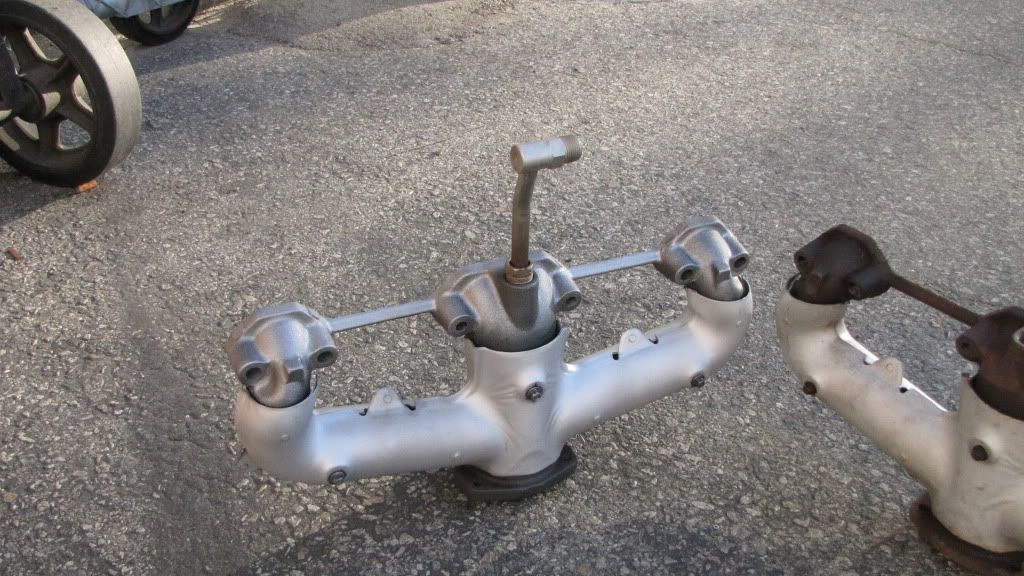
I found some great pics of the LT1 exhaust manifolds in the C4 section and I am going to pull the trigger and buy some used ones, from my C4 parts source. My whole problem is the steering column, period. I can't feel any heat coming from the AC or Heater ducts what sover, maybe just a little, but it's not pushing enough for me to even feel. It's that 144 degree steering column support plate on the inside, coupled with the 125 degree steering column, that's radiating a ton of heat into the driver's side footwells.
The passenger side feels cold in comparison! I wave my hand in there, while I'm roasting in here and it doesn't have nearly the amount of heat whatsoever. I measured a 110 degrees, while warm, is nothing close to being overwhelmingly hot.
There may be different problems with these cars, and some don't even have problems at all, but I am going to tackle, what is the cause of the problem in mine, the steering column heat.
Tonight, I put on the backside of the heatshield, Kapton film and start to assemble the pieces necessary to put the Ram-Air together. Also, I'm going to start saving up for an entirely new exhaust system, to go along with the new LT1 manifolds. I'm using the LT1's, because I have the L98 heads, specifically, the 882 castings, which are the D-port and the LT1 was a D-port as well.
Big Bonus, is they come completely shielded, from the factory!!! Secondly, they'll be farther from the steering column, then the Hedman Headers, I have on there now and also, I won't have four huge heat radiating pipes jutting out horizontally and pouring heat into the engine compartment and down to the collector. If you think about the surface area, that those four header pipes have, compared to the pics below, there's a huge difference, versus, one exhaust pipe, running straight down and close to the side of the block. And I may just shield that too, with a corrogated aluminum, like Tudz is talking about.


The passenger side feels cold in comparison! I wave my hand in there, while I'm roasting in here and it doesn't have nearly the amount of heat whatsoever. I measured a 110 degrees, while warm, is nothing close to being overwhelmingly hot.
There may be different problems with these cars, and some don't even have problems at all, but I am going to tackle, what is the cause of the problem in mine, the steering column heat.
Tonight, I put on the backside of the heatshield, Kapton film and start to assemble the pieces necessary to put the Ram-Air together. Also, I'm going to start saving up for an entirely new exhaust system, to go along with the new LT1 manifolds. I'm using the LT1's, because I have the L98 heads, specifically, the 882 castings, which are the D-port and the LT1 was a D-port as well.
Big Bonus, is they come completely shielded, from the factory!!! Secondly, they'll be farther from the steering column, then the Hedman Headers, I have on there now and also, I won't have four huge heat radiating pipes jutting out horizontally and pouring heat into the engine compartment and down to the collector. If you think about the surface area, that those four header pipes have, compared to the pics below, there's a huge difference, versus, one exhaust pipe, running straight down and close to the side of the block. And I may just shield that too, with a corrogated aluminum, like Tudz is talking about.
Last edited by F22; Oct 22, 2013 at 10:38 AM.
Melting Slicks
Joined: Aug 2012
Posts: 3,487
Likes: 83
From: Titusville Florida
After thinking about it this morning I think you're on the right track F22, yesterday when I measured the temp under the gas pedal it was significantly cooler that was the cheap rubber mat just under the steering column. I wish I would have thought to bring my IR gun with me this morning to measure the inside column temp when I got to work, I should be driving the Vette into work again tomorrow so I'll have to remember to throw the IR gun in the Vette tonight when I get home.

Instructor
Joined: Nov 2012
Posts: 118
Likes: 0
From: Pennsylvania
I flipped thru this thread---the subject has already been covered---but, like another member stated..."has technology out-witted itself"? I like the electric fans....but the subject has been brought up that there is a lack of air circulation when the mechanical fan is removed.
How about a compromise from a rookie using ideas from this thread: Leave the electric fans in place and re-install the mechanical fan after modifying it to fit.
Trim down the mechanical fan blades to a smaller-easier-to-use diameter(12"?)/add more pitch to each blade by using an angle gage/construct a modified fan "shroud".
The front of the shroud should be enclosed on an angle to deflect 195*F radiator air downward before it reaches the engine. The front of the shroud will have two 4" diameter flanges located horizontally 180* apart.
4" flexible duct would be connected to each 4" flange and run to the respective front grills.
This way, whether the car is stationary or moving, fresh ambient air will be pulled thru the ducts and delivered over the engine/exhaust manifolds/firewall/transmission---this air will be much cooler than the air pulled thru the 195*F radiator/A.C. (which will still be cooled by the electric fans).
I would be more than willing to give up 3-4 h.p. that the mechanical fan will use to reduce the engine bay temps ........example: 280*F near headers mixed with 195*F radiator air opposed to 280*F air mixed with 90*F ambient air at 1200CFM from the modified mechanical fan.
(In-line axial fans could be used in the ducts which would be directed at the headers/there would be no need for a mechanical fan/shroud set-up....BUT...axial fans would only supply a 20% airflow compared to the mechanical fan set-up)
How about a compromise from a rookie using ideas from this thread: Leave the electric fans in place and re-install the mechanical fan after modifying it to fit.
Trim down the mechanical fan blades to a smaller-easier-to-use diameter(12"?)/add more pitch to each blade by using an angle gage/construct a modified fan "shroud".
The front of the shroud should be enclosed on an angle to deflect 195*F radiator air downward before it reaches the engine. The front of the shroud will have two 4" diameter flanges located horizontally 180* apart.
4" flexible duct would be connected to each 4" flange and run to the respective front grills.
This way, whether the car is stationary or moving, fresh ambient air will be pulled thru the ducts and delivered over the engine/exhaust manifolds/firewall/transmission---this air will be much cooler than the air pulled thru the 195*F radiator/A.C. (which will still be cooled by the electric fans).
I would be more than willing to give up 3-4 h.p. that the mechanical fan will use to reduce the engine bay temps ........example: 280*F near headers mixed with 195*F radiator air opposed to 280*F air mixed with 90*F ambient air at 1200CFM from the modified mechanical fan.
(In-line axial fans could be used in the ducts which would be directed at the headers/there would be no need for a mechanical fan/shroud set-up....BUT...axial fans would only supply a 20% airflow compared to the mechanical fan set-up)
I would love to know the temperature of the air as it leaves the radiator, as I'm not convinced using radiator air is bad for cooling the rest of the engine bay as long as there's enough net flow to pull the heat off the engine and take it outside the car.
Where abouts did you get the 20% airflow number? Is that just from typical 4" electric fan CFM?
Last edited by Tudz; Oct 22, 2013 at 11:04 AM.
Le Mans Master
Joined: Oct 2006
Posts: 6,842
Likes: 285
From: Palmdale CA
After thinking about it this morning I think you're on the right track F22, yesterday when I measured the temp under the gas pedal it was significantly cooler that was the cheap rubber mat just under the steering column. I wish I would have thought to bring my IR gun with me this morning to measure the inside column temp when I got to work, I should be driving the Vette into work again tomorrow so I'll have to remember to throw the IR gun in the Vette tonight when I get home.

Melting Slicks
Joined: Aug 2012
Posts: 3,487
Likes: 83
From: Titusville Florida
Good deal! FIrst, I'd measure the inner support plate, for the steering column itself, on the inside. My measurements indicated, that's the absolute hottest thing in the footwell at 144 degrees. Then it transfers that heat to the column itself, which was 125 degrees constant. I'd like to see your results for both the inner support plate and the steering column itself on the inside of the car.

Pro

Joined: May 2008
Posts: 582
Likes: 9
mac79vette, if you call 335 hp at the wheels a mild 350, I wonder how many hp it would take for you to call it hot, and I can only assume it is not the original engine or it has been modified....what engine are you running and what modifications have been made? I will be interested to know how many hp the aluminum heads will add.
Racer
Joined: Jul 2013
Posts: 385
Likes: 3
From: Leesburg VA
Why not track down the issue with the A/C system, make it work like stock and then see if you have heat problems or not. The vacuum door problem may just be the vacuum valve under the A/C control, $10 part and two screws to fix that and then the doors might all work for you.
), as well as keeping a look out for other places where air can get in.If I can get this resolved without tearing the dash apart I will be a happy camper. THAT job is not something I am very comfortable with at this point. Its not the wires that disturb me, its wondering if I can get all the panels put back together so they look like they do today. Nothing seems to just unscrew and come off without some bending or flexing or minor force. I tried to take the passenger panel off and it was not going to happen easily even after I had all the screws loose.
John
Instructor
Joined: Jun 2010
Posts: 170
Likes: 8
From: Bastrop Texas
LudemJo, I don't know if they are the same, but I have a 1977 Corvette Climate Control Vacuum Diagram. If you are interested, I will send it to you if you provide an email address. Also, to check how the plenum is sealed against the fender, at night or in dark area shine a light source into the passenger side kick panel vent(from what you have stated about air flow I assume the door is open), and from under the car you can detect any cracks by the light shinning through.
Racer
Joined: Jul 2013
Posts: 385
Likes: 3
From: Leesburg VA
Thanks PRIrish, I believe I have a diagram in the AIM. Honestly, I just haven't been too focused on the HVAC system because I normally drive with the windows open and didn't feel that the heat was coming in through there. I could be wrong, but I now feel like I should at least try to get it working enough to convince myself that it is not the proble,
I will give the light trick a try...maybe I can find other leaks that way as well...firewall, etc.
I tell you, I find it really puzzling that some cars have this problem and others don't.
John
I will give the light trick a try...maybe I can find other leaks that way as well...firewall, etc.
I tell you, I find it really puzzling that some cars have this problem and others don't.
John
Racer
Joined: Jul 2013
Posts: 385
Likes: 3
From: Leesburg VA
OK, F22 this is going to freak you out. After I got home tonight, I used the multimeter to take some temps after my 20 minute drive home with ambient temps about 70. Admittedly, this wasn't long enough to get some serious heat built up in the car, but here is what I found.
Temp on steering box closest to the stock manifold was 151, steering shaft just above the rag joint was in the high 140s as was the metal plate around the steering column. Inside, the steering column and the metal plate on the inside of the firewall measured 100! I could literally hold on to every piece of metal under the dash and it was just barely warm. I was just starting to feel the warm air building as I got home, and with the drivers window open it was blowing a ton from the passenger side kick panel based on the yarn tufts I had taped around under the dash.
So it looks like my major issue right now is the HVAC system. That is where I am going to focus for the time being I think.
John
Temp on steering box closest to the stock manifold was 151, steering shaft just above the rag joint was in the high 140s as was the metal plate around the steering column. Inside, the steering column and the metal plate on the inside of the firewall measured 100! I could literally hold on to every piece of metal under the dash and it was just barely warm. I was just starting to feel the warm air building as I got home, and with the drivers window open it was blowing a ton from the passenger side kick panel based on the yarn tufts I had taped around under the dash.
So it looks like my major issue right now is the HVAC system. That is where I am going to focus for the time being I think.
John
Le Mans Master
Joined: Oct 2006
Posts: 6,842
Likes: 285
From: Palmdale CA
OK, F22 this is going to freak you out. After I got home tonight, I used the multimeter to take some temps after my 20 minute drive home with ambient temps about 70. Admittedly, this wasn't long enough to get some serious heat built up in the car, but here is what I found.
Temp on steering box closest to the stock manifold was 151, steering shaft just above the rag joint was in the high 140s as was the metal plate around the steering column. Inside, the steering column and the metal plate on the inside of the firewall measured 100! I could literally hold on to every piece of metal under the dash and it was just barely warm. I was just starting to feel the warm air building as I got home, and with the drivers window open it was blowing a ton from the passenger side kick panel based on the yarn tufts I had taped around under the dash.
So it looks like my major issue right now is the HVAC system. That is where I am going to focus for the time being I think.
John
Temp on steering box closest to the stock manifold was 151, steering shaft just above the rag joint was in the high 140s as was the metal plate around the steering column. Inside, the steering column and the metal plate on the inside of the firewall measured 100! I could literally hold on to every piece of metal under the dash and it was just barely warm. I was just starting to feel the warm air building as I got home, and with the drivers window open it was blowing a ton from the passenger side kick panel based on the yarn tufts I had taped around under the dash.
So it looks like my major issue right now is the HVAC system. That is where I am going to focus for the time being I think.
John
I think that you should try this test out with a minimum of 45 minutes to an hour and then, tell me if it's both the HVAC blowing hot and the floorboard-steering-column-plate temps that are contributing. Not wanting to
 ya, just trying to get a good set of parameters going. You might be on to something with the HVAC as well. Mine is totally inop.